
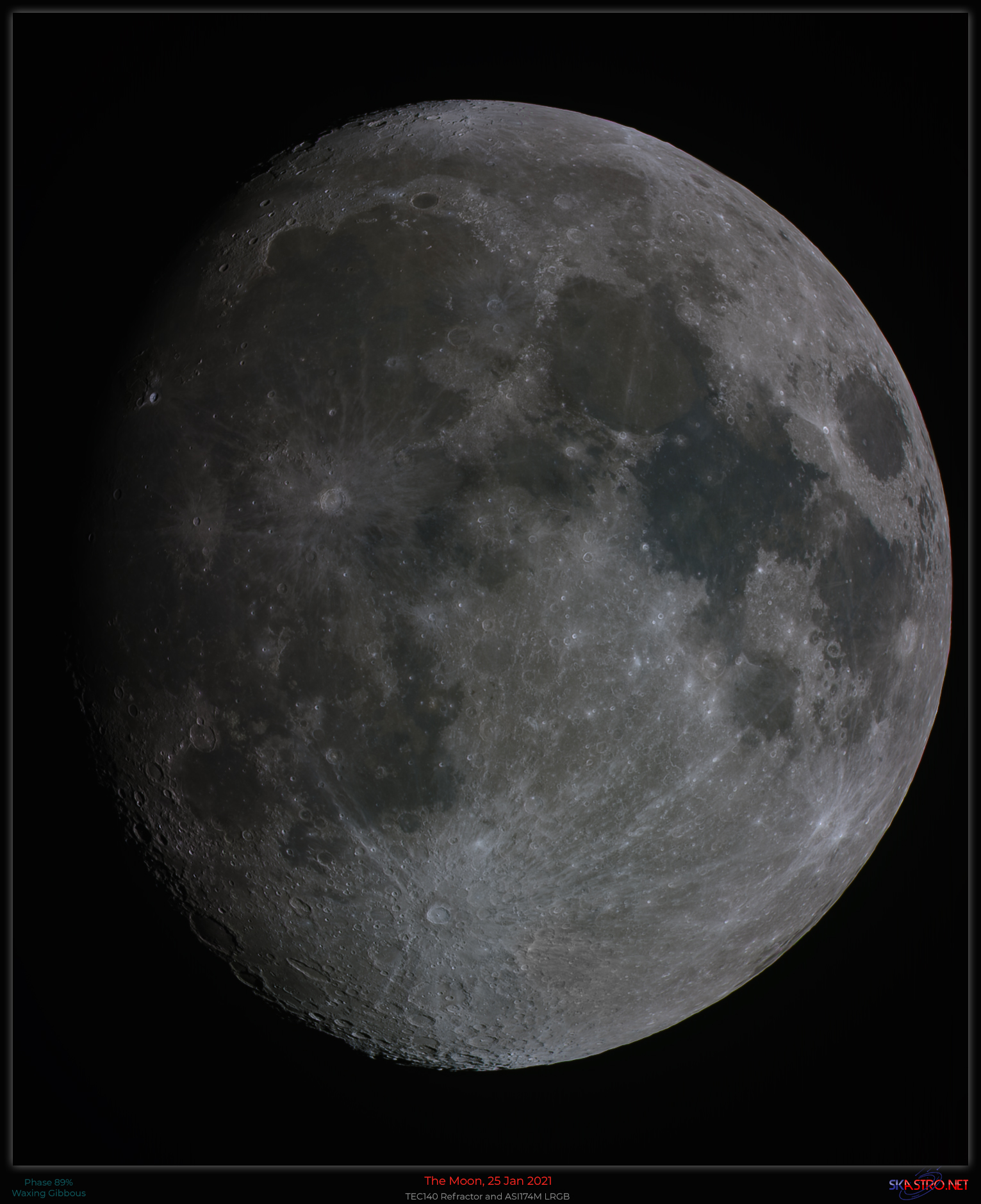
Lunar Images, 25th Jan 2021
The Moon on 25th January 2021 at 89% in Gemini. It was freezing cold, snow on the ground with reasonable skies and seeing conditions. The full disk below is the best 20% in each of the R,G and B filters out of 10000 frames. I used Planetary System Stacker software to process the raw .SER files from the camera and then used PixInsight and Photoshop for processing. I used my TEC140 refractor and ASI174M high speed camera with Baader RGB filters.
I no longer capture a separate luminance channel and instead make a synthetic luminance from the RGB data and then sharpen that and use as a luminance layer in Photoshop.
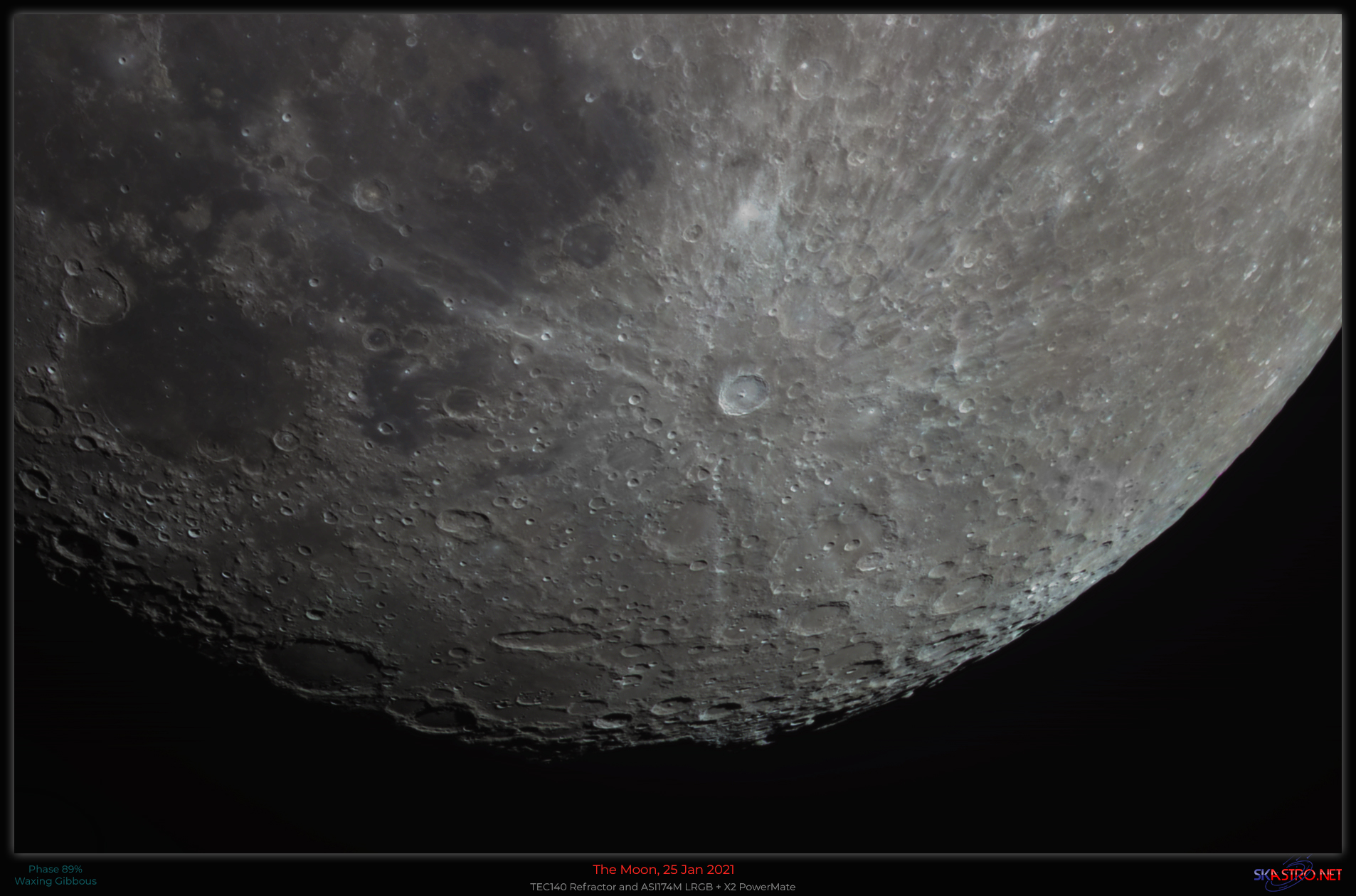
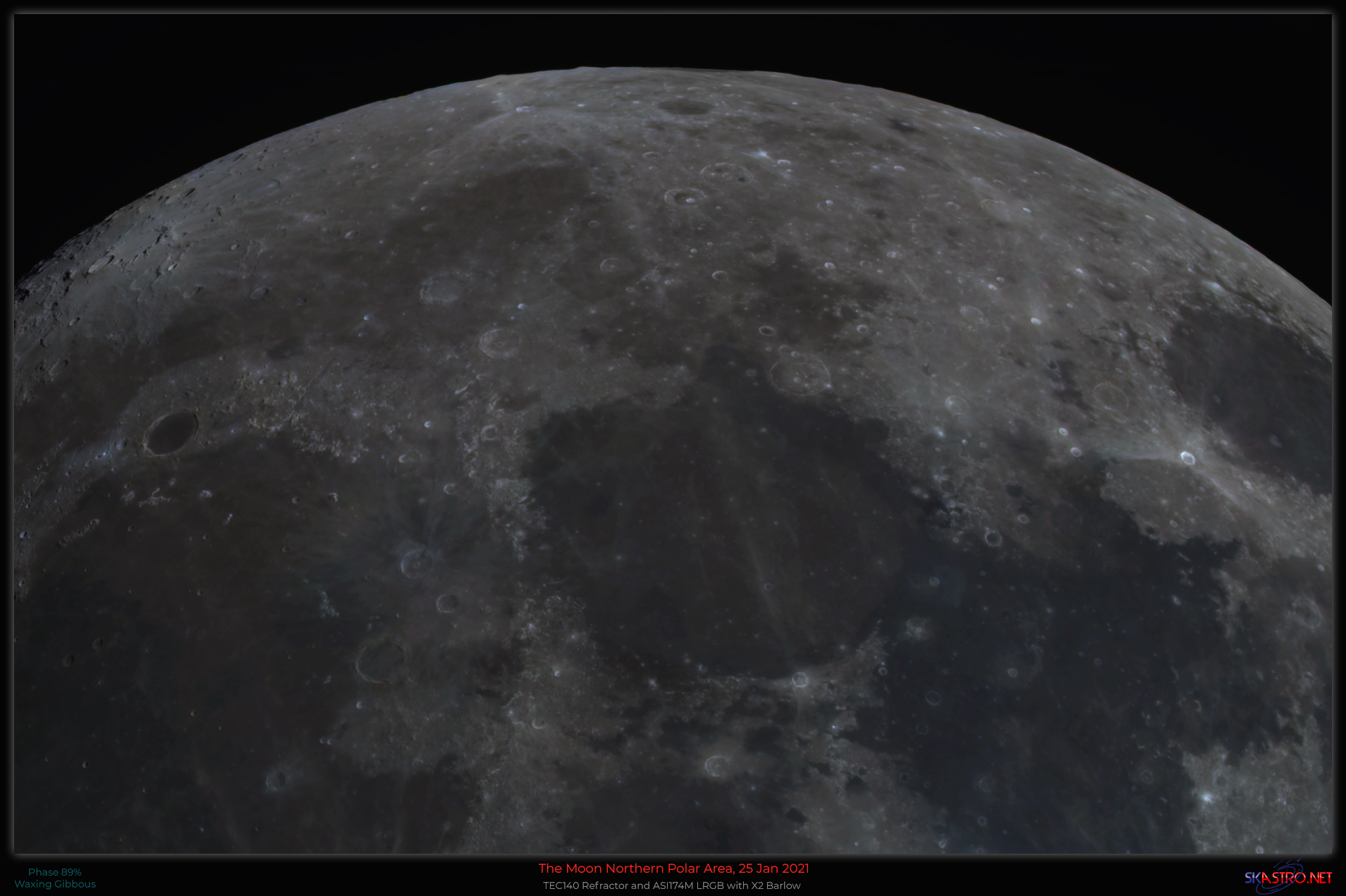
For the two images below I used my Televue 2" Powermate X2 in order to double the TEC140 telescope's focal length to 1960mm. The processing and frame set is the same as the full disk at the top.

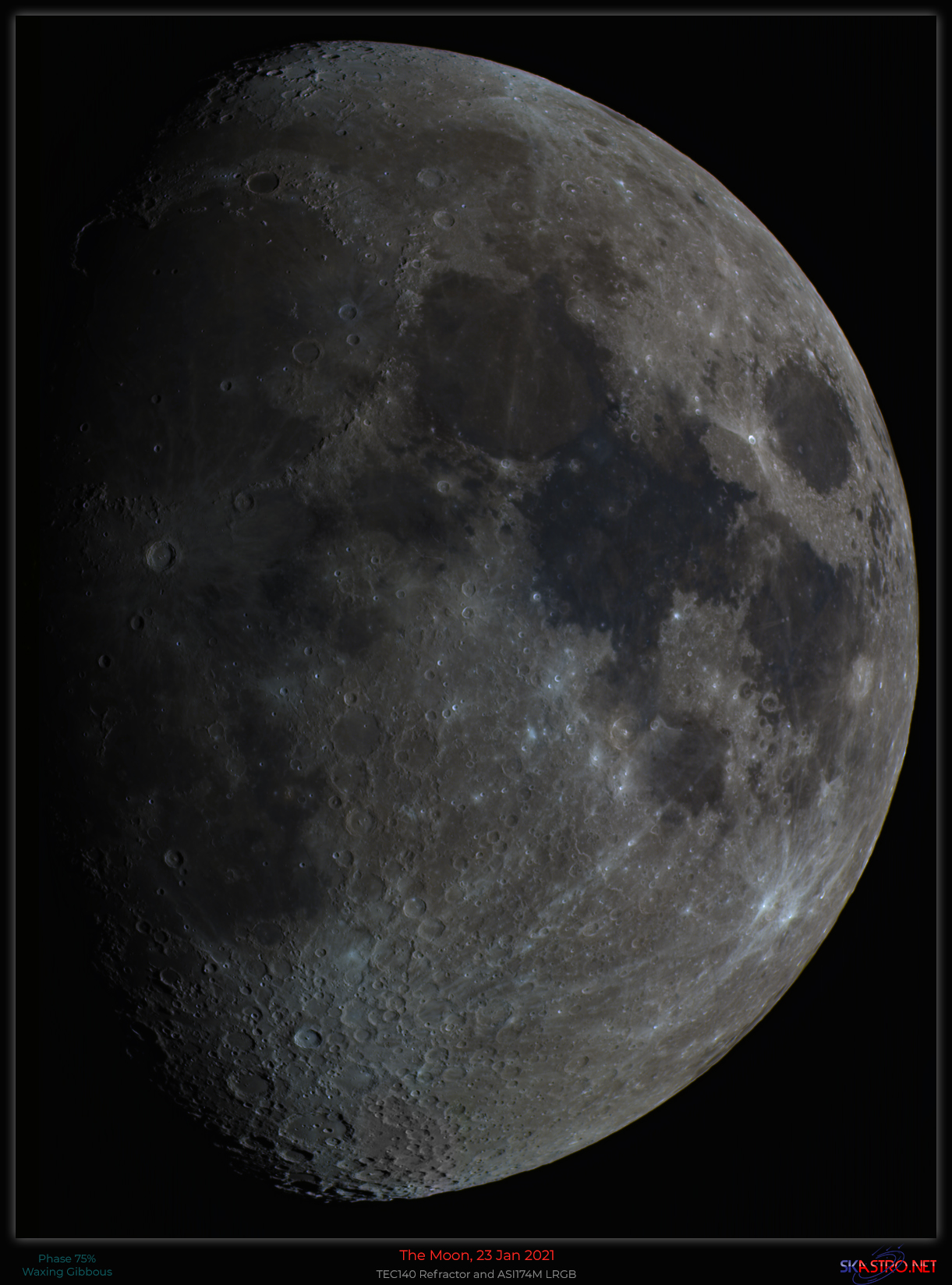
Lunar Images, 23rd Jan 2021
After months and months of cloud, The Moon shone down on us in Nottinghamshire on the 23rd January from high up in the sky in Gemini (my daughter's birthday!) It was at a phase of 74% waxing gibbous. I used my TEC140 scope, ASI174M camera and Baader RGB filters. The full disk image was with the telescope at its native focal length and with the two closer up views at the bottom I used a 2" Televue Powermate x2 in front of the filter wheel/camera assembly.
Above is best 25% of 20000 frames in each of RGB.
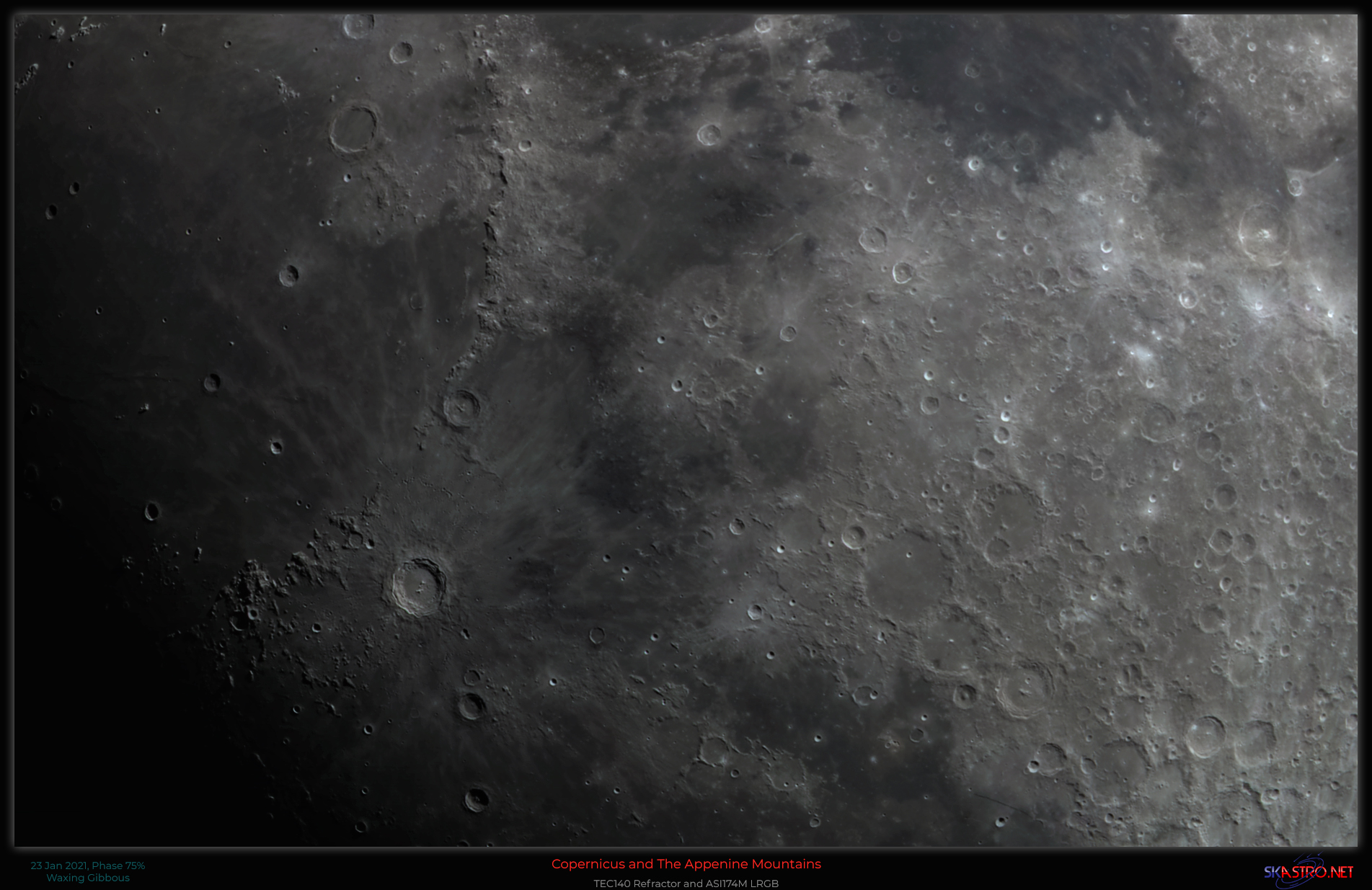
After the full disk image I inserted the Televue 2" x2 Powermate to get a more zoomed in view. Above is the Apennine Mountains and Copernicus crater to the left of centre. Best 15% of 5000 frames in LRGB.
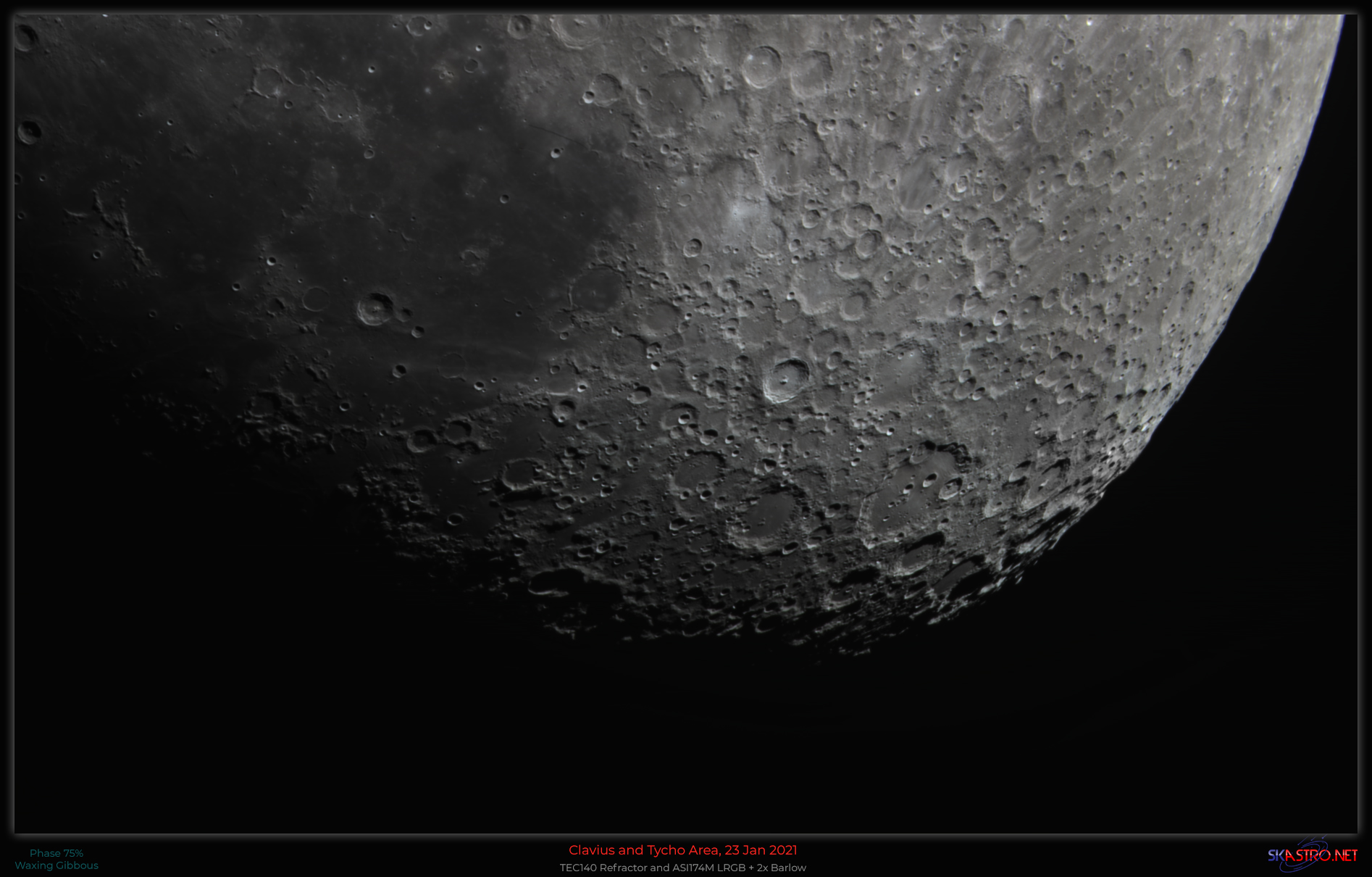
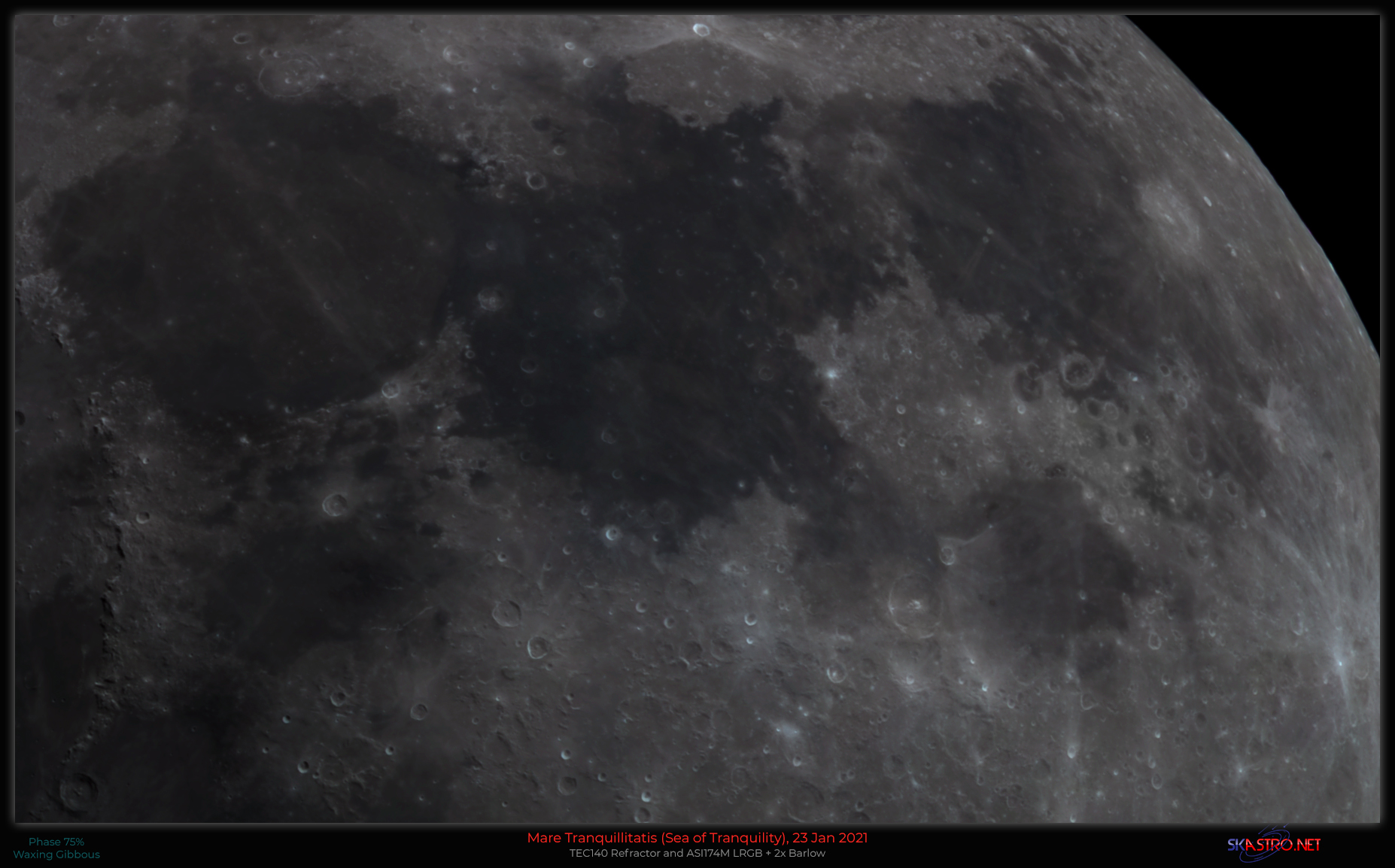
The below two images are the same telescope configuration Again, best 15% of 5000 frames in each of LRGB. To the left we have The Sea of Tranquillity (Apollo 11 landing area) and to the right Copernicus and the Apennine Mountains.
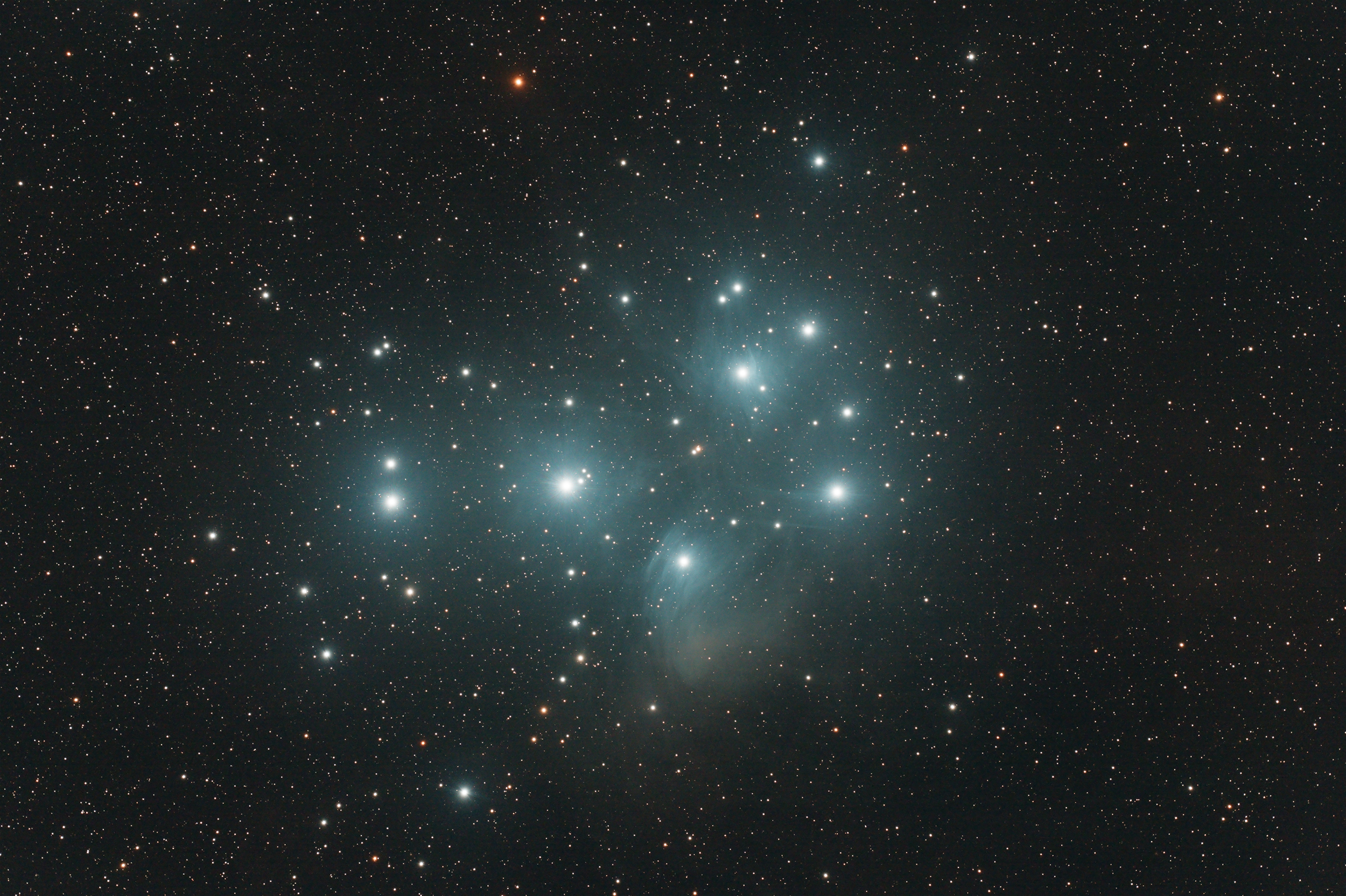
M45 - The Pleiades
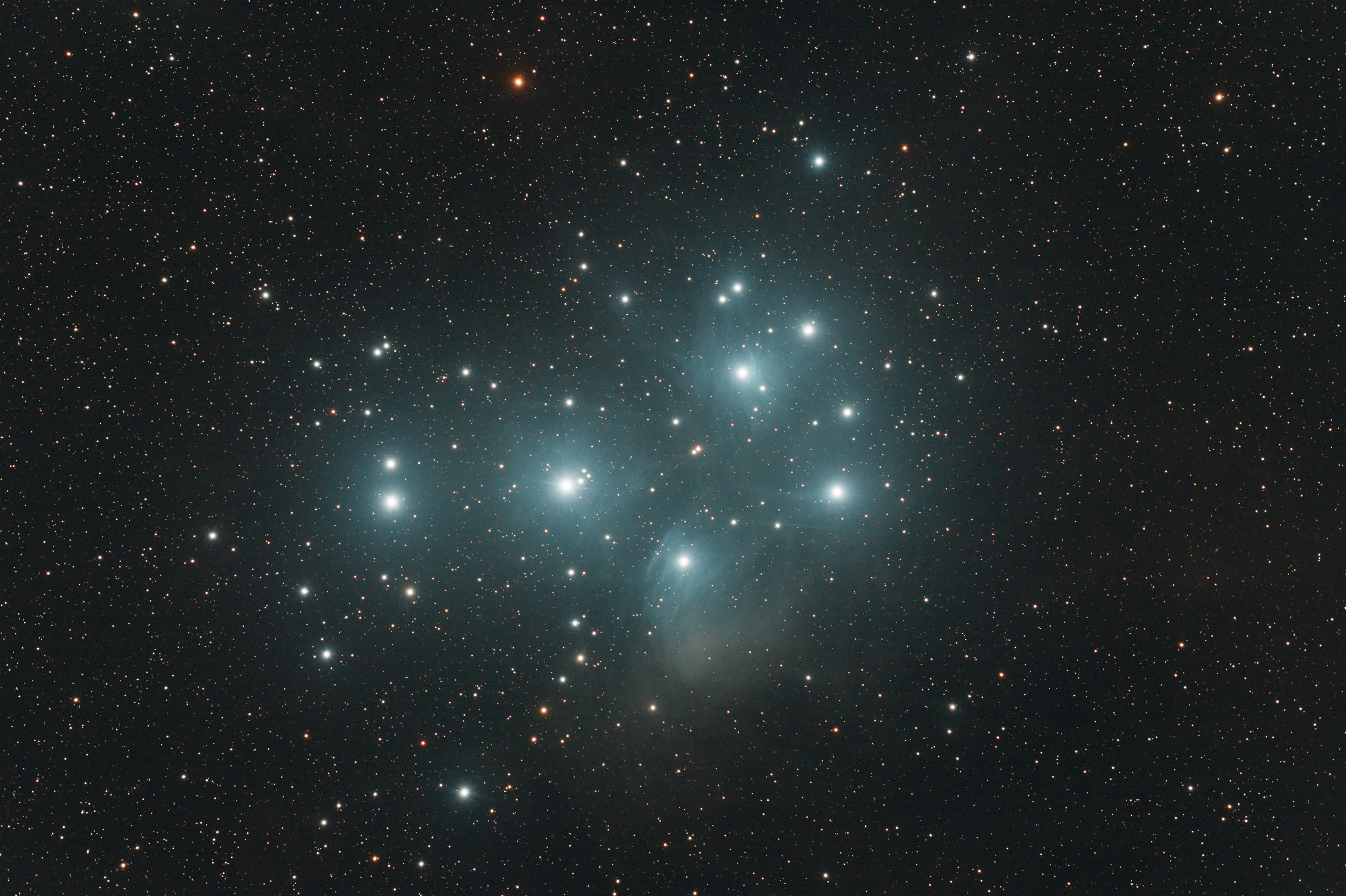
Easily visible with the naked eye, M45, The Pleiades - sometimes referred to as The Seven Sisters, is a well known and famous Open Cluster in the constellation of Taurus. IT has been known since ancient times due to its prominence. The cluster is located between 450-500 light years away and contains several hundreds member stars. The cluster is quite young by astronomy standards and the cluster is moving through a cloud of gas which is easily visible in images and can been seen visually in a dark sky as well.
Technical Details
Imaged from my backyard in Nottingham on Saturday 9th January 2021 when high to The South. A meridian flip occurred half way through the data acquisition. I used my Takahashi FSQ85 refractor and QHY268C One Shot Colour camera. The image was created with quite a small data set of only 38 x 180s exposures.
Data acquired with Sequence Generator Pro and processed with PixInsight and Photoshop CC 2021. Very little processing has been done other than some noise reduction and a stretch into the none-linear state and a bit of vibrance added to the colour.
I have imaged M45 before. In a close-up setting and also in a widefield setting.

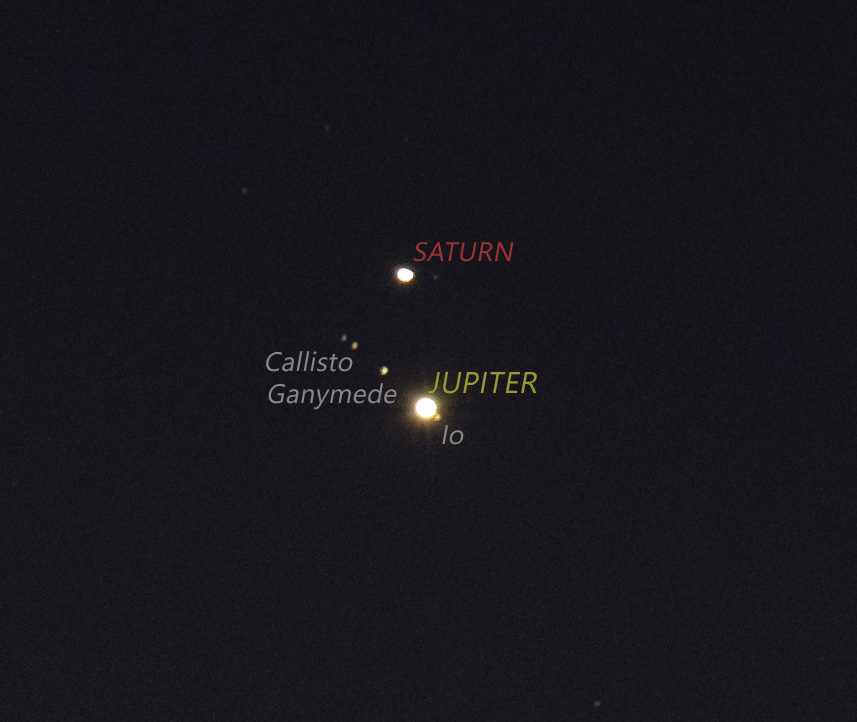
The Grand Conjunction of Jupiter and Saturn
Imaged with a FujiFilm X-T2 and a 55-200m zoom lens (set to 200mm). Camera mounted on a Skywatcher Star Adventurer to prevent smearing of the image due to 7 second exposures at that focal length. Imaged at F4 and ISO 800.

This set of pictures was taken almost one day before the planets' closest approach and were taken on 20 December 2020 at 17:20. The closest approach itself was on the 21st December at 18:00 but that day was clouded out with very heavy rain where I live (as usual, most astronomy special events are clouded out in the UK - typical!).

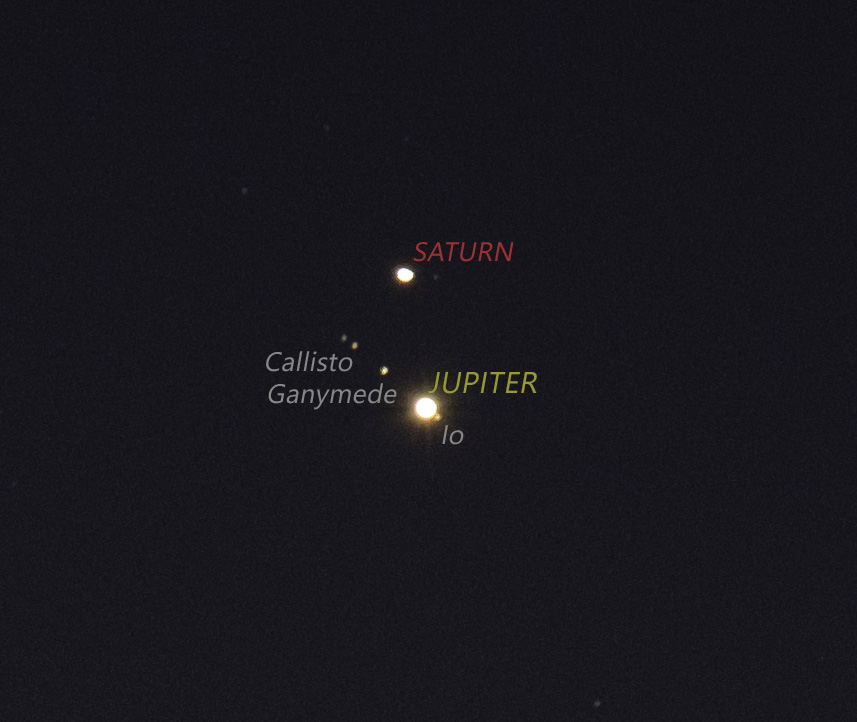
Jupiter and Saturn were around 32 arcminutes apart when this picture was taken, moving to their closest at around 30 arcminutes at their closest the following day. 30 arcminutes is about the same diameter of The Sun and The Moon.
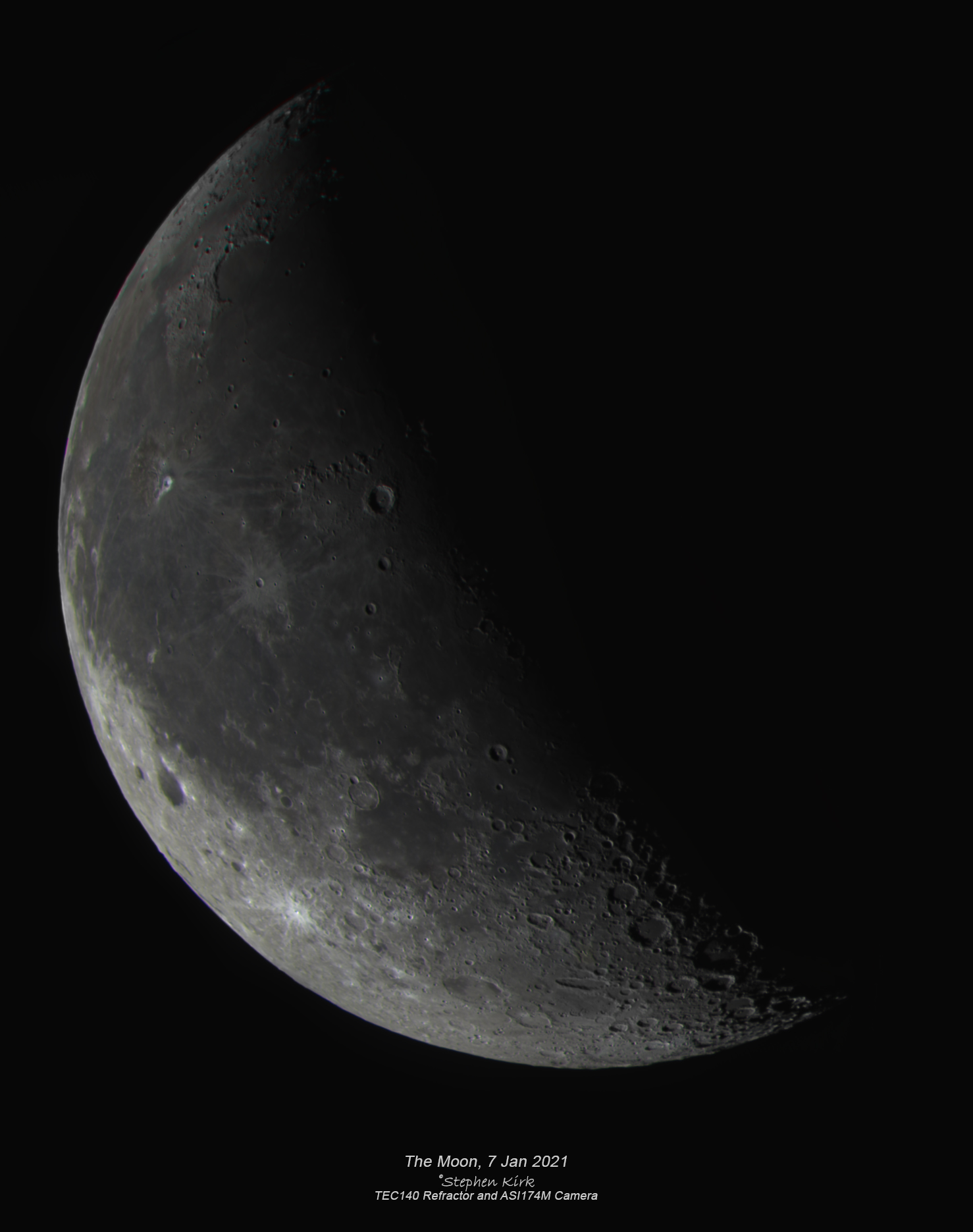
The Moon, 7 January 2021
I had to get up early in the morning to get this picture of The Moon. I set my alarm and got up at 05:00 which took considerable motivation, especially since it was -6C! I don't capture many last quarter and later moon pictures because the Moon is only ever visible in that phase early in the morning and working full time it is not easy to be getting up very early when you have to do lots of driving. However, conditions for astronomy in the UK have been exceptionally poor for the last six months of 2020 and I am desperate to be able to image anything at all!
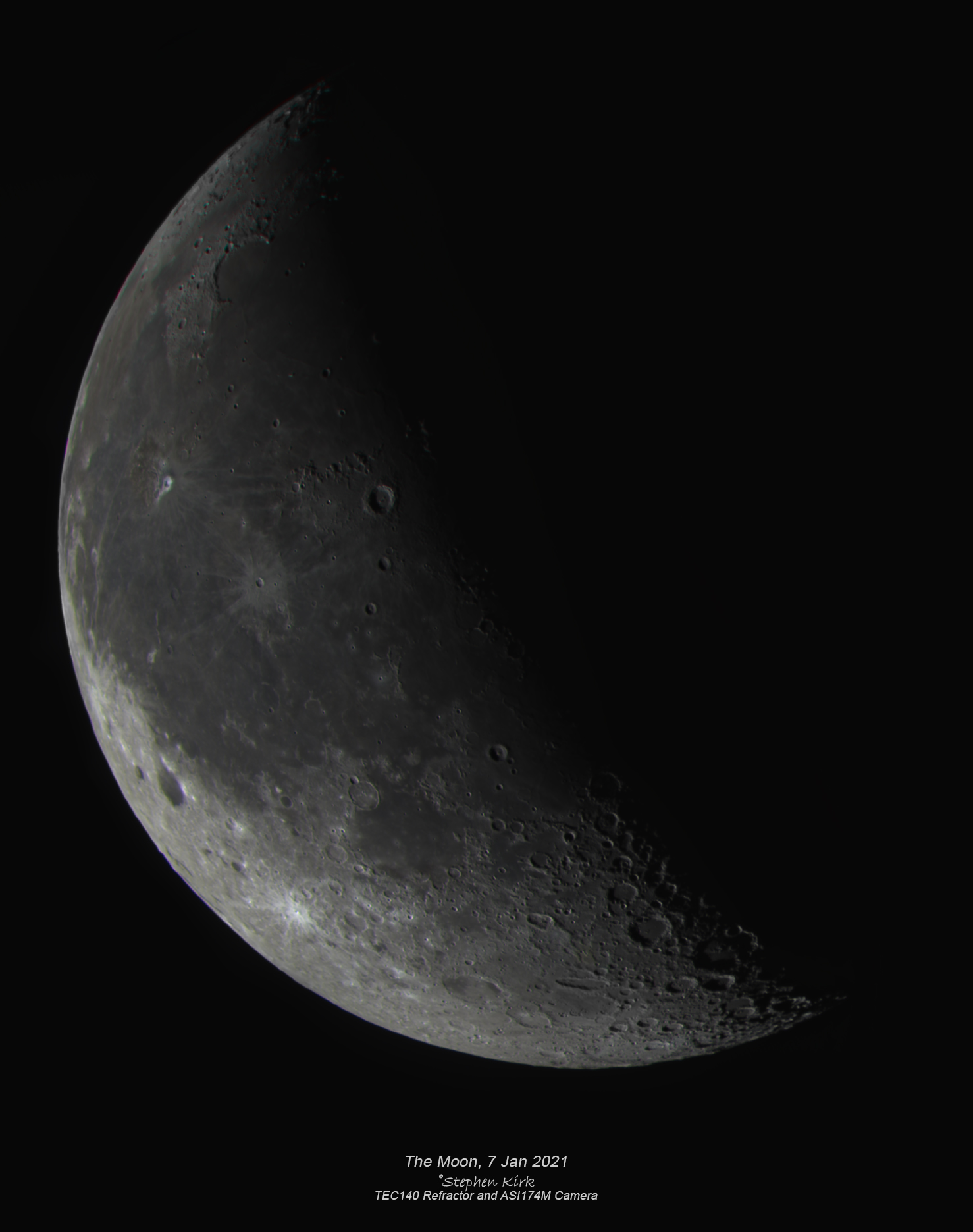
Technical Details
The Moon was in Scorpio, low down to The South from my location, and seeing was average with the Moon at such a low altitude Phase is 38% waning.
Imaged from my back garden with my TEC 140 refractor and ASI174M camera with LRGB filters. I captured 10000 frames in each of R,G and B and 25000 in luminance. The .SER files were quite jumpy with The Moon being at quite a low altitude and so I used about 50% of the frames from each recording. I captured with Sharpcap and then processed with Autostakkert, PixInsight and Photoshop.
I hope you like it!
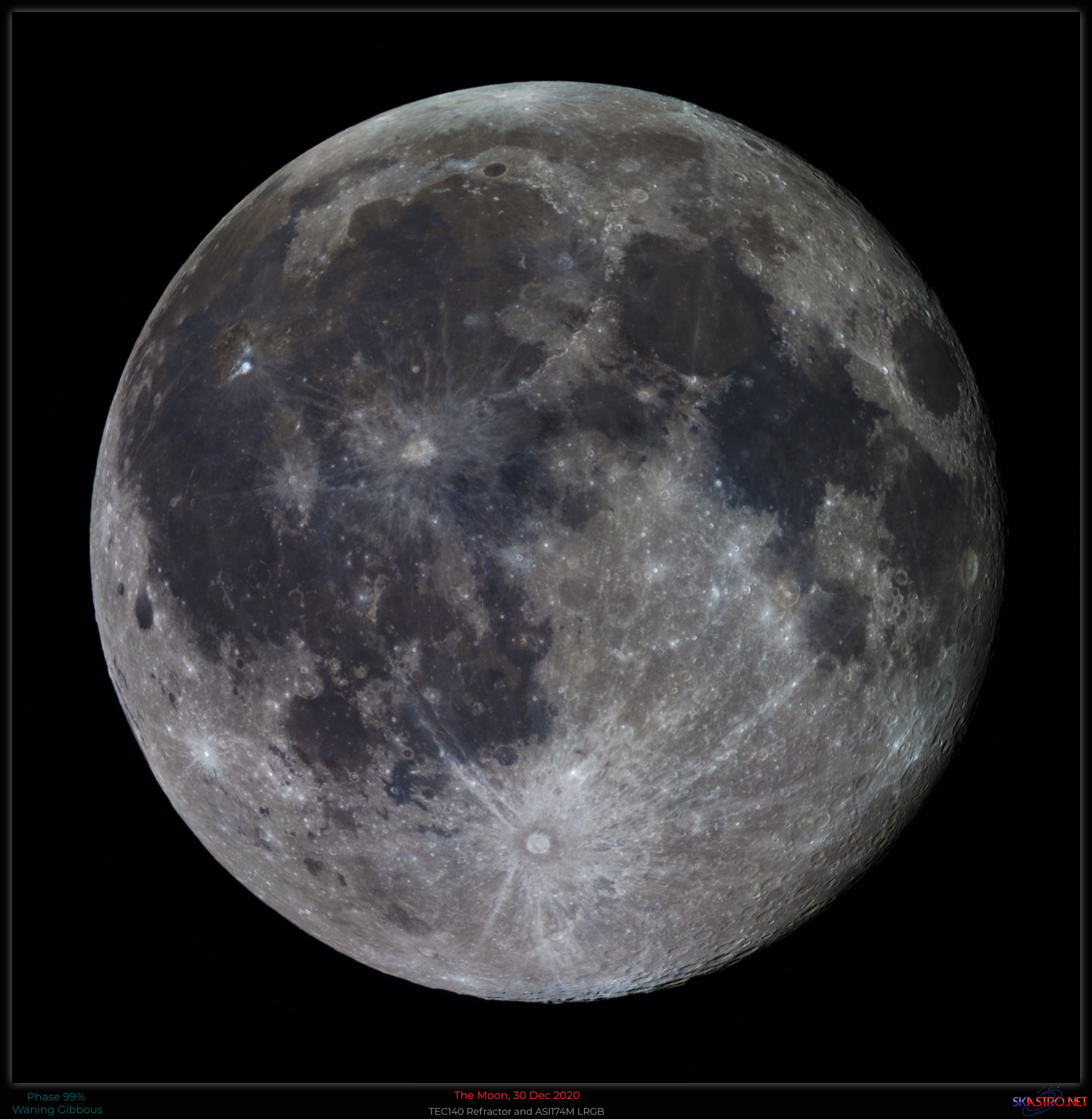
The Moon, 30 Dec 2020
The Moon at a 99% waning phase 30 Dec 2020 between 21:30 and 22:20. Note the bluish and tan colours of the mare (seas).
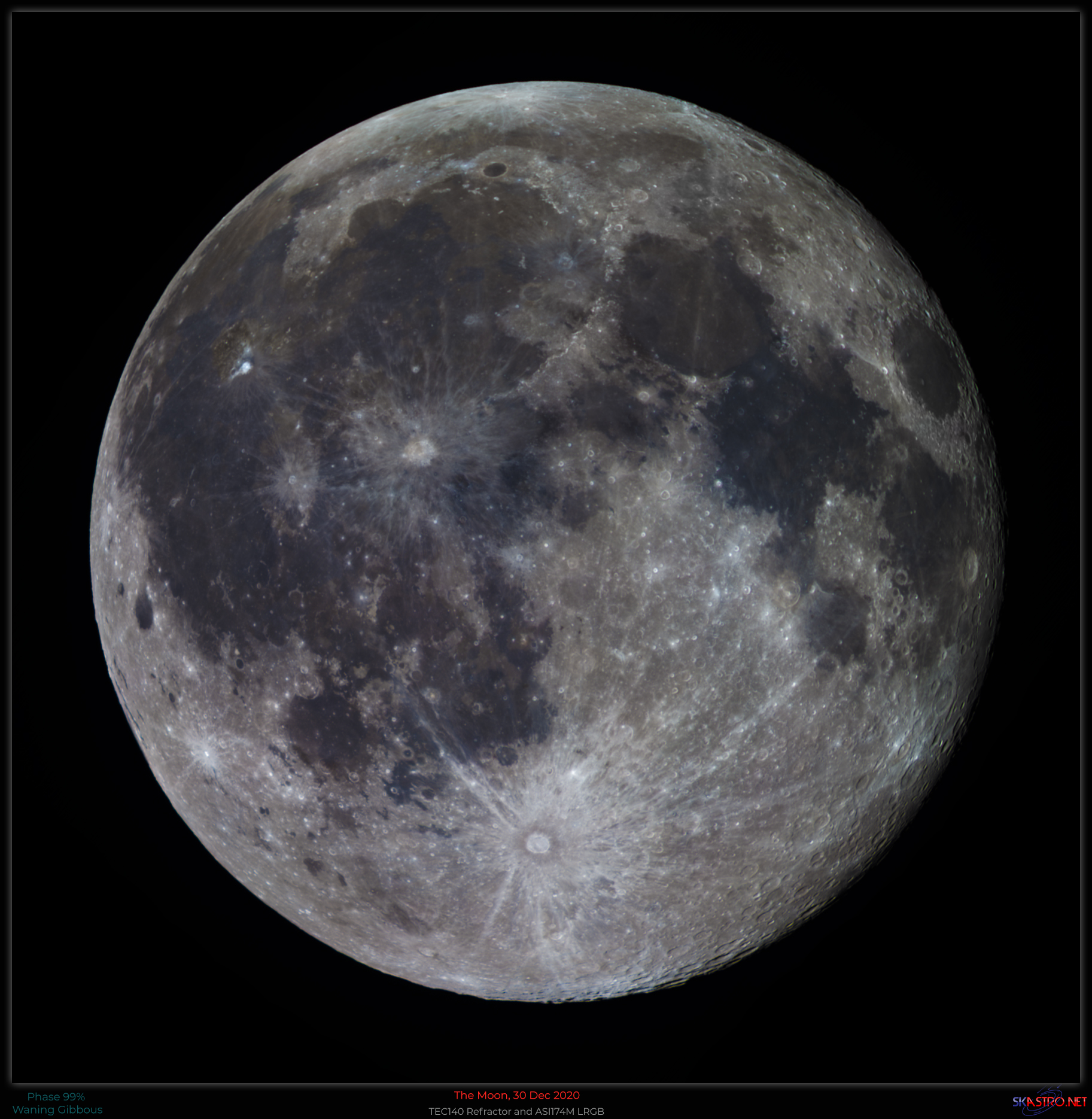
Technical Details
Imaged from my back garden in Nottingham, UK. The Moon was high up in the constellation of Cancer and seeing was very good - unusual in the UK. TEC140 refractor and ASI174M camera.
The image scale is such that I had to capture two runs with each filter to capture the North and The South parts of The Moon and then stitch the two together in Photoshop using the Merge tool. I used LRGB filters and captured 10000 frames in RGB and 20000 in luminance. Data set was in excess of 500 Gigabytes! I then used Autostakkert, Photoshop and PixInsight to process. Capture software in Sharpcap.
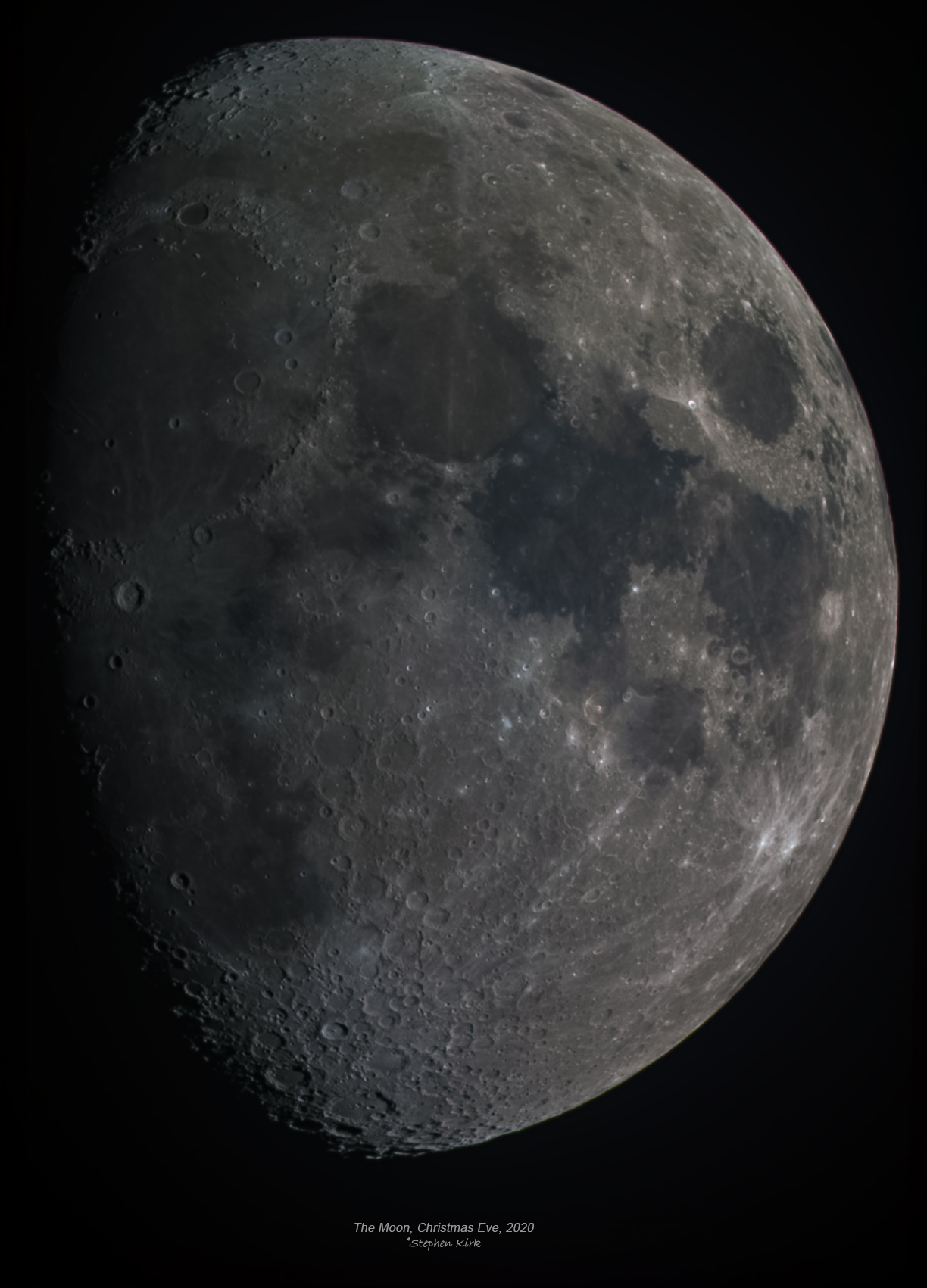
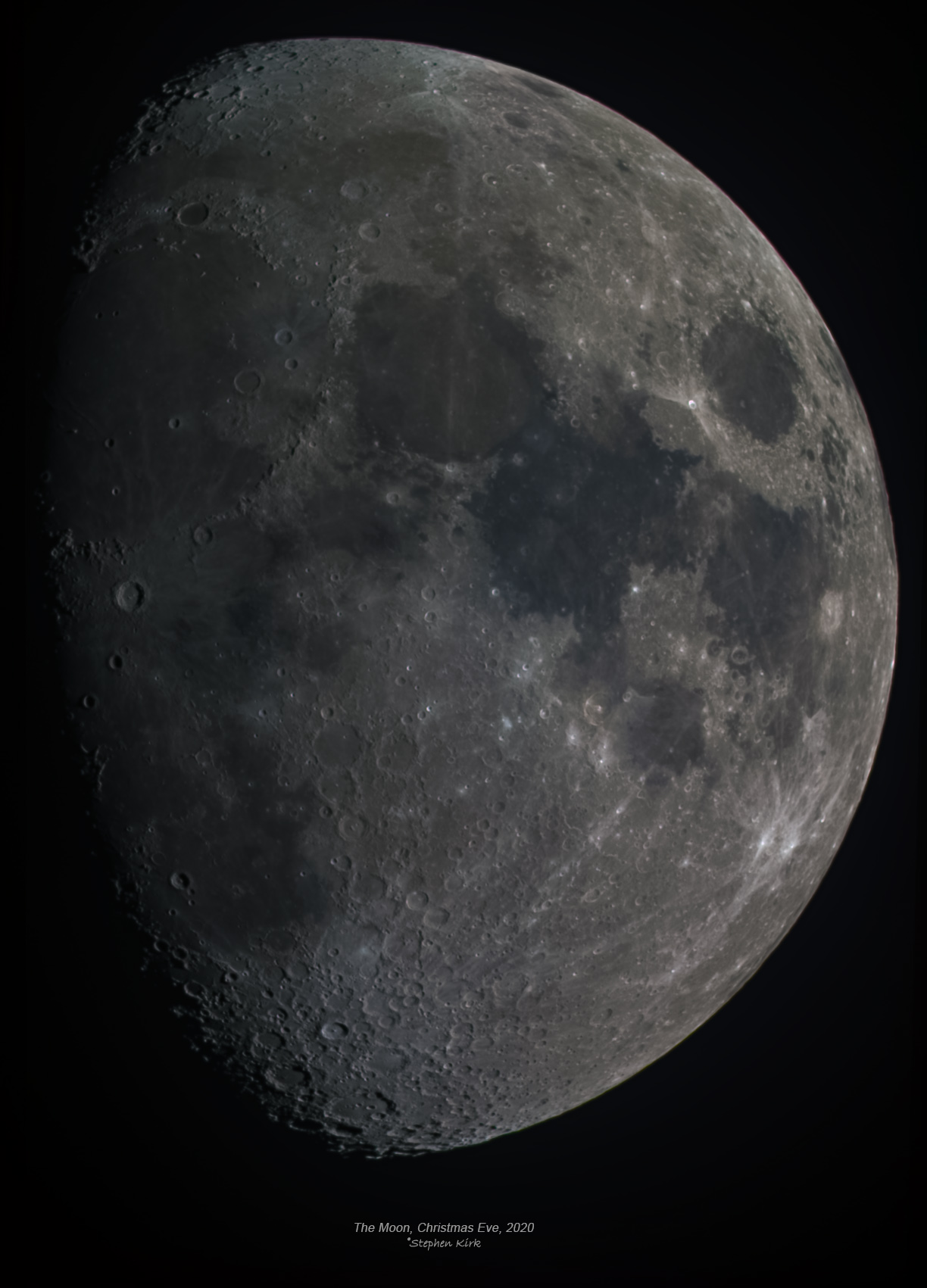
The Moon, 24 Dec 2020 LRGBHa with TEC140
Technical Details
This image of The Moon is a composite picture taken with my TEC140 refractor and an ASI174M high speed mono camera through Baader LRGB and Neodymium filters - the same filters that can be used for Deep Sky imaging (and I have used them for exactly that purpose too).
Moon is in a 73% waxing gibbous phase in the constellation of Taurus.
I captured 2000 frames through the Baader luminance filter and another 2000 through the neodymium filter. I then registered and combined the master image from each of these with Pixelmath with scaling. I used Multi-Scale linear transformation to sharpen the image and a very slight HDR transformation to bring out the fainter detail. This created the master luminance.
Each master R, G and B sub is the best 50% of 5000 frames. I registered the separate RGB channels with the master luminance and then used channel combination to make an RGB image after linear fitting them as individual master subs to attain the same intensity across the three channels. All these steps done with PixInsight.
I then combined the master Luminance with the master RGB to create the picture above in Photoshop with a slight tweak of the vibrance and saturation with Camera Raw filter.
I hope you like it! It is fun and enjoyable creating these lunar images.
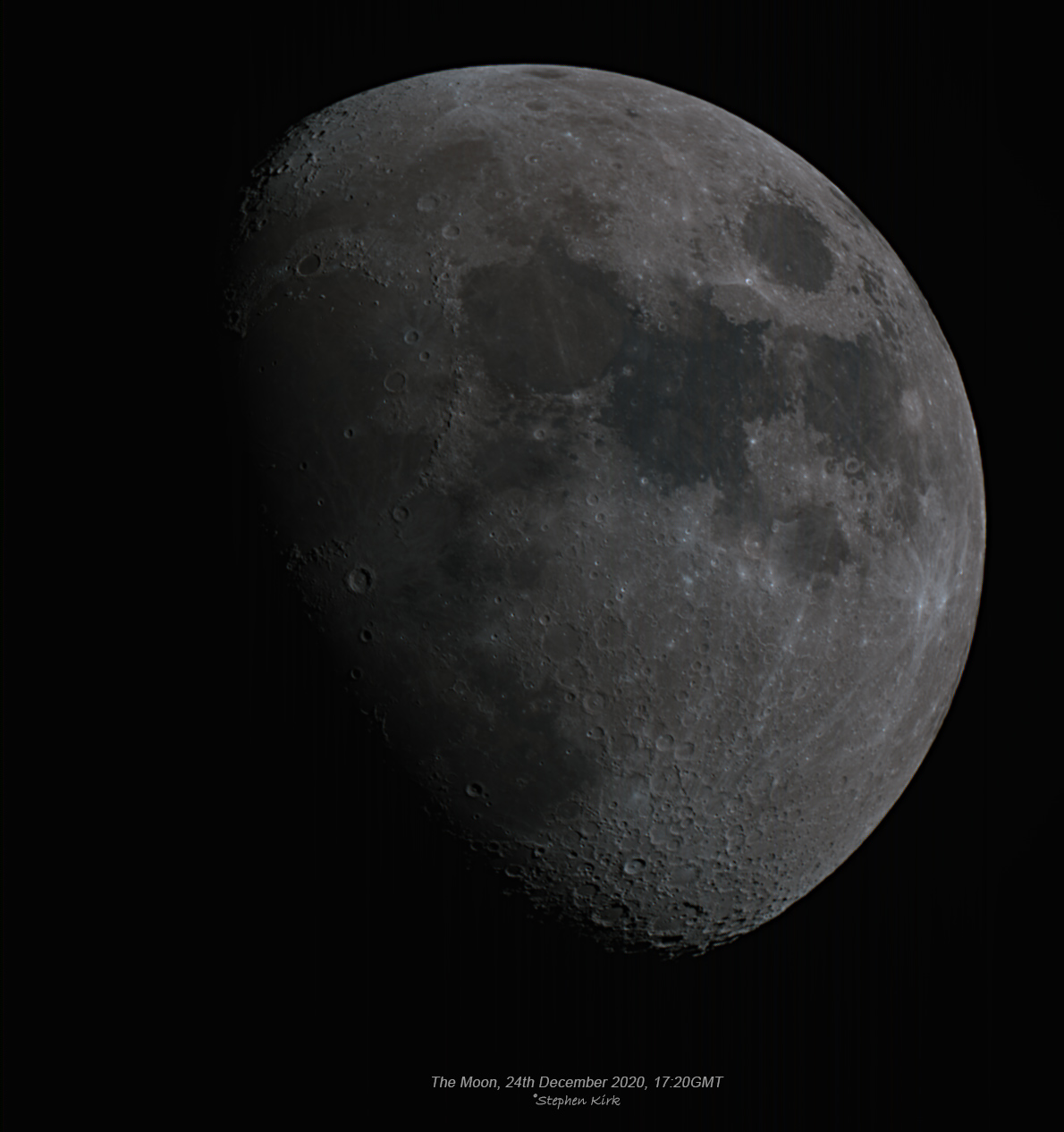
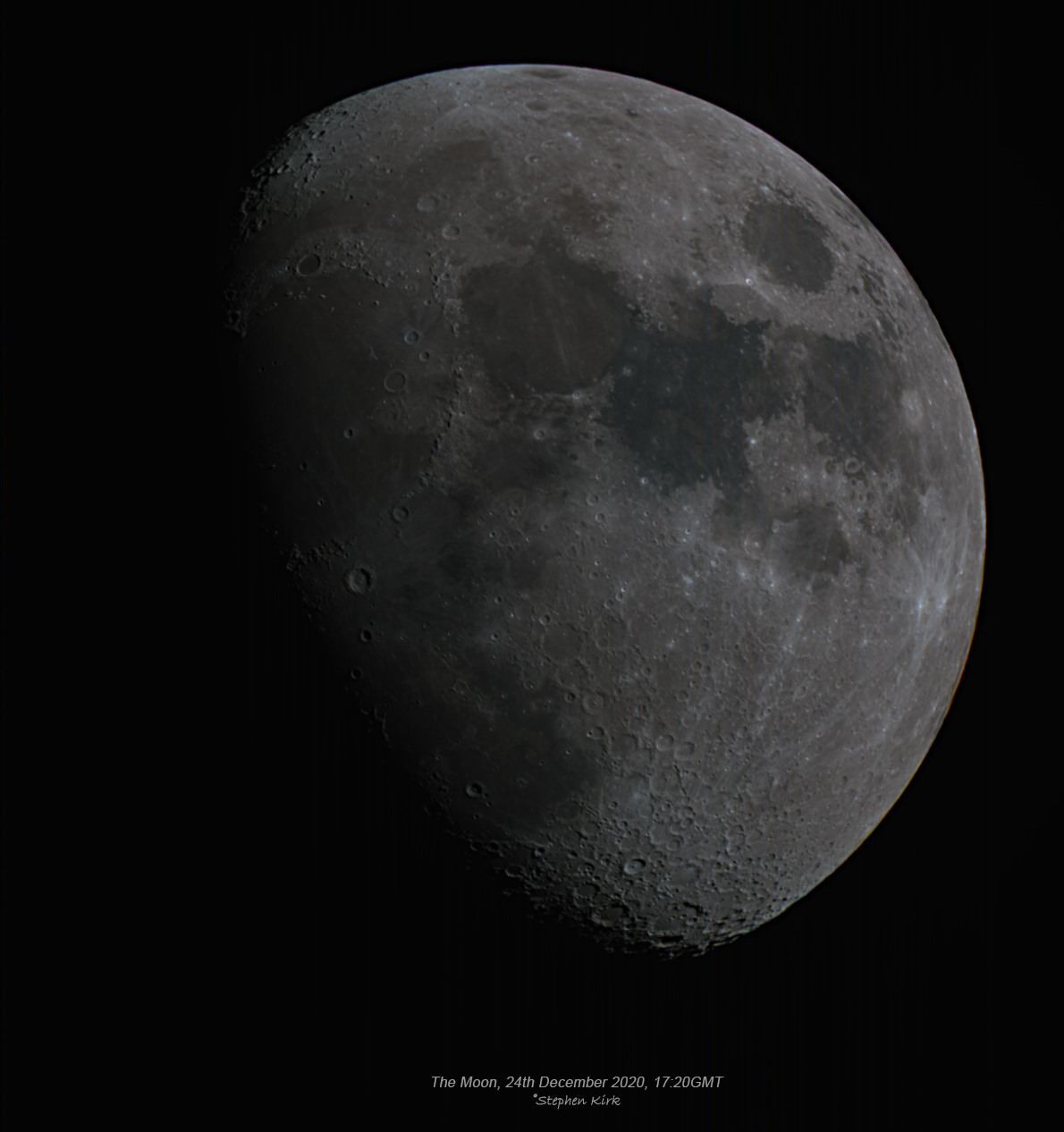
The Moon, 24 Dec 2020, FSQ85 and QHY268C
This is a one shot colour picture of The Moon through my Takahashi FSQ85 telescope and my QHY268C colour camera. Seeing between bouts of cloud dodging was quite good with very little in the way of shimmering. This is the best 40% of 5000 frames captured with Fire Capture. I did not use the full resolution of the QHY268's 6000x4000 sensor, I just captured the central 1600x1200. Unusual to see the FSQ85 used as a planetary or lunar scope but it does excel at this as well as deep sky astrophotography work. It is also a very good instrument for visual observations.
Processed with Autostakkert, PixInsight and Photoshop. I hope you like it. It could do with a bit more colour to bring out the colour in the Mare (sea) regions.
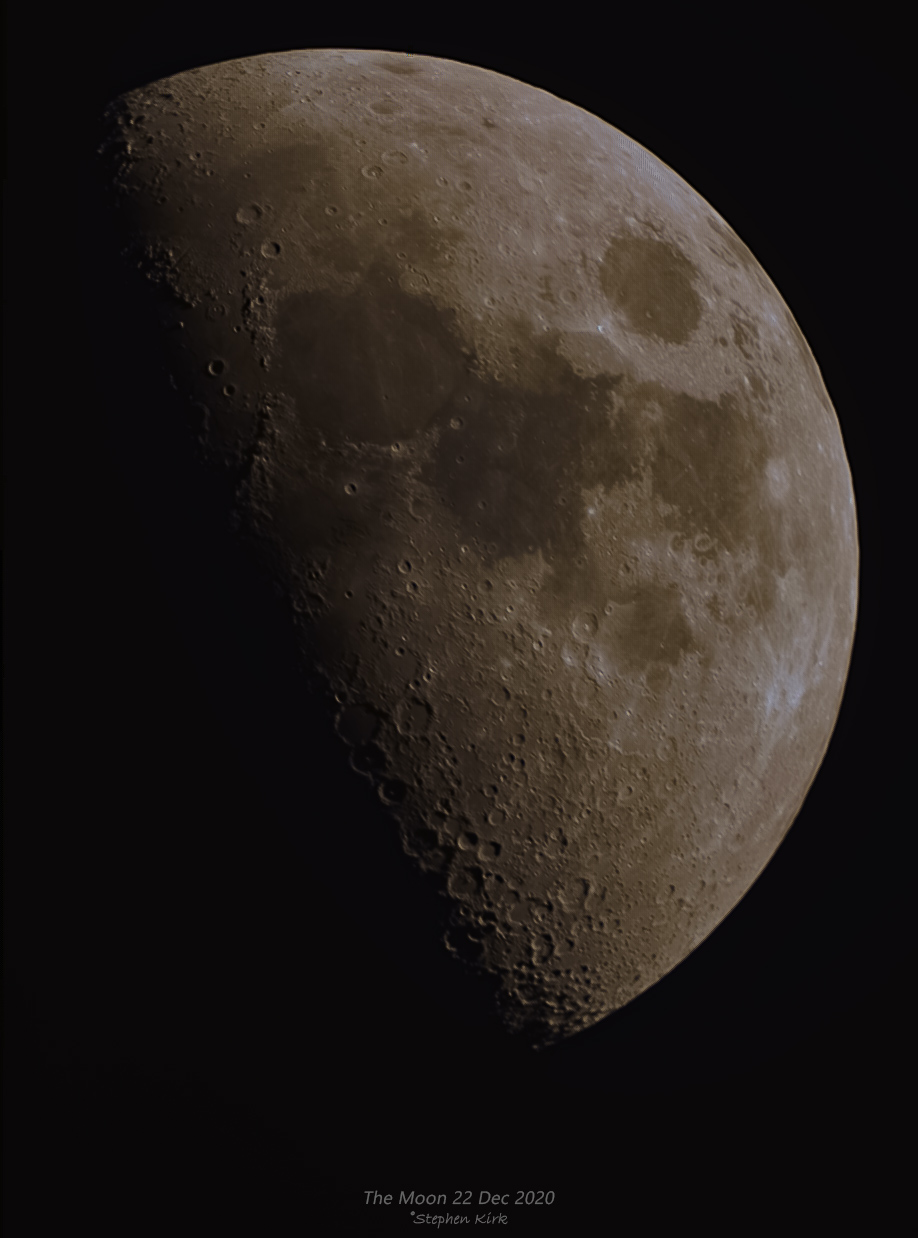
The Moon
The Moon was at about first quarter when I captured this image. There are a lot of firsts in this image when capturing as I discuss below.
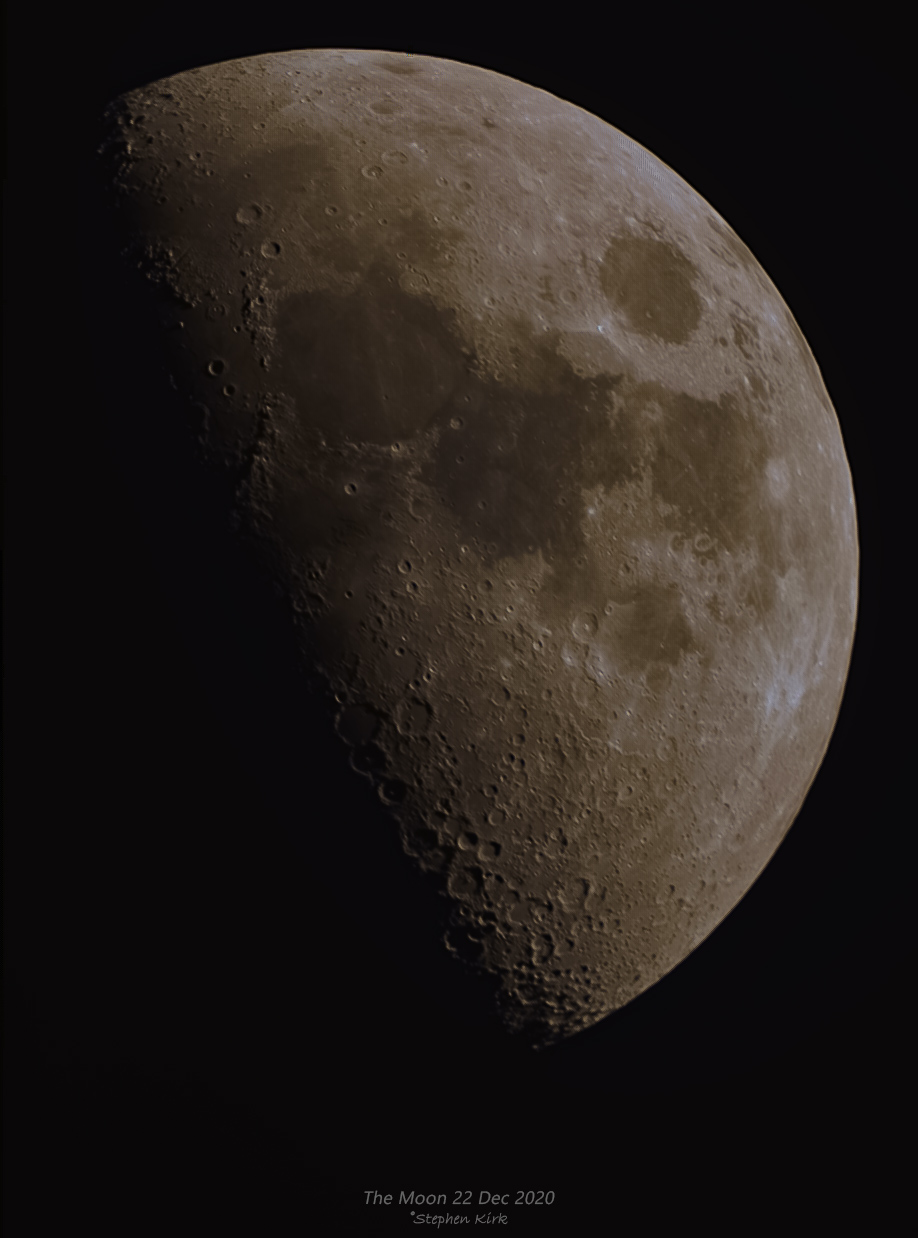
First up, this is the first time I used the QHY268C for planetary photography in video mode. Before now, I always used this camera in long exposure mode. I think the camera works very well and when I cropped the capture area down to 1600x1200 from its native 6000x4000, I was capturing16fps in Sharpcap, which is quite reasonable.
Secondly, this is the first time I used my Takahashi FSQ85 as a planetary/lunar scope. I think it worked our pretty well. I would normally have moved the camera over to the TEC140 or even the C925 SCT scope, however, I do not yuet have the adapters for the QHY268C to do that just yet.
Technical Details
As mentioned, imaged with FSQ85 and QHY268C. I used Lakeside motorfocus and captured 2000 frames in Sharpcap - another first use of this software (excellent) and utilised the best 35% of the frames in Autostakkert.
I used Photoshop to process the outputr from Autostakkert. Try as I might, and despite colour correction, I still think there is a slight green tinge to The Moon in this image so I will experiment with some different processing techniques.
EDIT: I am leaving the image as is but the reason for the green tinge is because I did not equalise the RGB channel intensities properly. There are several ways to achieve this. You can use linear fit in PixInsight and use the weakest median channel as the master with which to equalise the other two channels. Or, again with PixInsight, you could combine the RGB with channel combination with the channel intensities as they emerge from the stacking program and then do a colour combination to equalise the three channels. Or, you could use autocolour in Photoshop to achieve the colour calibration. Actually, there is a fourth way too, bu using Helmut Bornemann's autocolour script in PixInsight.
http://www.skypixels.at/pixinsight_scripts.html
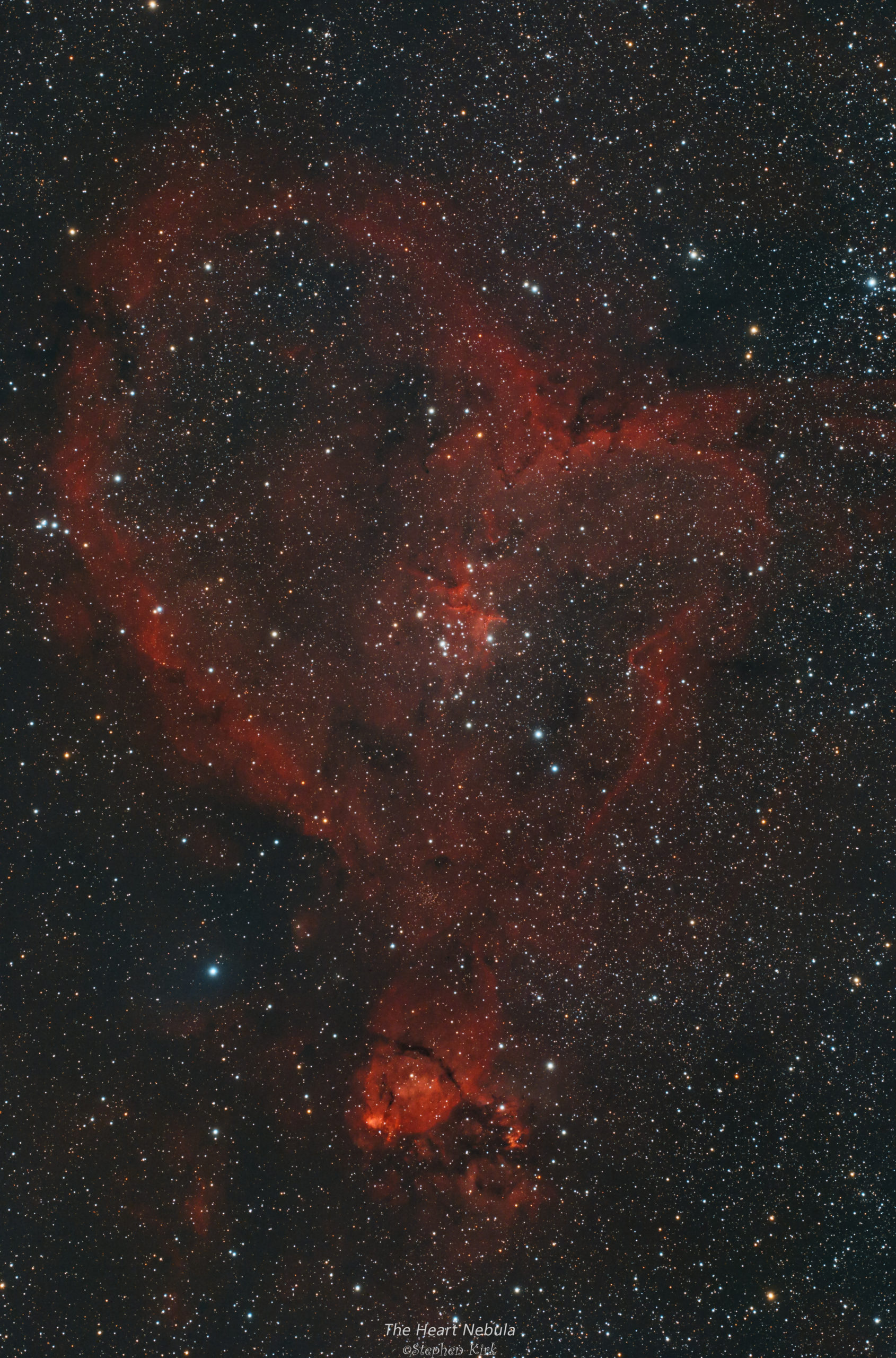
The Heart Nebula - IC1805
A famous emission nebula in the Northern constellation of Cassiopeia, the Heart Nebula is a huge star forming region located about 8000 light years away, out in the Perseus Arm of our galaxy. It is often imaged as a pair of nebulae alongside the Soul Nebula as the famous Heart and Soul Nebulae. I have imaged them together here as well as The Soul nebula here, presented on its own. It is also known as IC1805 and Sharpless S2-190.

It is a beautiful nebula and I have even seen it portrayed on Valentine cards :)
Technical Details
Imaged from my back yard in Nottingham, UK on 20 December 2020. Seeing conditions and sky transparency were reasonable. I used Takahashi FSQ85 refractor at native focal length and a QHY268C OSC CMOS camera. I took 42 x 180s exposures and the data was captured with Sequence Generator Pro. Processed in PixInsight and Photoshop.