
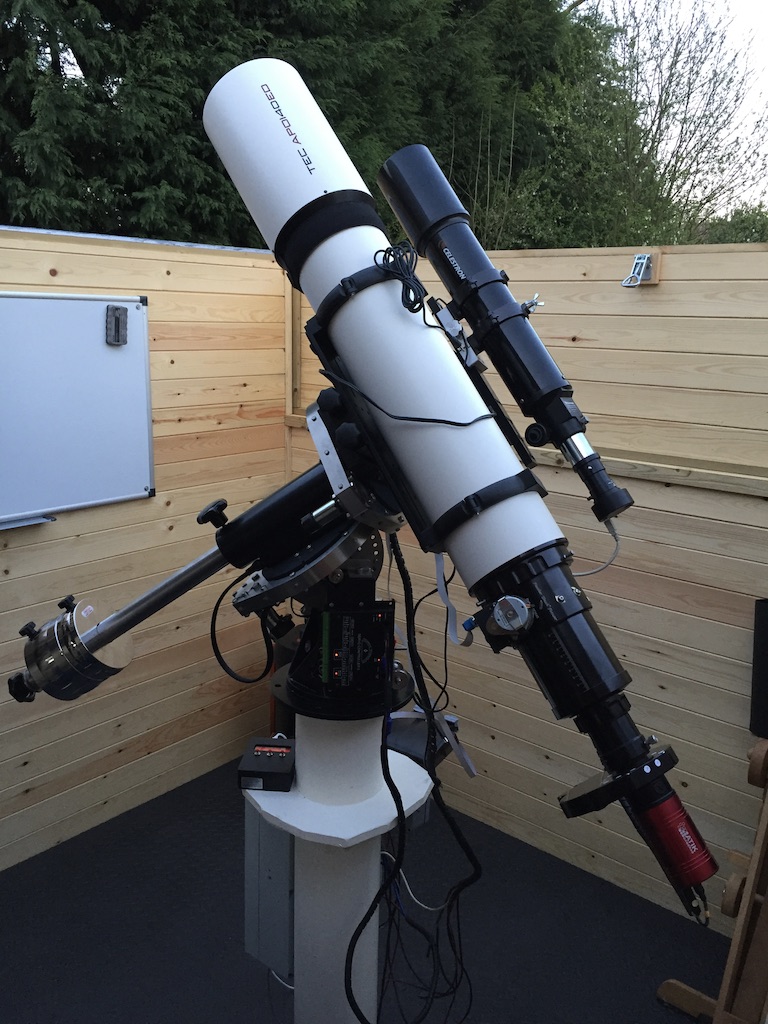
My TEC 140 Refractor - Ordering, Review and Impressions
Please note, the opinions expressed here regarding my TEC 140 are mine. No one paid me any money, offered me any free equipment or offered me any discounts or services on anything astronomy or otherwise nor did they request I write this article. I bought my telescope with my own money and I offer my thoughts, ideas and opinions to help others because I enjoy doing so, not for material or financial gain for myself. If the scope sucks, rest assured I will say so.
Introduction
Mention the word "telescope" to the general public and they will almost certainly think of what we astronomers know as a refractor. If you asked a child to draw a telescope, it's a refractor they will draw for you. Refractors are the oldest of telescopes and it was a refractor that Galileo pointed at the stars and Jupiter in 1610.
I have long been a refractor enthusiast. For sure, SCT's and Newtonian telescopes in their various guises are great too and offer a lot of aperture for the money and I use those types as well. But the simplicity of a refractor takes some beating. They require no regular collimation, no hours of cooling, they are easy to keep clean and simple to use. I have a wide-field, high quality Takahashi FSQ85 refactor for astrophotography and I wanted a high quality, premium refractor of about 5 - 6 inches (130-150mm) aperture for closer scale imaging and lunar observation - something I enjoy a lot. I considered several options; maybe an AstroPhysics Star Fire? Great, but a ten year waiting list and an astronomical (pardon the pun) cost to go with it. I considered a Skywatcher Esprit 150 too but they were very early in their production cycle and I had no wish to be a guinea pig (as in turned out, these are great scopes too). But in the end, after reading many reviews and speaking to some other owners, I settled for the TEC 140 from Telescope Engineering Company based out of Golden, Colorado, USA. This is a highly colour corrected, 140mm clear objective diameter, 980mm focal length F7.0 scope.
The TEC 140 is a premium quality - and priced - instrument. It sits within several lines of refractor that TEC makes and the TEC140 is the second "lowest" of the line since they make a TEC 110 as well (110mm objective). The TEC refractor line ranges from from the aforementioned 110mm all the way to the mighty (and giant) 250mm (10 inch) refractor. Additionally, the models larger than the TEC 140 (starting with the TEC 160) start to use more exotic (and expensive) types of glass for even better colour correction than the already superb TEC140.
We can dream, for sure, about these huge, expensive refractors but leaving the stratospheric larger models to one side, I decided to go for the TEC140.
Ordering
I contacted Yuri Petrunin, an optical engineer originally from The Ukraine who is the founder and owner of TEC, to discuss how I go about ordering and owning a TEC 140. This is so popular a telescope and has such a great reputation that, despite costing $7400 (2016 prices, check for the latest price), he can sell the small production batches he makes each year many times over. Rumour has it that he only makes about fifty or so TEC 140 scopes per year. He invests in high quality production methods and he has not been tempted to outsource his operations to cut costs and he makes the telescopes himself with his son and a couple of other highly skilled craftsmen. TEC grind and polish the lenses and make all the metal work themselves. So, despite dealers advertising these telescopes, they will have to go to Yuri and join his manufacturing queue, just as if you were to order directly from him yourself, as I did.
To join Yuri's production queue he required a deposit of $1200. Being in the UK I had to find a way of converting my currency (pounds sterling ££) to US dollars, so I paid the deposit with an international banking service XE.com. I am not being paid by them to say that, just letting you know how I did it, and there are no doubt many others offering this service too. However, XE.com did me a good exchange rate, a modest fee (about $25) and the transfer goes across to Yuri inside a day or two. If the production queue is full for the next production run you will have to wait for Yuri's next batch which could be a full year later. Depending on how busy he is (and I will forewarn you that he is VERY busy) this could add another 6 - 12 months to the time you get your scope. So if you want one of these TEC scopes you need to get yourself onto Yuri's queue as soon as you can.
Once you are in the production queue Yuri will keep you in the loop about what is happening. He does not deliver a running commentary but lets you know what you need to know. About seven months after I paid my deposit Yuri let me know my scope was built and ready to ship and to pay the remaining balance. Upon paying the balance (again, I used XE.com) and shipping fees (the shipping and insurance were about $250 to the UK), the scope was shipped to my home in the UK with a shipping number and I eagerly watched its progress from Yuri in Colorado, via Denver and San Francisco then cross the Atlantic Ocean to Heathrow, UK via the UPS tracking number. I had to pay significant UK import duties plus 20% sales tax (VAT) and other government fees to the tune of about £1300 (about $1800) before the UK customs released the package. Upon completing the UK import tax forms (UPS and other shipping agents help you do this), UPS released it from UK customs and delivered it to my home address.
All in, my TEC140, landed at my door with all duties and shipping paid, was a £7500 investment (about $10000). A lot of money. Shortly afterwards, following the Brexit referendum in the UK, the £sterling rate tanked against the US dollar and would have made my scope over £1500 more expensive !!! So I consider myself very lucky to get the scope when I did. Despite that, £7500 or $10000 is a serious investment into an hobby by any standards. But I justified it to myself because this is a lifetime scope and I had some commission from work. I also spent some of the money from my late wife left me since I know she would have wanted me to have this scope. Thank you Yvonne ♥️ xx
Receipt Of The Scope
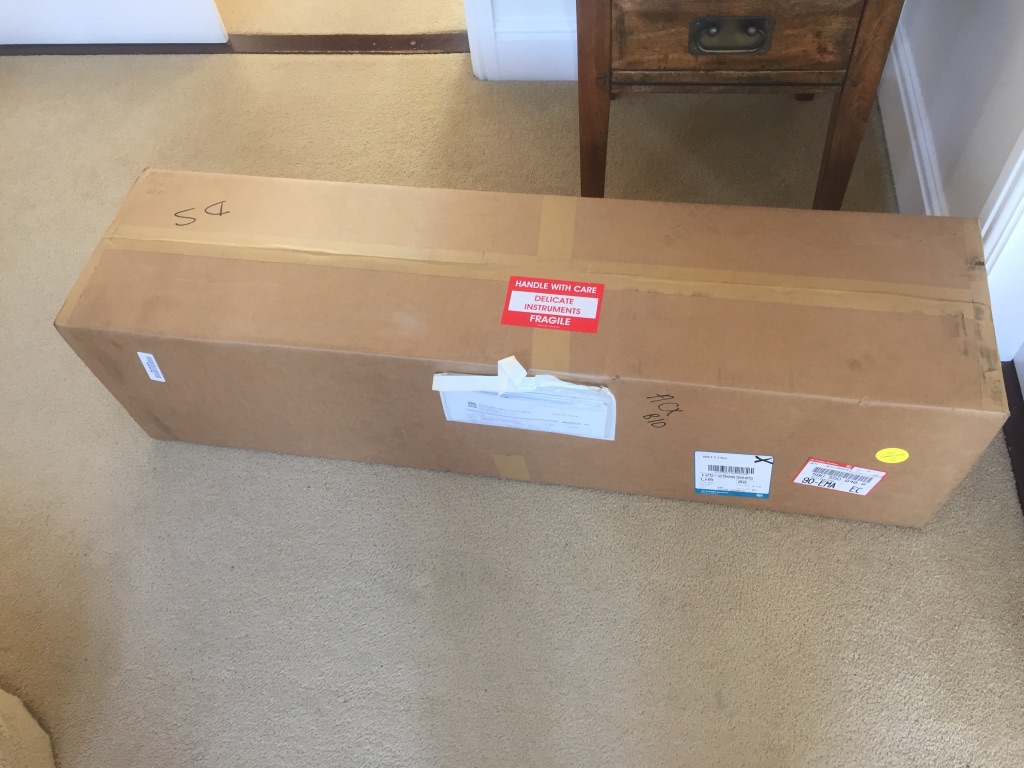
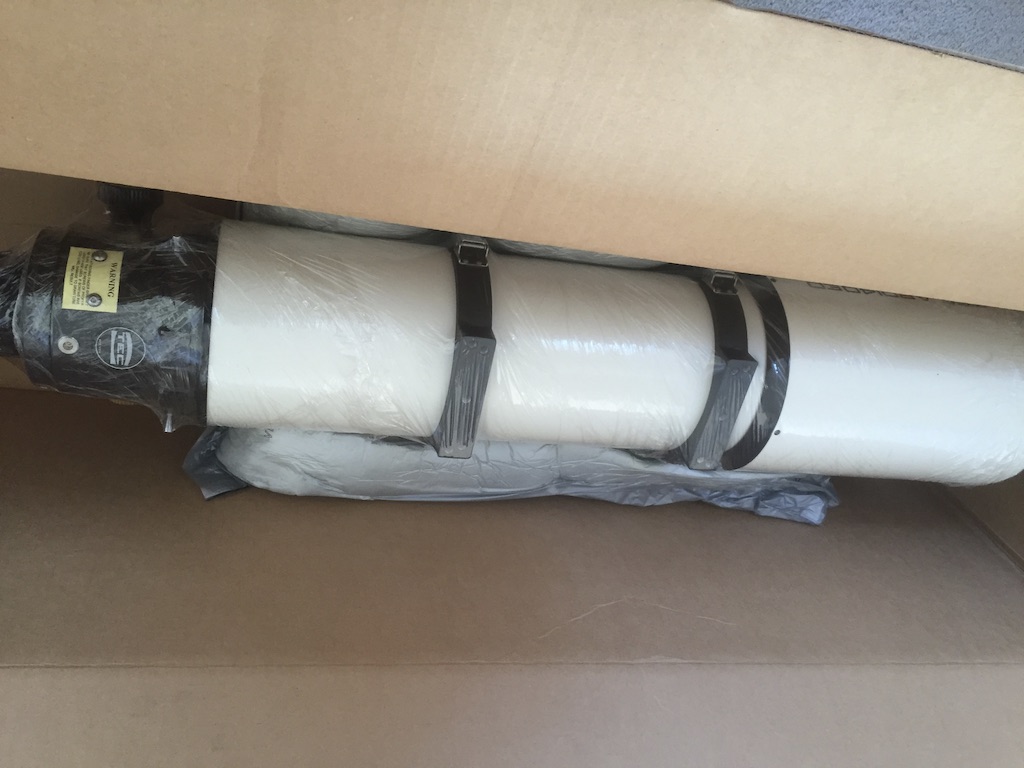
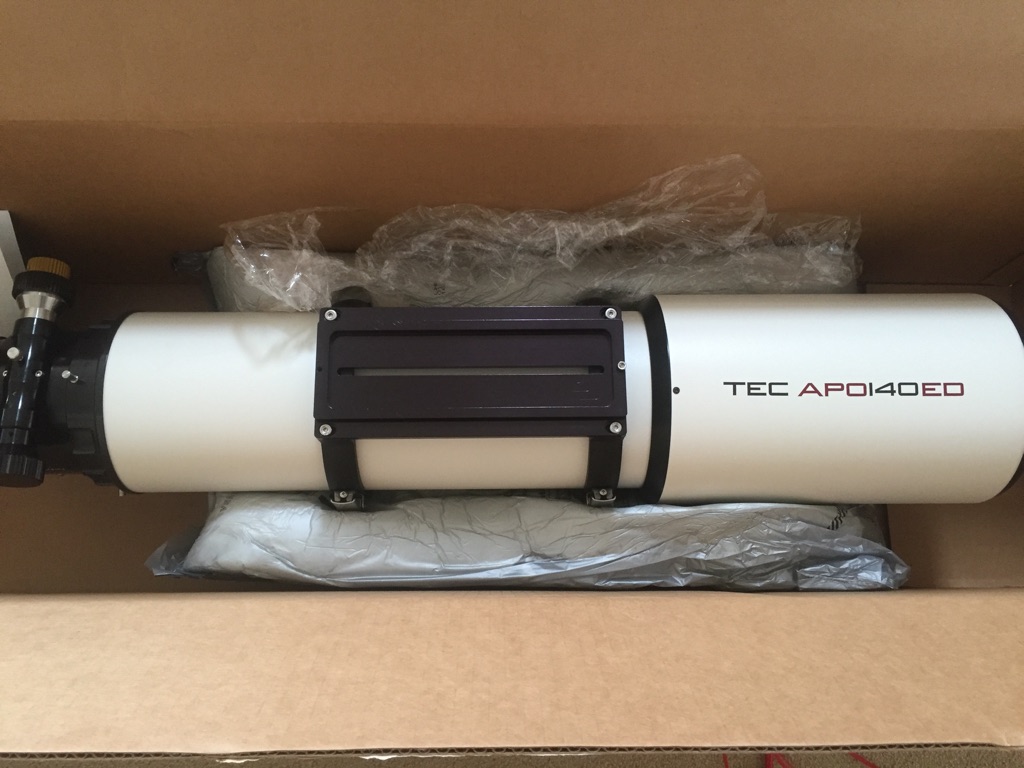
The scope is shipped in a strong and rigid cardboard carton with very strong and rigid styrofoam moulded to the shape of the scope to protect it. The scope inside is then wrapped and sealed in Polythene-like material with some desiccant to absorb any moisture. You could also specify your scope be provided (and shipped) in a permanent, hard exterior and felt lined shell storage case that you can purchase at the time of order. However, since my scope will be permanently mounted in my observatory I elected not to specific this option. The only option I chose upon ordering was to specify the Losmandy dovetail plate. I had no need of Yuri's finder (an option you can also specify) since I use my own red dot laser finder. (Update: As of 2023 - seven years later - my TEC140 has been permanently mounted and has never been outside my observatory).
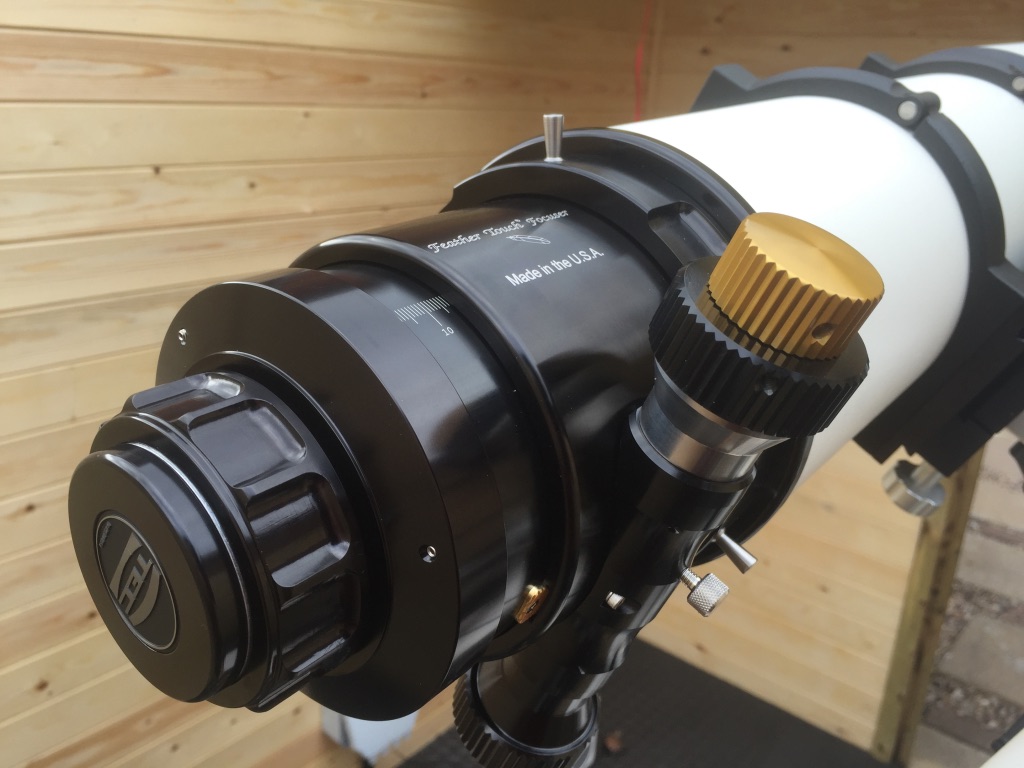
My initial reaction upon opening the box was one of "wow!" and being incredibly impressed. My scope, made by Yuri for me, was utterly immaculate in every way and is a thing of beauty with its matt white coat paint, the beautiful Starlight instruments 3545 focuser and the immaculate front lens element, proudly engraved with the scope's serial number - in my case number 690. There were no marks at all on the glass elements - it was crystal clear.
The build quality is impeccable. It is robustly made with very high quality materials and with a superb fit and finish. It has a weight and heft that is very reassuring. It is a scope made by an astronomer for astronomers. Yuri is so experienced and knows what astronomers want and need in a scope.
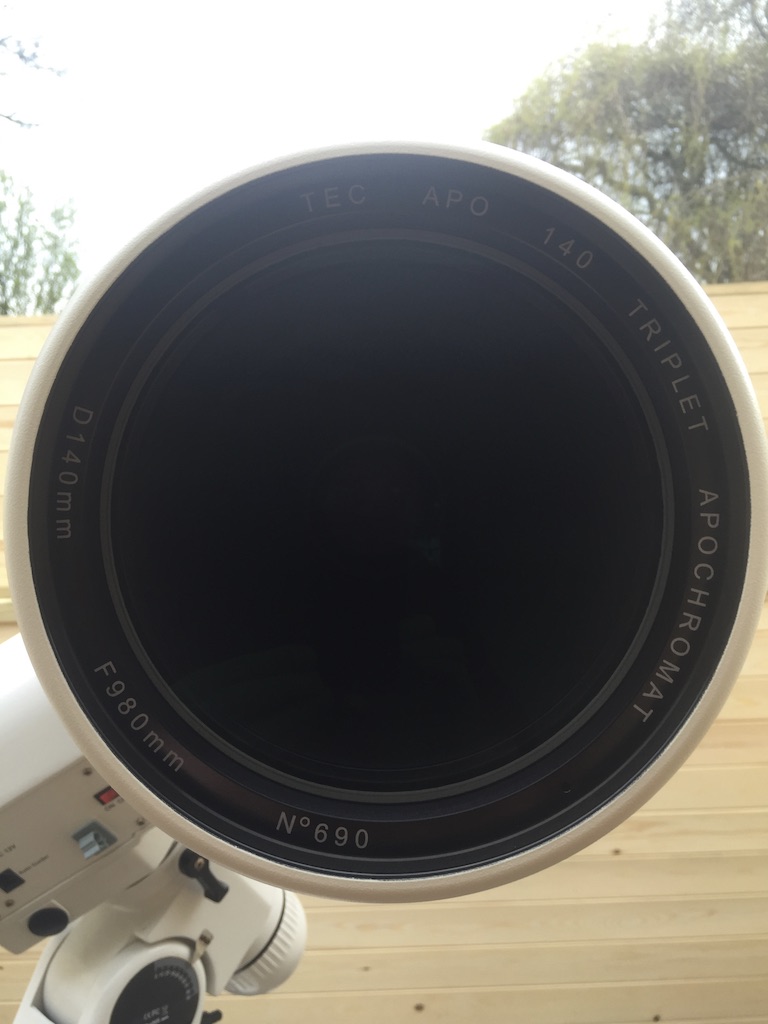
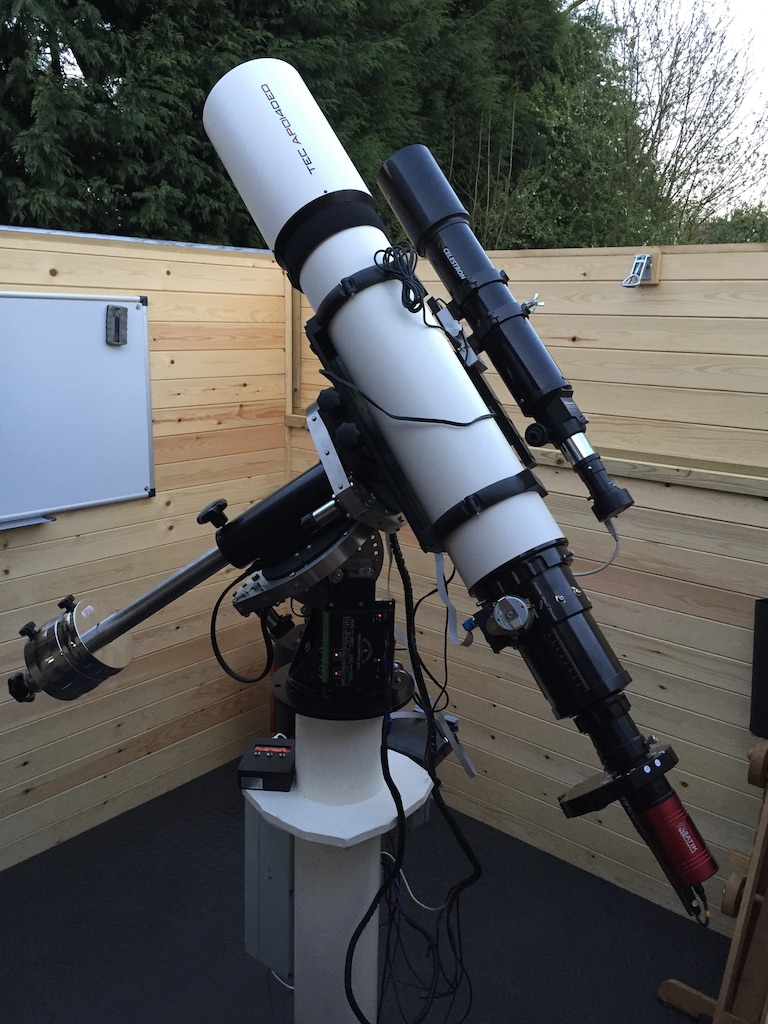
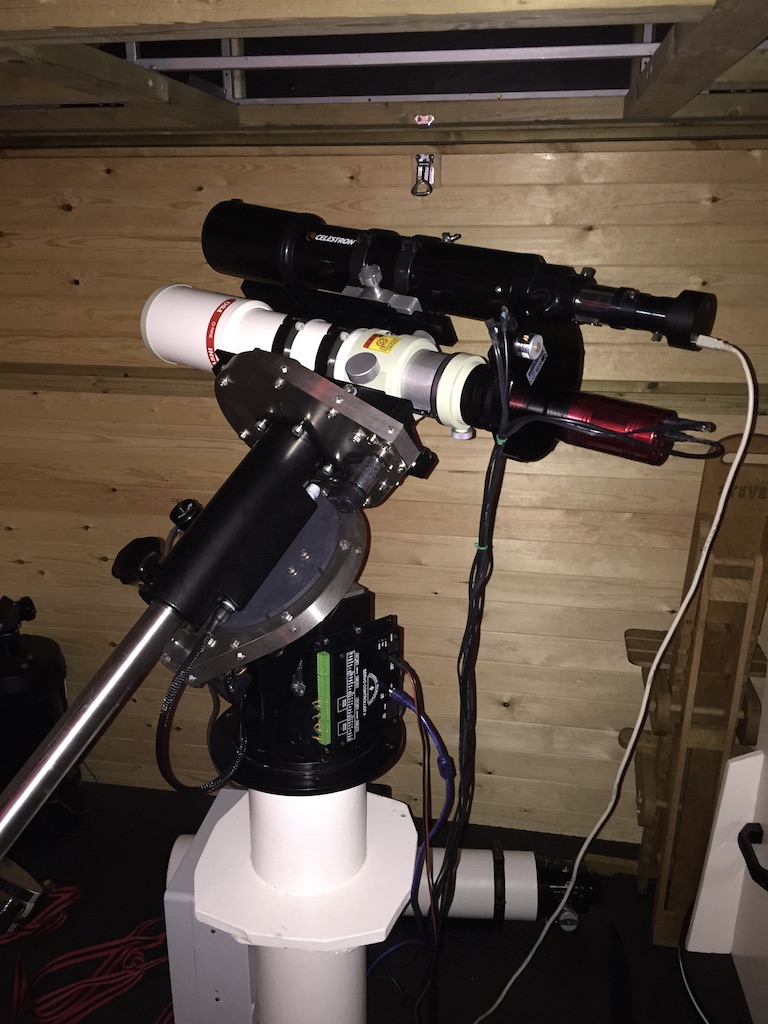
Almost immediately upon opening - literally within the hour - I had it mounted on my Skywatcher NEQ6 mount. I have since repurposed this mount and bought a MESU 200 but the NEQ6 held the TEC 140 with no problems at all. I think you guys in North America call this mount the Atlas mount. I installed my guide-scope onto the mount and a Dew Shield. This is not my current telescope/mount configuration but was the one I used at the time in April 2016 (I now have the TEC140, FSQ85 and Celestron C925 all simultaneously mounted).
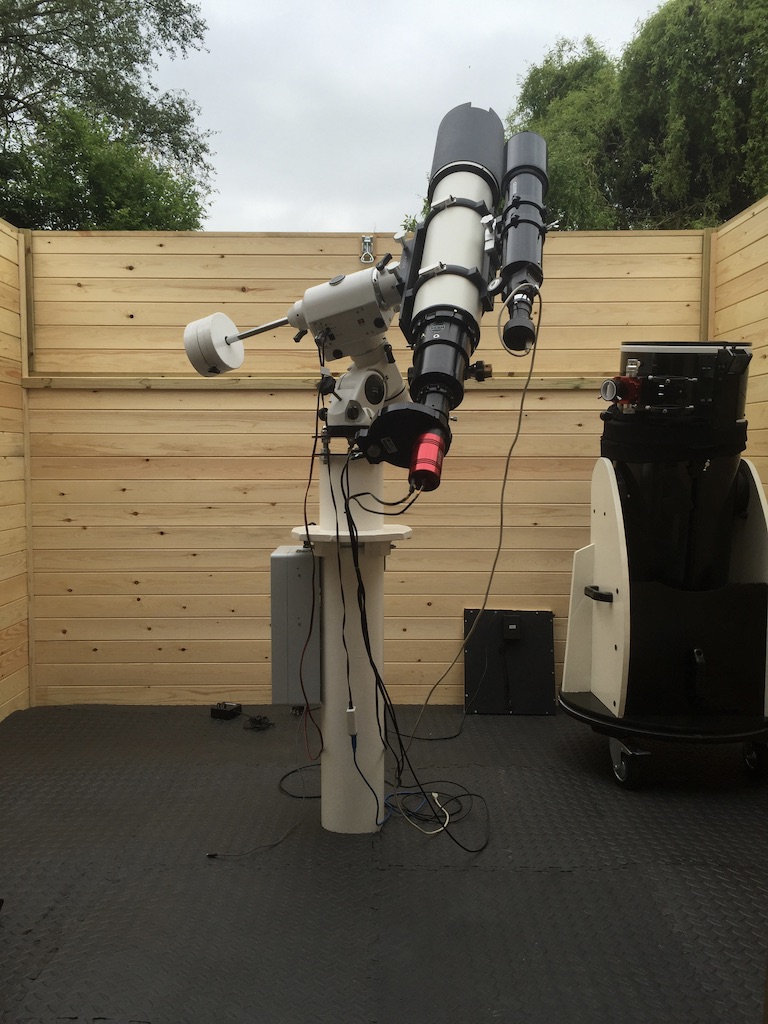
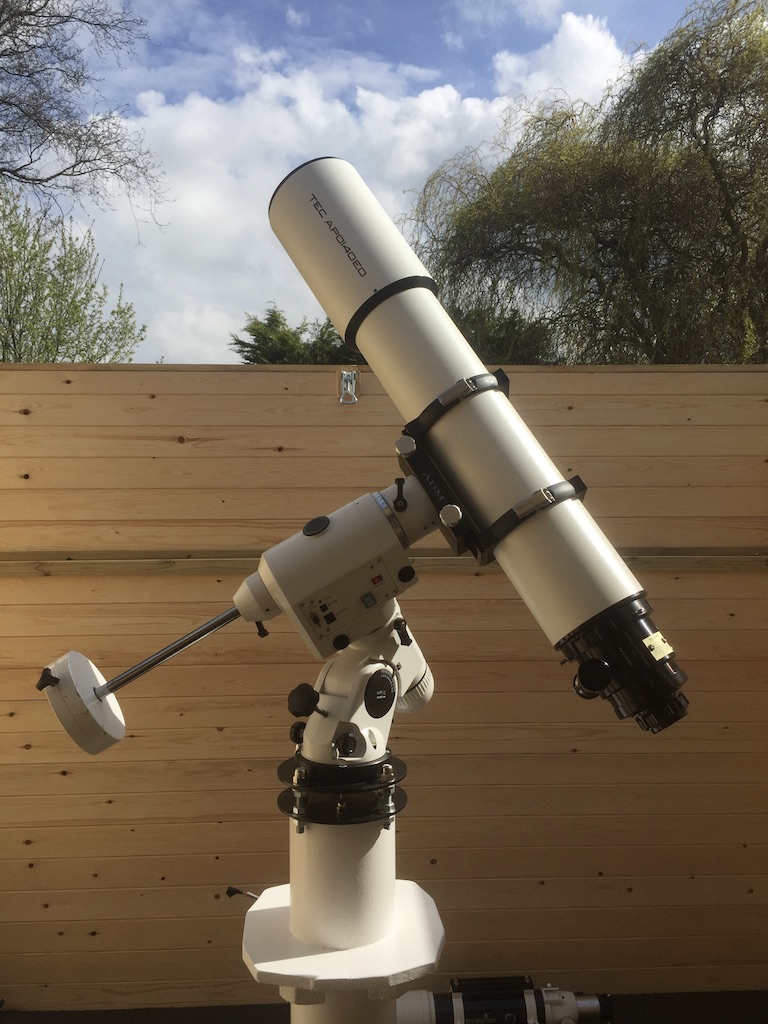
Now, all astronomers will know of the "new gear curse" - namely, when you've got new kit to test out you can be almost 100% certain that it will coincide with weeks of cloudy weather. This uncanny curse effects me and almost everyone else almost all the time. Yet, uncannily, on the very day I received the scope in April 2016, it was quite clear! Miraculous!!!! So that night, the moon was up, and I love lunar observation with quality refractors. They bring it to life with a vibrancy that you just don't get with an SCT in my opinion. So what a golden chance to test my new scope!
Using my Williams Optics 2" diagonal and a Televue Nagler 17mmm I pointed it at The Moon and swallowed hard when I looked through the eye piece. I was disappointed..... disappointed that I had not bought one of these superb telescopes YEARS BEFORE!!!!! The crispness of the detail, the vibrancy of the image, the porthole view of the moon in exquisite detail with zero colour fringing!!! I then went onto split some double stars. The scope split them without breaking a sweat almost down to its theoretical limit.
The 3545 focuser is weighted perfectly and it is wonderfully smooth. The 1:10 reduction feature makes the focusing simple and easy.
I then did some astrophotography with the scope, paired with my AtIk 460 CCD Camera. Superb and so easy to use. The captain's wheel allows the whole focuser assembly to be rotated to frame the object. With cheaper focusers rotating the focuser with the captain's wheel in this way throws out the focuser completely - even my [very] expensive Takahashi FSQ85 suffers from this. I found that with the TEC 140 I lost focus only minutely, allowing the autofocus to easily bring the precise focus back. It is magnificently engineered.
I have since equipped my TEC 140 with the optional field flattener and a Lakeside motor focus to allow unattended focusing and I will discuss these two additions separately. However, both of these additions are optional and the scope is superb to go as-is, right out of the box.
Please click on the tag cloud to the right and select TEC140 to see my images created with this magnificent scope. I'll add that I am not the best expert at astrophotography and the TEC140's capabilities are vastly in advance of my own.
Negatives? I really can't think of any, I really mean that and you can trust me to report it had there been any issues but there truly isn't. That's always a key indicator of a superb product that has been thoroughly thought through and researched. Sure, it is expensive, but that is the price you pay for this type of quality.
Conclusions
$10000 is a lot of money for sure. But sometimes in life, if you want the best in class you have to get the wallet/pocketbook out, breathe deeply, swallow hard and go for it. That's what I did here. To me this is a "lifetime scope". It is so good, so premium, so well made, it is something to cherish and I can never see myself selling it. It is a superb scope for visual observations and also excels at astrophotography. If you can afford to buy one and you don't mind waiting for a few months for it to be made, I would recommend Yuri and the TEC140 unhesitatingly.
Feel free to add any comments or questions below.
Clear skies!
Steve
P.S. I'll add more photos of the scope.

EDIT April 2023: still loving my TEC140. Here is a picture looking up from the focuser along the length of the telescope. TEC is mounted on MESU 200 mount and dual mounted with my FSQ85 and Celestron C925
I absolutely love the TEC140. It is a powerhouse of a telescope. It is brilliant for lunar, planetary and deep sky visual work and astrophotography. It has good aperture and superb optics.

Further Experience with Takahashi FSQ85 Baby Q
I have had the scope for three weeks now and have used it three times. That's good going in the UK in case you possibly thought that's bad; it's not uncommon to wait for six weeks for a first light in our cloudy climate! Anyway, leaving aside the usual British moans about our weather......
The FSQ is so easy to use. Just point it, focus and forget. I am using Baader LRGB filters in 1.25" guise in an Atik EFW2 filter wheel. These filters are stated to be parfocal. However, with my Skywatcher ED80 telescope I found they were not. The focus wandered slightly between the filters. I normally focus on the Luminance channel first. I then grab LRGB in that order. But by the time I got to the blue filter I found stars were becoming bloated, not massively - but enough to take the edge off the picture. This problem is definitely not an issue with the ED80 stock focuser - I could adjust that sufficiently to make it rock solid - but is more attributed to the differing light wavelengths coming to a minutely different focus with the ED80 primary objective, blue is always affected worse. This is hardly surprising at the ED80 price point and indeed, the ED80 is an excellent telescope for its price. When using the FSQ though the focus is perfect on all LRGB filters and is as perfect on all four corners of the image. It just makes the scope so easy to use. I sincerely hope this is also the case when I get some Baader narrowband filters as well. However. considering the FSQ is ten times the cost of the ED80 is it ten times better? Of course not. That is not the way of things - it is diminishing returns at this end of the market as is the case with any other premium product. You pay a massive amount more to make it 20% better.
The FSQ-85 focuser is heavy and robust. However, a slight word of caution here that knocks a mark off the score for the FSQ-85. I have found that with my filter wheel and camera attached (EFW2+Atik460 = just over 1kg so hardly that heavy) I find that I need to have some focus knob lock applied or else the focuser can start to very slowly slip when pointed at over 50 degrees or so above the horizon. This came as a bit of a surprise to me since I have read some web articles that state the focus lock can be fully undone and the focuser does not slip even when pointed vertically. This is not my finding; I need some focuser lock applied to "brake" the slip and can then use the fine focuser. That makes me give the scope 9/10. Otherwise it would have got a perfect 10/10. I penalise it a full mark since the focuser action is a critical part of using a scope and at this price point I should not be expected to start shelling out yet more money for after market focusers or fiddling with tightening screws etc. This is a Rolls-Royce scope; you don't buy a Roller and expect to be under the hood tinkering on day 1. I need to do some further research into this. Maybe the focuser can be "tightened" perhaps..... Or maybe my expectations are unrealistic and this is the whole point of having the focus lock. To be fair the use of the lock screw is pretty intuitive and easy. Had it not been I would have sent the scope back (EDIT 2016 - I now use a Lakeside autofocus system that prevents any wander of the focus)
What is very commendable about the FSQ is the accuracy of the Camera Angle adjuster and focuser working together. So, when I achieve precise focus and then need to turn the CAA to frame the subject (something that I will be doing all the time) the focus does not shift even a fraction. I checked it out by slewing the scope to a bright star and putting on the Bahtinov mask after so adjusting the CAA after previous focus - the focus had not moved at all. That shows how accurately the scope and its bits are made.
I have used the FSQ on two objects so far, in both cases at native focal length - I have yet to use it with the reducer even though I bought the reducer with the scope. I grabbed further data on M33 Triangulum galaxy to add to the image on my previous post and I also grabbed RGB on the Double Cluster.
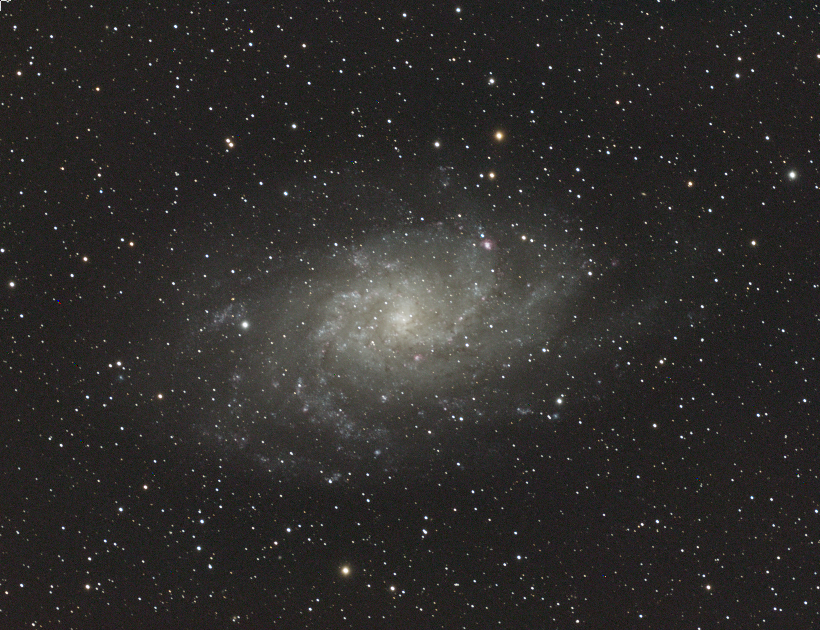
This image of M33 in Triangulum (lower quality here as a jpeg) has two hours of Luminance and 90 minutes each of RGB. The Luminance was 1x1 binned and the RGB was 2x2. The data was captured on the evenings of 21 and 25 November 2013 from my back yard (semi light polluted). I also should really have been using my IDAS Hutech Light pollution filter! All processing was in Pixinsight. The image needs more data to really let the spiral arms and the HII regions jump out. It could use some Ha as well. Nevertheless, it is coming along nicely I think. The two data sets are closely aligned and that will allow me to grab a whole lot more data. Next time it is clear I will grab a lot more luminance and Red data. Indeed, I might push the subs out to 15 minutes. What stops me doing that normally is that Nottingham is under the flight path for US West Coast flights from Heathrow that tend to plague my exposures! It hurts throwing away otherwise perfect 15 minute subs! However, I have recently discovered that Pixinsight's Windsorised Sigma clipping routines are extremely effective at removing plane and satellite trails, especially if I use dithering during capture.
The important thing to note is the stars are nice and round in the corners so the scope is performing very well! You can see this image at higher resolution here.
Next up is the Double Cluster in Perseus. This data was captured on 4th December 2013, again from my back yard. This time though I used the IDAS LP filter and this has reduced light pollution light splatter very effectively.

Star field pictures show errors in an optical system all too readily and I am very pleased the FSQ came through this test very well, despite very mediocre seeing on the night. Here are 30 minutes per RGB channel at 5 minutes exposures, binned 1x1. Higher resolution of this image is here. There is no luminance here at all. Also, no flats here since I mistakenly captured the flats at 2x2 binning as I normally bin 2x2 on RGB! Doh... Oh well, it still came out quite well with Pixinsight's DBE tool to remove the vignetting.
So, to sum up, I am very pleased with the scope so far. It is optically wonderful. It looks the part and I have great pride in owning it. The build quality is superb. The focuser is good and robust but has slight slippage that has taken the edge off a tiny, weeny bit.
Would I buy again? Absolutely! This is scope for life and look forward to doing some great things with it. I might even buy a FSQ-106 to go with it as well ;)
Next blog entries will be how I connect all the bits together to connect to my Atik EFW2 at both native and reduced. Another blog entry will be about how I mounted the scope to my NEQ6 and guide-scope.