
M52 with FSQ85 and G2-8300 Camera
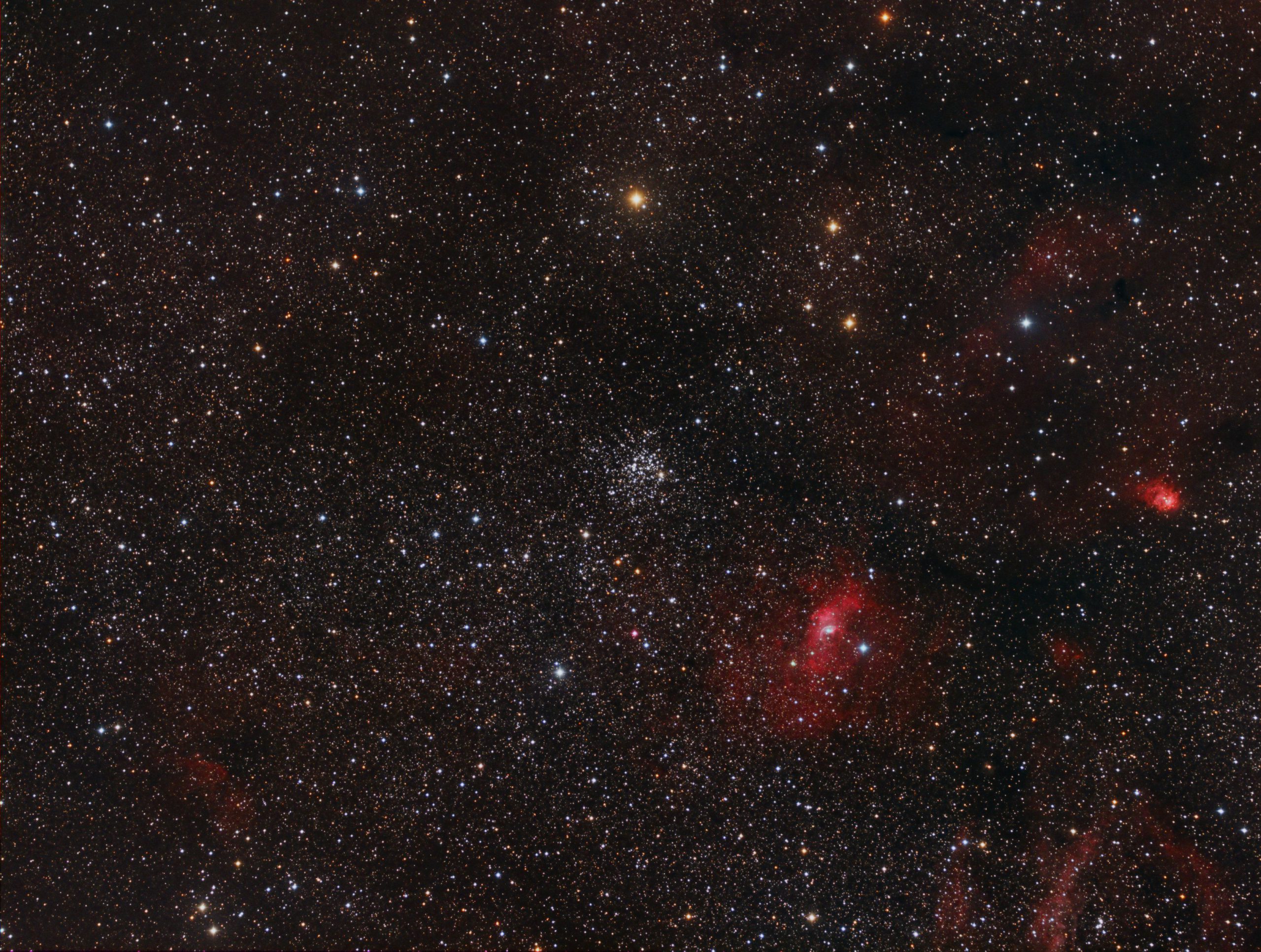
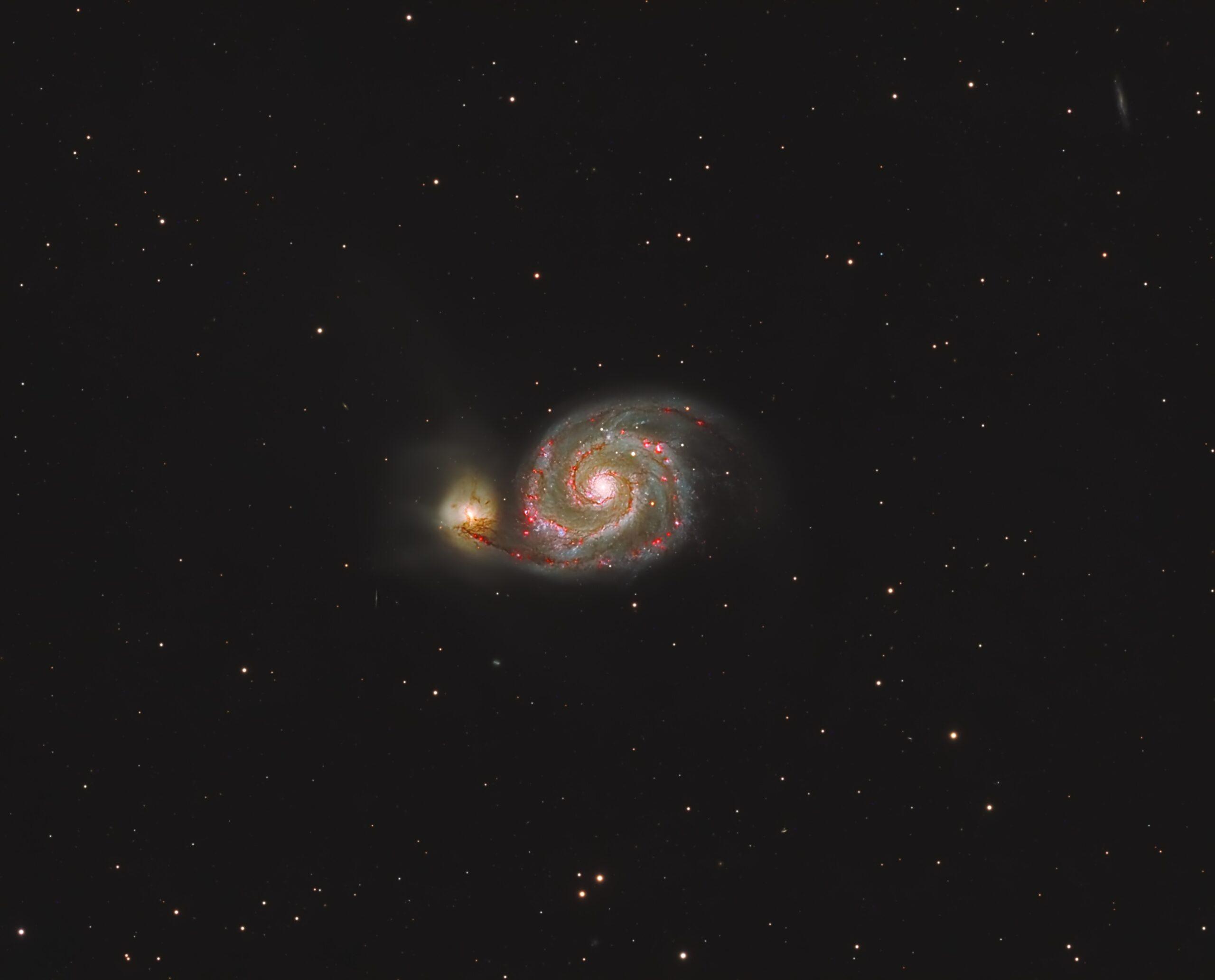
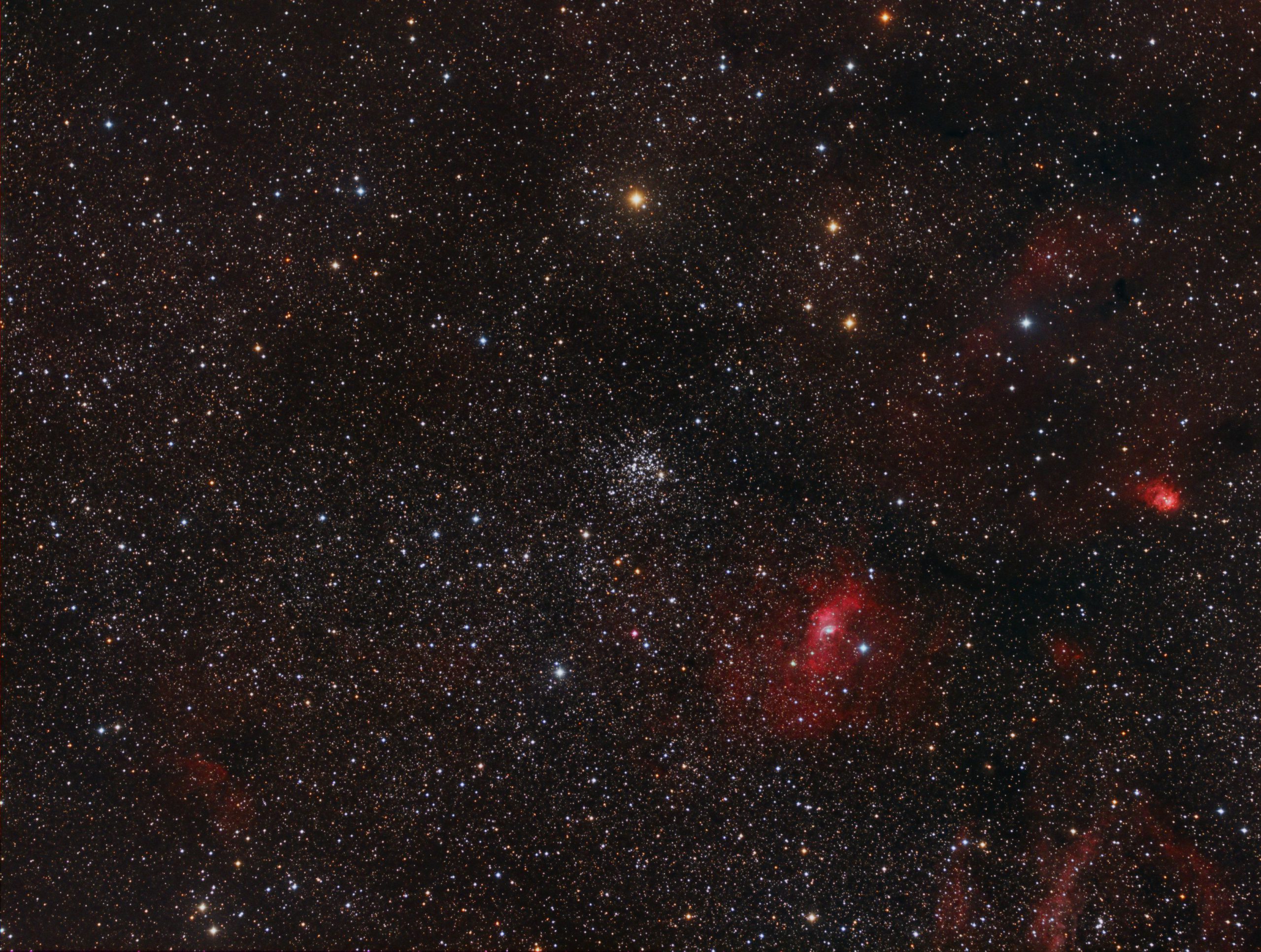
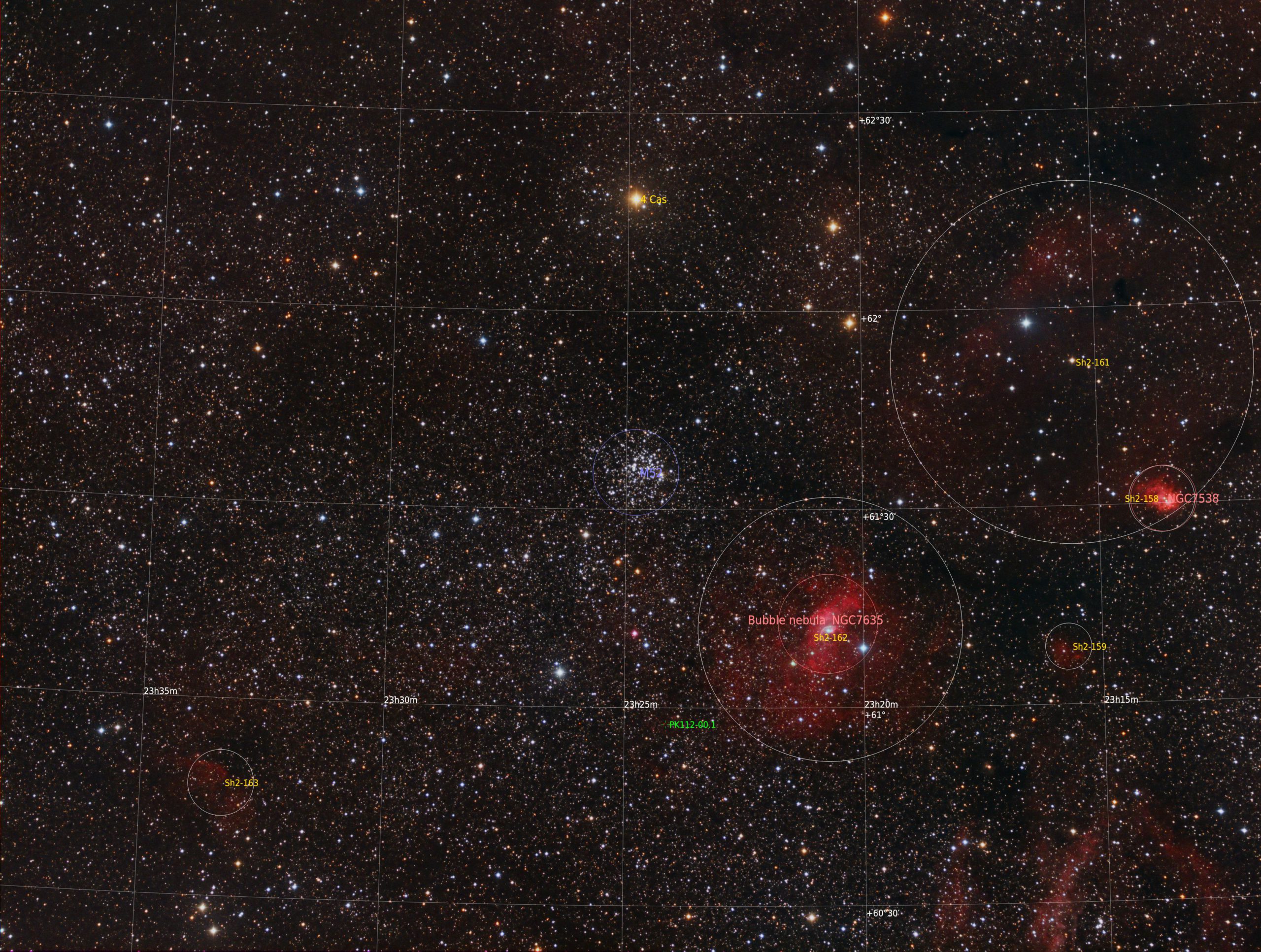
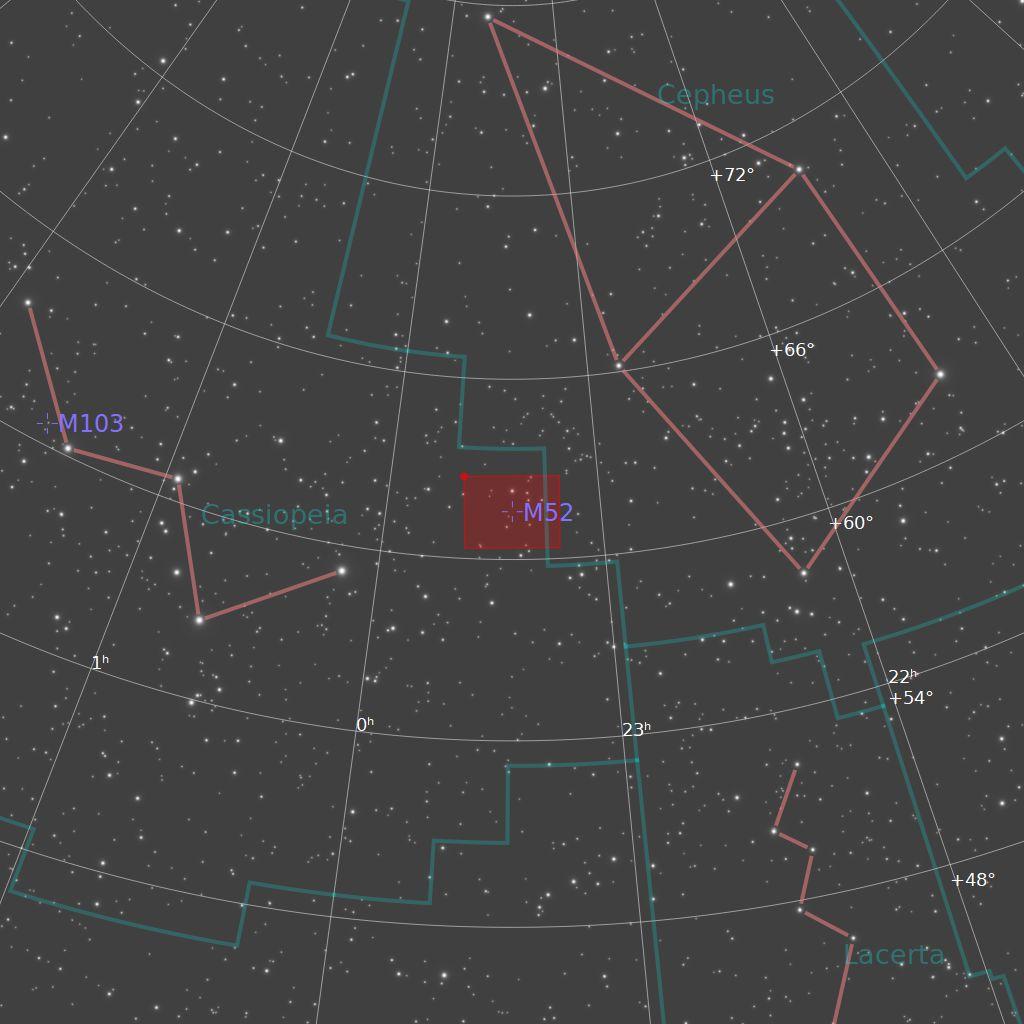
M52 is a fabulous open star cluster in Cassiopeia. It is set against a huge amount of nebulosity that spans across the constellations of Cassiopeia and Cepheus. In this image The Bubble Nebula can be seen at the four o'clock position with respect to M52 and many other objects in the Sharpless Catalogue of nebulae are also visible. These are detailed in the annotated version of the image below. The square red box on the finder chart on the right represents the image.
Full resolution image here (opens in a new tab).
Technical Information
Imaged from my backyard in Nottingham, UK on 28 November 2021 with a FSQ85 refractor and a Moravian G2-8300 cooled CCD camera with Astrodon HaRGB filters on my MESU200 mount guided with OAG.
All image data is binned 1×1: Note I do not capture a separate luminance when I bin all of the data channels is 1x1 in order to save some precious (In the UK) clear sky time. I do know purist swill say that it is best still to capture a luminance because that captures all of the light frequencies at the 1x1 level. I agree.
Ha> 9 x 300s ; Red > 9 x 300s ; Green 9 x 300s ; Blue > 9 x 300s
Image capture is with NINA and processing in PixInsight.
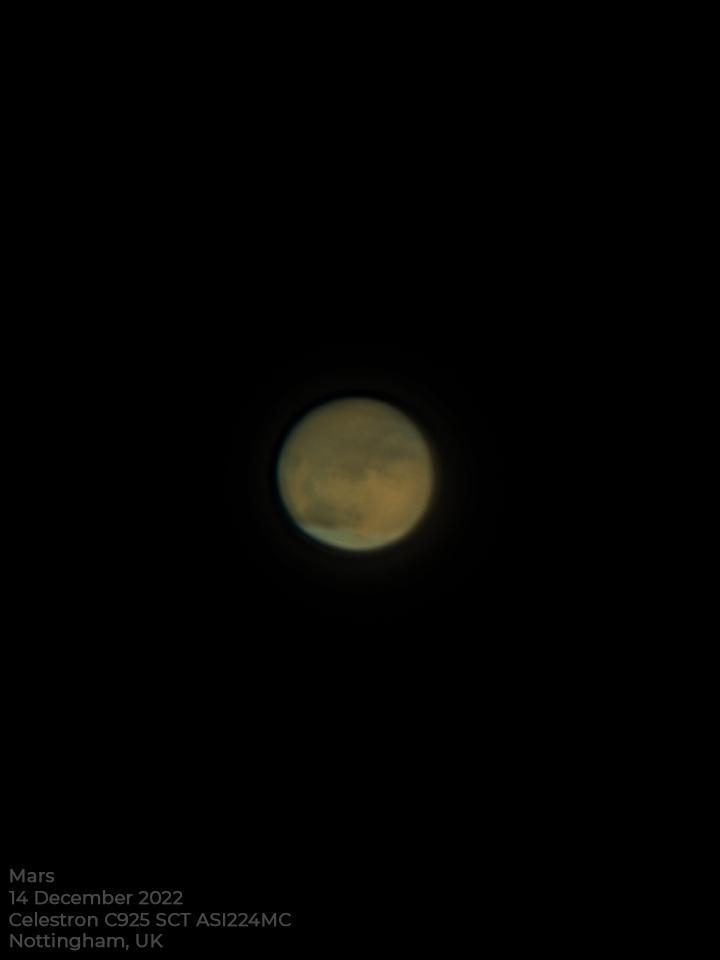
Mars 14 Dec 2022, C925 and ASI224MC
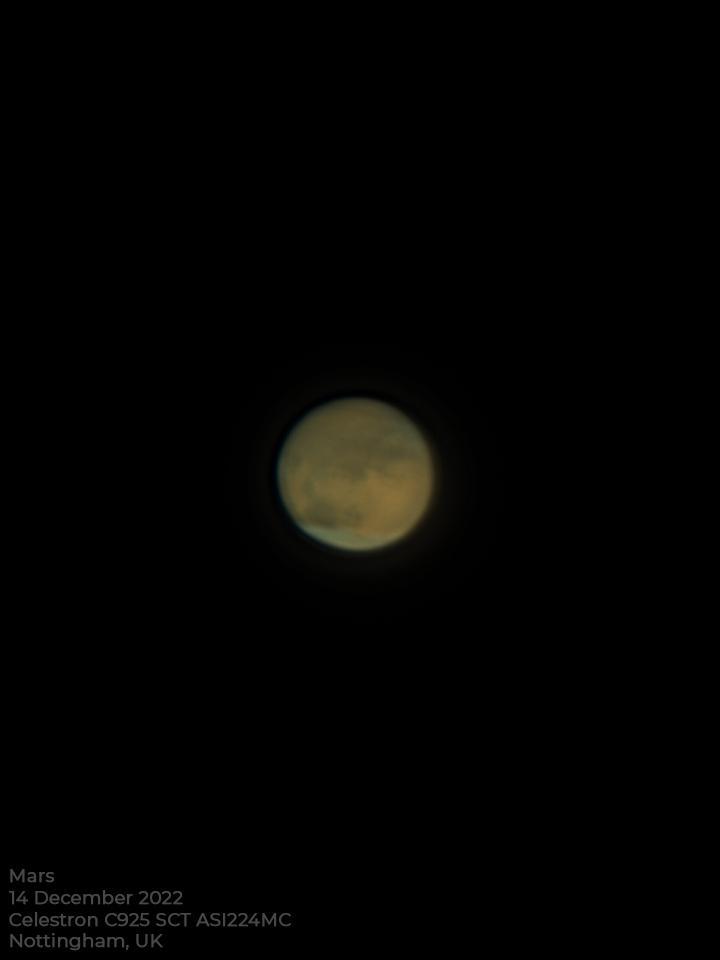
The planet Mars captured with my Celestron C925 SCT telescope and my ASI224MC colour camera. I used a Powermate x2 barlow lens to give a higher image scale together with an Atmospheric Dispersion Corrector (ADC).
A total of 12000 frames were captured using Firecapture to a SSD drive on my capture PC. I used Autostakkert to process the best 20% and then PixInsight to bring out the details with 8 wavelet layers. A bit of unsharp mask afterwards to sharpen it up a bit.
Mars was to the East of the meridian and about 40 degrees in altitude.
From my backyard in Nottingham, UK.
I am quite new to using the ADC and what I did was use the colour alignment tool in Firecapture to "tune" the ADC to get the colours all as perfectly aligned as I could.
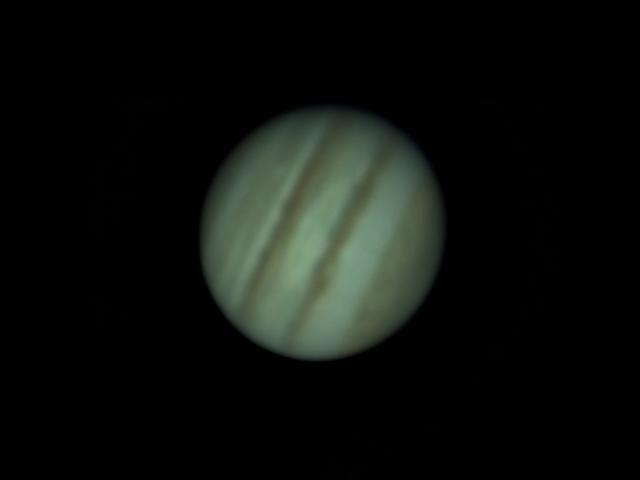
Jupiter, 7 December 2022
Jupiter, 7th December 2022 with C925 SCT and ASI 224MC camera

I am not experienced with imaging the planets other than the Moon. This image is not going to win any prizes or keep the award winning planetary imagers awake at night! However, it's a first effort at Jupiter and a foray in planetary imaging to give me some other astronomy options since almost always, when it is clear the moon is bright thus rendering deep sky observing and photography impossible
I used my Celestron C925 telescope with a x2 Powermate (a 2" version). I then used an ADC to try and improve colour correction and to this was connected my ASI224MC colour camera.
I tried my very best to "eyeball" the focus the best I could. This is very difficult to do as Jupiter was bouncing around considerably due to quite poor seeing. Jupiter was at about 30 degrees altitude almost at the meridian but was above a neighbour's house and this affected the seeing conditions (heat rising from the house and thus creating air currents that spoil the seeing). Collimation of my scope may not be ideal either and this is something I need to check into.
All this said, many of Jupiter's features are visible in this image - the Northern and Southern equatorial belts, the temperate belts as well as the polar regions. A few of the ovals in the cloud formations are also visible. At this time the Great Red Spot is not visible and is on the hemisphere facing away from the Earth.
Technical Stuff
5000 frames in colour from ASI 174MC camera with C925 telescope on MESU200 mount.
Captured with Firecapture and processed in Aurtostakkert where best 30% of frames used. PixInsight Multiscale Median Transformation used to sharpen up five layers. No other processing at all other than this.
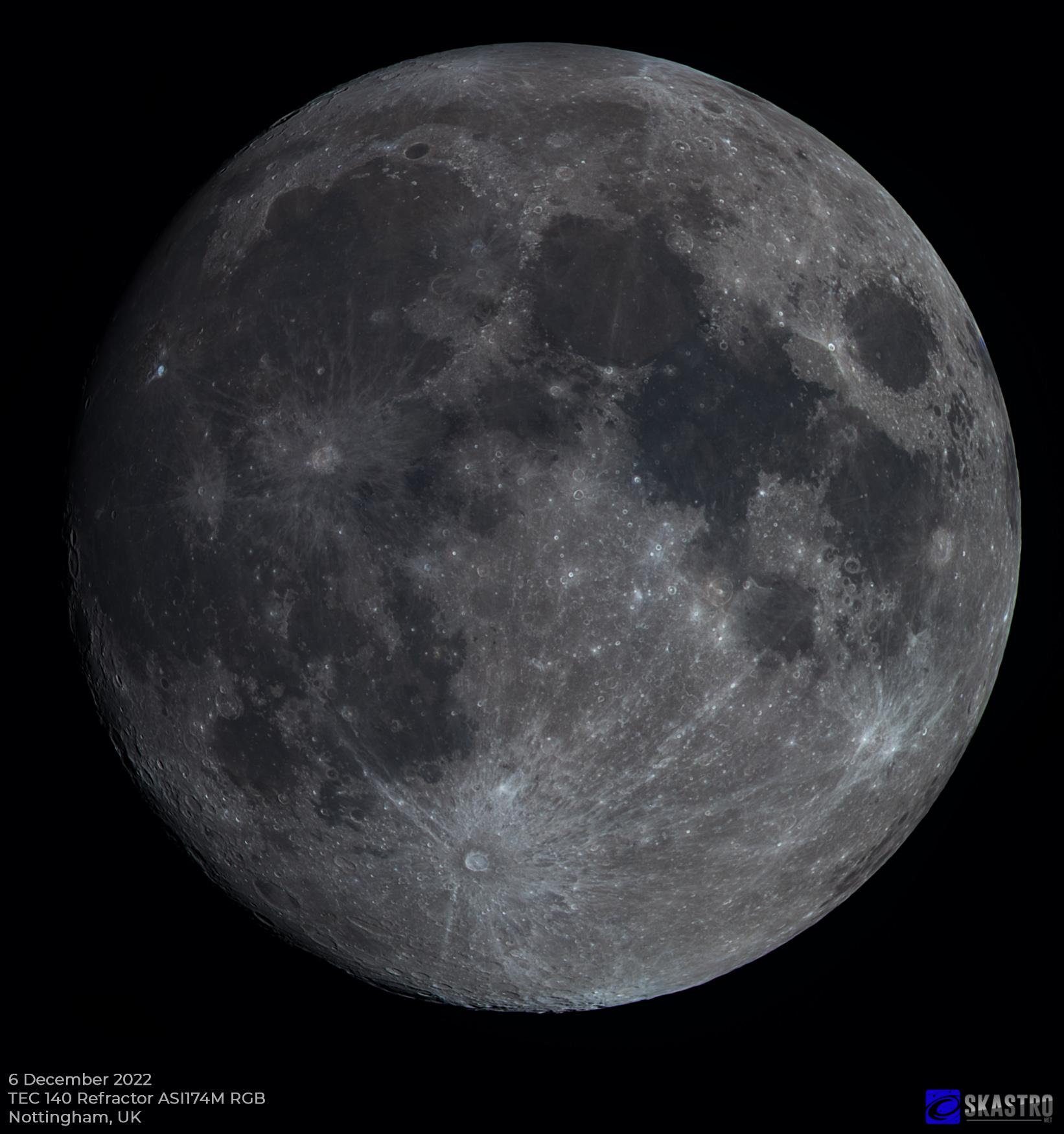
December Moon with TEC140 Refractor
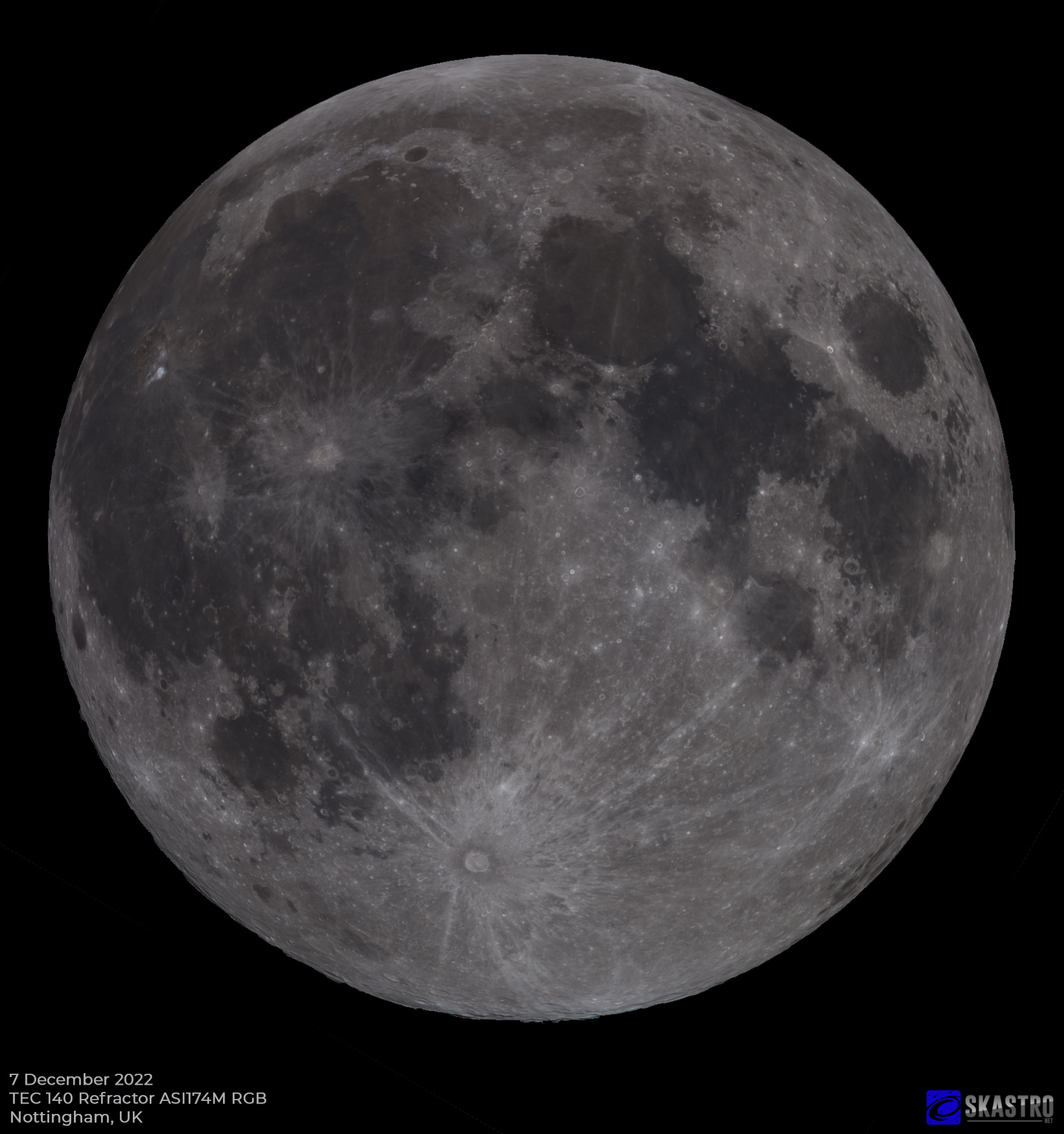
The Moon with my TEC140 December 2022.
Images taken on the 6th and the 7th. The 6th was not quite a full moon and the 7th was just a few hours past full. On the picture on the left you can see that the circle of the moon's disk is not quite full between the 6 and 11 O'clock positions.
Both images were taken with my TEC140 refractor and ASI174M camera through Baader RGB filters.
Each capture was of 5000 frames and the seeing was quite good so that I could utilise the best 50% of frames of each capture run. Because of the Field of View with the combination of the F8 focal length of the TEC140 and the chip size of the AIS174M, each capture run through each filter was comprised of a North and South run. I then stitched the two together in Photoshop.
Weather conditions were extremely cold at about -2C when the captures were taken on the early evenings of the 6th and 7th December. The Moon was very high in Taurus.
From my backyard in Nottingham, UK. My skies are at Bortle 5 in terms of light pollution.