
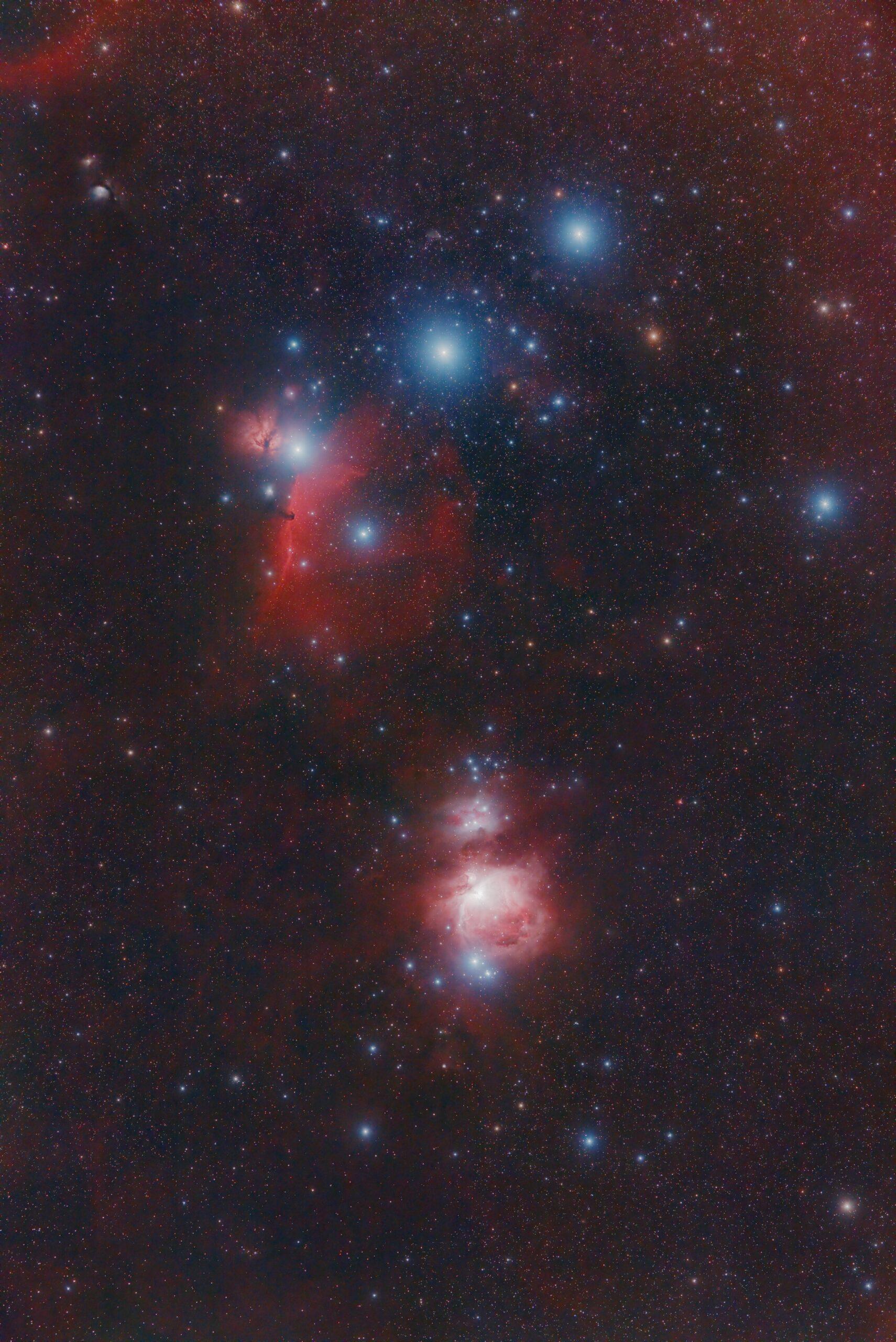
Southern Orion in a Wide Field View
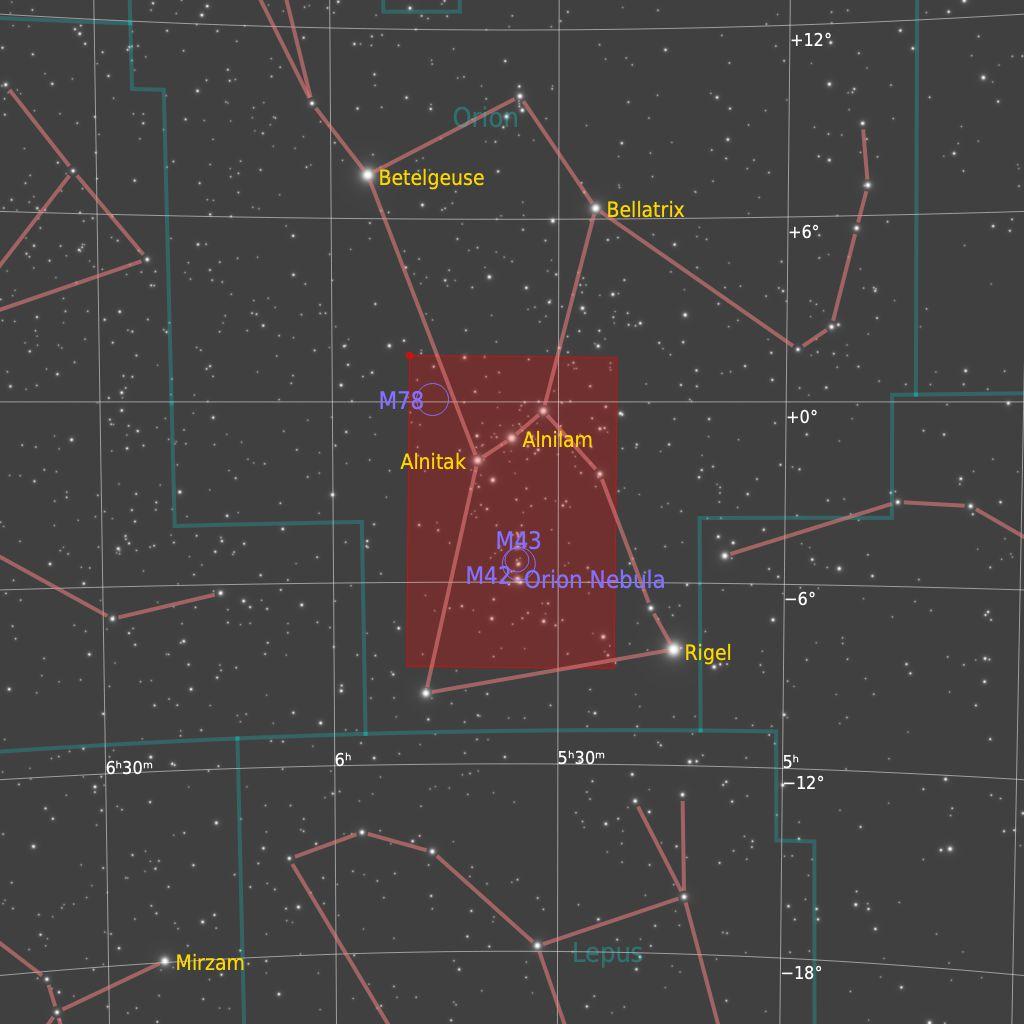
An image of Orion from January 2023 taken with a QHY268C cooled astronomy camera mated with a Samyang 135mm lens to give a very wide field view.
Full sized image here (opens in a new tab).
The image is composed of 56 x 120s exposures at F2.8. I used my wide field rig with autofocus to get the stars and nebulosity sharp and tight. I captured flats, darks and dark-flats. Mounted on NEQ6 with a guider scope and image data captured with NINA. All pre and post development is done in PixInsight.
Captured over two nights 20th and 23rd January 2023 when Orion was high to the south. From my back yard in Saxondale, Nottinghamshire - suburban, Bortle 4-5.
I have also captured the Constellation of Orion here.


Cassiopeia
Share on facebook
Facebook
Share on twitter
Twitter
Share on pinterest
Pinterest
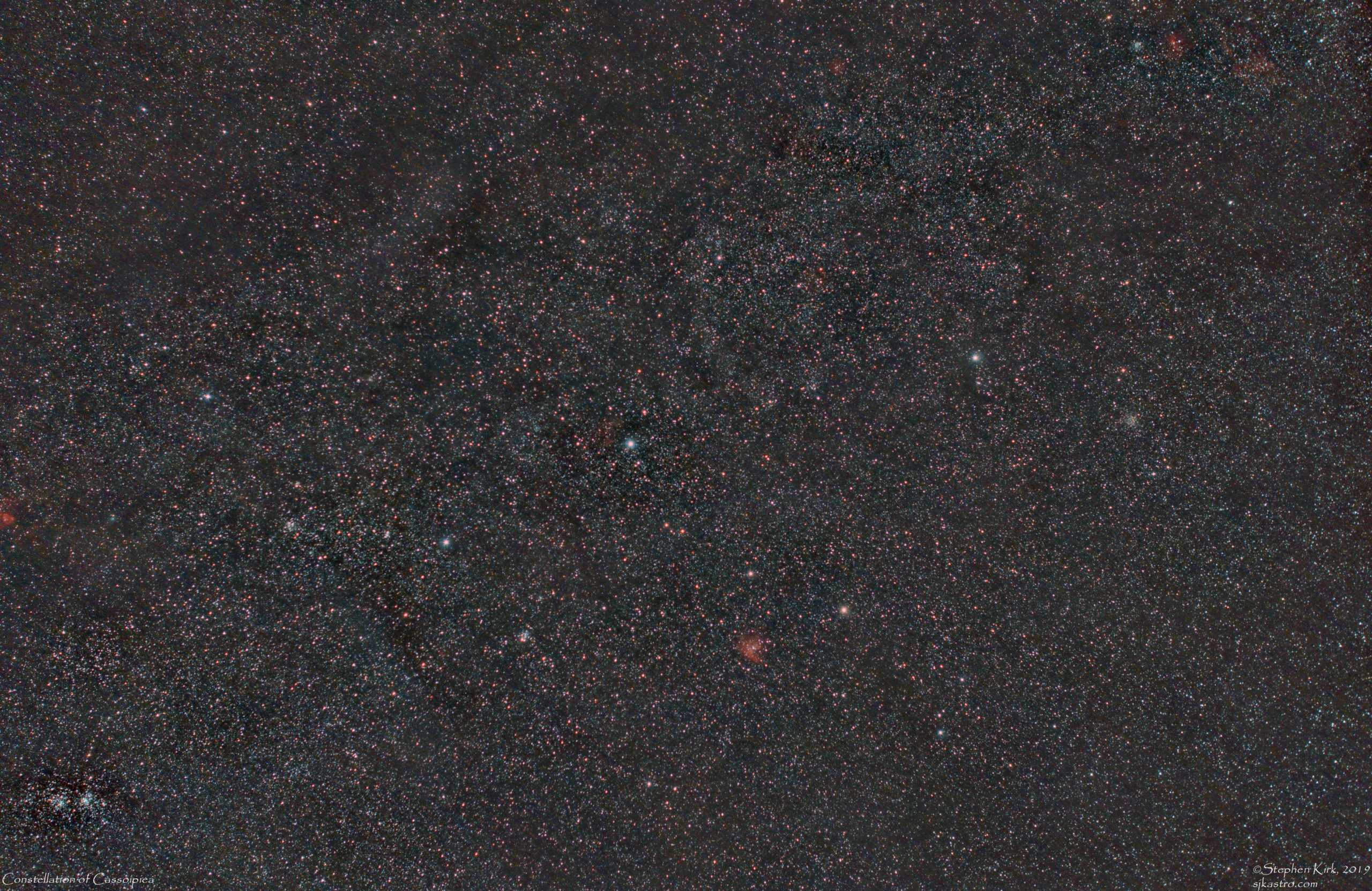
A far Northern constellation - circumpolar from my location in Nottingham - Cassiopeia lies in the middle of numerous star fields and nebulae fields, looking out from the core of the galaxy. The famous "W" shape is very recognisable and one of the first constellation that beginners to astronomy learn. It is rich in interesting nebulae, star clusters and other objects.

Image above was taken at the beginning of March 2020 when Cassiopeia was setting towards the North West. Conditions were not very good with the seeing and transparency being quite poor. Nevertheless, I managed to grab 45 x 60s exposures at ISO 800 and F4 with Canon 1100D and 50mm lens. Quite a quick and dirty picture and more exposure time would reveal much finer detail and nebulae details.Even in this image, you can see the huge number of objects withing the constellation, especially nebulae in the Sharpless Catalogue (Sh2).
Below is an annotated version of the above picture, showing some of the interesting objects and also an inverted view.


Auriga - The Charioteer
Auriga -
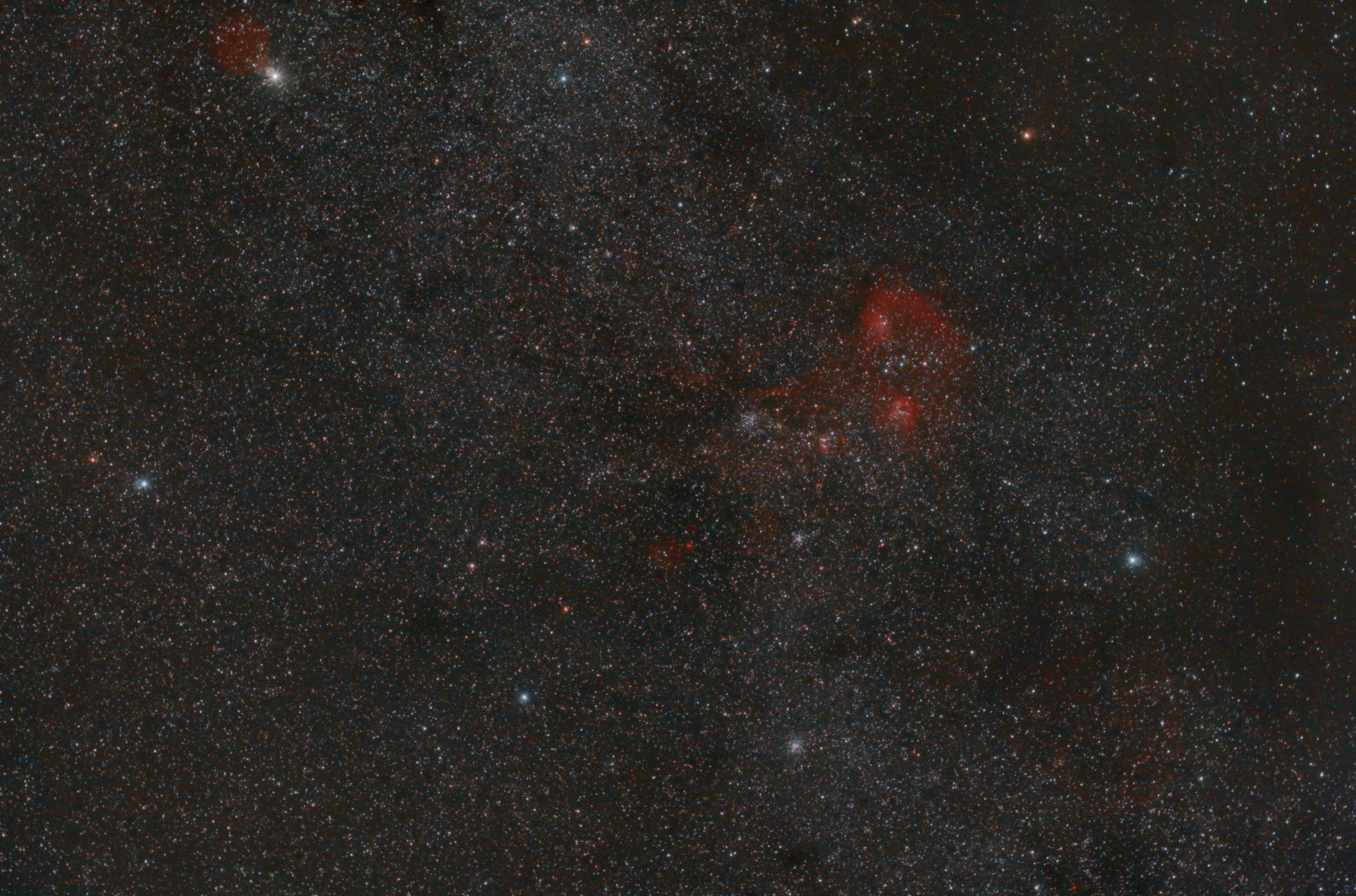
A famous constellation in the winter Northern Hemisphere sky, Auriga contains many very interesting objects and nebulae. Arguably the most important of these objects are the famous Open Clusters M36, M37 and M38, all of which I have imaged individually.
This image was taken in January 2020 from my backyard in Nottingham, UK on my modified (i.e. with the IR filter removed) Canon DSLR 1100D and a Canon 50mm lens. It is composed of 80 x 90s exposures at ISO 800 at F4, mounted on a Skywatcher Star Adventurer sky tracker mount. Astrophotography does not have to be expensive and you can achieve great things with a DSLR and a tracking mount!

Below, to the left, is an annotated version of the above picture and it shows many of the interesting objects present within the constellation of Auriga. You can see the many Sharpless catalog (Sh2) objects as well as the more famous Messier open clusters. To the right is a high contrast inverted view of the image.
I hope you like this page and found it useful.


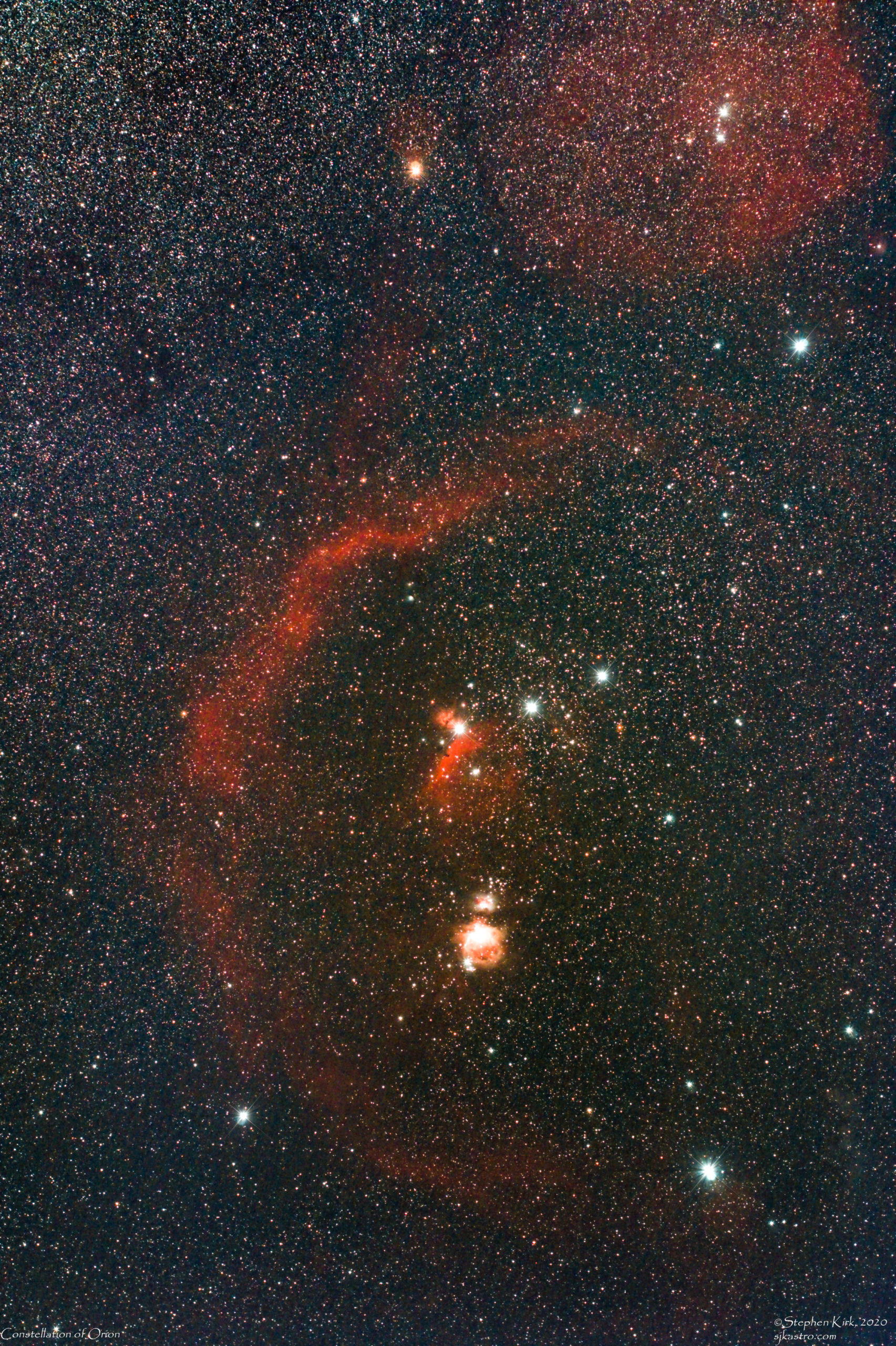
Orion
Orion
Dominating the Winter sky in the Northern Hemisphere, Orion is probably the most recognisable of constellations. It is full of very important and popular astronomy objects and stars.
The image here is a stack of 80 x 80 second exposures at F4 and ISO 800 taken in January 2020 from my backyard in Nottingham with a modified Canon 1100D and a 50mm lens. The camera followed the sky with a Star Adventurer tracker. It was cold and windy at the time I took the exposures. I stacked them with Deep Sky Stacker and processed with PixInsight and Photoshop.
You can see the arc of Barnard's Loop and The Orion Nebula and Horsehead Nebula. Also visible glowing faintly to the bottom right is the ghostly outline of the Witch Head Nebula.

Below is the annotated version showing many of the interesting stars and objects within Orion. Very obvious is the Great Orion Nebula and Barnard's loop.


