
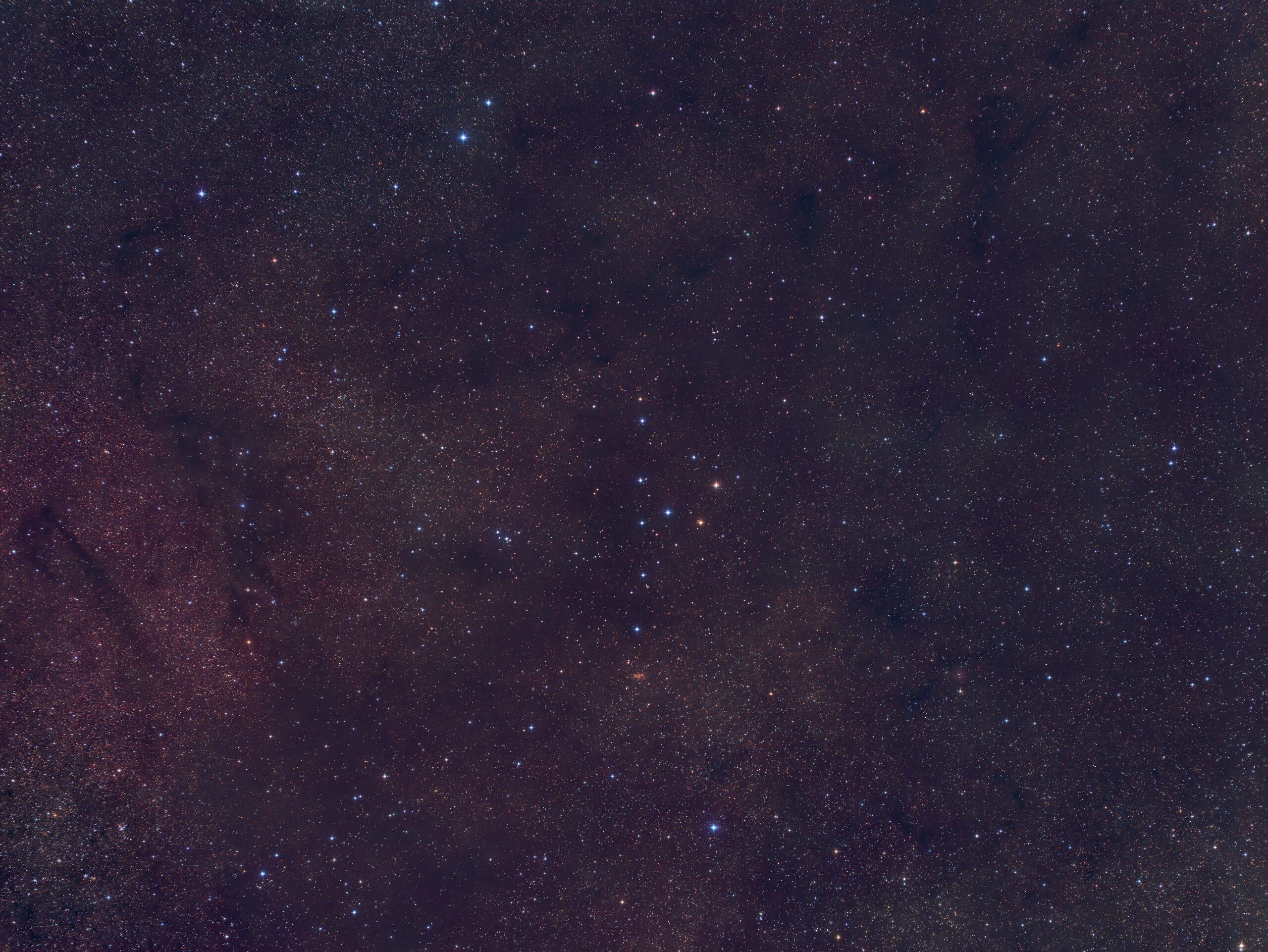
Collinder 399 "The Coathanger" Samyang 135mm
Collinder 399 or Brocchi's Cluster is offered nicknamed "The Coathanger" for its striking resemblance to that wardrobe item! If you look at the stars in the middle of the image and it looks very much like a coathanger on its side. It is located within the constellation of Vulpecula - The Fox - within a larger asterism called The Summer Triangle. The Coathanger is a chance, line-of-sight effect and the stars that form the appearance of the coathanger are not physically associated with each other at all and range from 350 to 2300 light years in distance.
The stars are backdropped against the vast clouds of glowing hydrogen that dominate the spiral arms of the Milky Way galaxy.
Image Technical Data
Uncompressed version of the image is here (opens in new tab).
Image captured in my backyard in Nottingham, UK on Sunday 20th September 2020. I used a Samyang (Rokinon) 135mm DSLR lens with a Moravian Instruments G2-8300 cooled CCD camera. This was mounted on my NEQ6 mount and guided with a Skywatcher Evoguider and ASI120MM guidecam. All exposures are binned 1x1.
Red > 12 x 300s; Green 10 x 300s; Blue 11 x 300s
All processing is done in PixInsight and image capture was with SGP.



Architecture Walks are Popular, Find One in Your City
Many years ago, I worked for my parents who own a video production company. Because it is a family business, you inevitably end up wearing many hats and being the czar of many different jobs. I mainly managed projects and worked as a video editor. On production, there were times that I was called on to work as an audio tech and was made to wear headphones on long production days. In those days, having a really good set of headphones that picked up every nuance of sound was essential to making sure the client got what they needed. Naturally, my first impression of these headphones is based off of the look of them. They have a classic over-the-ear style that is highlighted by a blue light that indicates the power for the noise canceling. The padding on the ear pieces seems adequate for extended usage periods.
They are wired headphones, but the stereo mini-plug cable is detachable. Something else I noticed right of the bat was the very nice carrying case that comes with them. It has a hard plastic exterior with a soft cloth interior that helps to protect the surface of the headphones from scratches. I never truly appreciated cases for headphones until I started carrying them from place-to-place. Now I can’t imagine not having a case. Once I gave the headphones a thorough once-over exam, I tried them on. As I mentioned, they have a classic over-the-ear style and just looking at them, the padding on the ear pieces seem adequate and the peak of the headband seemed to be a bit lacking, but you don’t really know comfort unless you try on the product. So, I slipped the headphones on and found them to be exquisitely comfortable.
If you look at what you have in life, you'll always have more. If you look at what you don't have in life, you'll never have enough.
Oprah Winfrey
Now that I had the headphones on my head, I was finally ready to plug and play some music. I plugged the provided cable into the jack on the headphones and then the one on my iPhone. Then I called up Pandora. I tend to have a very eclectic music purview and have many stations set up for different moods. the sound quality of these headphones was remarkable. There is an amazing depth of sound and incredible highs and lows that make listening to music a truly breathtaking experience. In order to test how voices sounded, and the overall art of mixing, I pulled up Netflix on my iPad Air and watched a few minutes of a movie to hear all the nuances of the film.
None of them were lost. In fact, I ended up hearing sounds that I hadn’t heard before. Echoes…birds chirping…wind blowing through trees…breathing of the characters…it was very impressive what the headphones ended up bringing out for me.

Best New Studio Headphones: the Ultimate Musician Guide
Just the other day I happened to wake up early. That is unusual for an engineering student. After a long time I could witness the sunrise. I could feel the sun rays falling on my body. Usual morning is followed by hustle to make it to college on time. This morning was just another morning yet seemed different.
Witnessing calm and quiet atmosphere, clear and fresh air seemed like a miracle to me. I wanted this time to last longer since I was not sure if I would be able to witness it again, knowing my habit of succumbing to schedule. There was this unusual serenity that comforted my mind. It dawned on me, how distant I had been from nature. Standing near the compound’s gate, feeling the moistness that the air carried, I thought about my life so far.
Your time is limited, so don't waste it living someone else's life. Don't be trapped by dogma – which is living with the results of other people's thinking.
Steve Jobs
I was good at academics, so decisions of my life had been pretty simple and straight. Being pretty confident I would make it to the best junior college of my town in the first round itself, never made me consider any other option. I loved psychology since childhood, but engineering was the safest option. Being born in a middle class family, thinking of risking your career to make it to medical field was not sane. I grew up hearing ‘Only doctor’s children can afford that field’ and finally ended up believing it. No one around me believed in taking risks. Everyone worshiped security. I grew up doing the same.
‘Being in the top will only grant you a good life’ has been the mantra of my life. But at times, I wish I was an average student. I wish decisions would have not been so straightforward. Maybe I would have played cricket- the only thing I feel passionate about. Or maybe I would have studied literature (literature drives me crazy). Isn’t that disappointing- me wishing to be bad at academics. It’s like at times I hate myself for the stuff I am good at.
When you step out of these four walls on a peaceful morning, you realize how much nature has to offer to you. Its boundless. Your thoughts, worries, deadlines won’t resonate here. Everything will flow away along with the wind. And you will realize every answer you had been looking for, was always known to you. It would mean a lot to me if you recommend this article and help me improve.
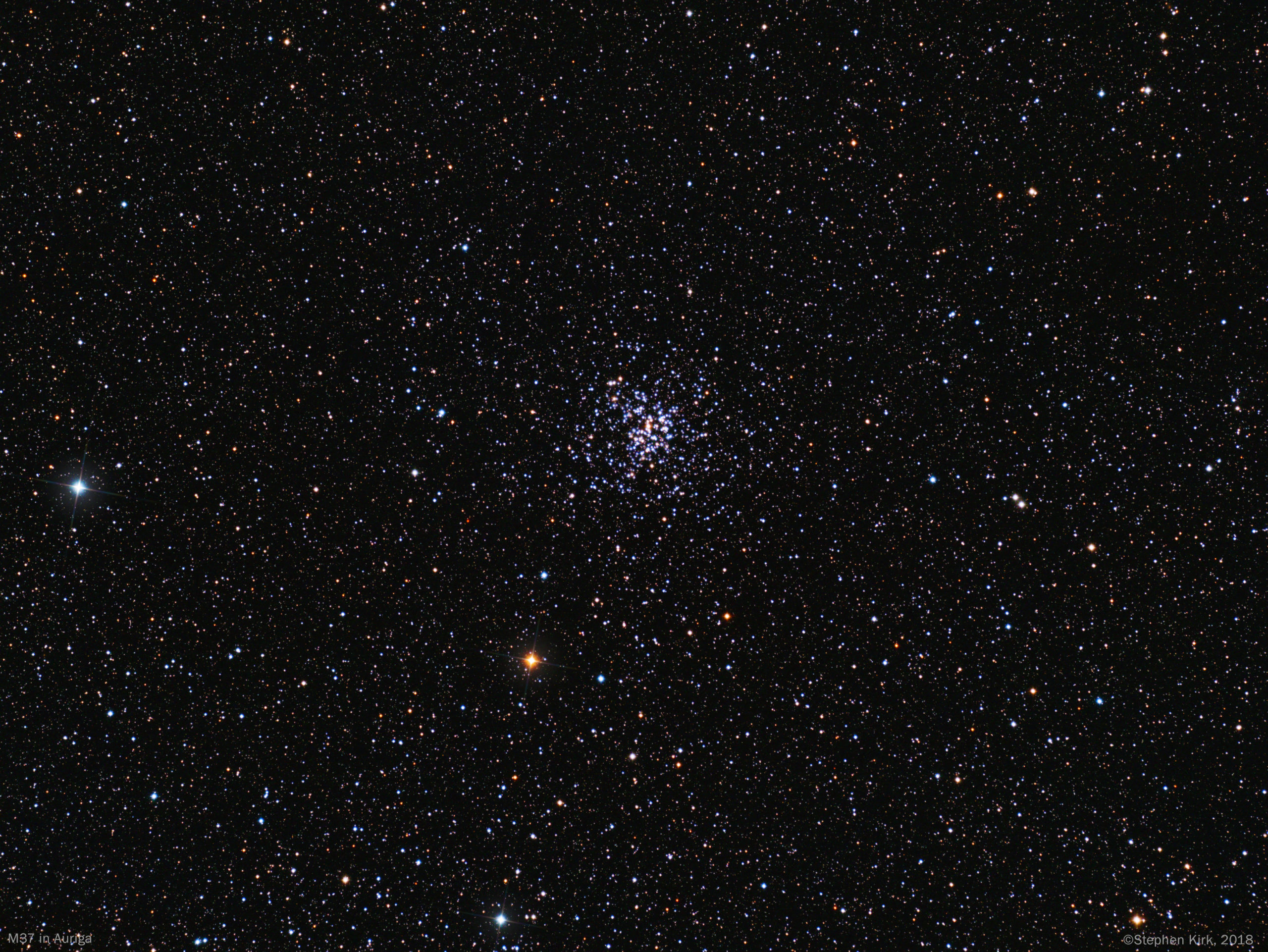
M37 - Open Cluster in Auriga with FSQ85
M37 is one of the three Messier Open Clusters in the Constellation of Auriga - the other two being M36 and M38. It is about 4500 light years away and contains several red giant stars, visible in this image, making it the richest of the three Auriga Messier Open Clusters. M37 appears high overhead from my 53 degree norther location during the winter months making it an ideal target for visual observations and imaging. It makes a fine site in a telescope and appears as a fuzzy ball in a pair of binoculars.

Image Technical Data
Imaged from my backyard in Nottingham, UK on the 9th February 2018. I used my Takahashi FSQ85 refractor and Moravian G2-8300 cooled CCD camera with Astrodon RGB filters. All expsoures are binned 1x1.
Red > 12 x 120s ; Green > 12 x 120s ; Blue > 12 x 120s


Kemble's Cascade with Samyang 135mm

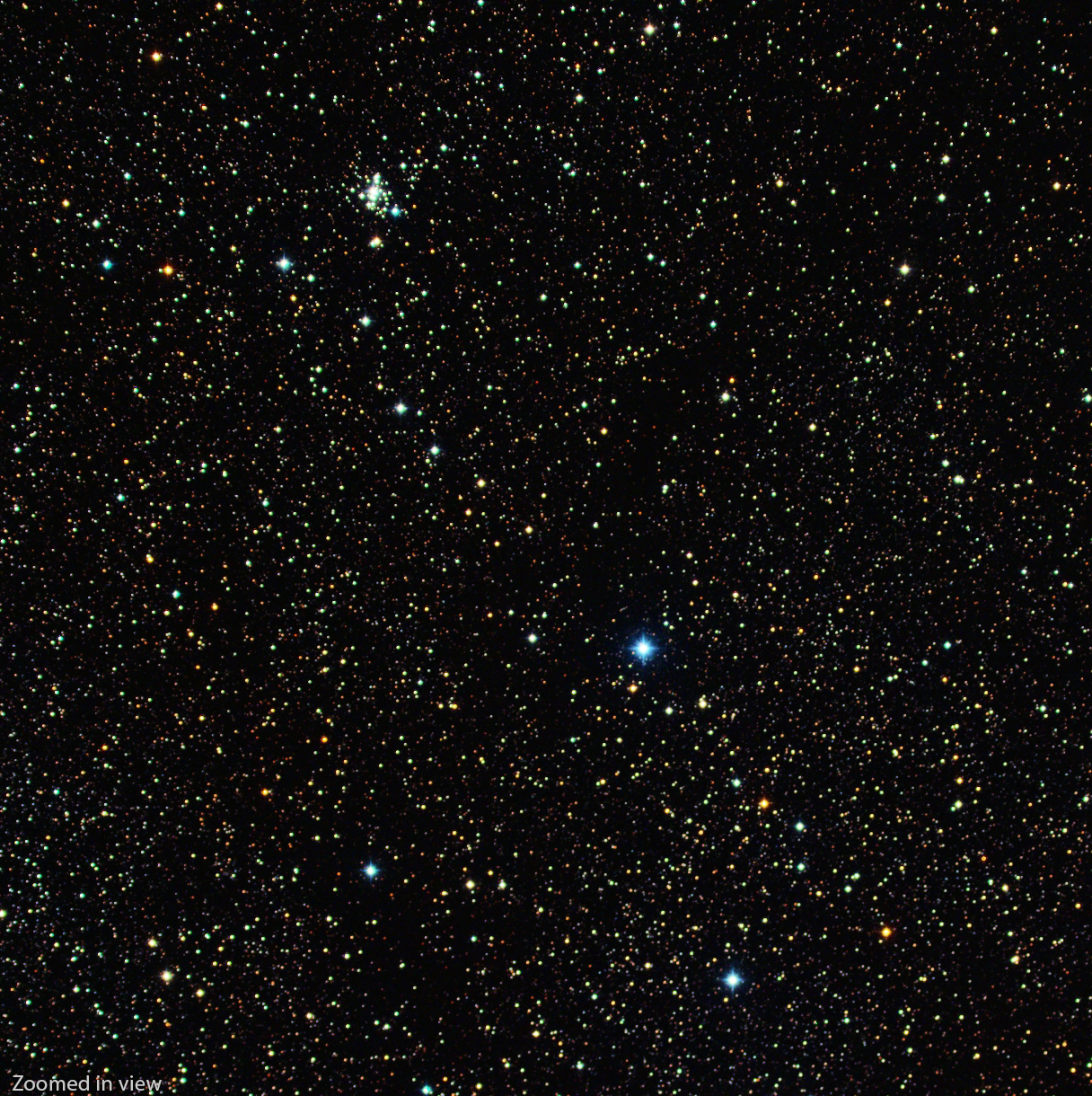
Kemble's Cascade (Kemble 1) is a chance straight-line alignment of 17 or so stars between the 5th and 10th magnitudes in the far northern constellation of Camelopardalis. The stars are of different colours and look lovely in a widefield telescope or binoculars. At the end of line of stars is the open star cluster NGC 1502. This asterism is named after the Franciscan monk and amateur astronomer Lucian Kemble. The cascade itself is about three angular degrees in length.
Image Technical Data
Imaged from my backyard in Nottingham, UK on 14 September 2020. Part of an automated capture sequence and the exposures were taken between 02:00 > 04:00 in the morning. Needless to say I was in bed asleep at the time :) I processed the images afterwards. I used Samyang 135mm DSLR lens connected to my Moravian Instruments G2-8300 CCD camera with Astrodon RGB Gen 2 E series filters on my NEQ6 mount. All exposures binned 1x1. No separate luminance (i.e. just RGB)
Red > 12 x 300s ; Green > 12 x 300s ; Blue > 10 x 300s
Total integration time is just short of three hours. Processed in PixInsight and Photoshop and captured with Sequence Generator Pro.
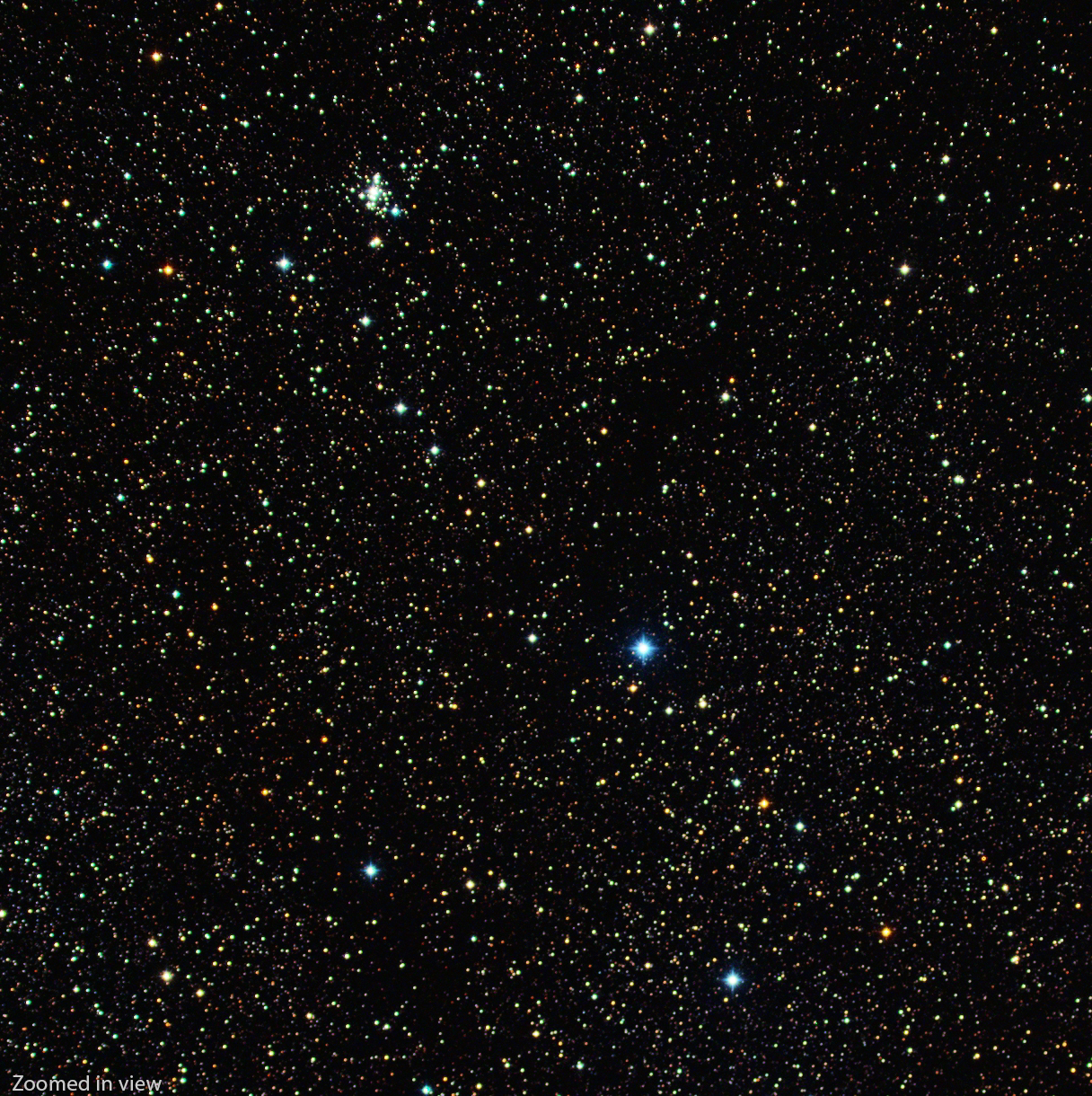
I just cut out the cascade stars from the image above. Personally, I prefer it in the wider setting in the topmost image


The inverted colour version above may make it easier to see the "cascade" of stars and make it easier for you to find them in the main image.
I hope you like it!
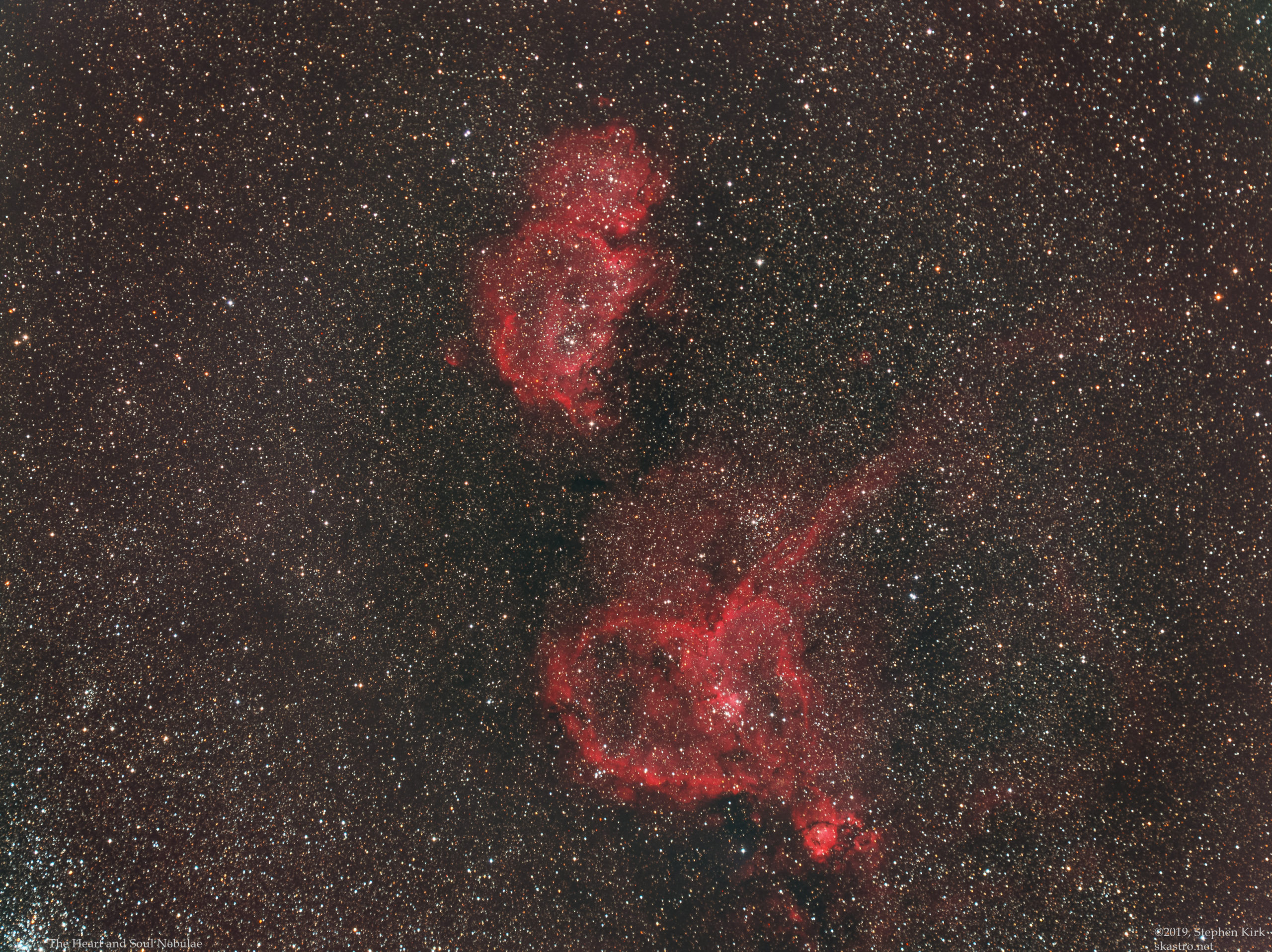
The Heart and Soul Nebulae Samyang 135mm
The Heart and Soul Nebulae are a well known and famous pairing of Nebulae in the late summer/autumn sky of the Northern Hemisphere. These nebulae are located far away - 7500 light years - in the Perseus arm of the galaxy, further out from the core of the galaxy than the Sun and are vast star forming regions rich in Hydrogen Alpha that gives the images the intense red glow.
All image data collected with a Samyang 135mm lens at F2.8 with a Moravian G2-8300 CCD camera. Below is the RGB image gathered with Astrodon RGB filters. All binned 1x1: Red 14 x 300s; Green 13 x 300s; Blue 14 x 300s. This gives an RGB integration time of 210 minutes or three and a half hours.
The picture looks nice but it does lack punch and vibrancy as it stands. It needs the addition of the Hydrogen Alpha data that will enhance the details.

Below is the Hydrogen Alpha channel that consists of 36 x 300s exposure with an Astrodon 3nm Ha filter with Samyang 135mm and G2-8300 CCD camera, collected with an Astrodon 31mm 3nm Ha filter. The amount of detail in this image is very evident. Below this is a starless version of the Ha image used to blend into the RGB image.


I finally created the blended HaRGB images by using layers of the Ha channel blended at different opacities as overlay and lighting layers in Photoshop. This gives the best of both worlds; the colour present in the RGB and the detail in the Ha image. The total integration time of the image is about six and a half hours.

Finally an annotated version of the image showing many Sharpless Catalog (Sh2) objects present.

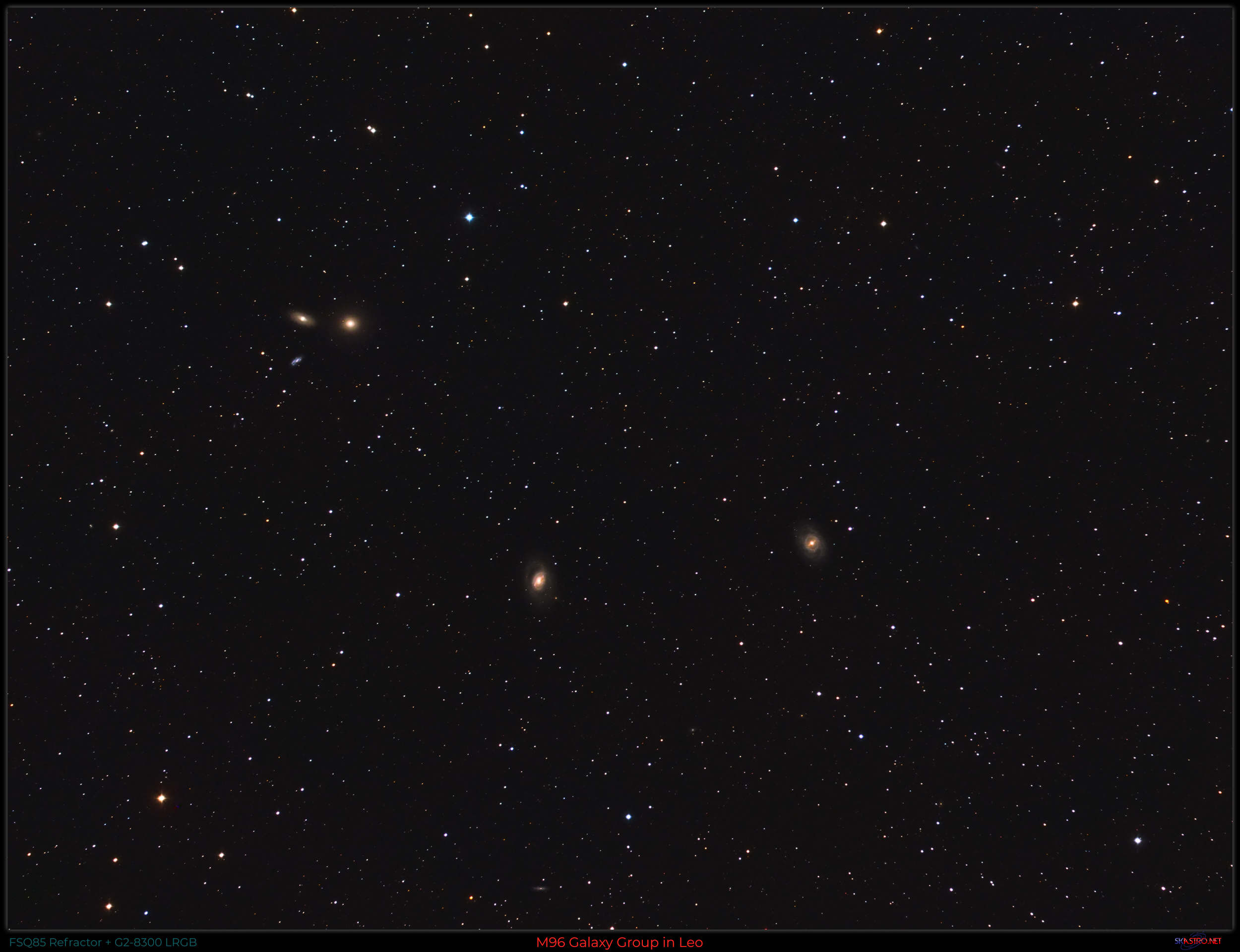
M96 Group in Leo - FSQ85
The M96 Group is a cluster of galaxies in the constellation of Leo. Not to be confused with the separate and arguably more famous Leo triplet. The M96 group contains three Messier galaxies (M95, M96 and M105) and many fainter galaxies in the background. The three main galaxies are about 35 million light years away and are easily visible in small telescopes.
Image Technical Data
Technical Information
Imaged from my backyard, March 2019, in Nottingham, UK. I used my FSQ85 refractor with 0.73 reducer and my Moravian instruments G2-8300 CCD camera and Astrodon LRGB filters. Mount is my MESU200 and guided with an Off-Axis guider. Image acquisition data:
Luminance 11 x 600s 1x1; Red 9 x 300s 2x2; Green 10 x 300s 2x2; Blue 10 x 300s 2x2

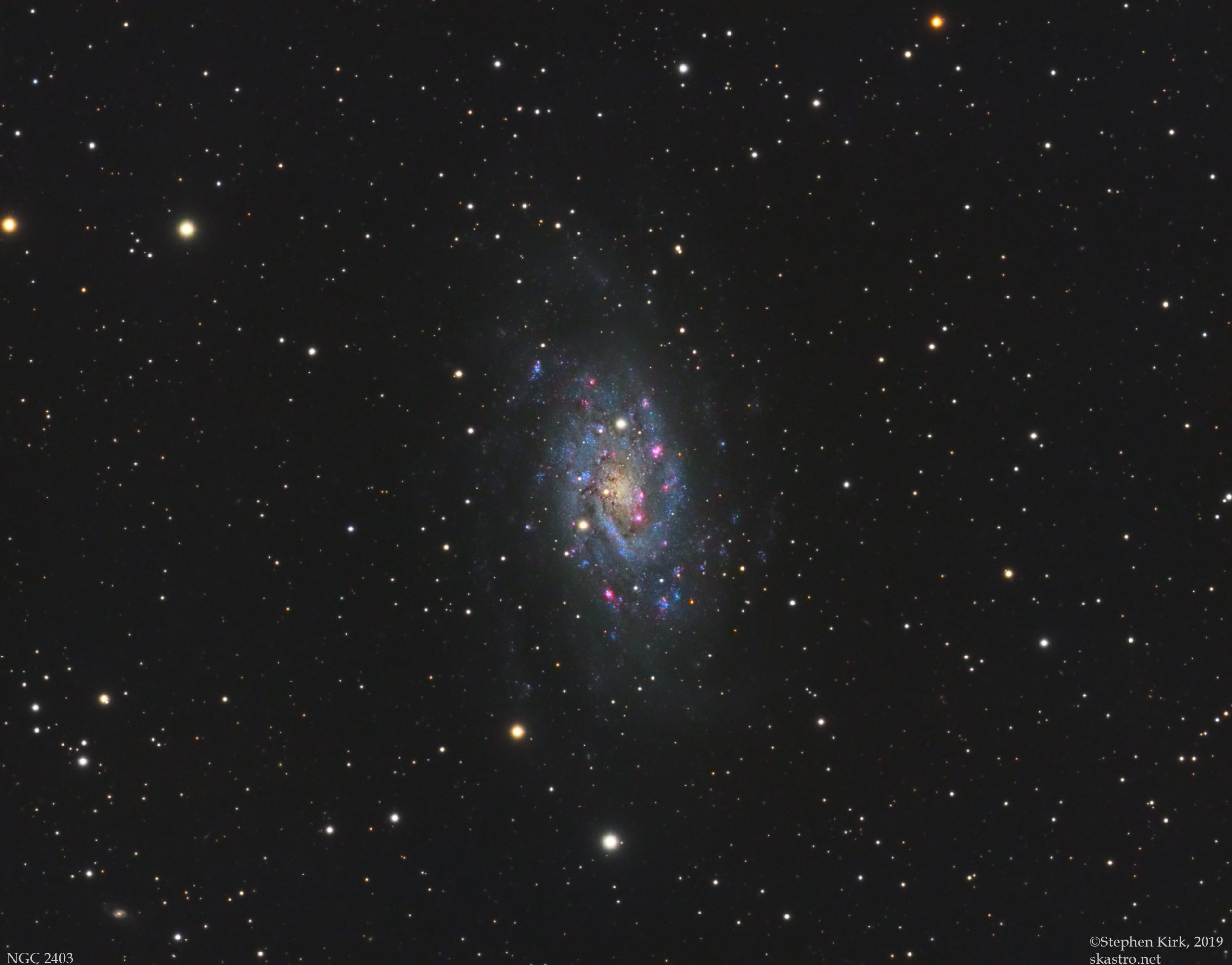
NGC 2403 - TEC140
NGC 2403 is a spiral galaxy located about eight million light years away in the constellation of Camelopardalis in the Northern hemisphere. It is an outlying member of the M81/M82 group. You will note that it bares a striking resemblance to M33 and contains huge HII star forming regions. NGC2403 is much smaller than our own galaxy, being only about 50000 light years in diameter as opposed to about 120000 light years for our own Milky Way galaxy. It is not known why a smaller galaxy like this should have such huge HII regions that dwarf those of our own, larger galaxy.

Image Technical Data
Imaged from my backyard, March 2019, in Nottingham, UK. I used my TEC 140 refractor with Atik 460 CCD camera and Astrodon LRGB filters. Image acquisition data, everything binned 1x1
Luminance 29 x 600s; Red 12 x 300s; Green 12 x 300s; Blue 12 x 300s


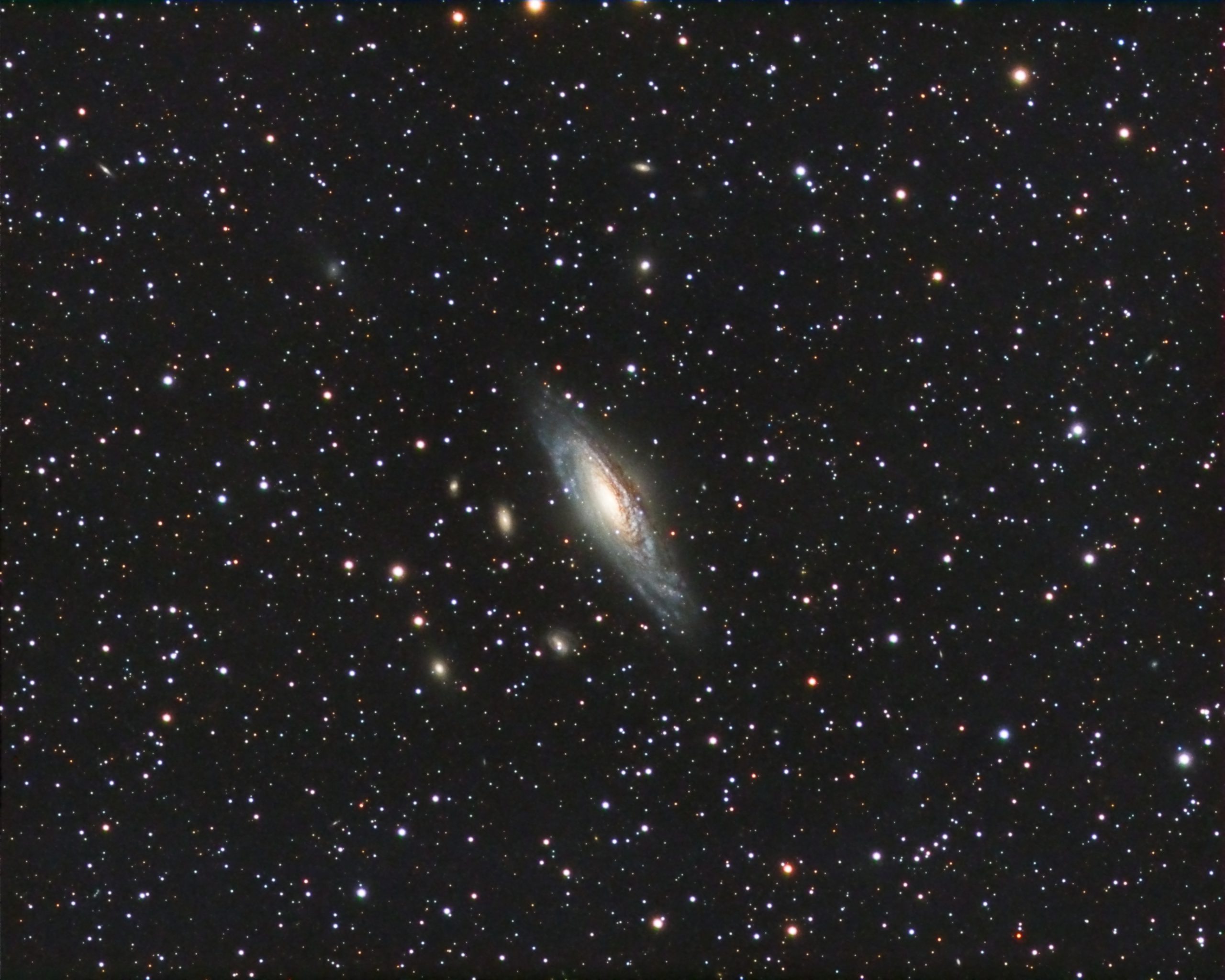
NGC 7331 TEC 140 Refractor - The Deer Lick Group
NGC 7331 (Caldwell 30) is a spiral galaxy about 46 million light years away in the constellation of Pegasus. It is a vibrant and colorful galaxy, often referred to as the Milky Way's "twin" due to it being of a similar size and mass to our own galaxy. It is visible in amateur telescopes as a faint smudge if the sky is dark.
In the images below, the smaller galaxies to the left of the main galaxy are a chance line-of-sight alignment. These four galaxies are much more distant than NGC 7331 (about 320 million light years) and are nothing to do with the main galaxy. This collection of galaxies (NGC 7331 and the distant background galaxies are collectively referred to as the Deer Lick Group named after the Deer Lick gap in the mountains of North Carolina by astronomer Tomm Lorenzin who liked to observe from there.

Image Technical Data
Imaged over two nights on the 21st and 22nd September 2019 with my TEC 140 refractor from my backyard in Nottingham, UK. I used my Atik 460 CCD camera with Astrodon LRGB Generation 2 E-series 1.25" filters. I used my MESU 200 mount that was guided via OAG.
Luminance 24 x 600s 1×1; Red 12 x 300s 2×2; Green 12 x 300s 2×2; Blue 12 x 300s 2×2
Total Integration of the data set is seven hours. It would benefit from the addition of more data but I am quite content with it now as it is.
Image processing with PixInsight and data collected with Sequence Generator Pro.

In the second version I processed the data slightly differently with a bit more focus on the red spectrum of the galaxy in the absence of any Hydrogen Alpha data. However, I think this is slightly too much and I prefer the first image as more natural. However, I include it here as an interesting contrast in the different approaches that can be taken to astronomy image processing with the same data set with differing emphases that can be quite subjective.

