
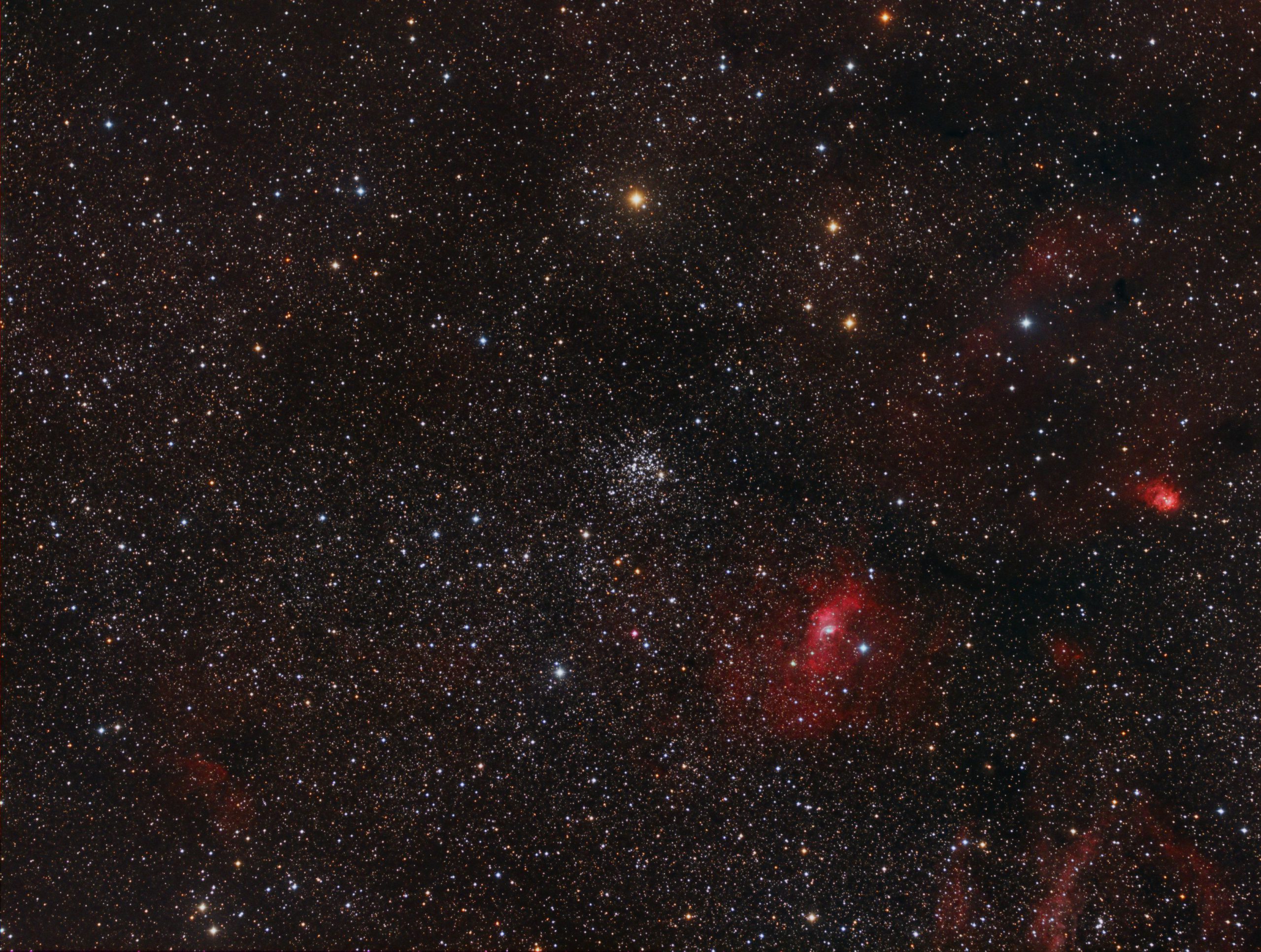
M52 with FSQ85 and G2-8300 Camera
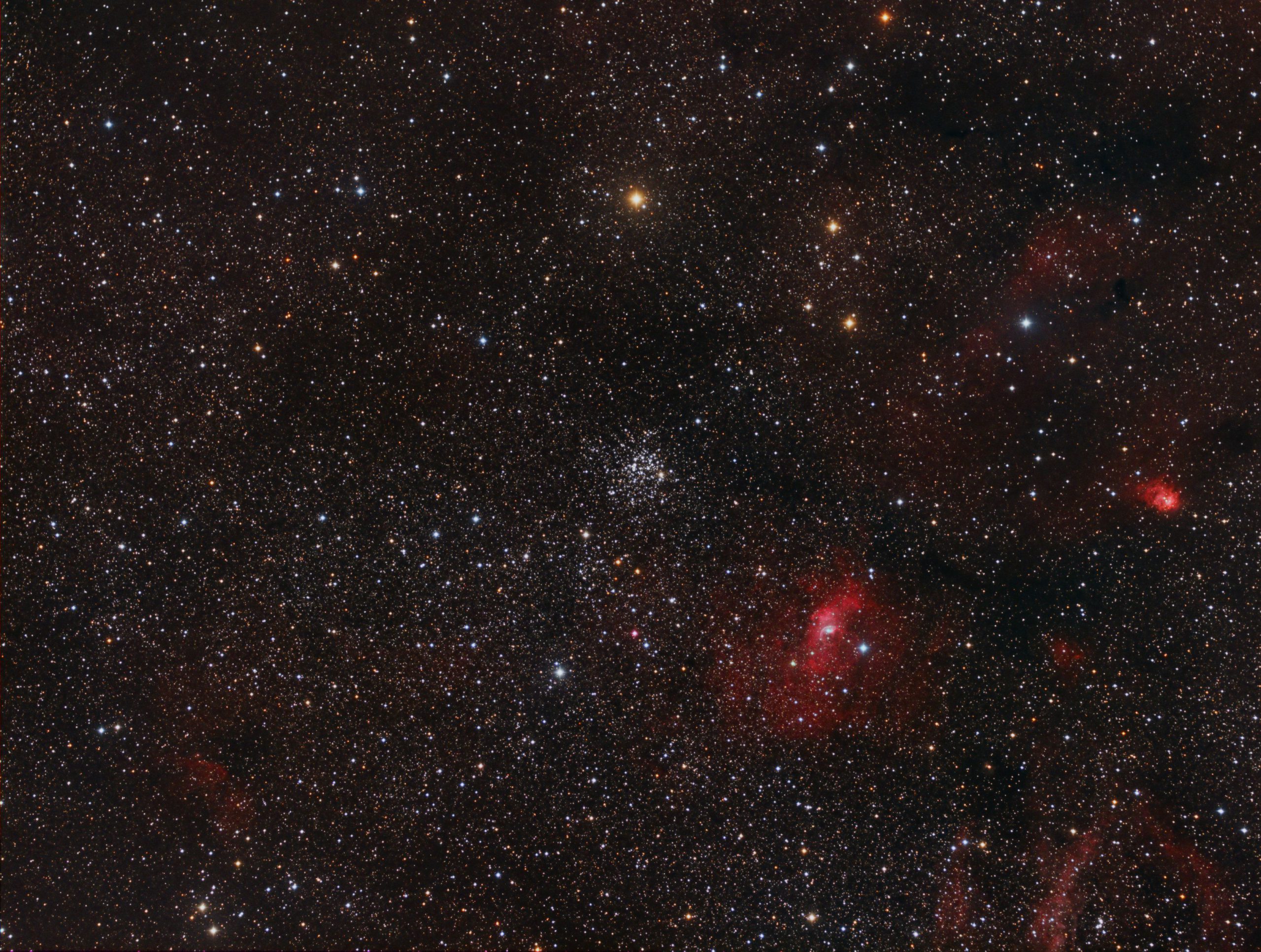
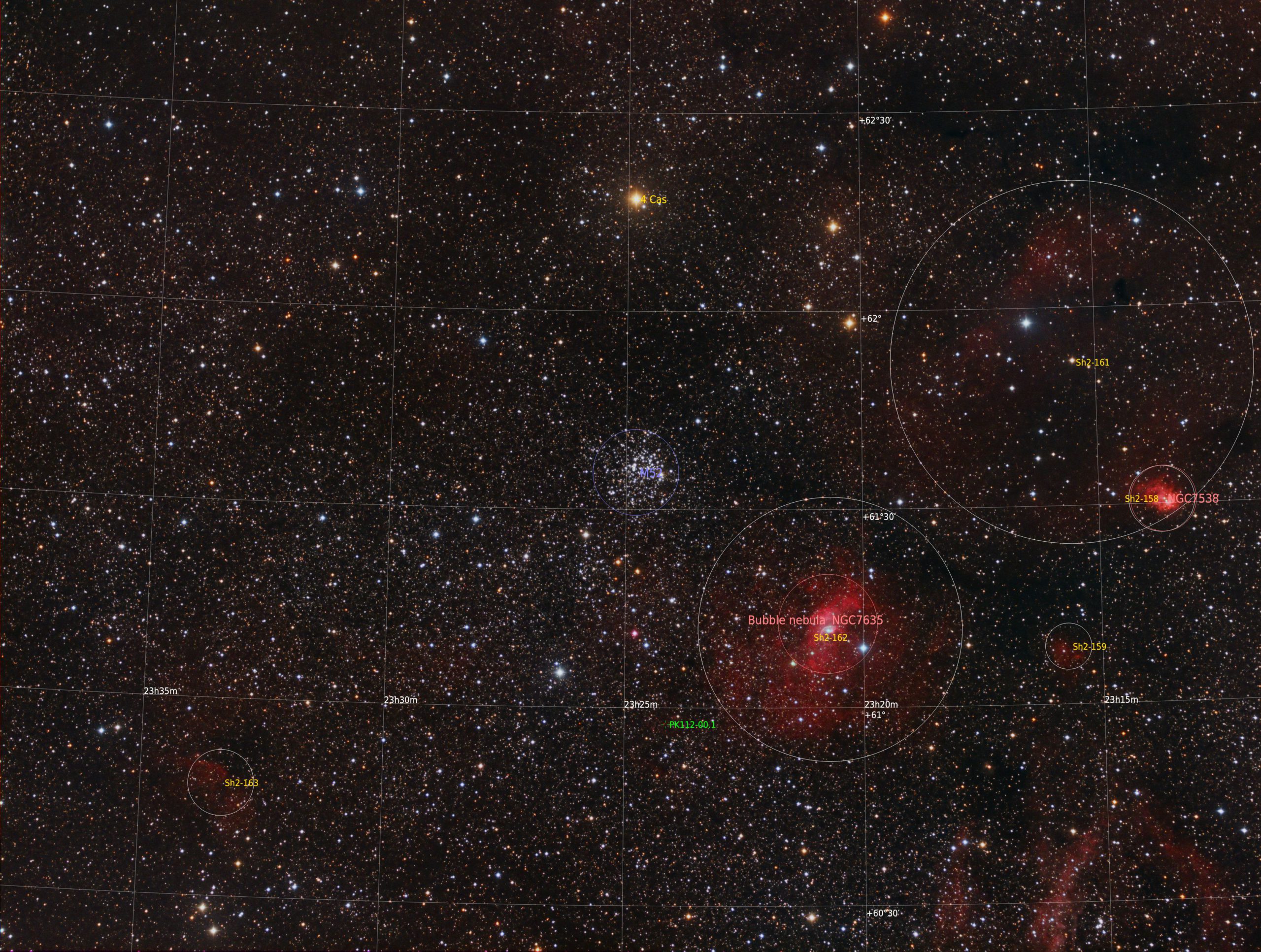
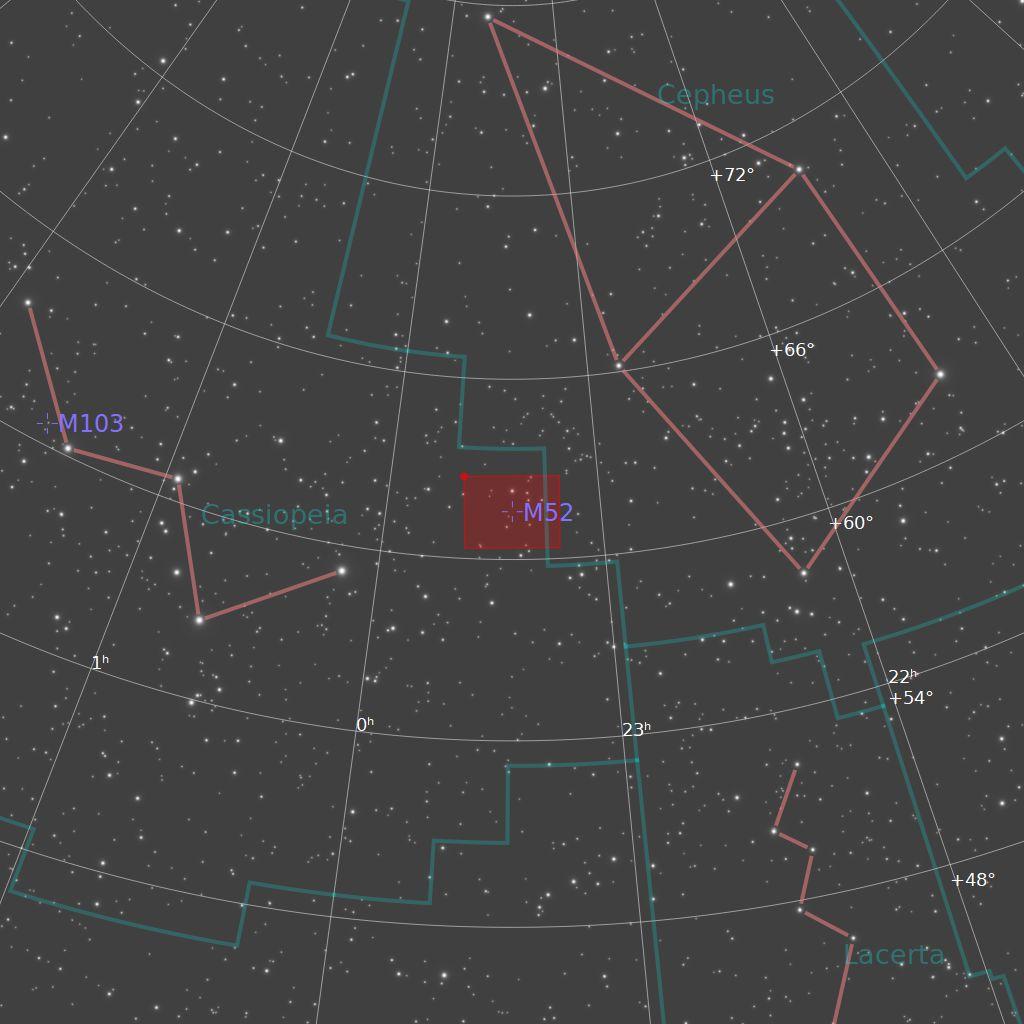
M52 is a fabulous open star cluster in Cassiopeia. It is set against a huge amount of nebulosity that spans across the constellations of Cassiopeia and Cepheus. In this image The Bubble Nebula can be seen at the four o'clock position with respect to M52 and many other objects in the Sharpless Catalogue of nebulae are also visible. These are detailed in the annotated version of the image below. The square red box on the finder chart on the right represents the image.
Full resolution image here (opens in a new tab).
Technical Information
Imaged from my backyard in Nottingham, UK on 28 November 2021 with a FSQ85 refractor and a Moravian G2-8300 cooled CCD camera with Astrodon HaRGB filters on my MESU200 mount guided with OAG.
All image data is binned 1×1: Note I do not capture a separate luminance when I bin all of the data channels is 1x1 in order to save some precious (In the UK) clear sky time. I do know purist swill say that it is best still to capture a luminance because that captures all of the light frequencies at the 1x1 level. I agree.
Ha> 9 x 300s ; Red > 9 x 300s ; Green 9 x 300s ; Blue > 9 x 300s
Image capture is with NINA and processing in PixInsight.

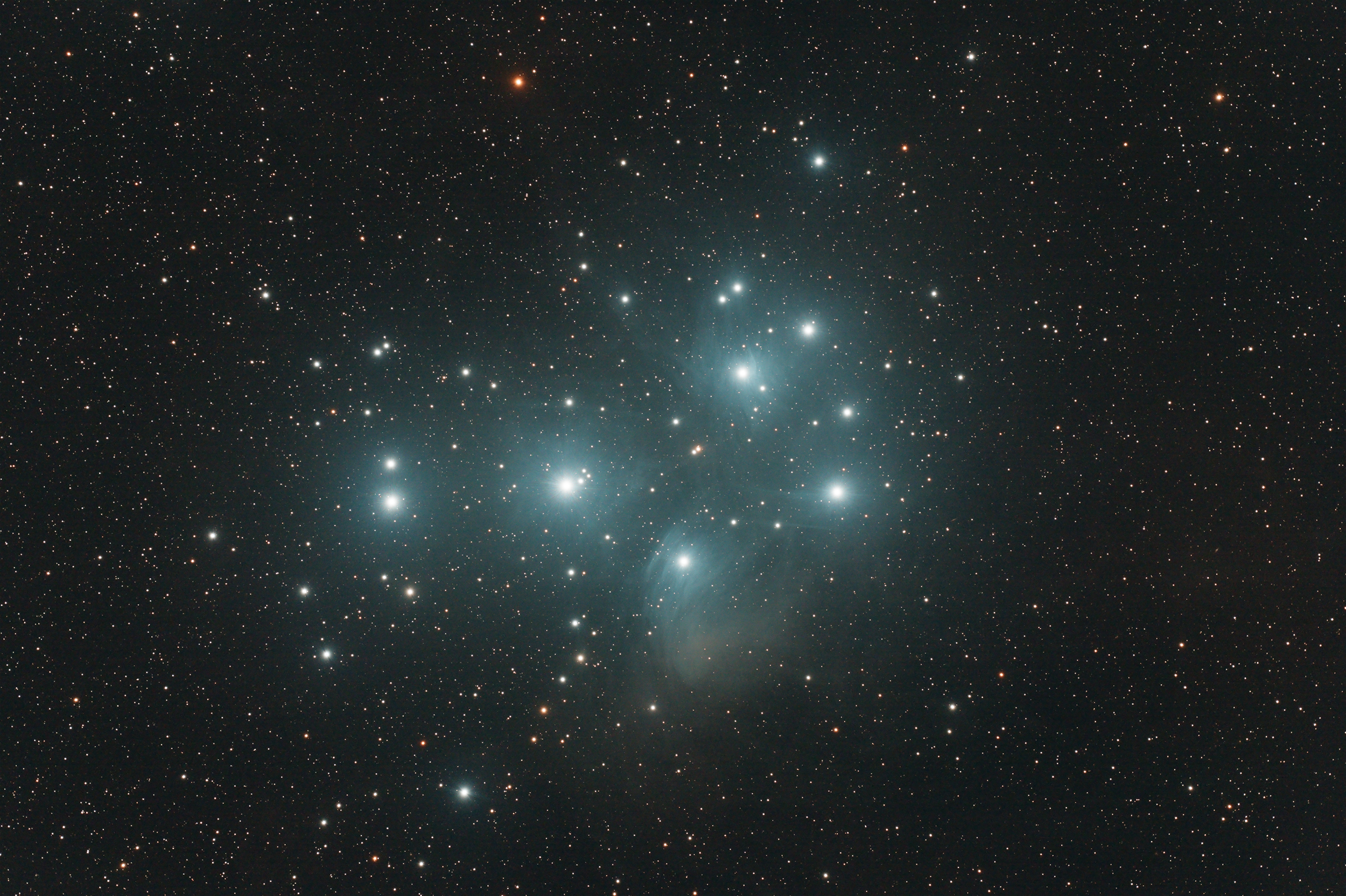
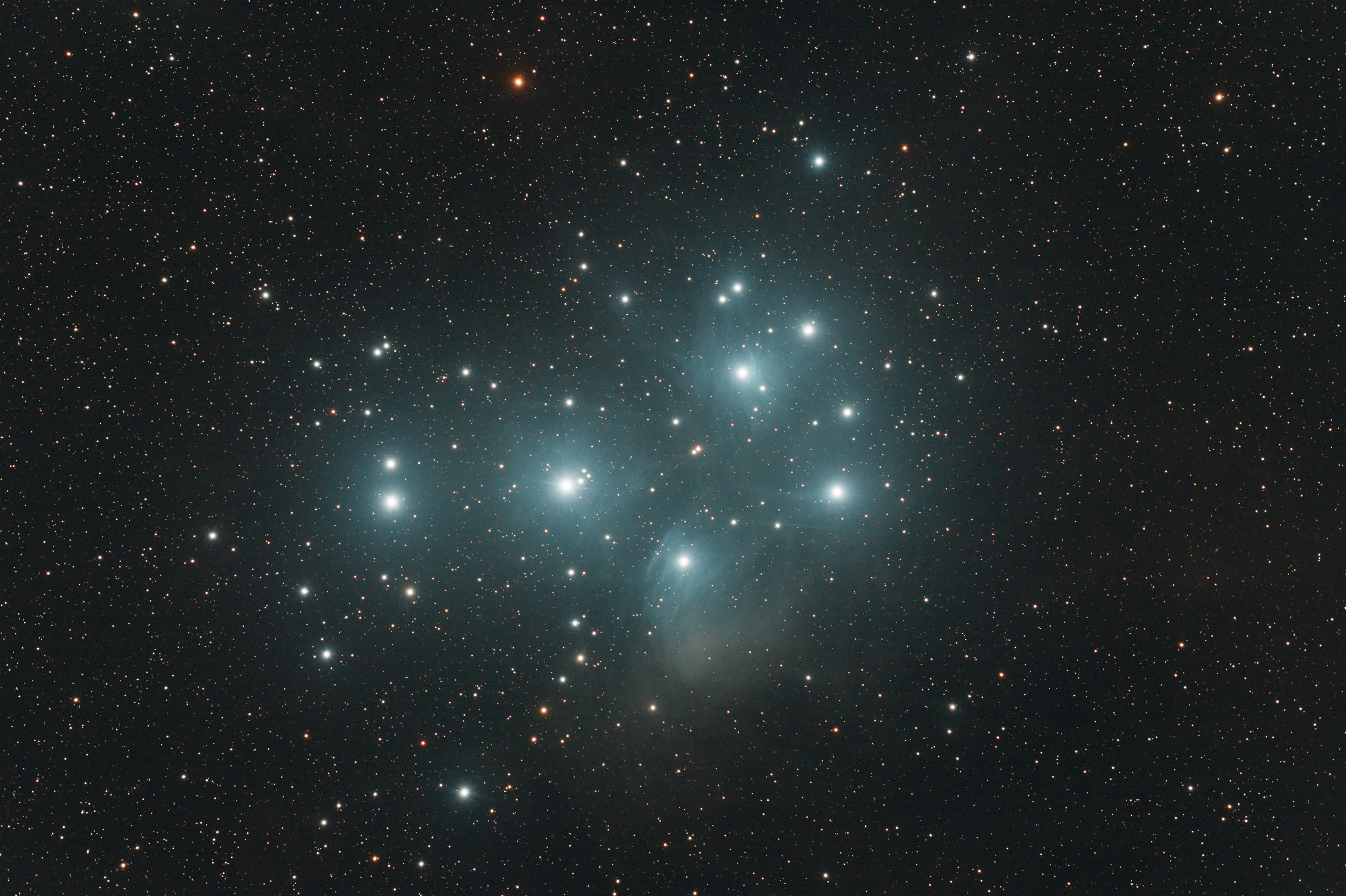
M45 - The Pleiades
Easily visible with the naked eye, M45, The Pleiades - sometimes referred to as The Seven Sisters, is a well known and famous Open Cluster in the constellation of Taurus. IT has been known since ancient times due to its prominence. The cluster is located between 450-500 light years away and contains several hundreds member stars. The cluster is quite young by astronomy standards and the cluster is moving through a cloud of gas which is easily visible in images and can been seen visually in a dark sky as well.
Technical Details
Imaged from my backyard in Nottingham on Saturday 9th January 2021 when high to The South. A meridian flip occurred half way through the data acquisition. I used my Takahashi FSQ85 refractor and QHY268C One Shot Colour camera. The image was created with quite a small data set of only 38 x 180s exposures.
Data acquired with Sequence Generator Pro and processed with PixInsight and Photoshop CC 2021. Very little processing has been done other than some noise reduction and a stretch into the none-linear state and a bit of vibrance added to the colour.
I have imaged M45 before. In a close-up setting and also in a widefield setting.

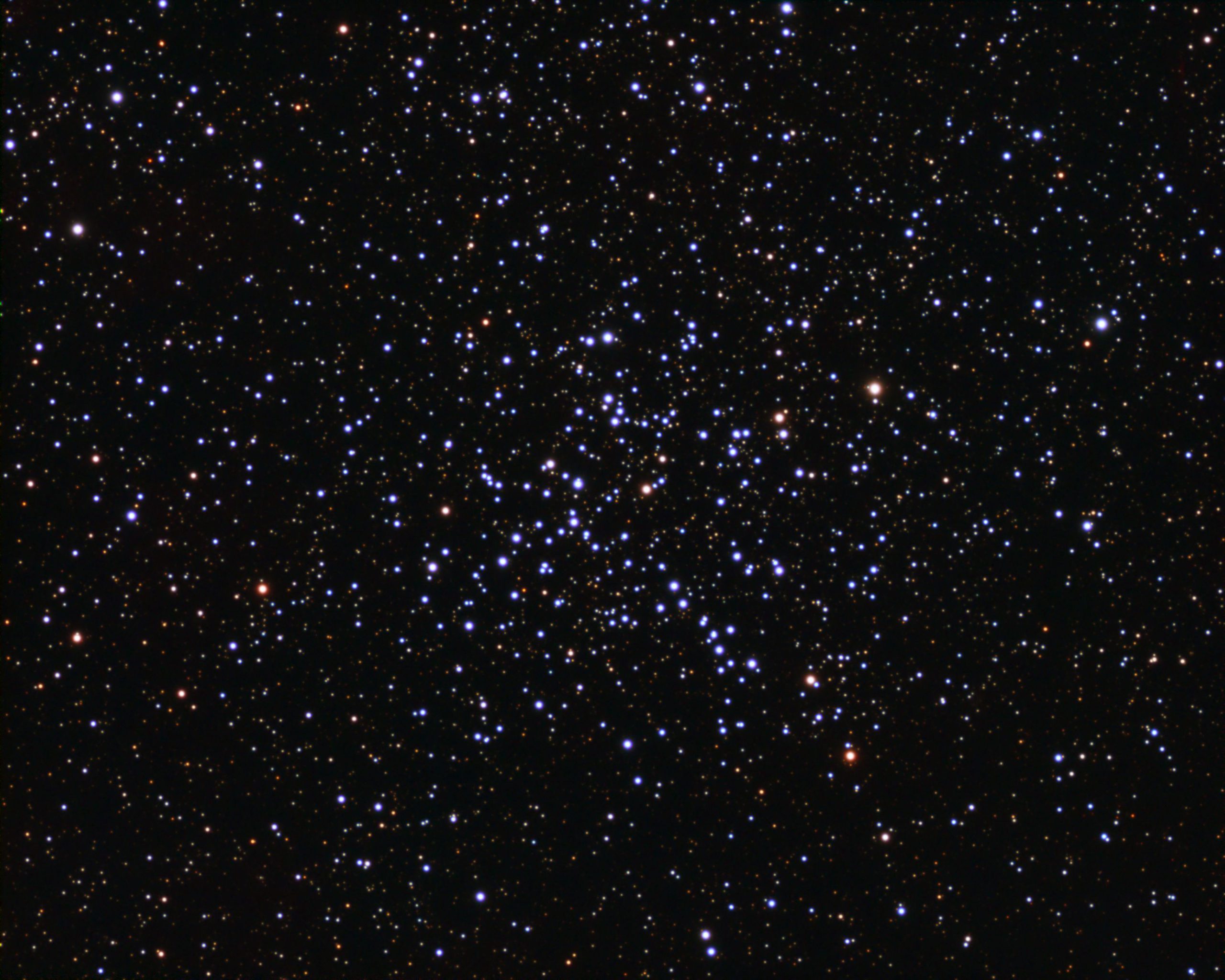
M38 - Open Cluster in Auriga TEC 140
M38 is the third of three Messier Open Clusters in the constellation of Auriga, in the Northern hemisphere of the sky. The other two Messier clusters are M36 and M37. All of them are easily visible with binoculars and are seen as faint smudges against the darker background. If you read my post on the Constellation of Auriga you will see all three of the Open Clusters in the same image

Image Technical Data
Imaged from my back yard in Nottingham, UK on the 18th January 2020 whilst high overhead from my location. I used my TEC 140 refractor with Atik 460 cooled CCD camera and Astrodon RGB E Series Generation 2 filters. I used my MESU 200 mount guided with OAG.
All exposures binned 1x1: Red > 12 x 180s ; Green > 14 x 180s ; Blue > 13 x 180s. This gives a total integration time of just under two hours.


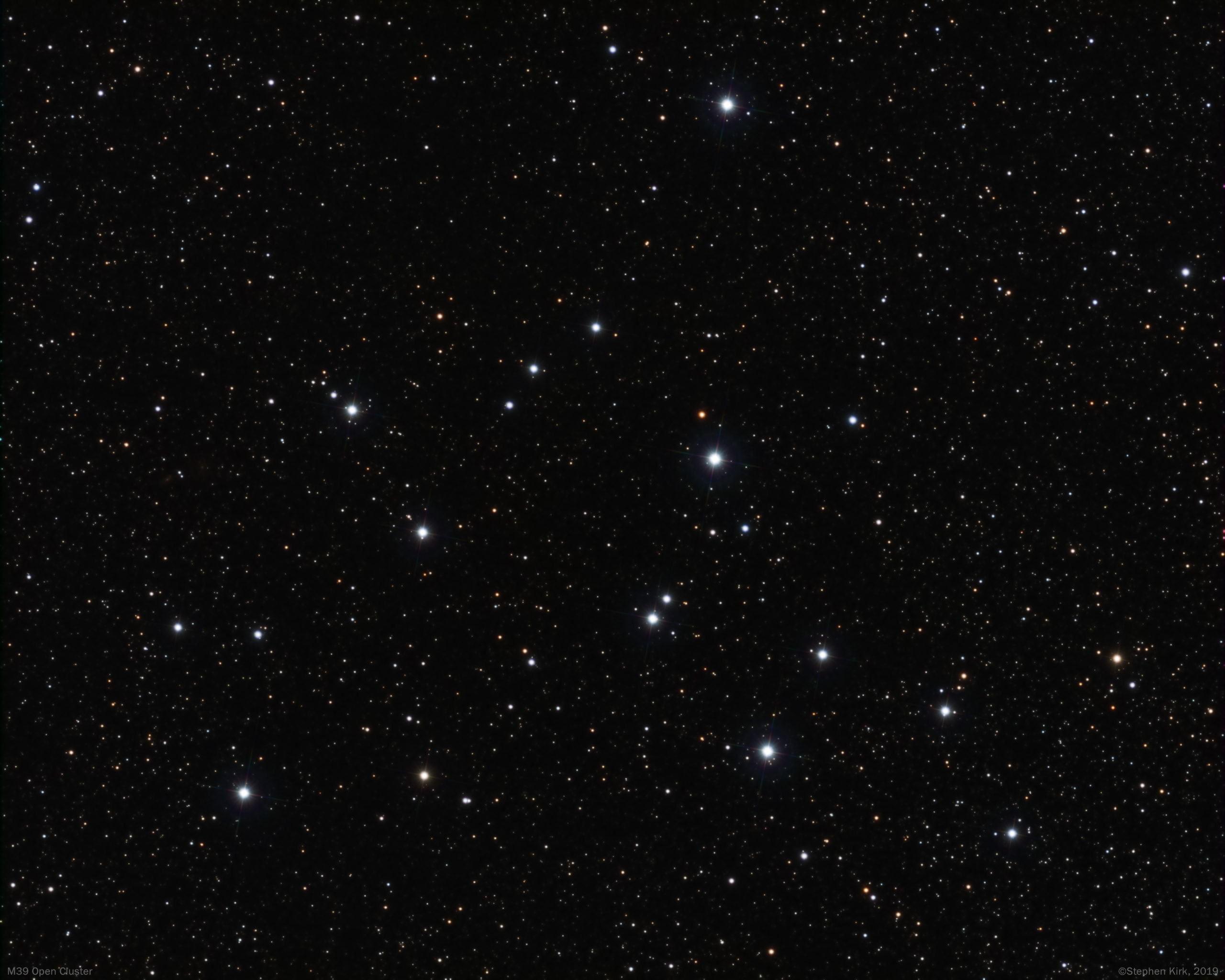
M39 Open Cluster in Cygnus - TEC140 refractor
M39 is an open cluster, about 1100 light years distant, in the constellation of Cygnus, The Swan. M39 is about 30 arc minutes in diameter, about the width of the full moon. The Cygnus constellation abounds in interesting objects and The Milky Way galaxy flows straight through it.

ImageTechnical Data
Imaged from my backyard in Nottingham, UK on the 16th October 2019 when it was high overhead from my location. I used my TEC 140 refractor and Atik 460 cooled CCD camera with Astrodon RGB E Series Generation 2 filters. I used my MESU 200 mount guided with an off-Axis guider.
All exposures binned 1x1:
Red > 15 x 120s ; Green > 12 x 120s ; Blue > 15 x 120s


I hope you like it! :)
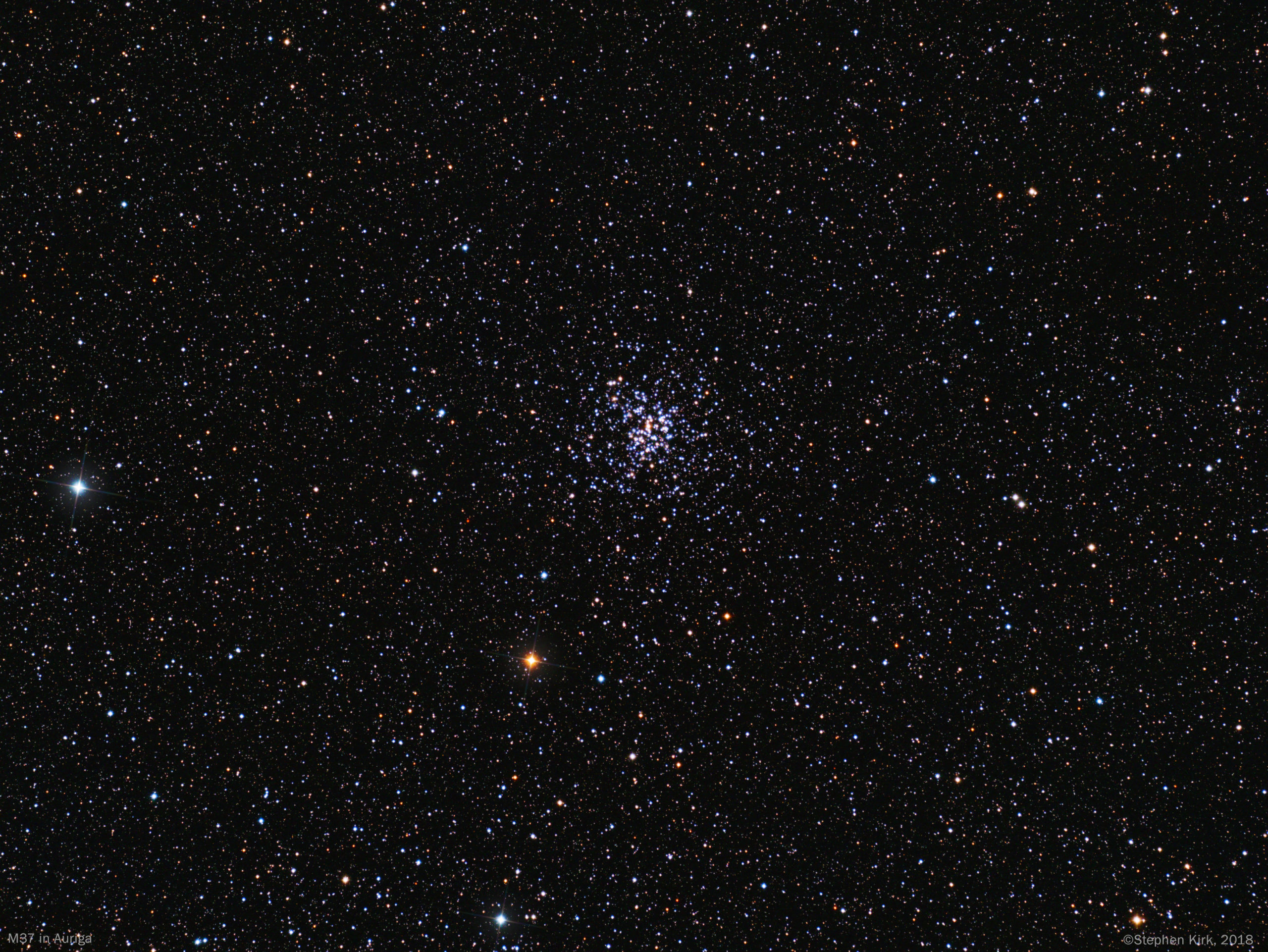
M37 - Open Cluster in Auriga with FSQ85
M37 is one of the three Messier Open Clusters in the Constellation of Auriga - the other two being M36 and M38. It is about 4500 light years away and contains several red giant stars, visible in this image, making it the richest of the three Auriga Messier Open Clusters. M37 appears high overhead from my 53 degree norther location during the winter months making it an ideal target for visual observations and imaging. It makes a fine site in a telescope and appears as a fuzzy ball in a pair of binoculars.

Image Technical Data
Imaged from my backyard in Nottingham, UK on the 9th February 2018. I used my Takahashi FSQ85 refractor and Moravian G2-8300 cooled CCD camera with Astrodon RGB filters. All expsoures are binned 1x1.
Red > 12 x 120s ; Green > 12 x 120s ; Blue > 12 x 120s


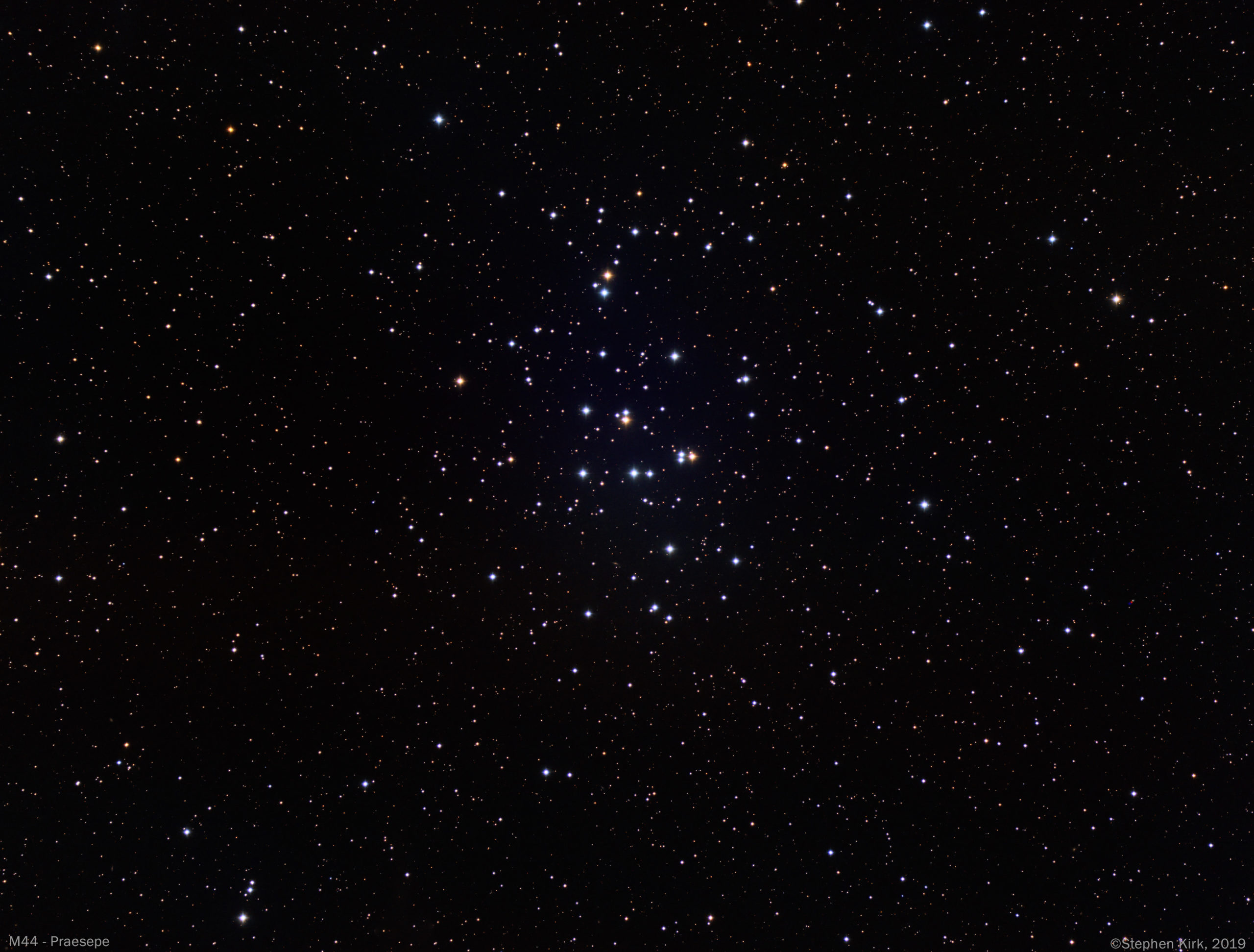
M44 - Praesepe - with FSQ85
M44 or "Praesepe" as it is called, is a famous open cluster visible in the late winter/ springtime in the constellation of Cancer - The Crab. It is often nicknamed The Beehive cluster since it resembles a swarm of bees when viewed in a wide-field telescope or binoculars. Along with M45 it is one of the most immediately breathtaking sights in the deep sky. At about 510 light years it is one of the closer Open Cluster to the Earth and is about 12 light years across and contains about 1000 stars. Note the tiny, distant galaxy in the bottom of the cluster PGC24400.

Image Technical Data
Imaged over two evenings, the 22 and 23 February 2019 from my backyard in Nottingham, UK. Conditions were far from ideal with a high, hazy mist that made transparency poor and subsequent processing difficult.
Captured with Takahashi FSQ85 and Moravian G2-8300 CCD camera with Astrodon RGB filters. All data binned 1x1:
Red > 14 x 120s ; Green > 16 x 120s ; Blue > 14 x 120s
Mounted on MESU 200 telescope mount and guided with OAG


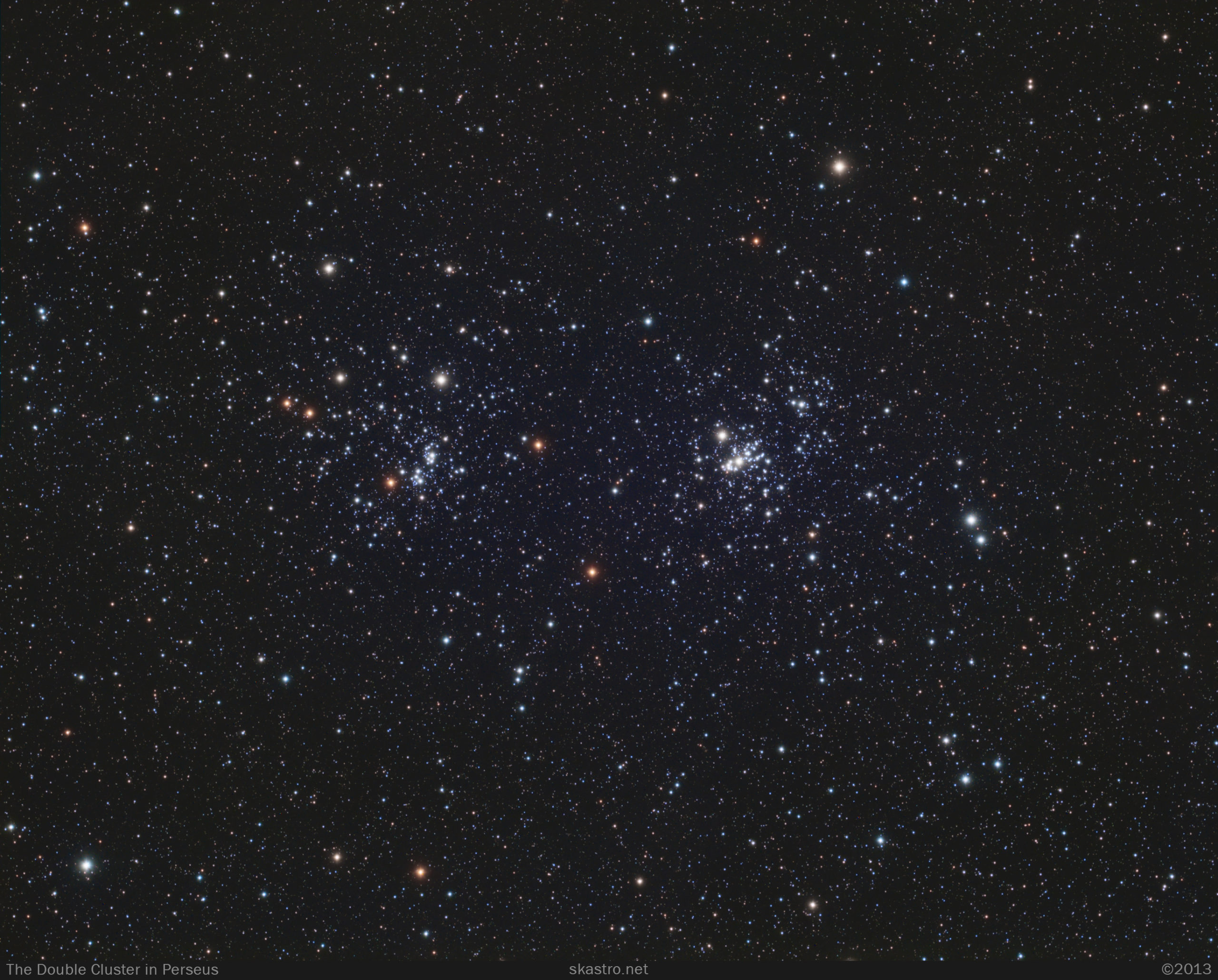
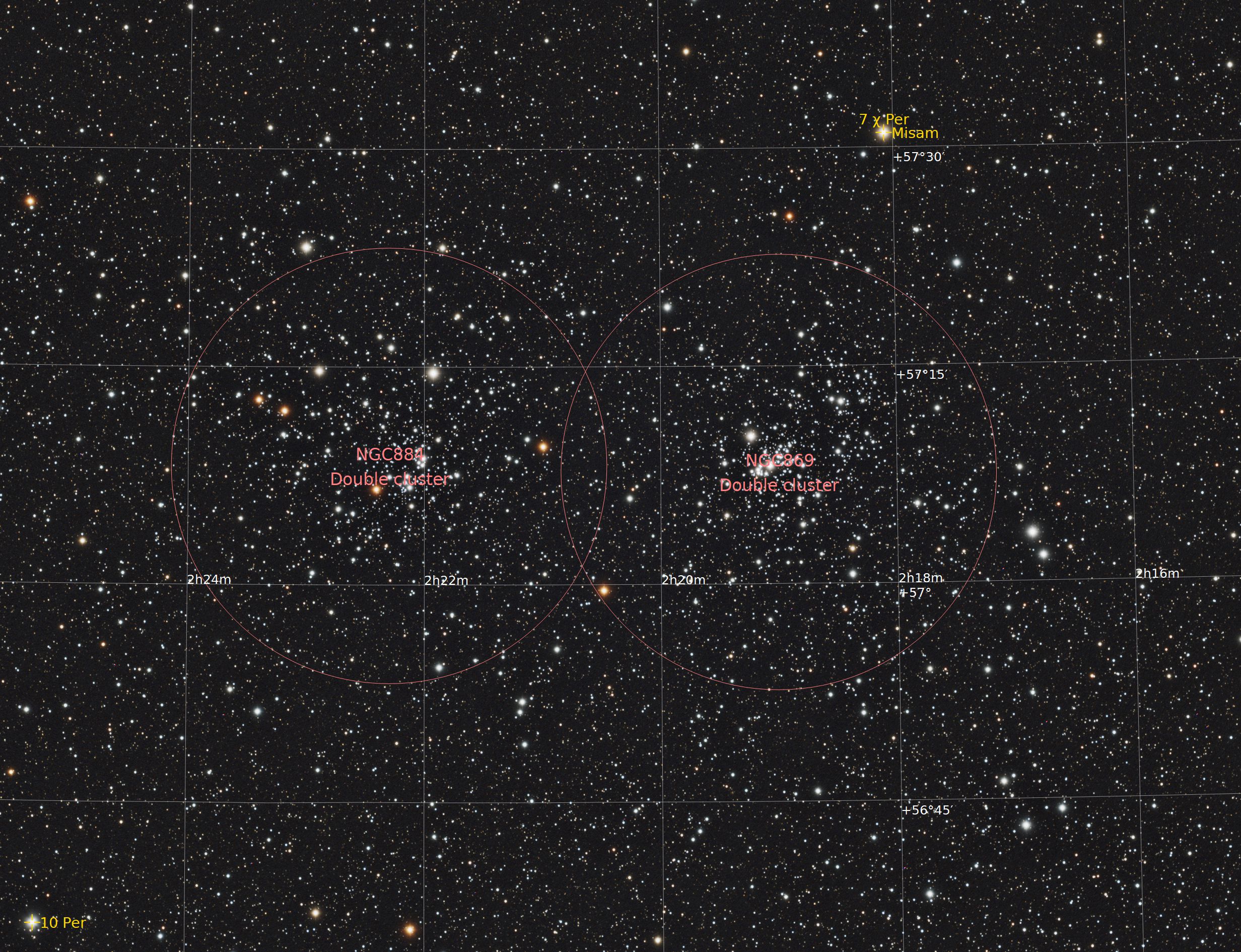
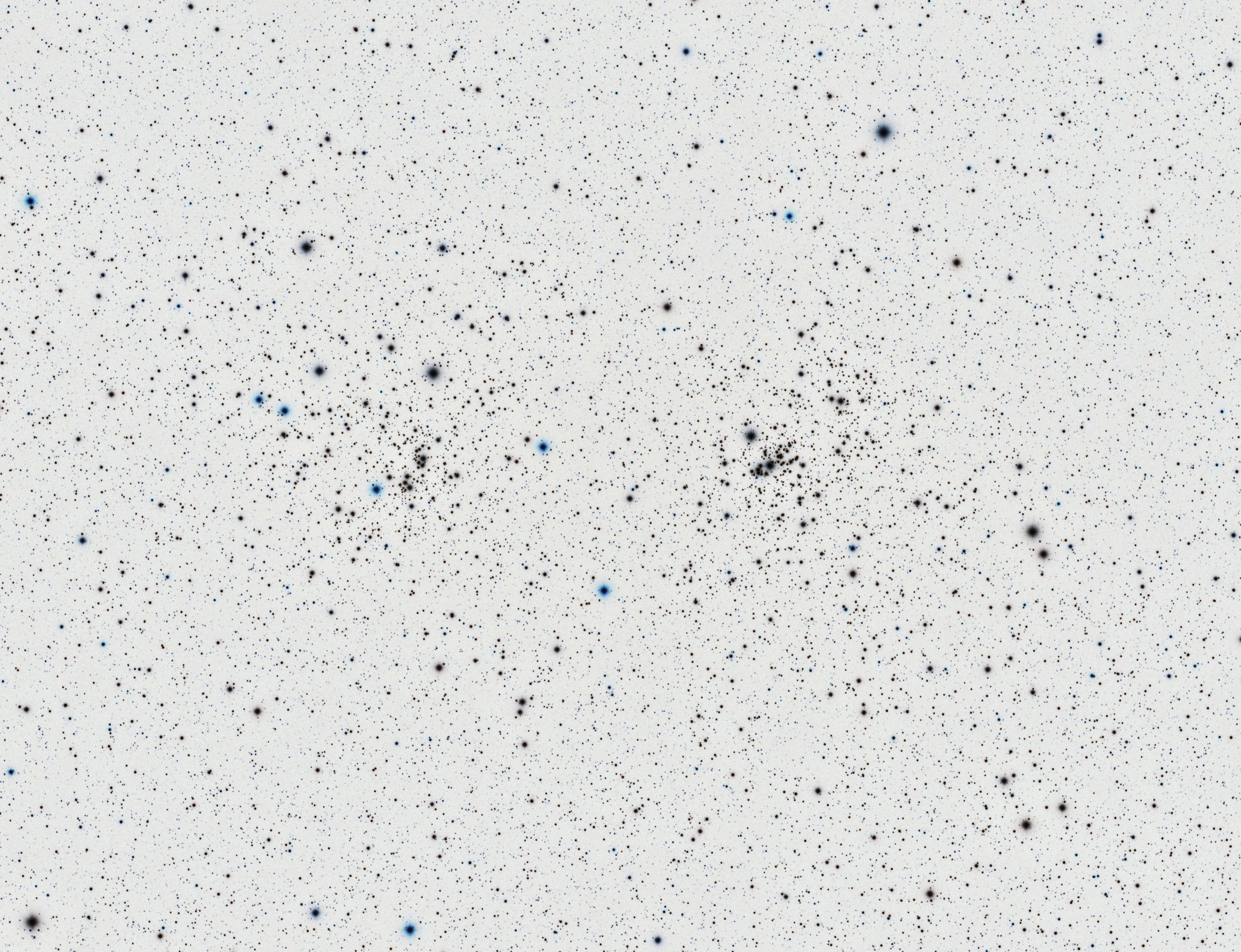
The Double Cluster

The Double Cluster is located in the constellation of Perseus, near the border with Cassiopeia and is composed of the two Open Clusters NGC869 and NGC 884. They are visible faintly to the naked eye on a dark night and a wide field eye piece shows them superbly in the telescope as does a pair of binoculars if you hold them steady.
The clusters are very distant from us at about 7500 light years and are located outwards in the Perseus spiral arm of the galaxy. Were they as close as The Pleiades (at 450 light years) they would dominate the night sky!
The above image was taken with my Takahashi FSQ85 refractor and Atik 460 CCD camera with Baader RGB filters and contains 45 minutes of exposures in each of the RGB channels. I took these exposures in 2013 and this was the first light of this telescope.
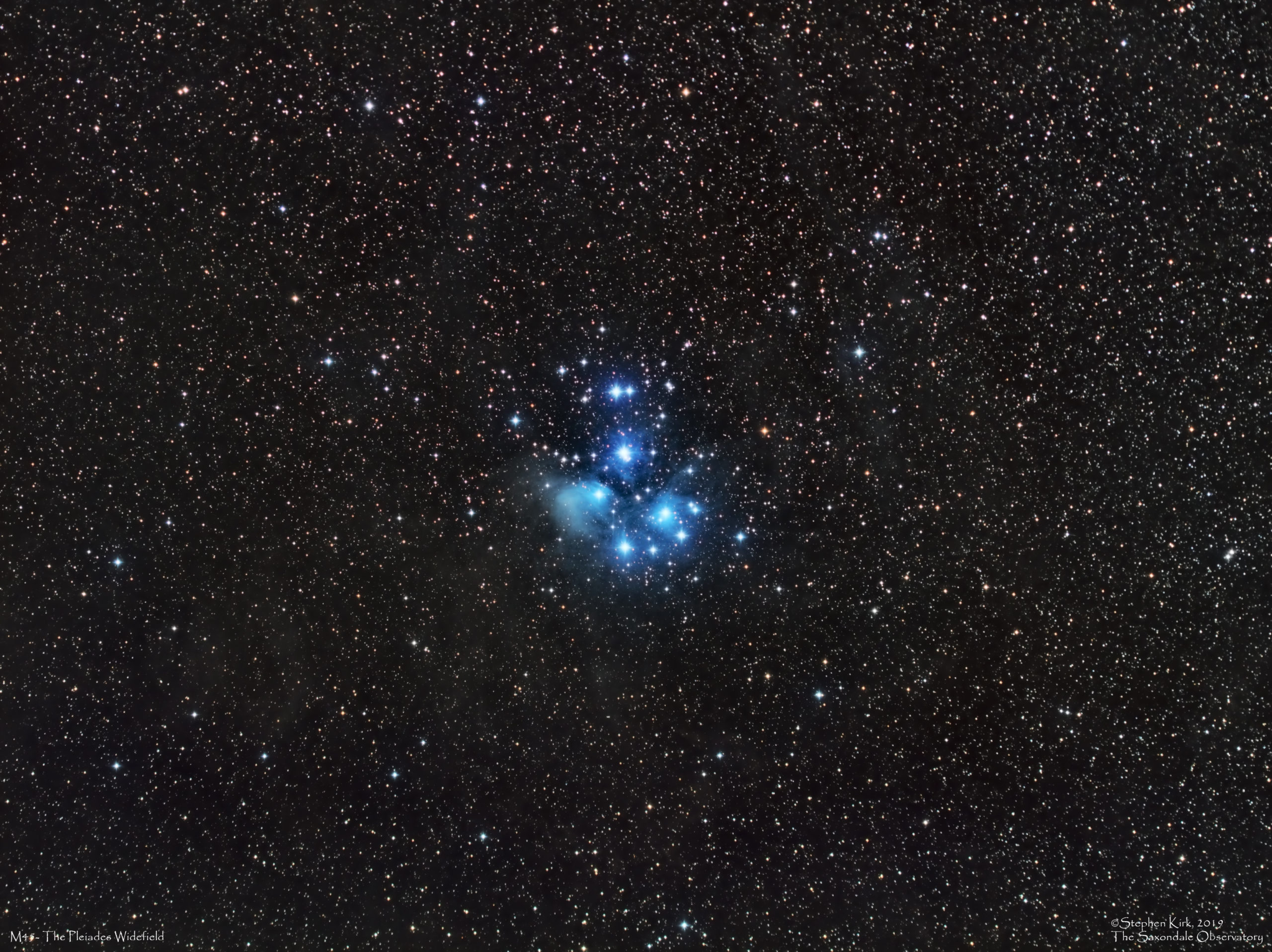
M45 in a Widefield

An image of the Pleiades taken with a Samyang 135mm lens and Astrodon RGB filters.
Field of view is approximately 6x4 degrees.
Taken 18 November 2019 and 10 x 180s exposures in each filter.

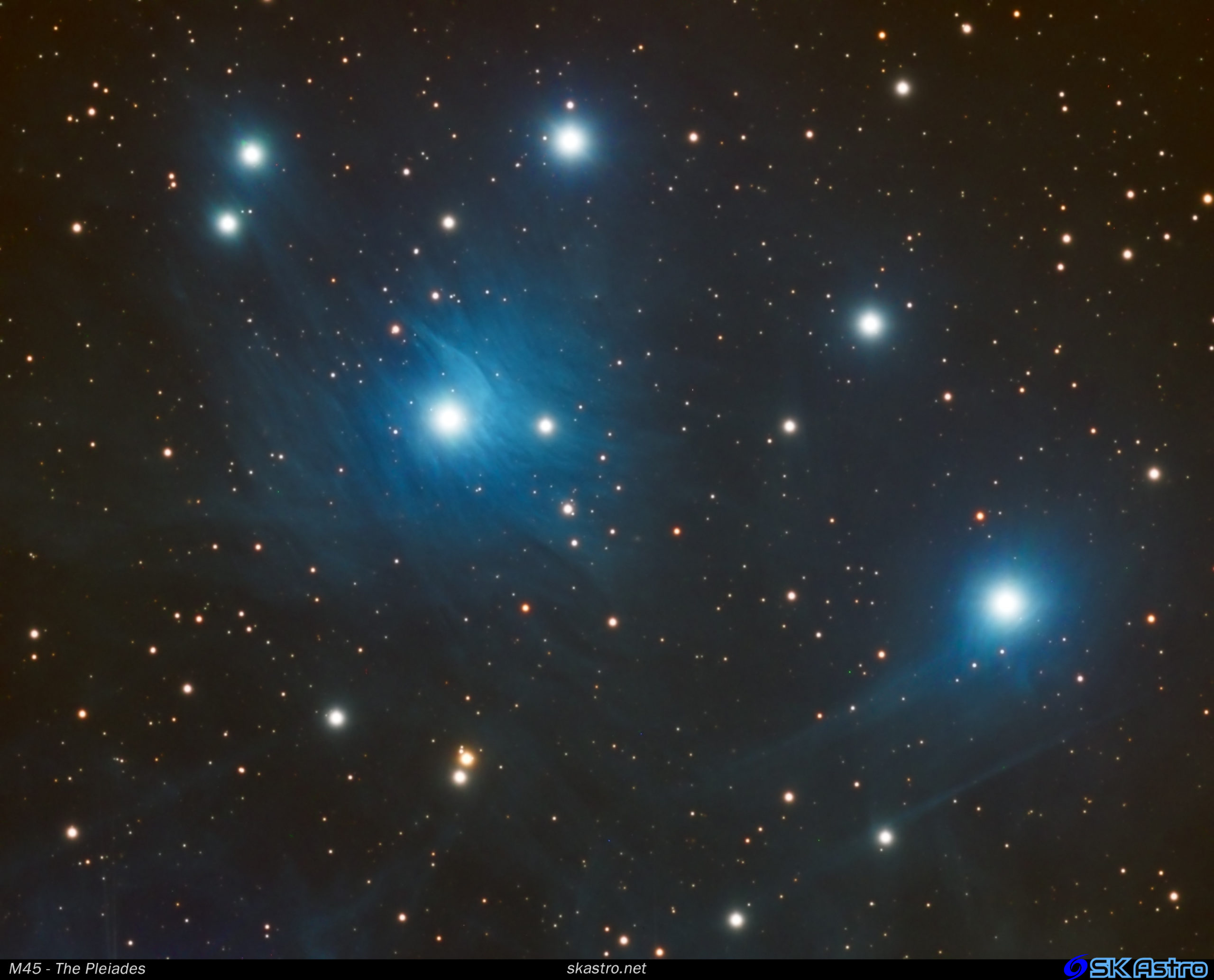
M45 The Pleiades
Introduction

Presented here is M45, the famous Pleiades Open Cluster of stars. Image was captured in one imaging run on the night of 18th December 2019. This image shows a small sub-section of The Pleiades, the "head". This main triangle shape of the bright stars Maia, Electra and Taygeta is visible to the naked eye.
Known since ancient times from cultures all over the world and even featured in prehistoric cave paintings, The Pleiades is a large, open cluster of stars in Taurus, visible late autumn and winter in the Northern Hemisphere
The Pleiades are actually composed of hundreds of stars, about 470 light years away. The cluster is vert young, about 20 million years, and is moving through a cloud of interstellar gas and dust. At some point many millions of years in the future, the stars will lose their mutual gravitational attraction an d will slowly disperse and start life on their own, orbiting the centre of the galaxy.


Technical Information
T: TEC 140 refractor
M: MESU200
C: ATIK 460 with Astrodon RGB
Twelve exposures in each filter, three minutes in length.
Total Integration time of 108 minutes, binned 1x1.
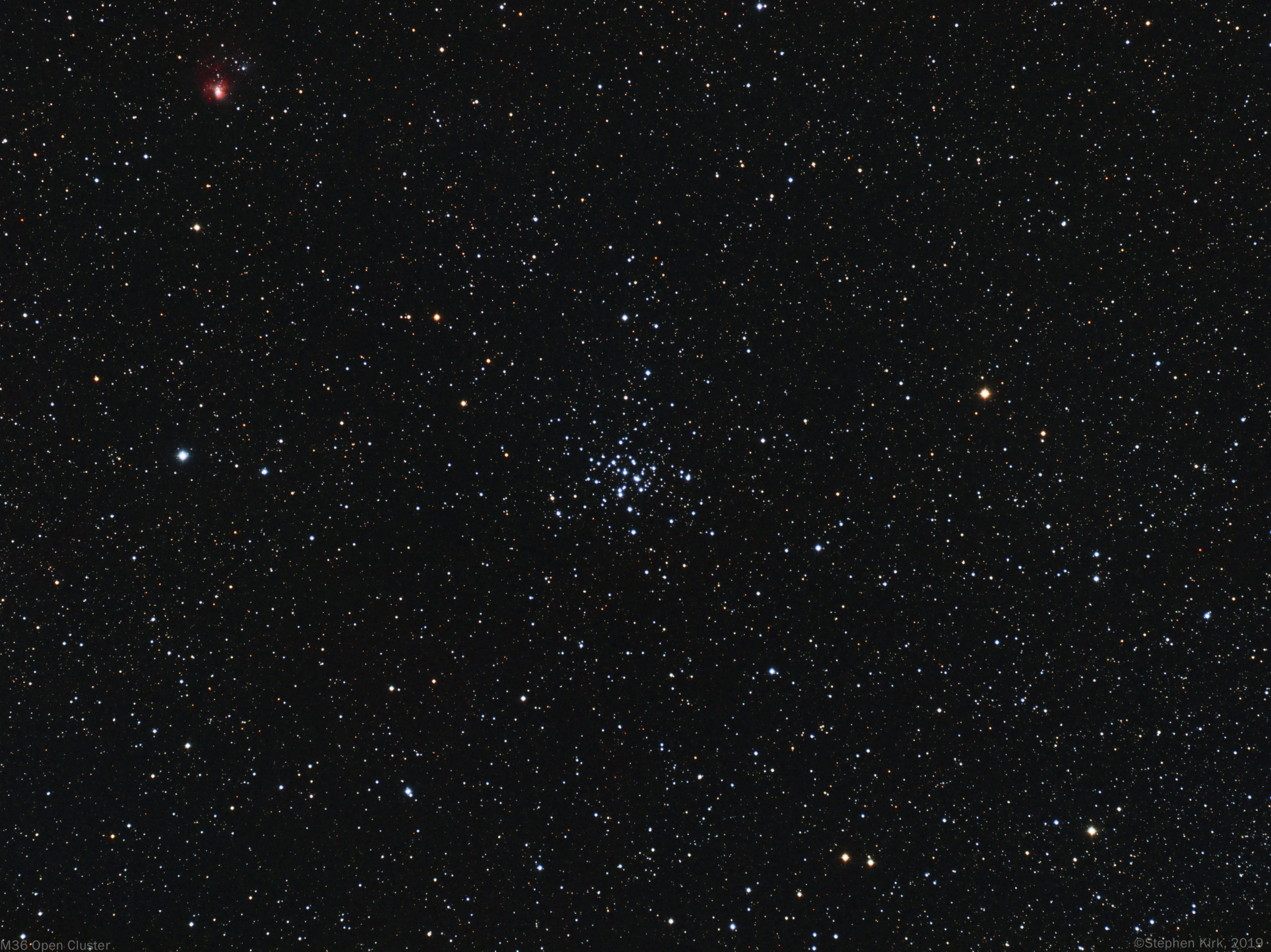
M36 Open Cluster in Auriga - FSQ85
M36 is an Open Cluster of stars (as opposed to a Globular Cluster) in the Constellation of Auriga. M36 is high overhead in Europe during the nightimes of winter months and is one of three Messier Open Clusters in Auriga, the others being M37 and M38. All of these are visible in a small pair of binoculars as nebulous and fuzzy blobs. M36 and the other clusters make a fine site in a telescope and dozens of stars can be seen. Note also the Red nebula to the top left - NGC 1931 (Sh2-237). There are some tiny PGC catalogue galaxies, billions of light years away in this image.

This image was taken from by backyard in Nottingham, UK on the 24th January 2018 with my Takahashi FSQ85 refractor and Moravian instruments G21-8300 CCD camera with Astrodon RGB Generation 2 E series filters on MESU 200 mount. All data was binned 1x1.
Red > 12 x 120s ; Green 12 x 120s ; Blue 12 x 120s
Total Integration is about an hour and twelve minutes. Data captured with Sequence Generator Pro and processed in PixInsight and Photoshop.


Astrobin Image here: https://www.astrobin.com/fersyj/