
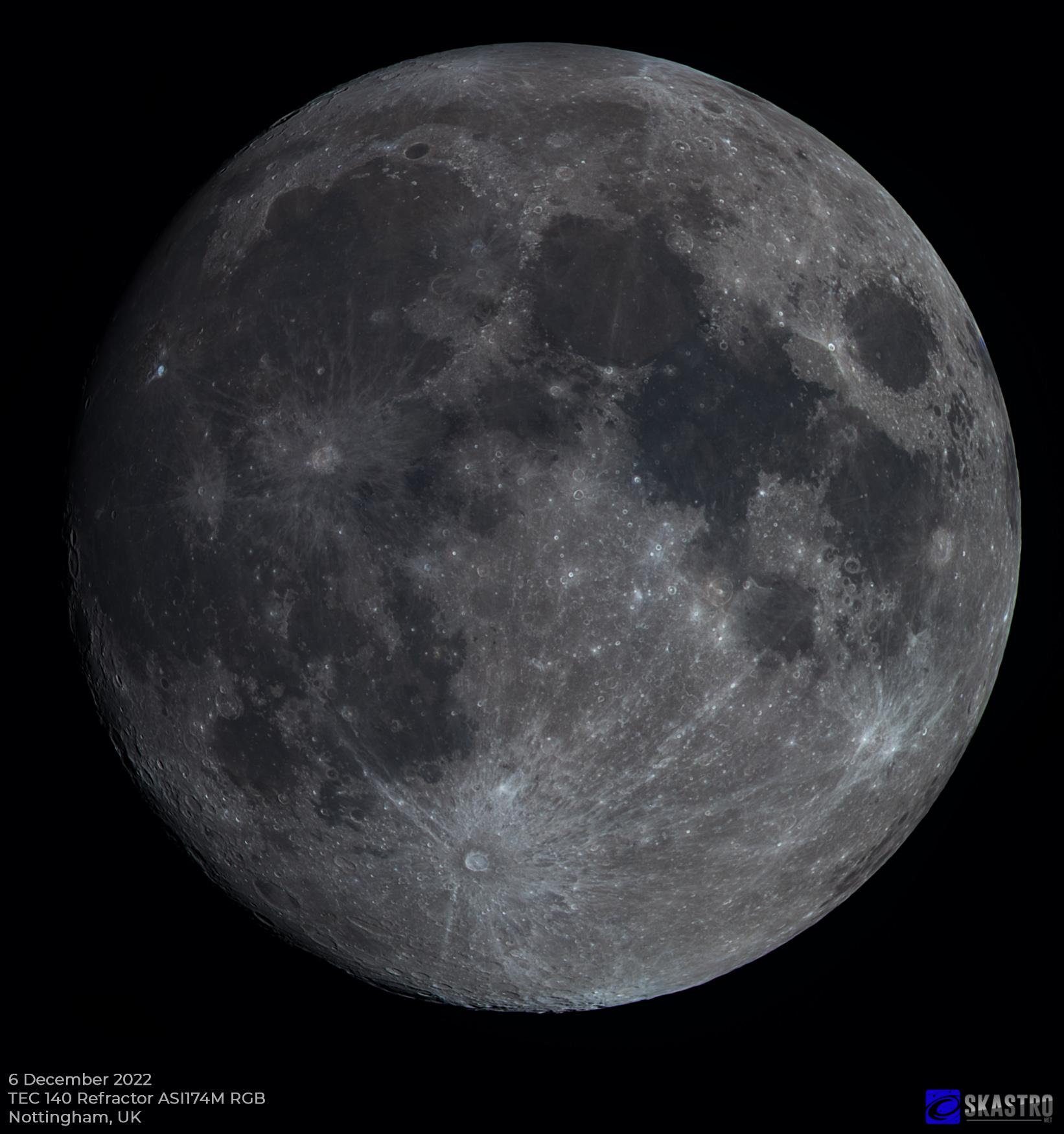
December Moon with TEC140 Refractor
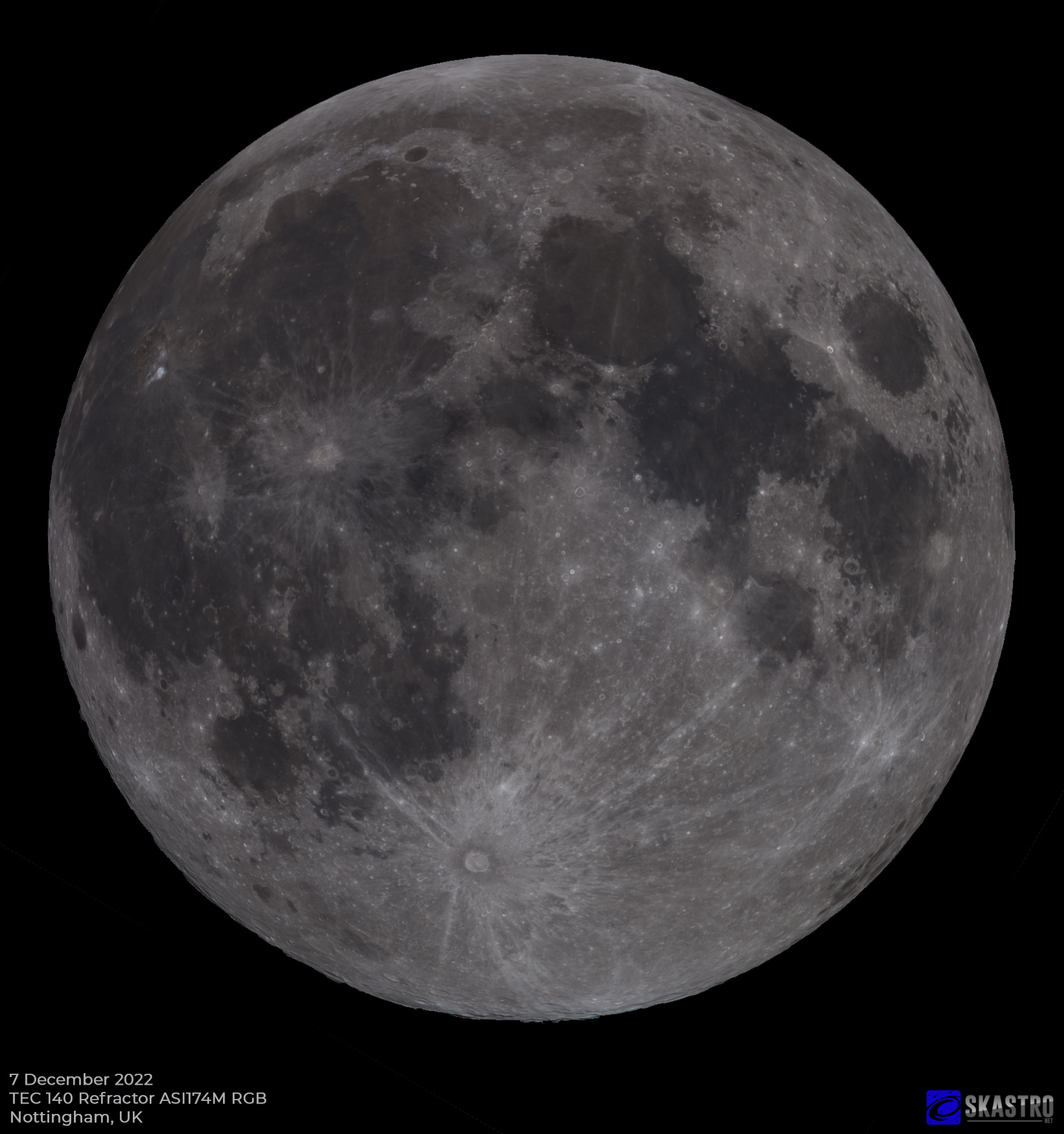
The Moon with my TEC140 December 2022.
Images taken on the 6th and the 7th. The 6th was not quite a full moon and the 7th was just a few hours past full. On the picture on the left you can see that the circle of the moon's disk is not quite full between the 6 and 11 O'clock positions.
Both images were taken with my TEC140 refractor and ASI174M camera through Baader RGB filters.
Each capture was of 5000 frames and the seeing was quite good so that I could utilise the best 50% of frames of each capture run. Because of the Field of View with the combination of the F8 focal length of the TEC140 and the chip size of the AIS174M, each capture run through each filter was comprised of a North and South run. I then stitched the two together in Photoshop.
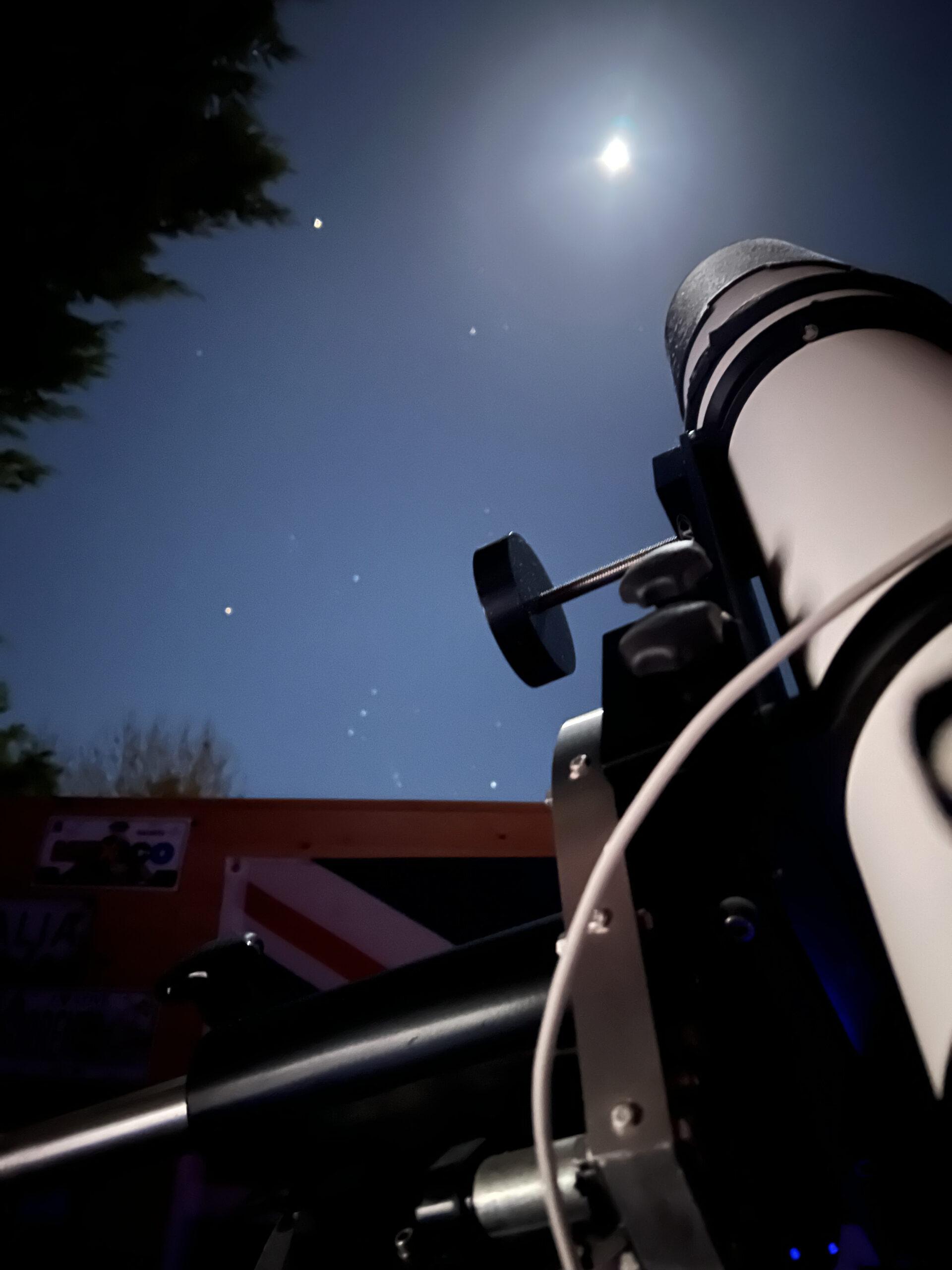
Weather conditions were extremely cold at about -2C when the captures were taken on the early evenings of the 6th and 7th December. The Moon was very high in Taurus.
From my backyard in Nottingham, UK. My skies are at Bortle 5 in terms of light pollution.

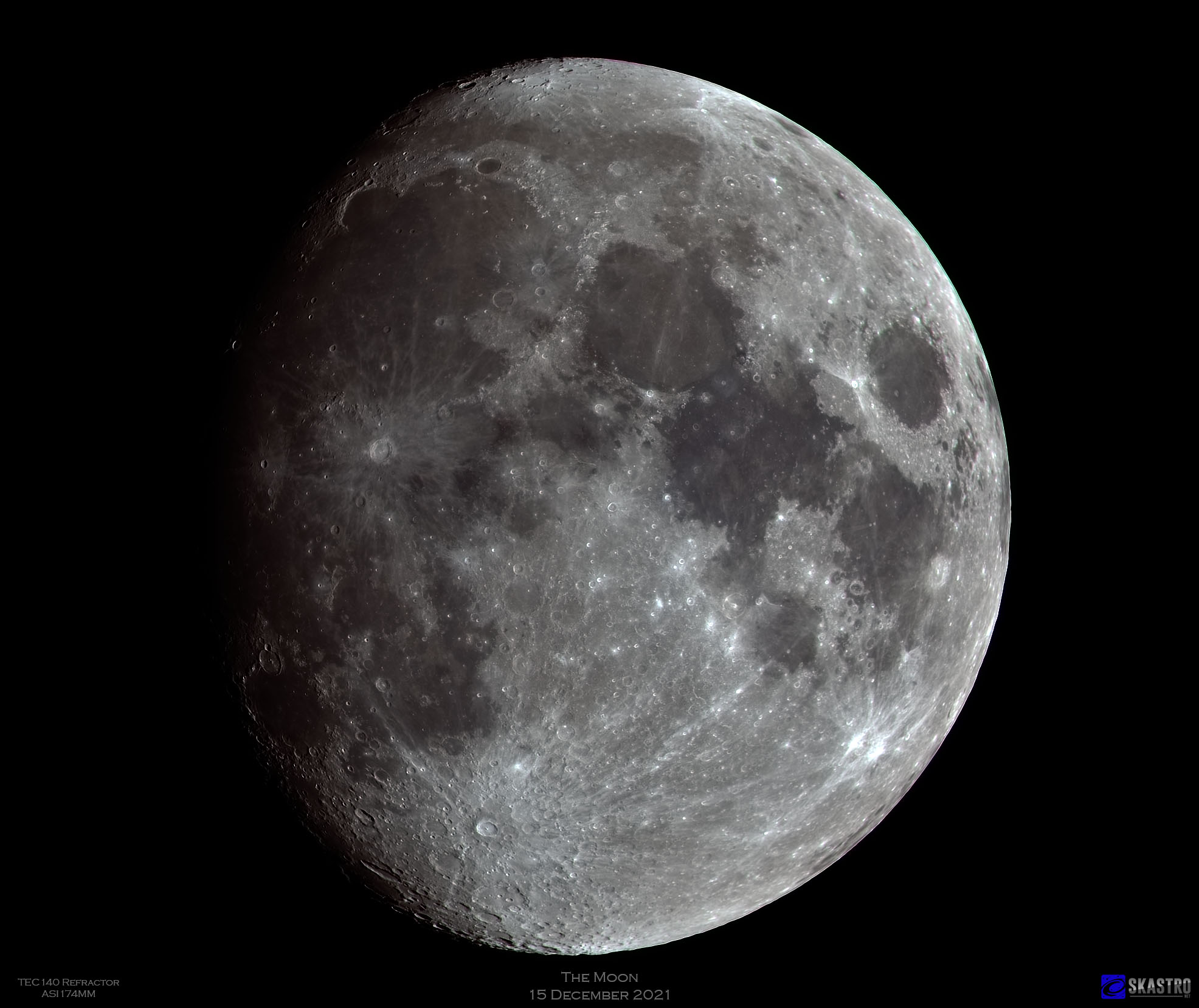
The Moon TEC140 Refractor/ASI174MM
This is a RGB image of The Moon captured at about 20:00 on 15th December 2021 from my observatory in Nottingham using my TEC140 refractor and ASI174MM camera.
I captured two capture runs in each filter and stitched the resultant images together in Photoshop. Each video capture file was 9GB in size.
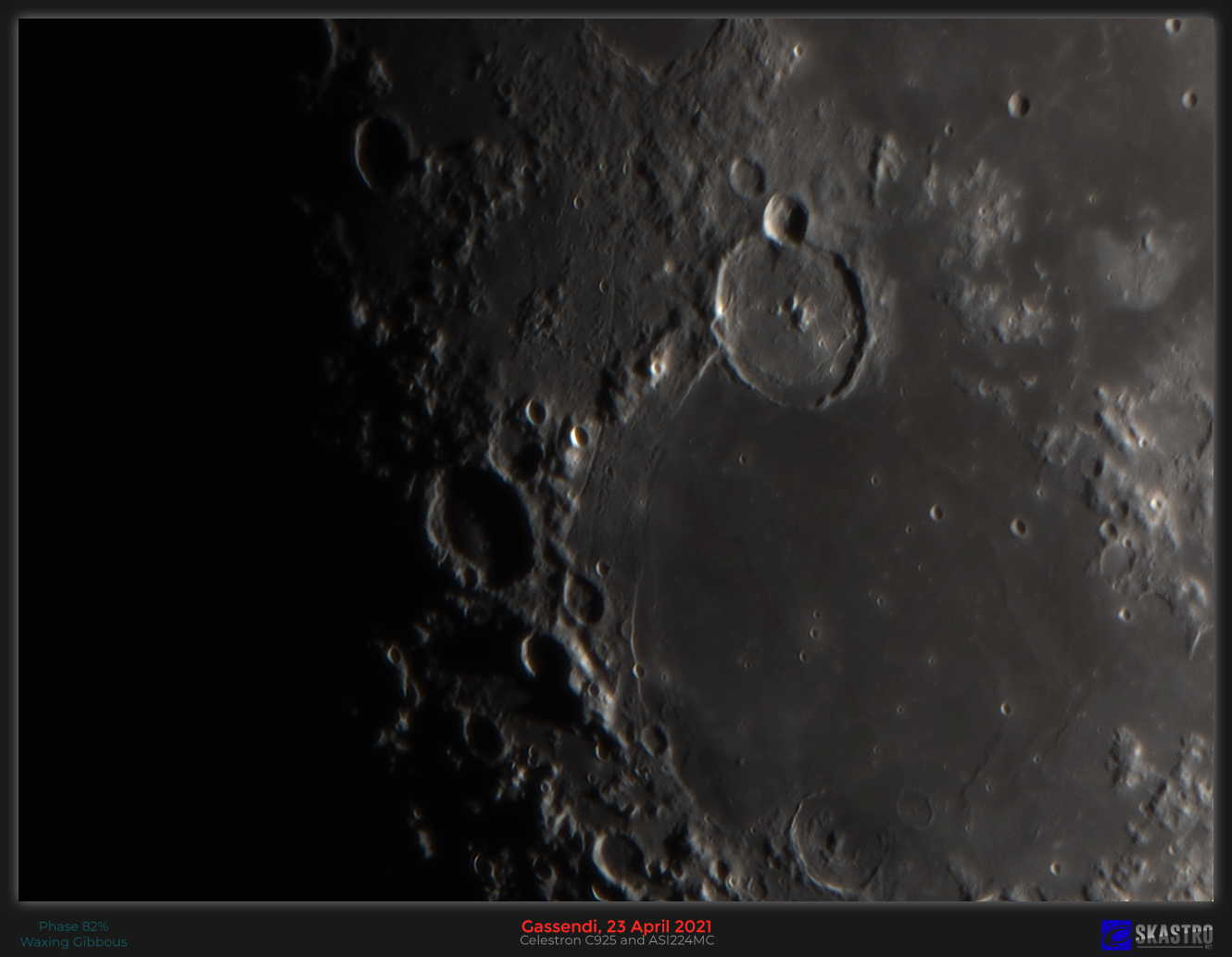
Lunar Pictures from 23rd April 2021 C925 and ASI224MC
A selection of images I took with my C925 and ASI224MC. Transparency was reasonably good but seeing was quite poor and the image was wobbly. Each image is developed from a 5000 frame .ser file choosing the best 15% of frames as a result of the poor seeing. The Moon is at a phase of 82% waxing gibbous and some nice shadows on the terminator.
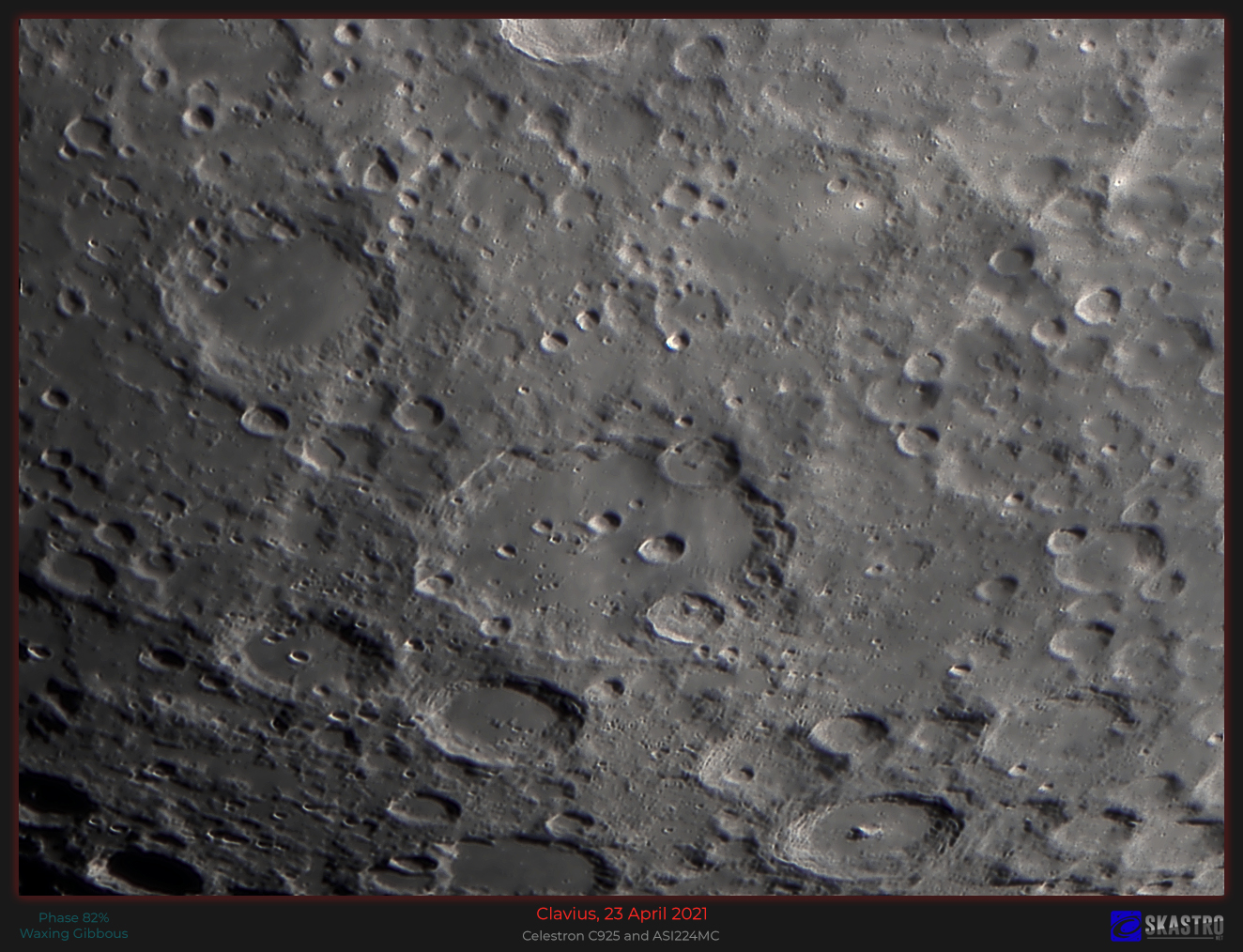
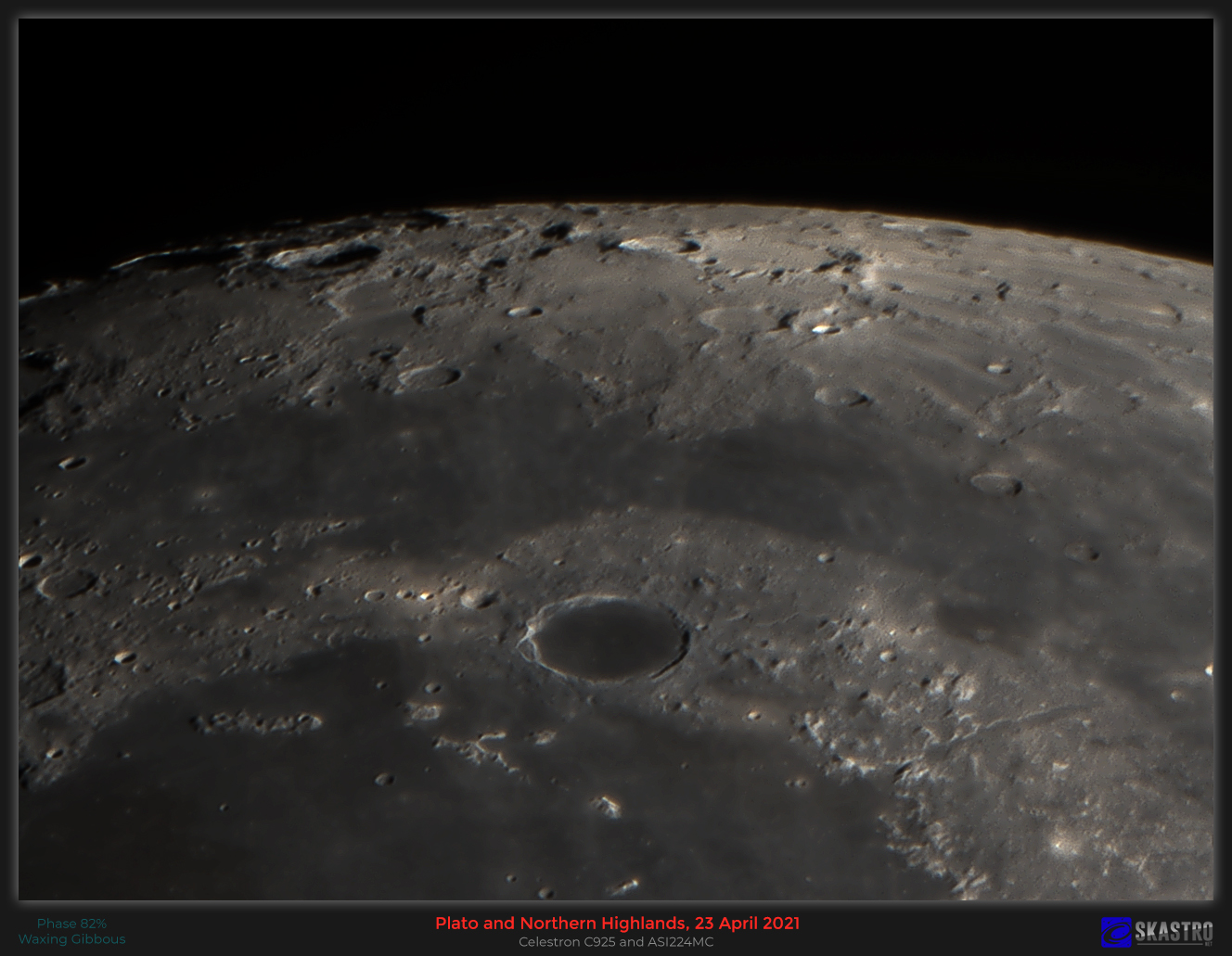
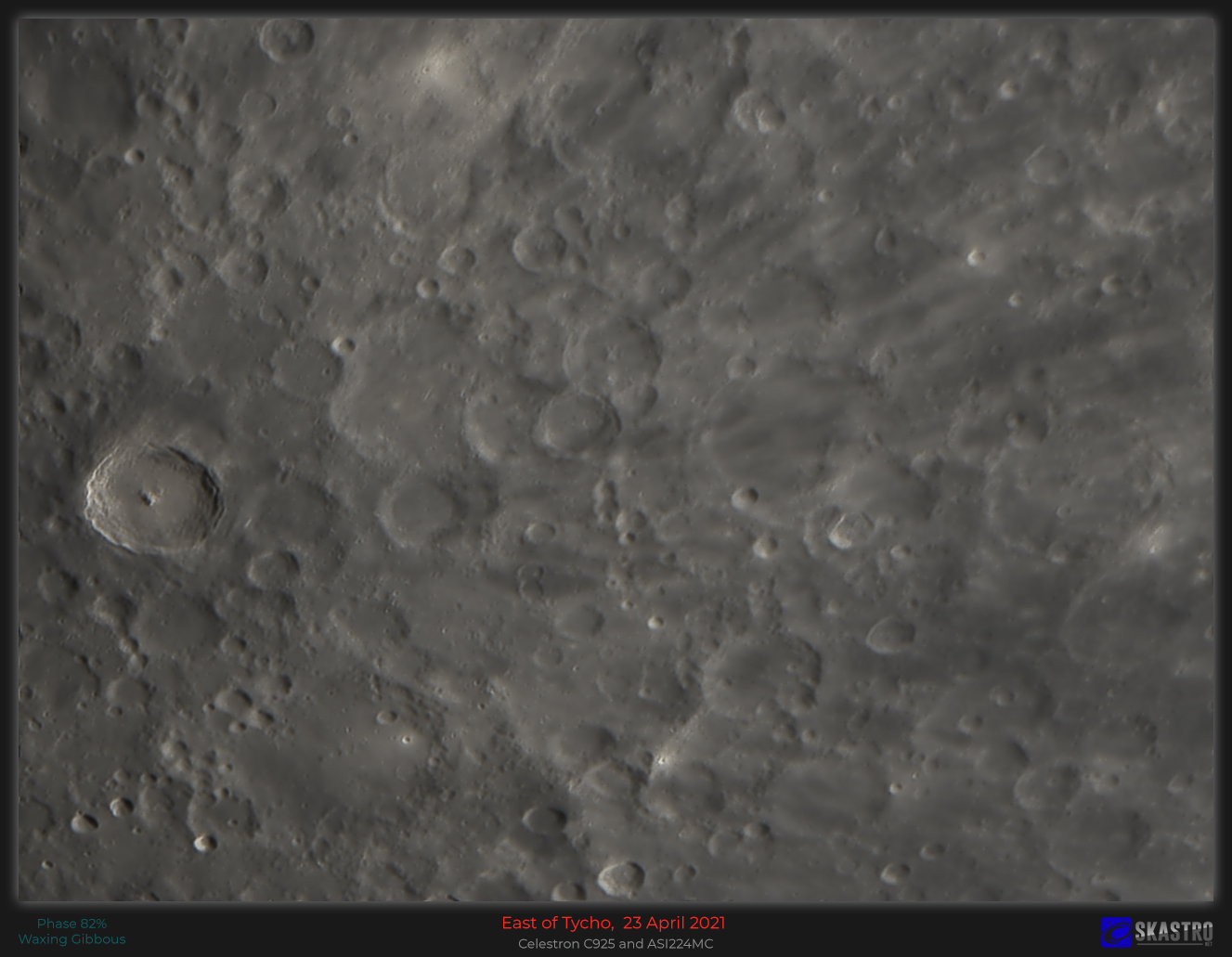
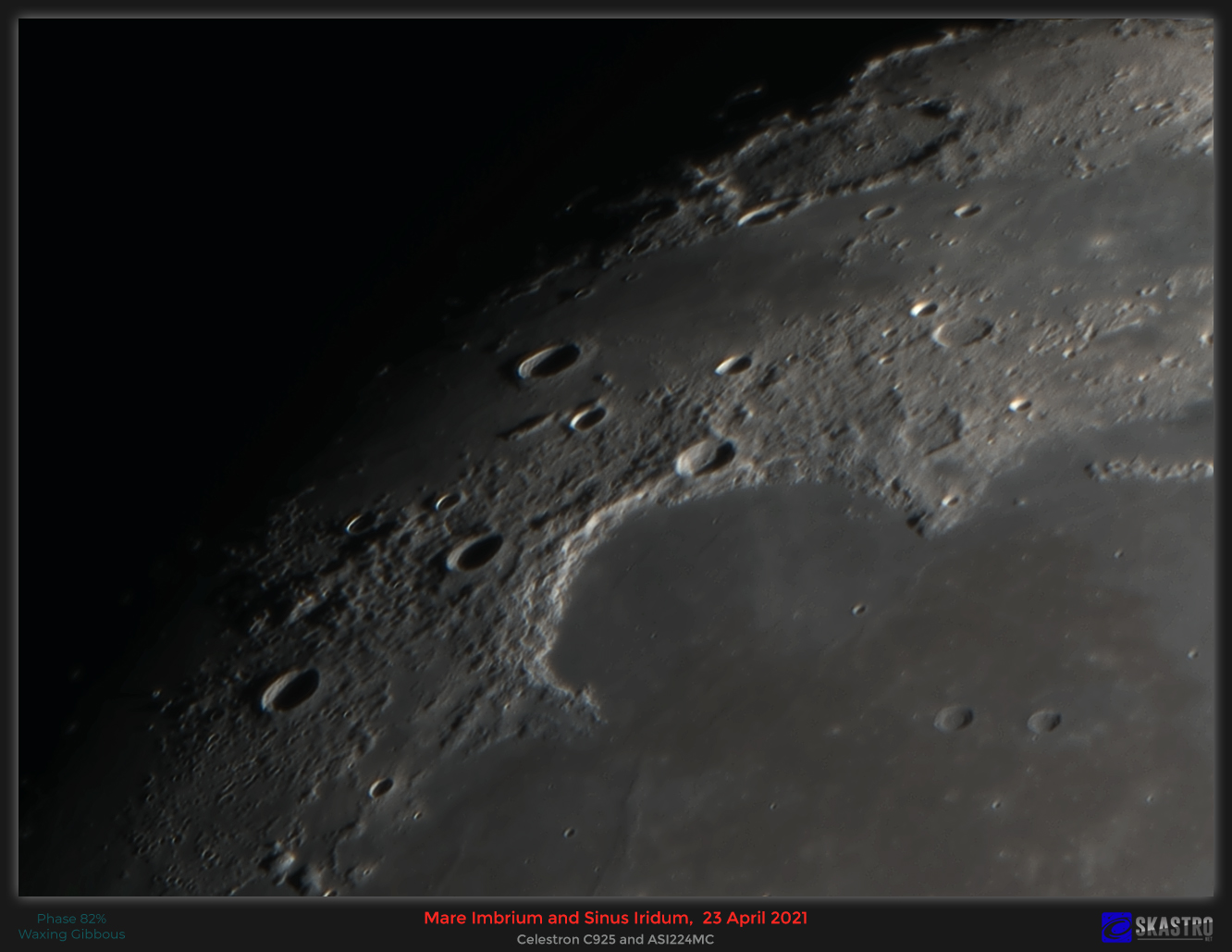
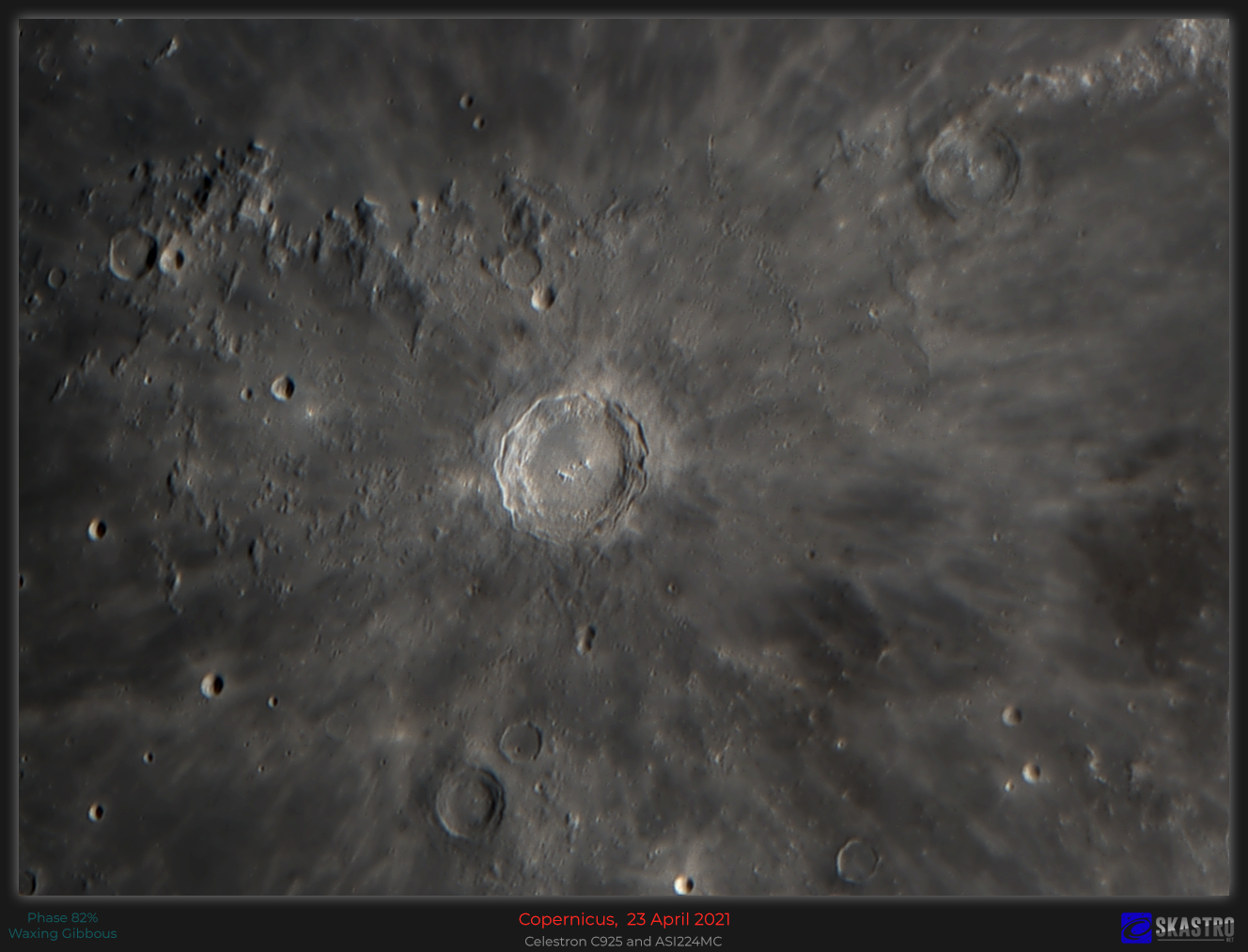
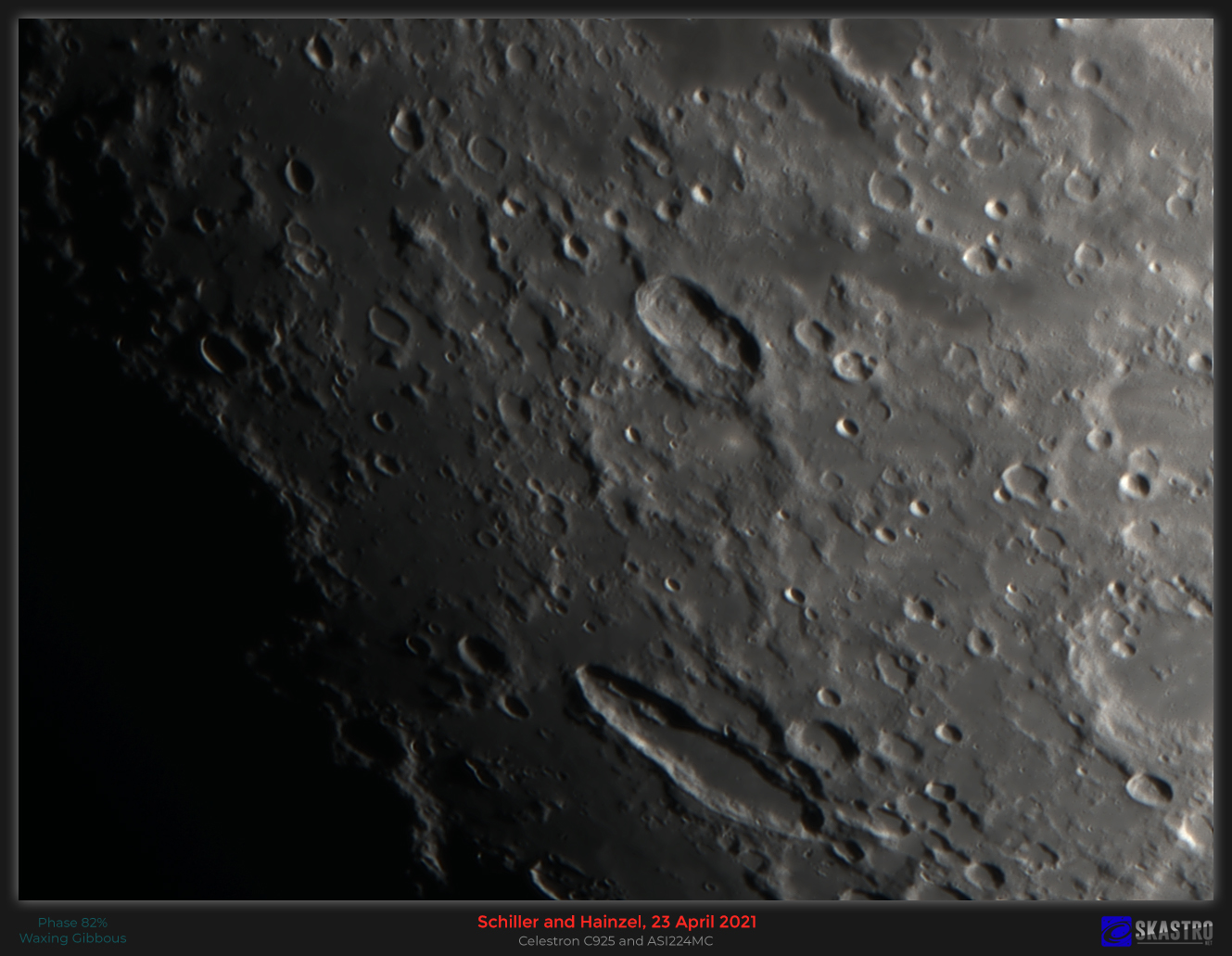
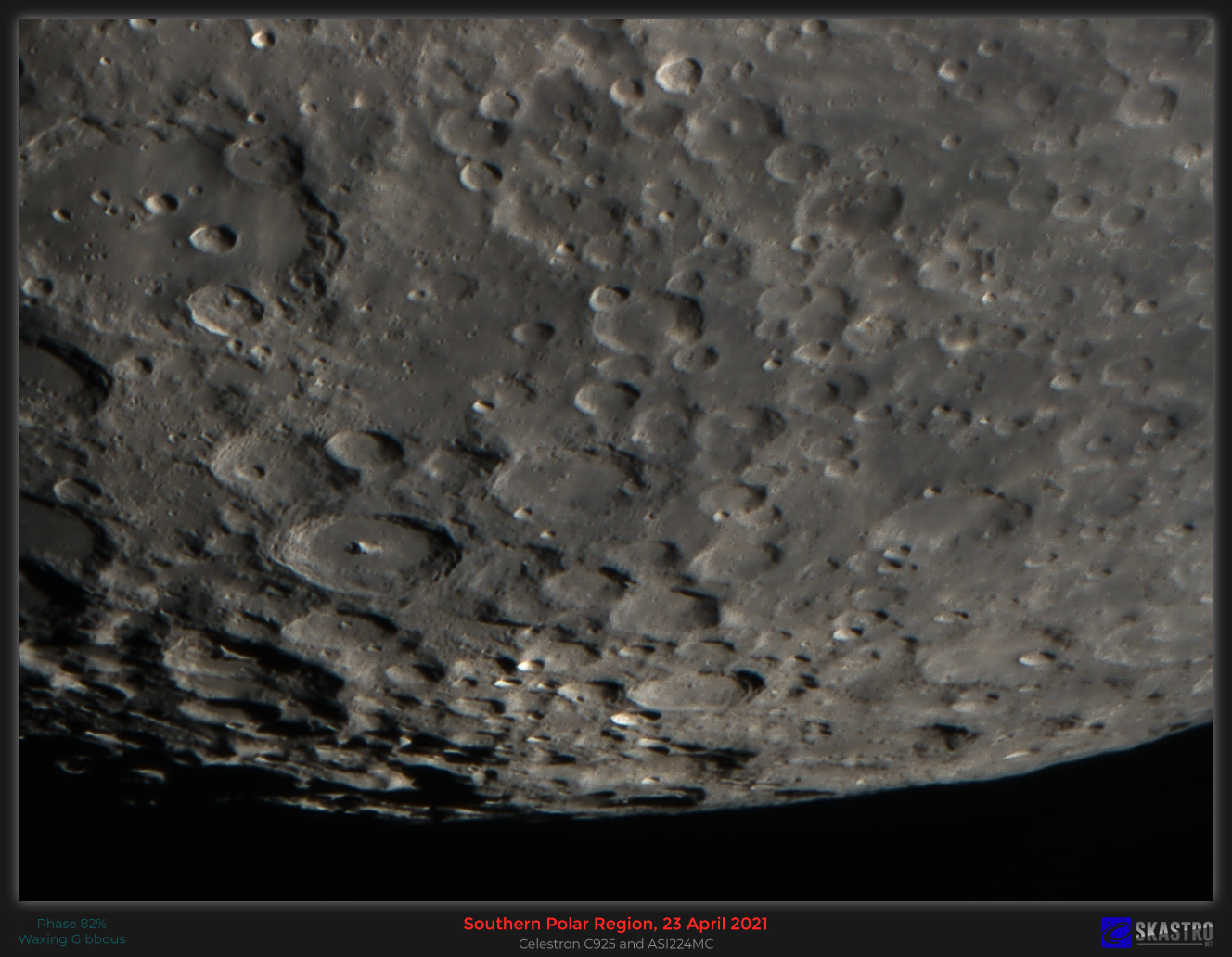
From my back yard observatory in Nottingham, UK. Using Celestron C925 SCT telescope and ASI224MC colour high speed planetary camera.
Telescope is at its native focal length of F10 for all these images since the seeing was much too unstable to use a Powermate or Barlow, even a x2 one woudl have been too much on this session.
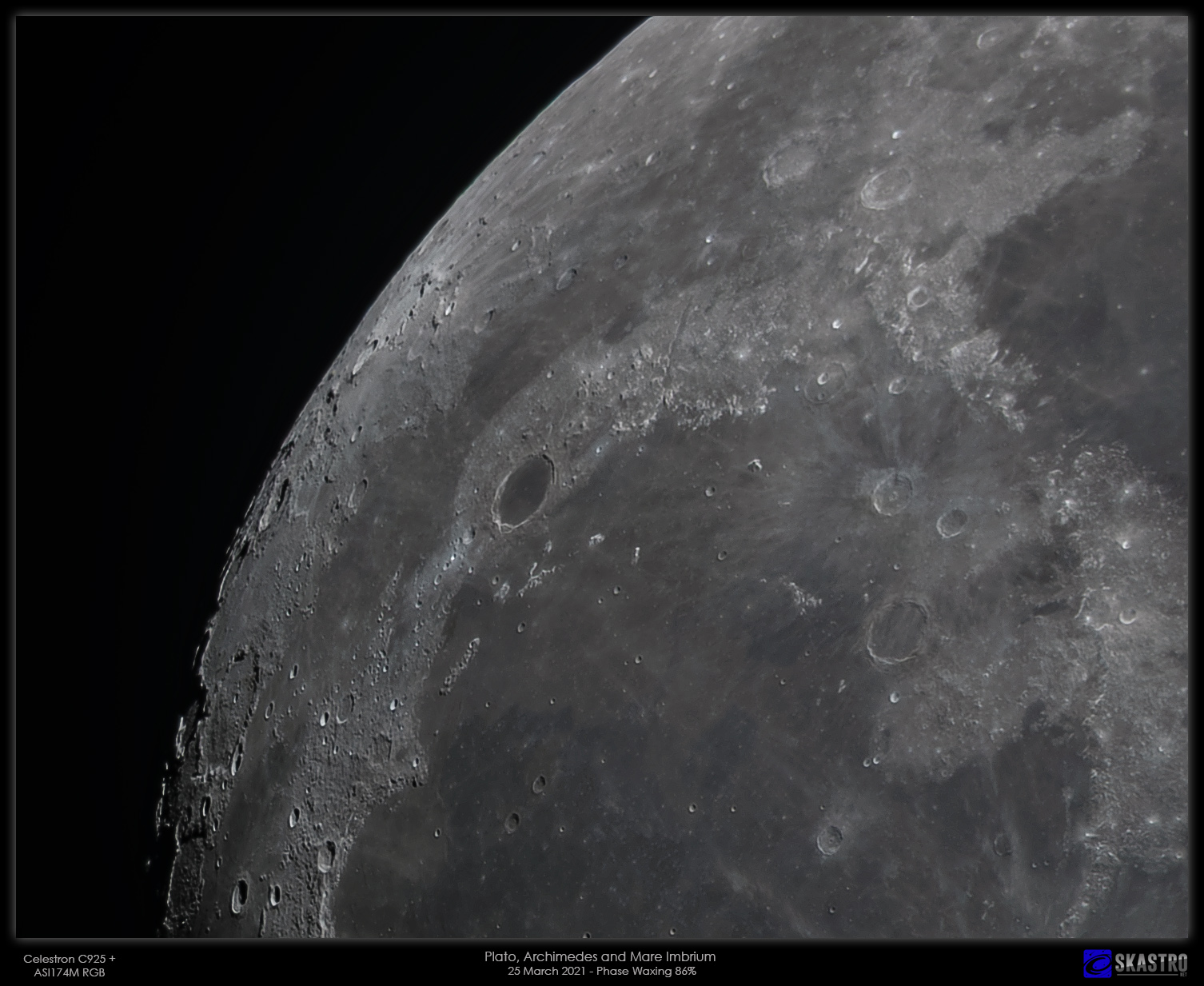
Lunar Images from 25th March 2021 with TEC140 and C925 SCT with ASI174M
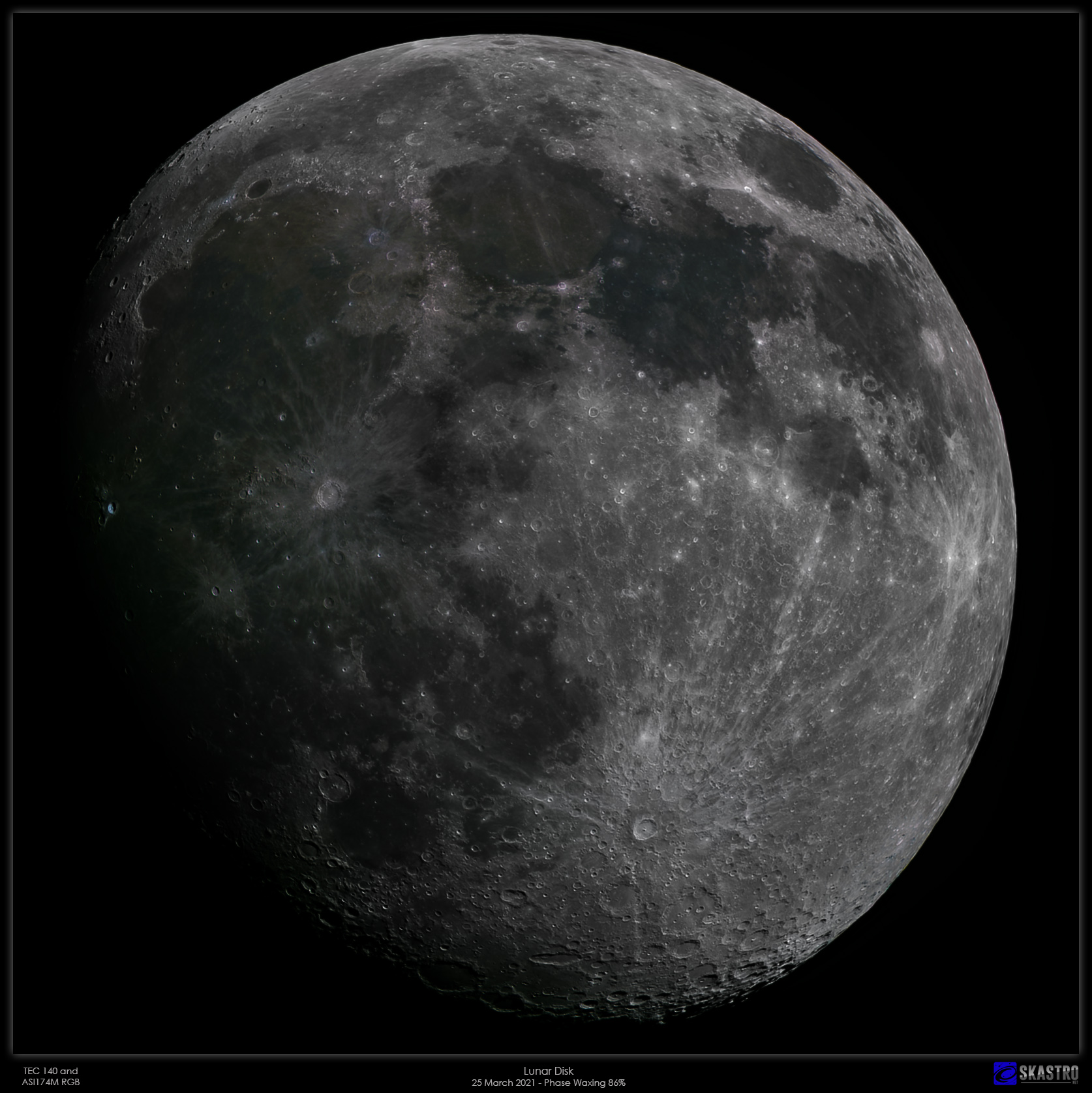
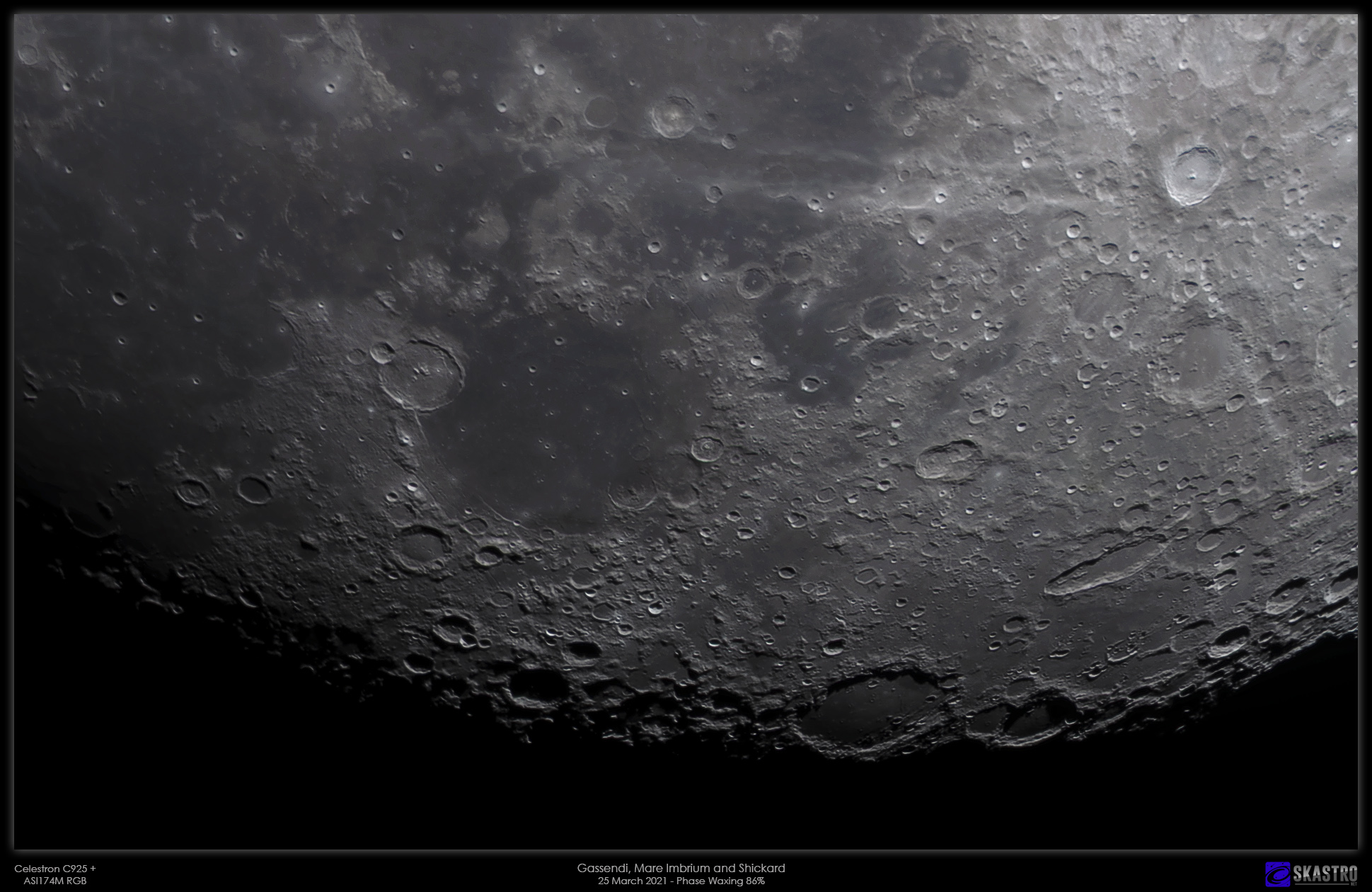
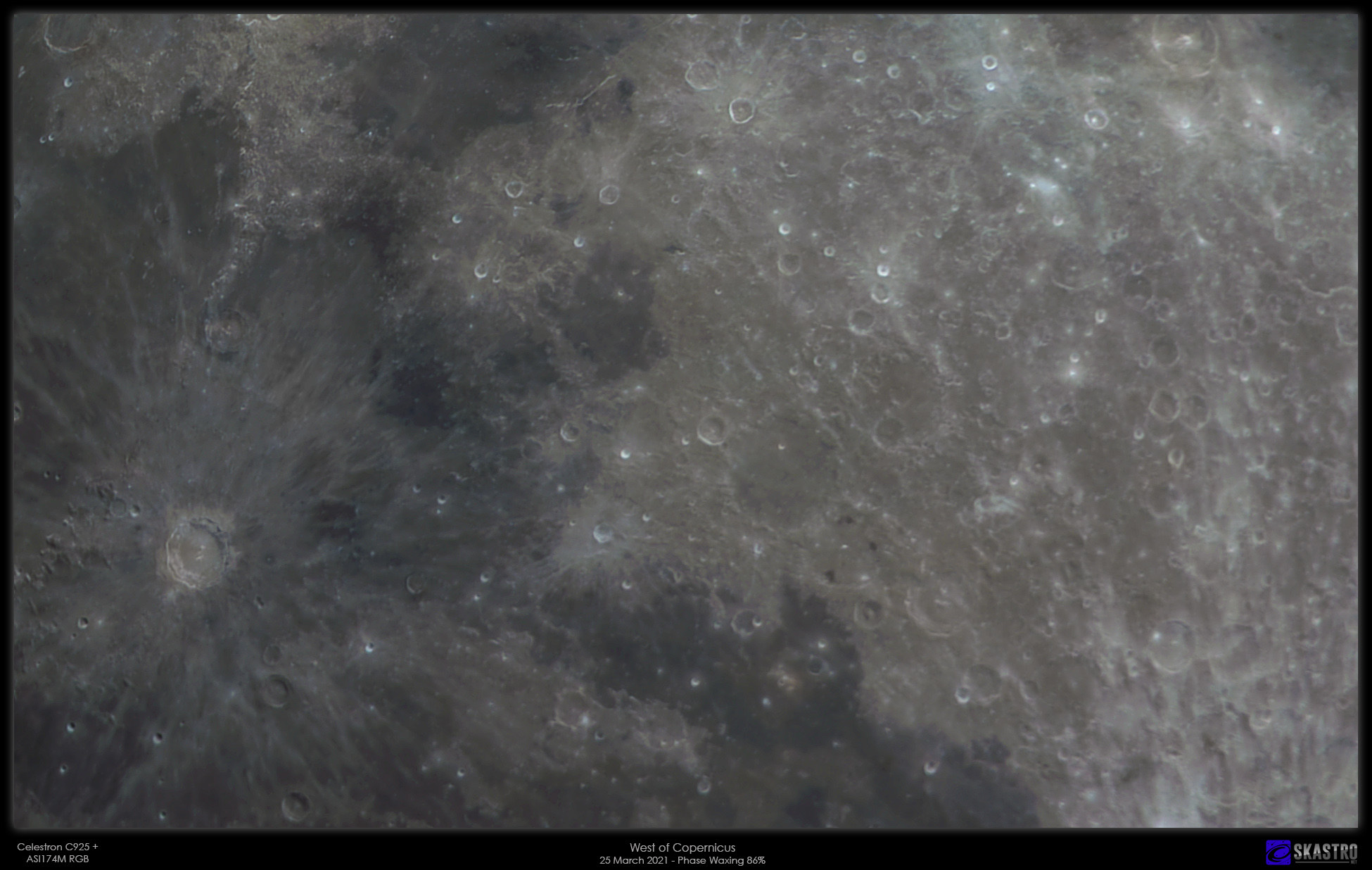
Images on this post were made by using the TEC140 and Celestron C925 SCT telescopes with my ASI174M mono camera. From my backyard in Nottingham on the evening of 25th March 2021 with the Moon high to the south in Leo at a phase of 86% waxing (i.e. growing towards full moon) and at an altitude of about 50 degrees above the horizon. A slightly hazy sky made for quite good seeing although it was very cold and windy and the moon was jiggling about a lot in the gusts, even inside my sheltered observatory. I had to try and time my capture runs between these gusts and passing clouds, a process that was not always successful. As a consequence I accumulated nearly 600G data for these four pictures in total, much of which had to be deleted. I was outside at the scope for about 90 minutes doing these captures.
All the captures were done in Firecapture software at about 60 fps in 16-bit mode. I used DeepSkyStacker for processing the .ser files and then Photoshop and PixInsight for image processing.
First up, the partial disk image below is with my TEC140 refractor (flattener removed) and the ASI174M camera. This is a two pane mosaic using RGB (Baader CCD RGB filters) for colour and a Baader Ha 7mm filter for the luminance. For the merging together of the two panes I used the Photoshop merge tool. The image is the best 50% of 6000 frames in each of the RGB channels and the top 50% of 10000 frames in the Ha. For my next run on this I am going to try for 20000 frames in each of the RGB to try and get more colour since I struggled to get more colour out of the bluer cobalt rich regions.
I am very happy with this image other than I wish it had that bit more colour. I think my technique of the Ha channel for the luminance is highly effective. I deconvolved this in PixInsight and then used a bit of HDR multiscale transformation and a bit of Unsharpmask to get a wonderful crisp luminance without overdoing it as I often see with some lunar images.
The RGB is simply aligned RGB channels with the alignment performed with the Star Alignment tool in PixInsight which is easier than Photoshop in my opinion for this purpose.
Below we have three images of the Moon in a closer up or more "zoomed in" imaging scale. These are with the C925 SCT telescope at its native F10 focal length - i.e. no Barlow - and again with the ASI174M with RGB filters. I did not use a dedicated luminance channel with these three images and I instead used RGB channels and made a pseudo-luminance after balancing those three channels in a 1:1:1 combination to create the pseudo-luminance. I then used deconvolution, HDR multiscale transformation and Unsharpmask in PixInsight on this pseudo-luminance to enhance the details before blending it with the RGB composite in Photoshop.
I hope you like them!
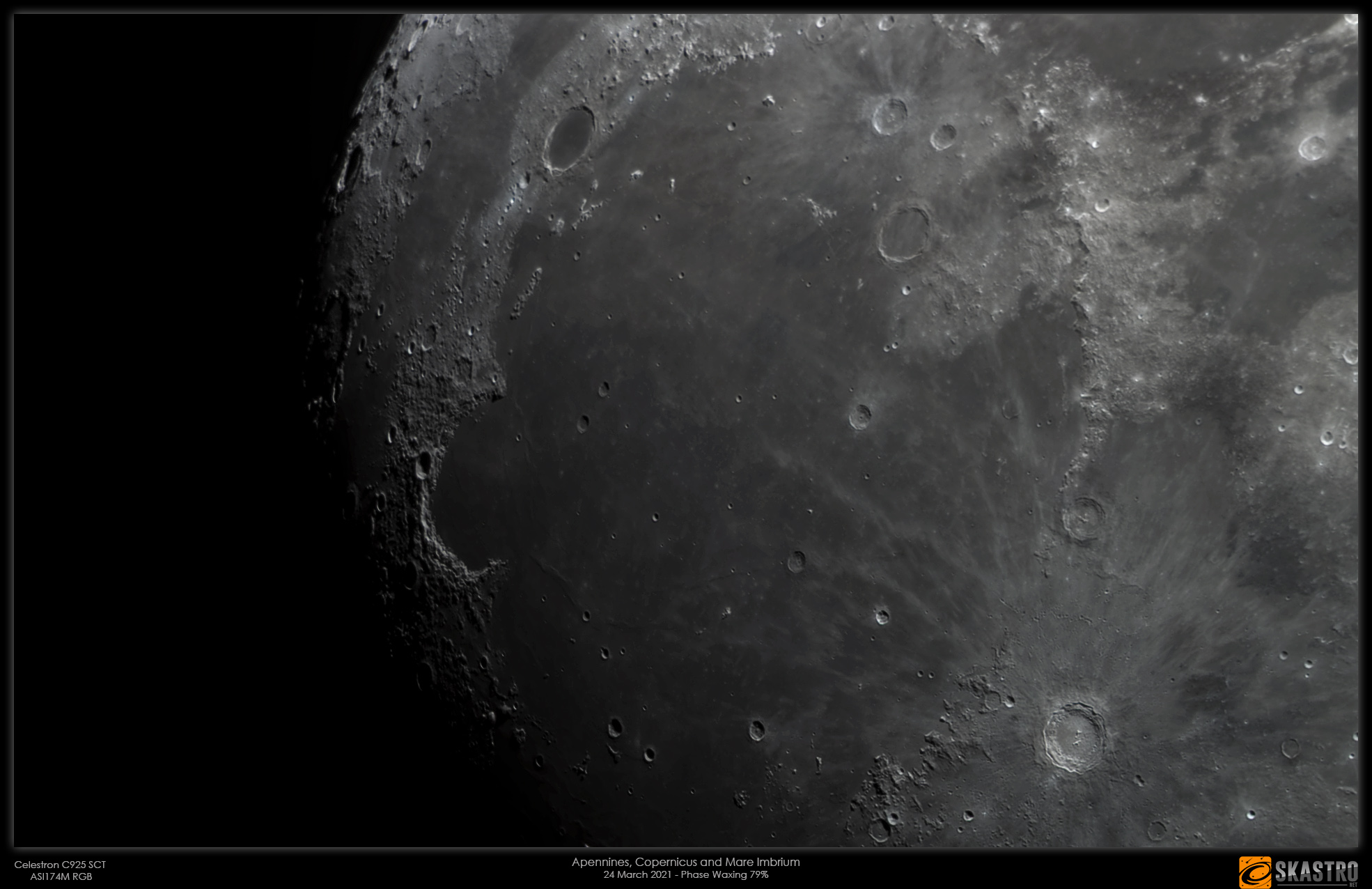
Lunar Images 24 March 2021 with TEC140 and Celestron C925 with ASI174M
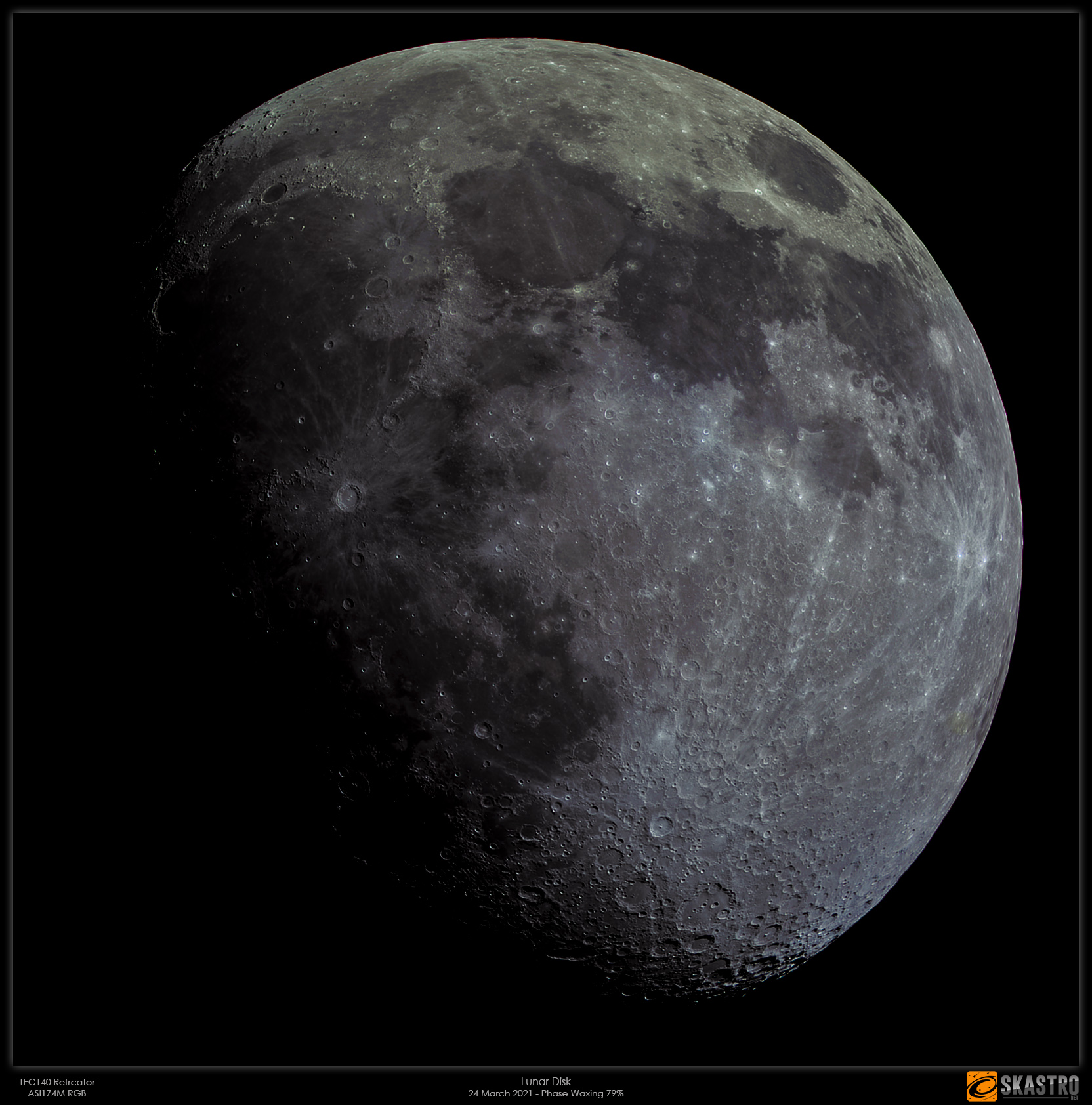
A selection of four images I took with my two main telescopes on the evening of the 24th March 2021 with The Moon at 78% waxing gibbous phase to the South in the constellation of Leo.
First up below is a main disk taken with TEC140 refractor. I shot RGB through those filters on my ASI174M camera and I took the luminance through a 7nm Ha filter. My field of view with the TEC140 and this camera is only half the disk and so I have to take sequence runs, one for the north and the other for the south and then combine them in Photoshop.
I then moved on to use my C925 SCT telescope again using the ASI174M in RGB mode. I did not capture a specific luminance channel this time and just used RGB and made a pseudo-luminance. The weather conditions were too windy to get a closer scale with the Barlow lens on this occasion.
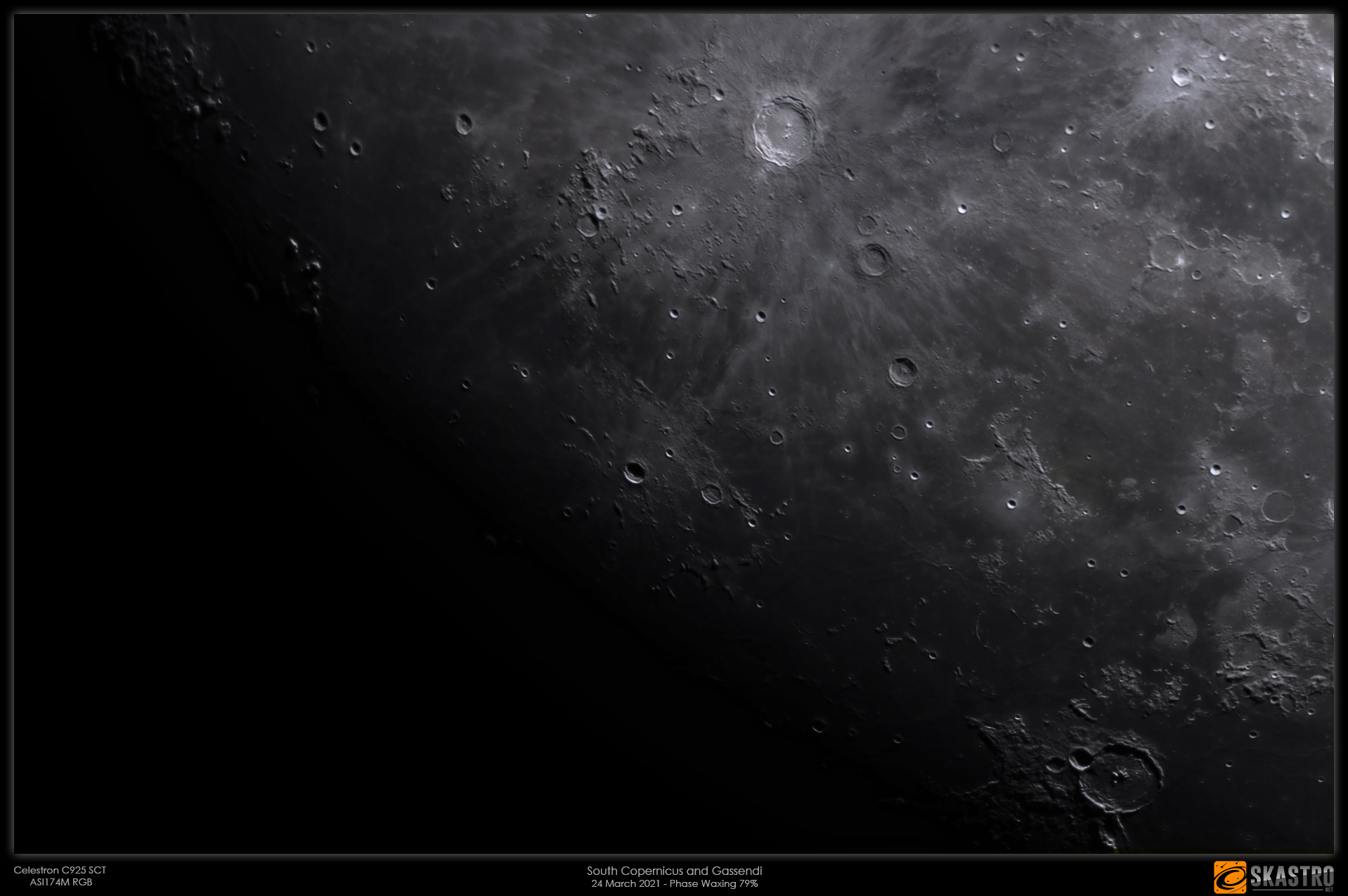
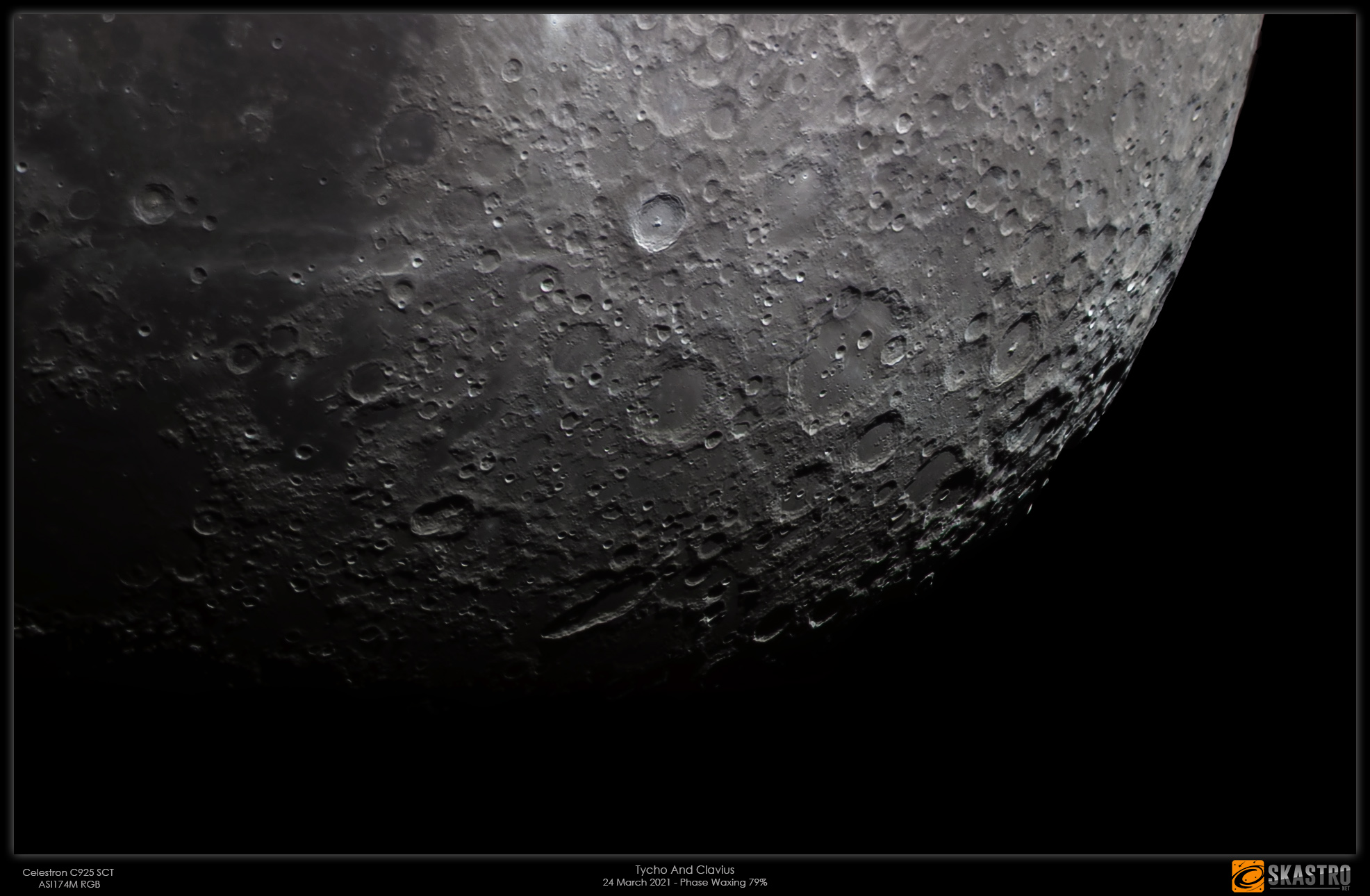
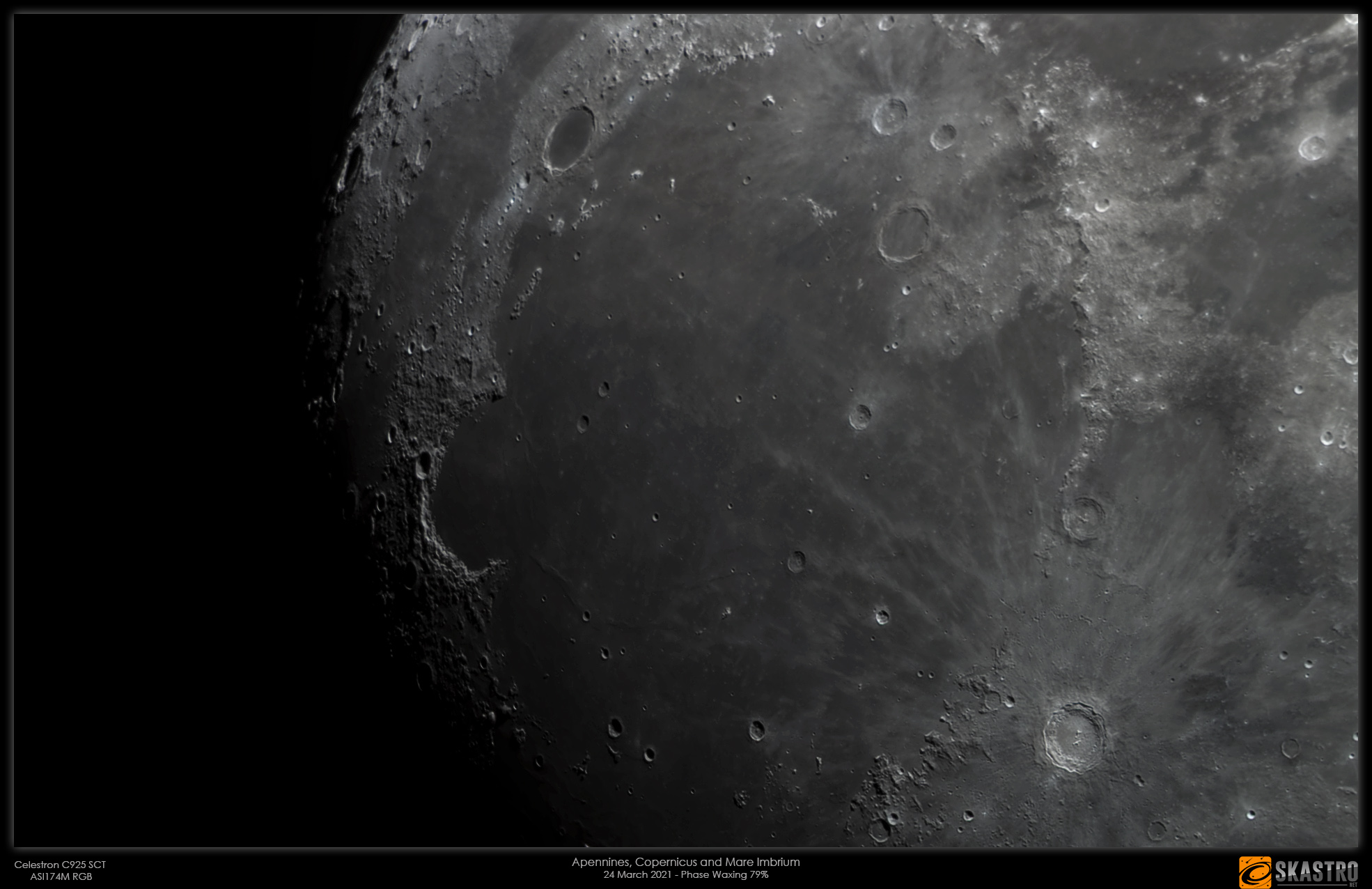
All images are RGB and captured with Firecapture software and then processed in Planetary System Stacker and then in PixInsight and Photoshop.
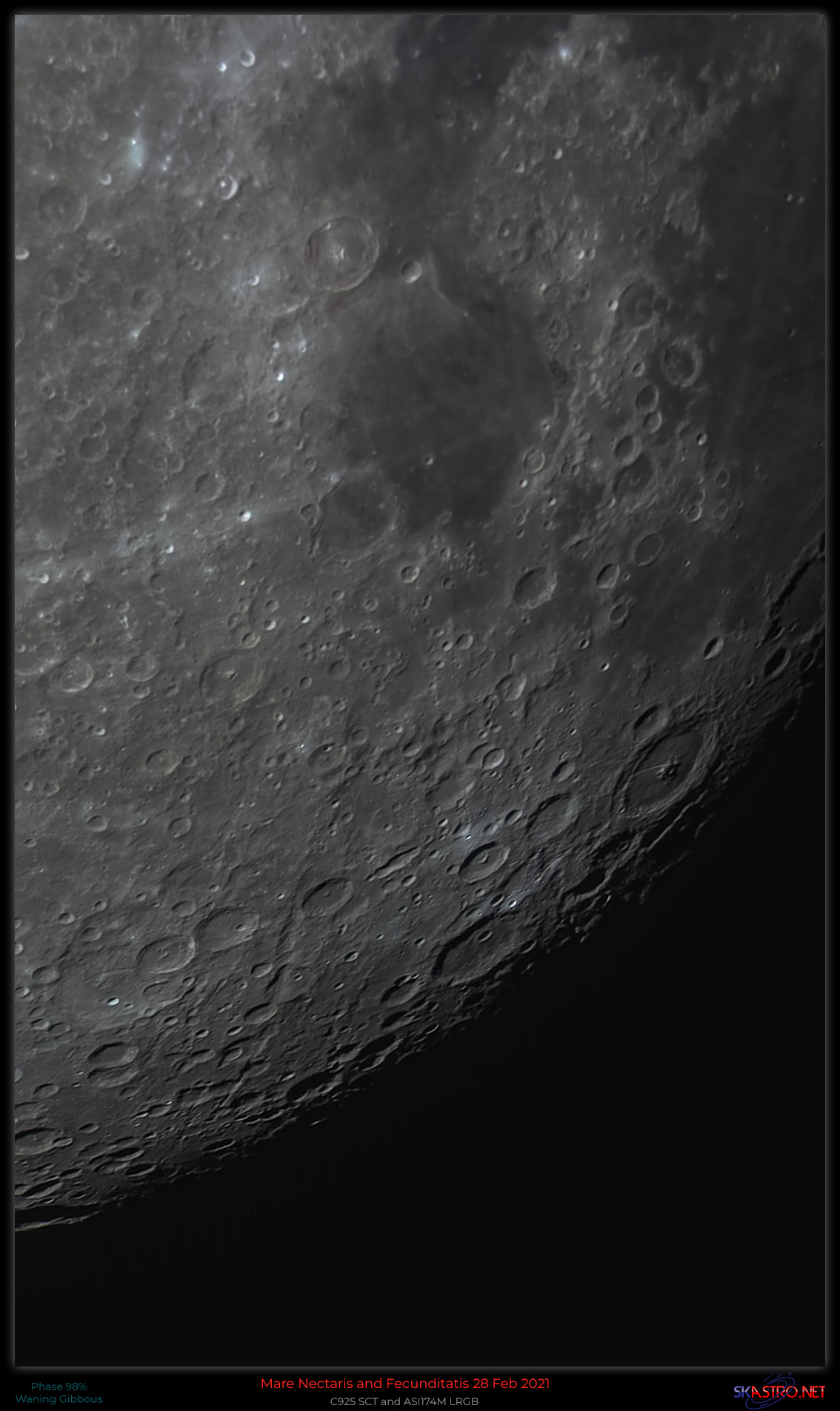
Lunar Images, February 2021 with C925
I have owned my Celestron C925 SCT telescope for many years but have only ever used it for visual purposes. I have always preferred the use of refractors for imaging. However, I have started to want to get much greater detail in my lunar images, having been bitten by the lunar imaging bug. I had some significant issues getting the C925 properly collimated, accurate enough for imaging purposes, a story I discuss here. After successfully collimating the scope these are my first two pictures taken with The Moon quite low down in the East with some slight mistiness.
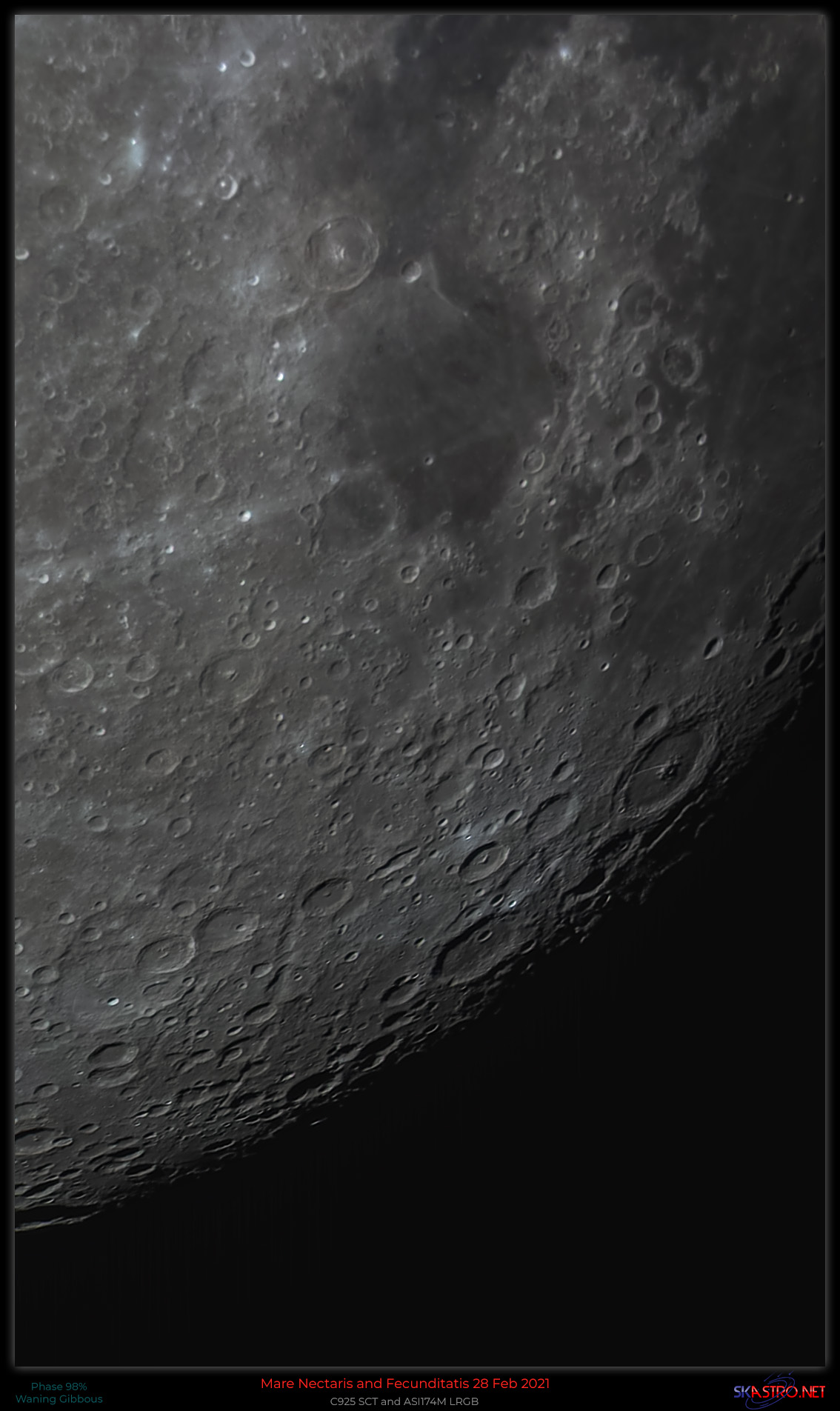
Above is the best 15% of 5000 frames in each of Red, Green and Blue. I collected the data with Sharpcap with ASI174M camera with Baader RGB filters. I created the master R,G,B files with PlanetarySystem Stacker and then used PixInsight and Photoshop to develop.
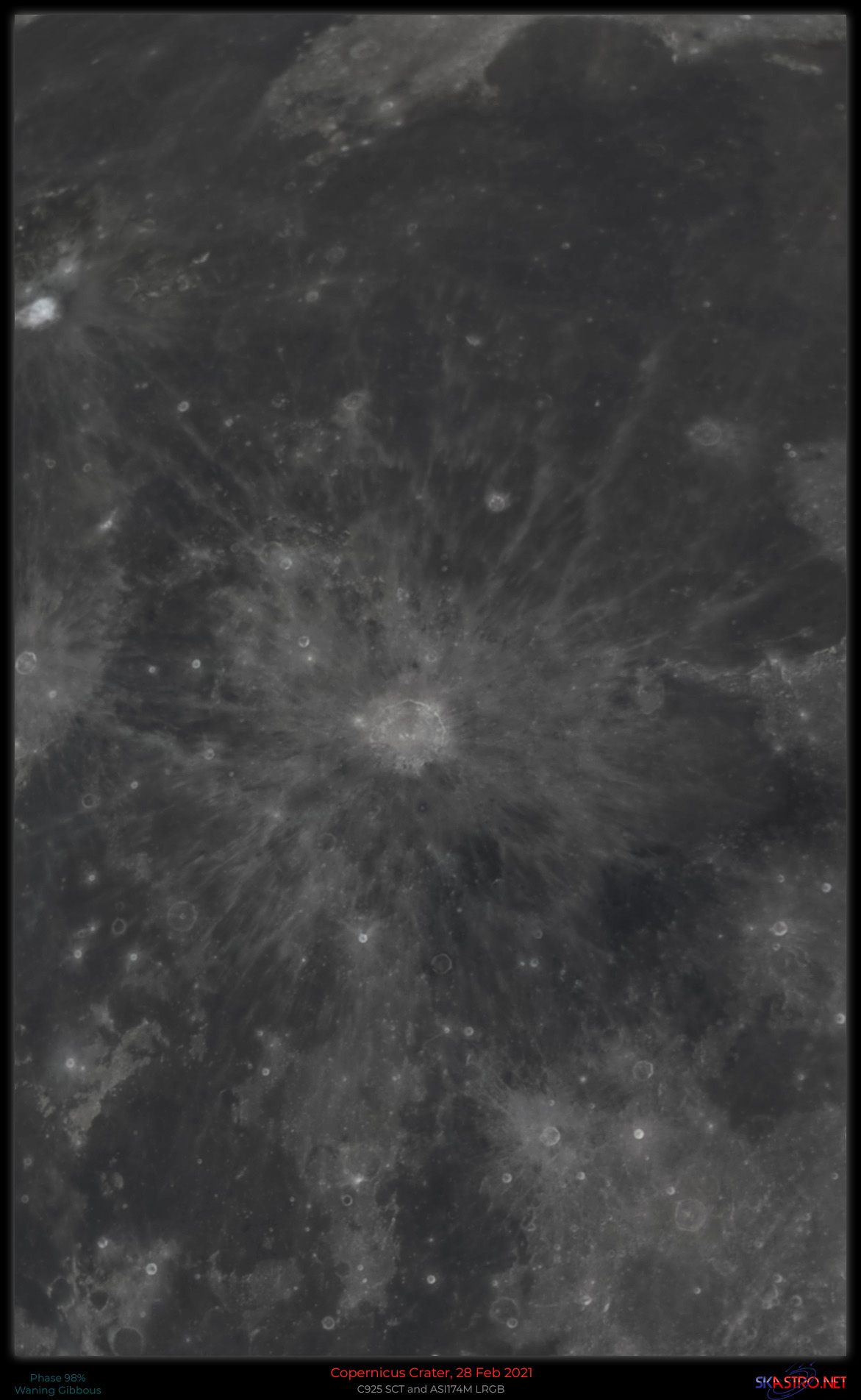
Above is Copernicus Crater and this time the best 15% of 3000 frames in each RGB filter. I used the same software and processes. However, you can see this does not quite have the same level of details as the top picture in this post due to lack of enough frames. There is always a balance of getting enough frames and the size of files and compute power to process them.
Lunar Images, 25th Jan 2021
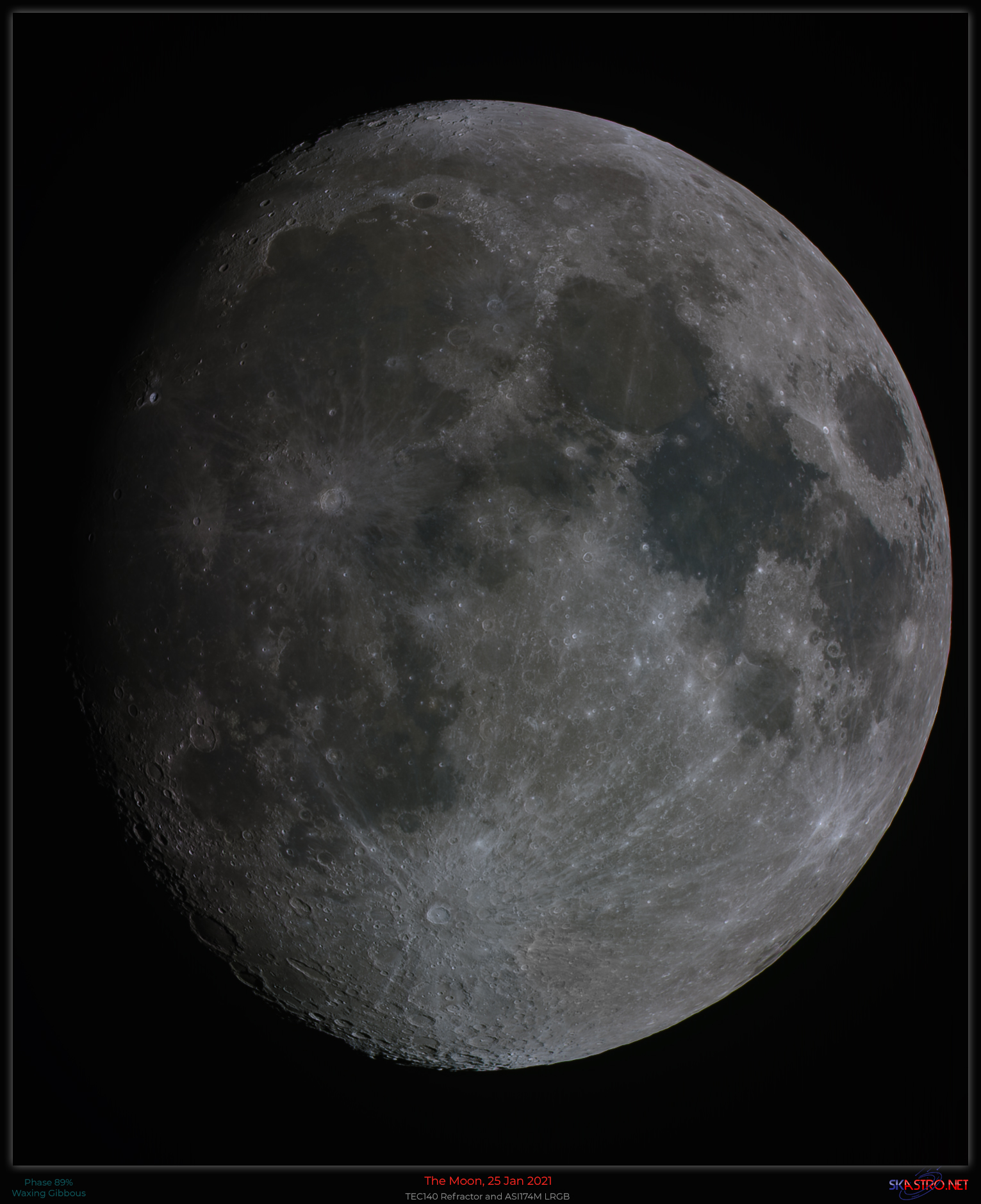
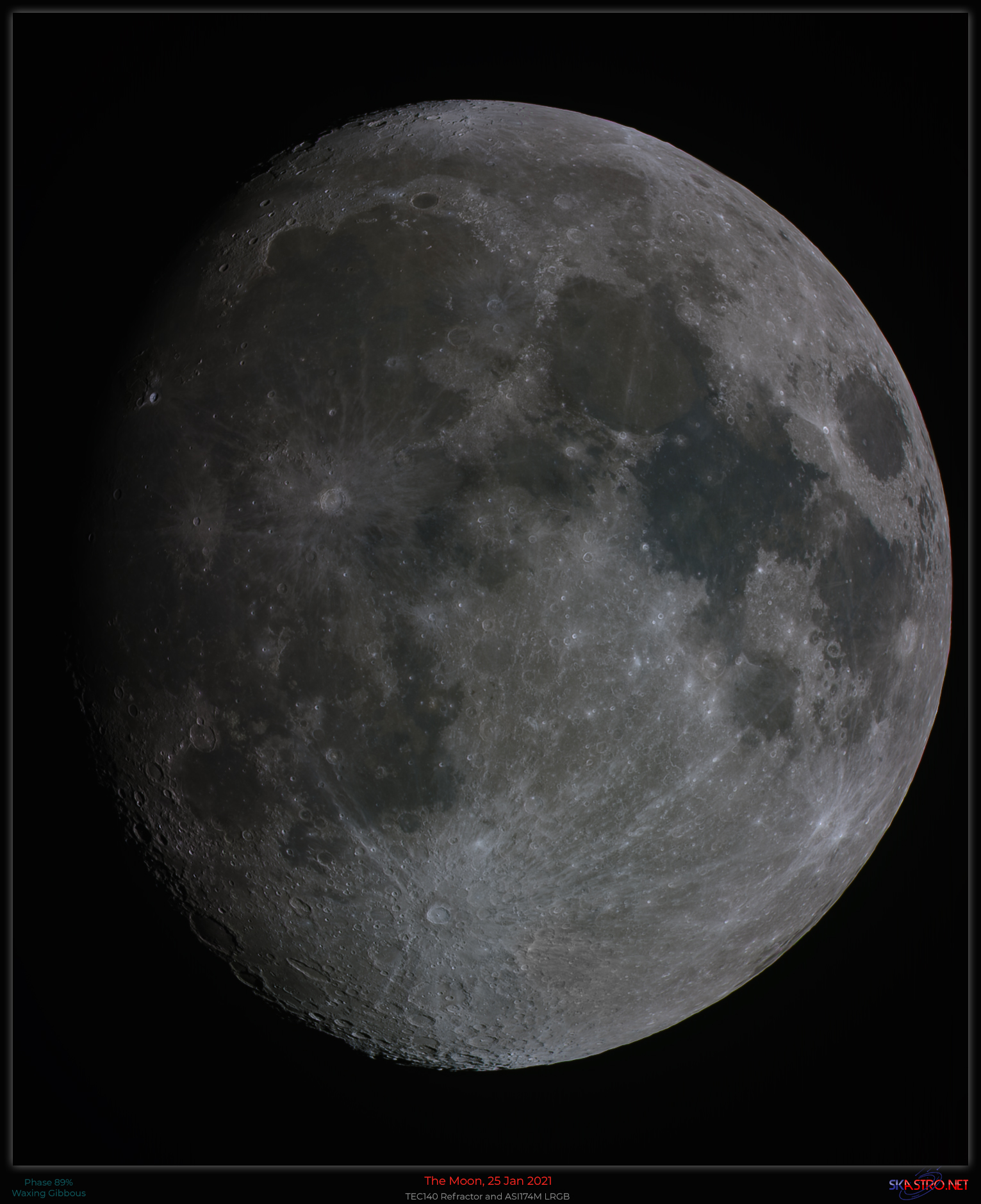
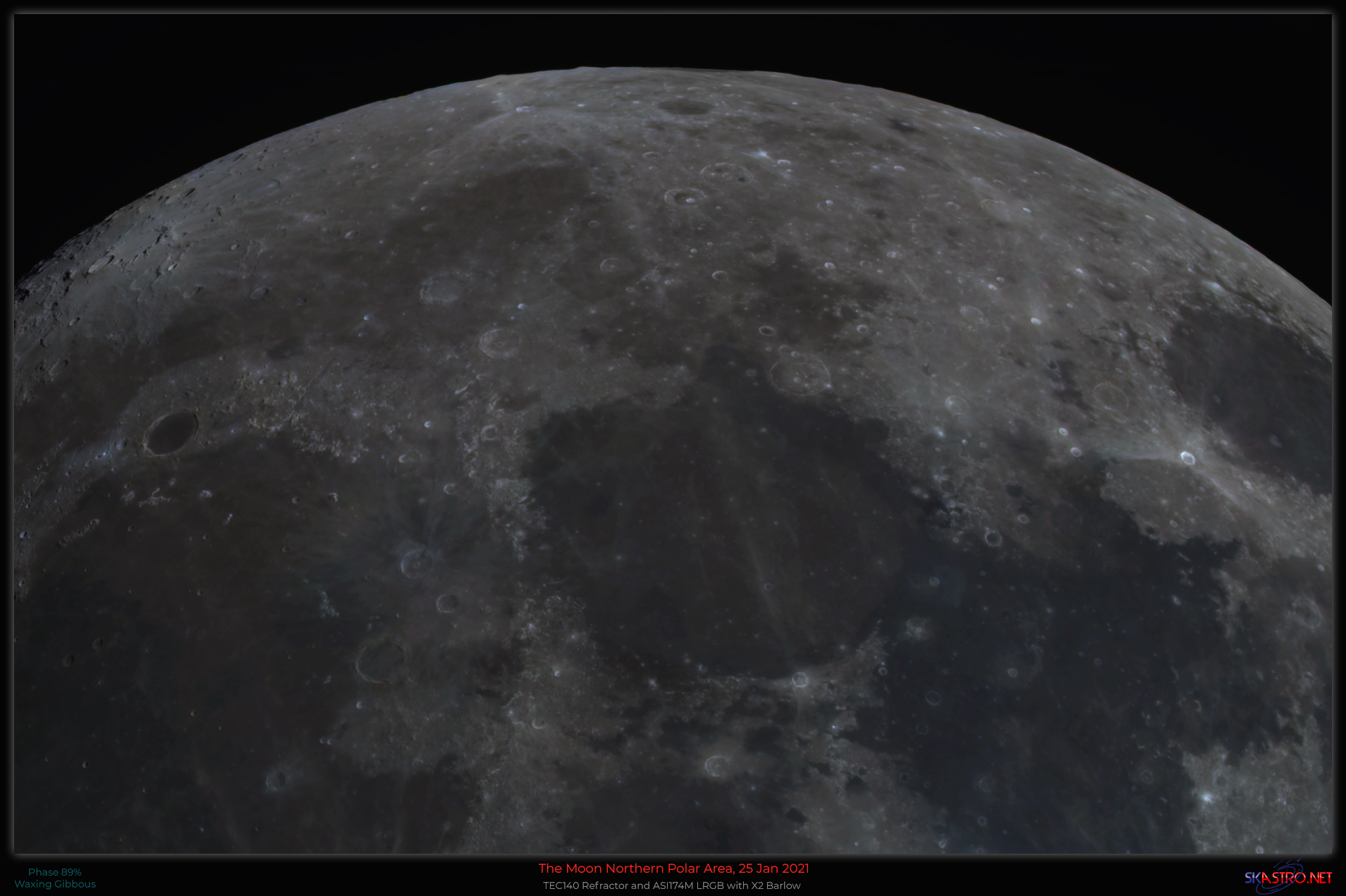
The Moon on 25th January 2021 at 89% in Gemini. It was freezing cold, snow on the ground with reasonable skies and seeing conditions. The full disk below is the best 20% in each of the R,G and B filters out of 10000 frames. I used Planetary System Stacker software to process the raw .SER files from the camera and then used PixInsight and Photoshop for processing. I used my TEC140 refractor and ASI174M high speed camera with Baader RGB filters.
I no longer capture a separate luminance channel and instead make a synthetic luminance from the RGB data and then sharpen that and use as a luminance layer in Photoshop.
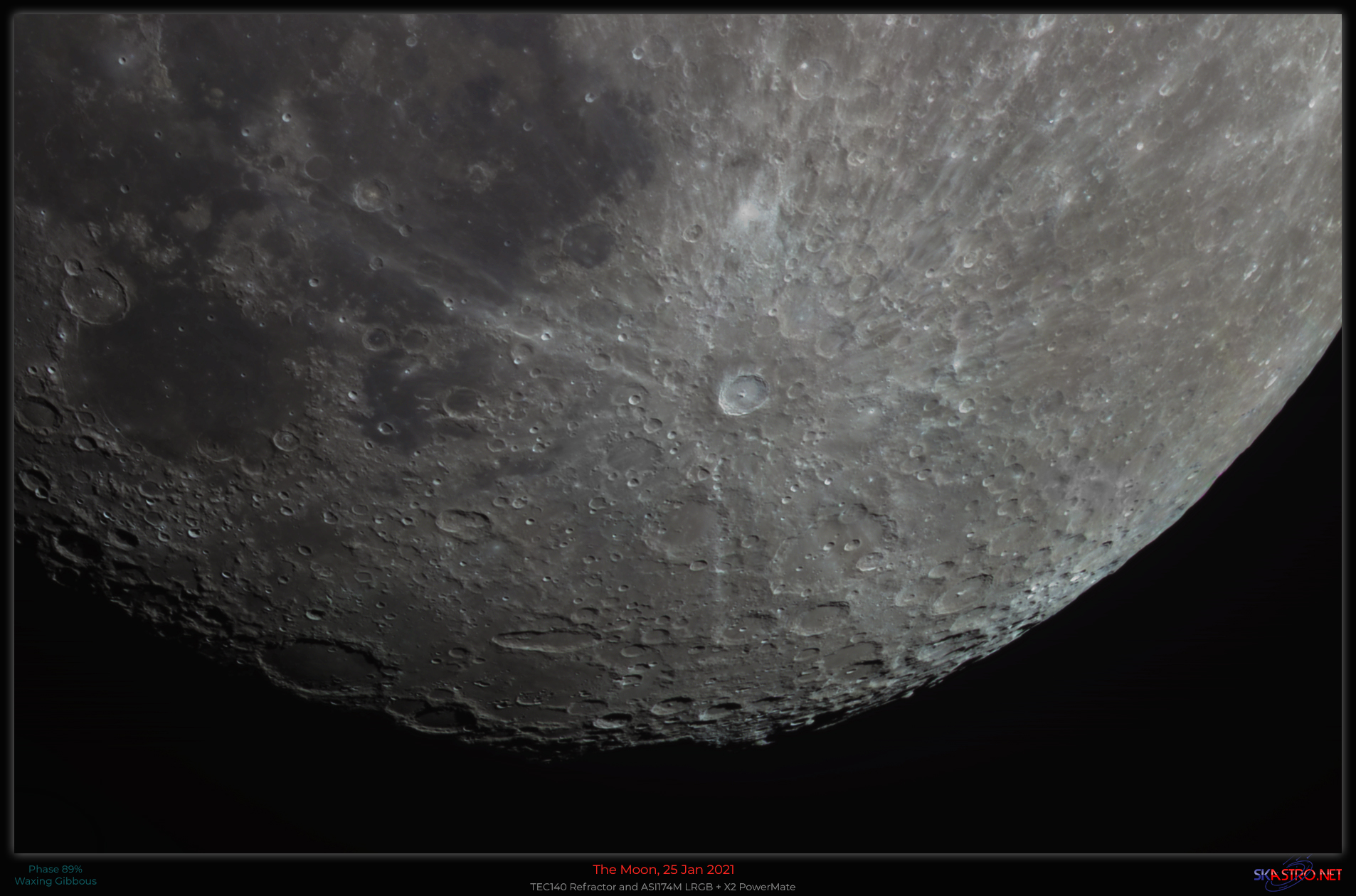
For the two images below I used my Televue 2" Powermate X2 in order to double the TEC140 telescope's focal length to 1960mm. The processing and frame set is the same as the full disk at the top.
Lunar Images, 23rd Jan 2021
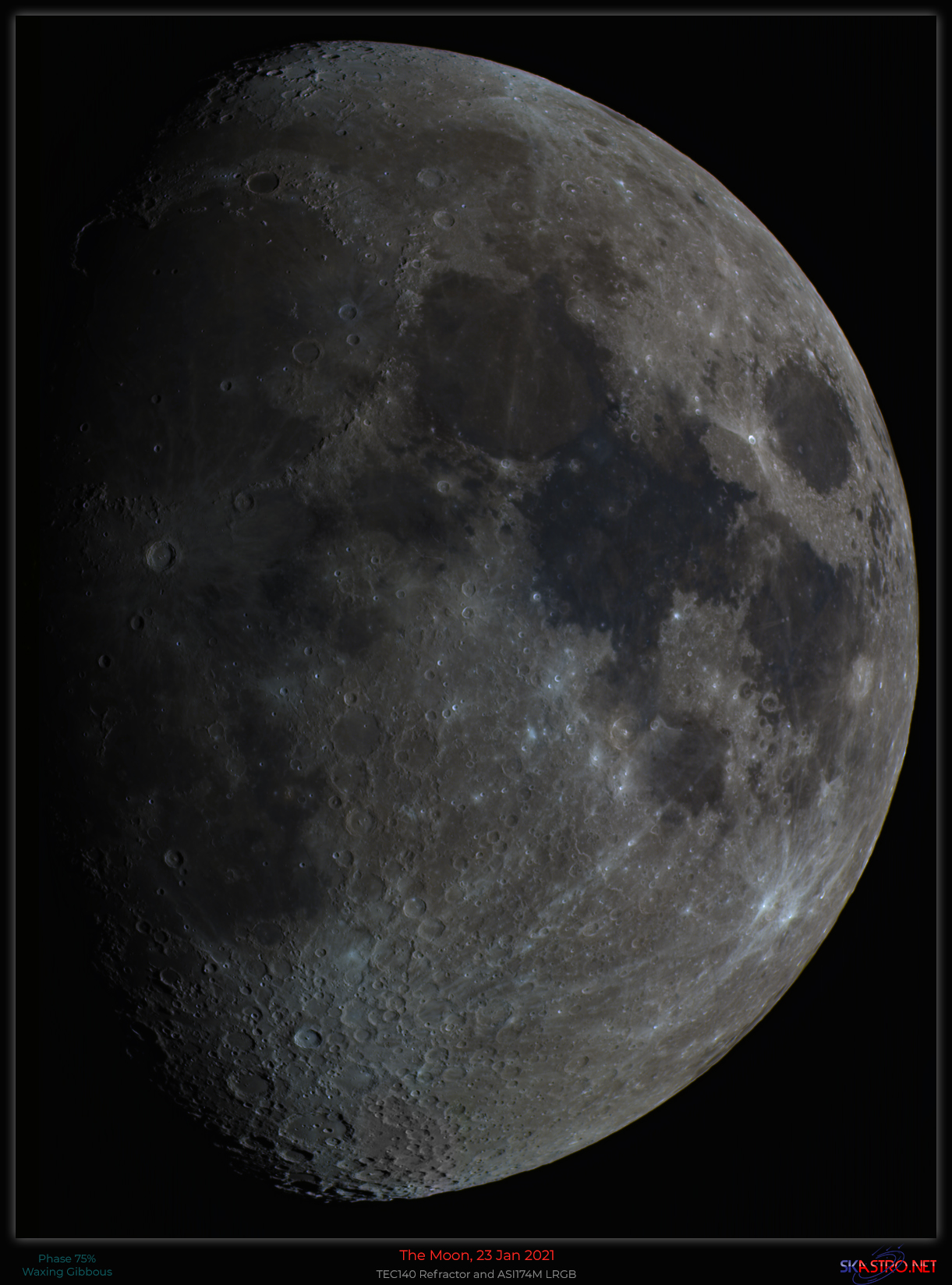
After months and months of cloud, The Moon shone down on us in Nottinghamshire on the 23rd January from high up in the sky in Gemini (my daughter's birthday!) It was at a phase of 74% waxing gibbous. I used my TEC140 scope, ASI174M camera and Baader RGB filters. The full disk image was with the telescope at its native focal length and with the two closer up views at the bottom I used a 2" Televue Powermate x2 in front of the filter wheel/camera assembly.
Above is best 25% of 20000 frames in each of RGB.
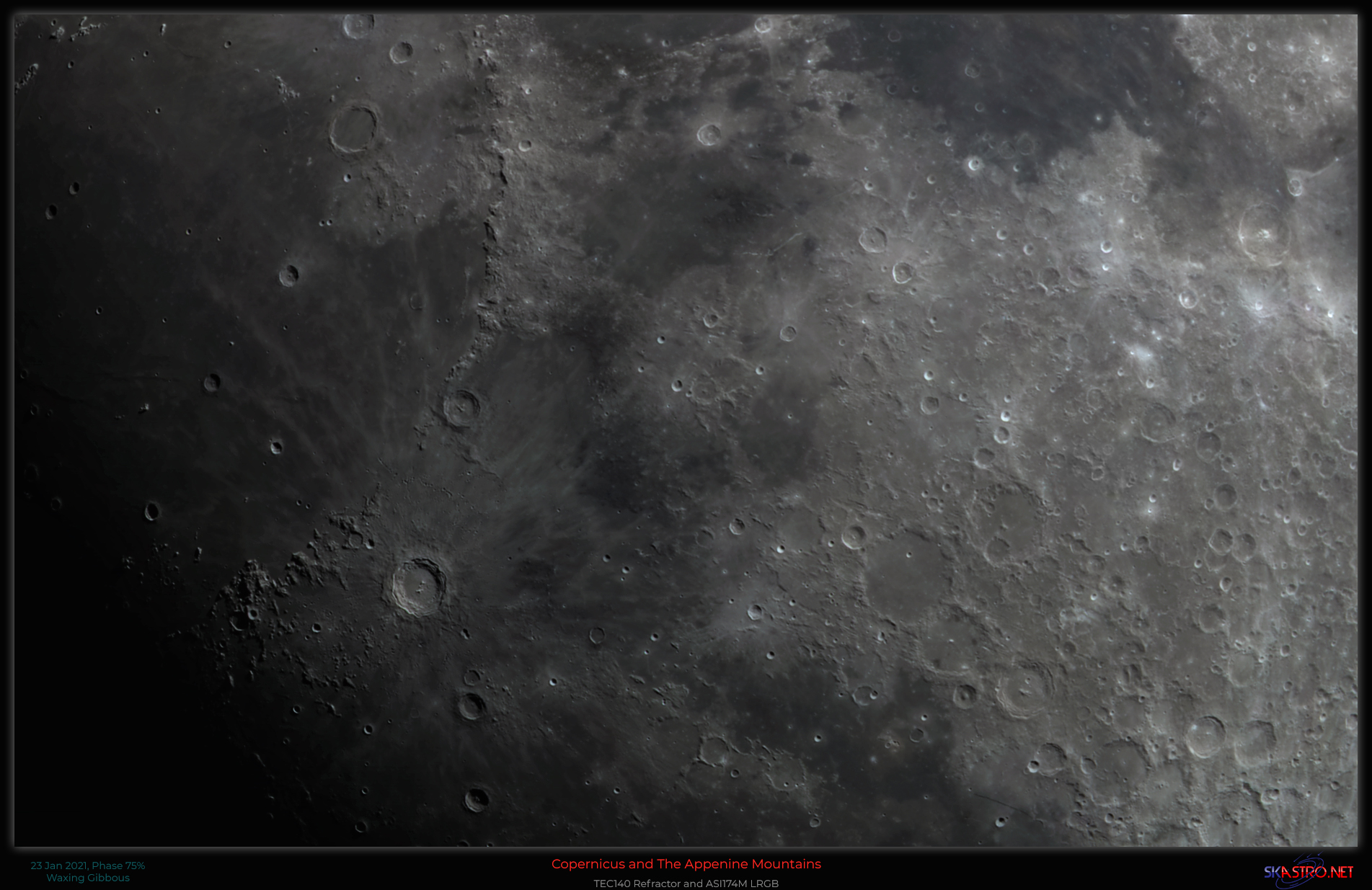
After the full disk image I inserted the Televue 2" x2 Powermate to get a more zoomed in view. Above is the Apennine Mountains and Copernicus crater to the left of centre. Best 15% of 5000 frames in LRGB.
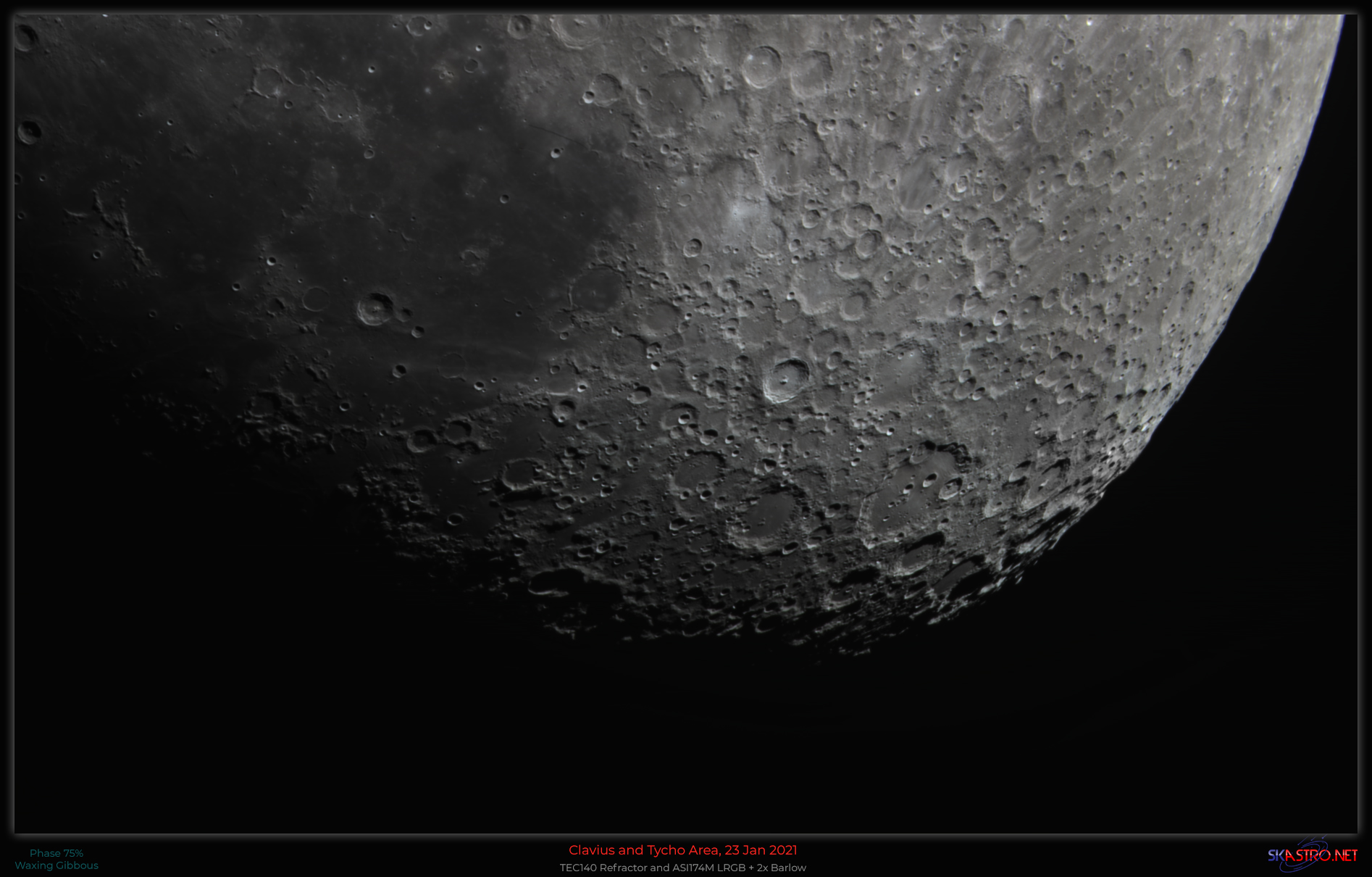
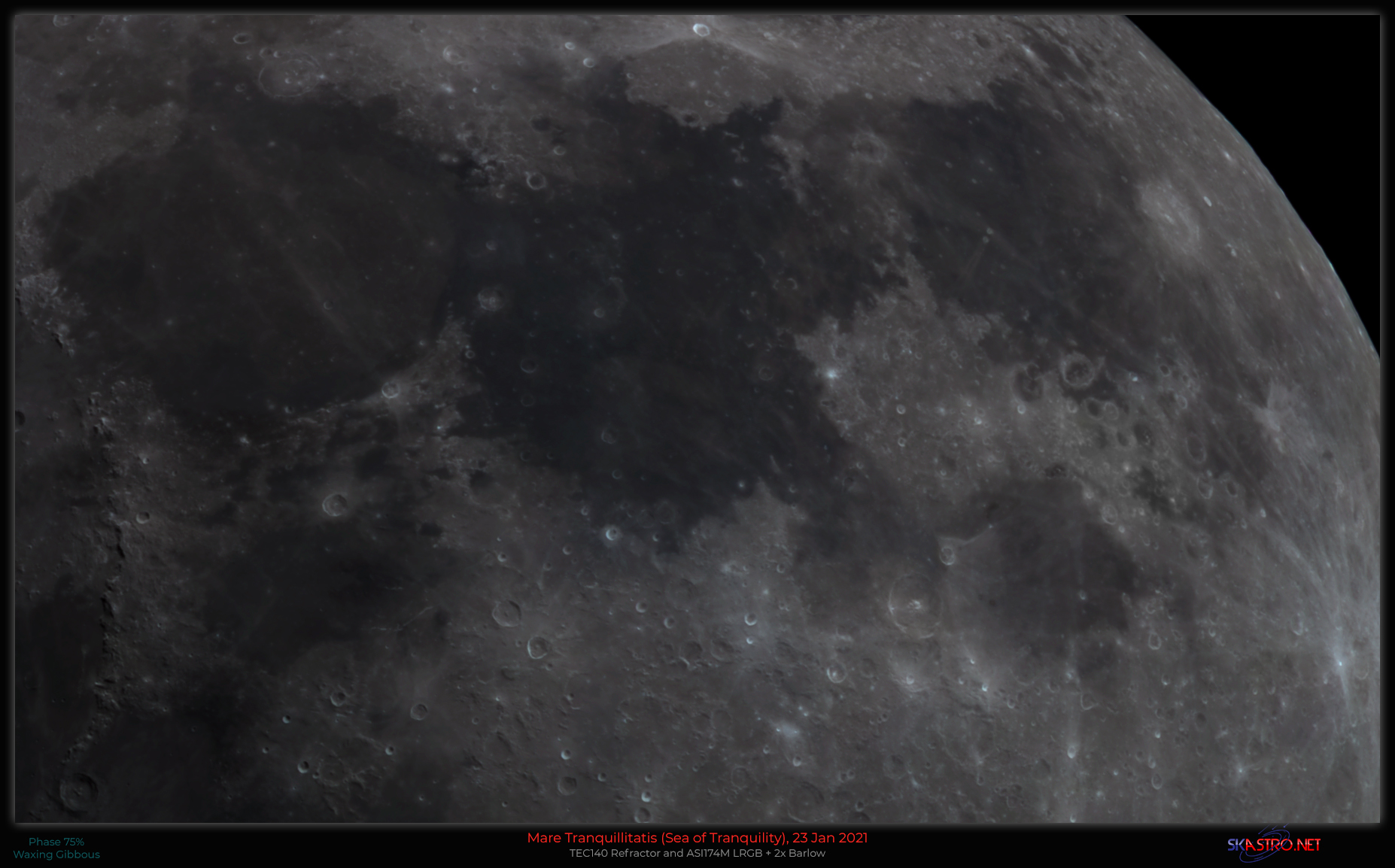
The below two images are the same telescope configuration Again, best 15% of 5000 frames in each of LRGB. To the left we have The Sea of Tranquillity (Apollo 11 landing area) and to the right Copernicus and the Apennine Mountains.
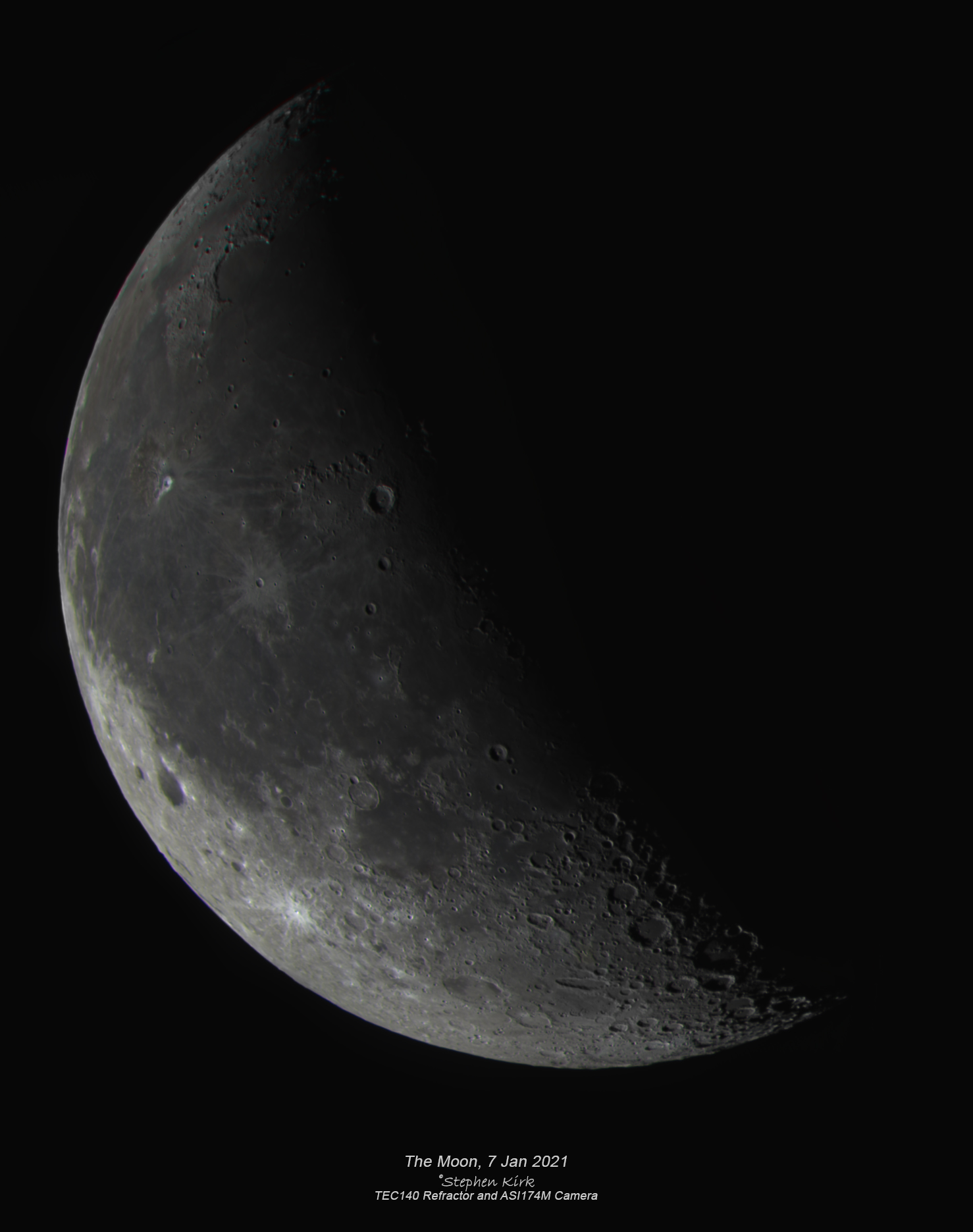
The Moon, 7 January 2021
I had to get up early in the morning to get this picture of The Moon. I set my alarm and got up at 05:00 which took considerable motivation, especially since it was -6C! I don't capture many last quarter and later moon pictures because the Moon is only ever visible in that phase early in the morning and working full time it is not easy to be getting up very early when you have to do lots of driving. However, conditions for astronomy in the UK have been exceptionally poor for the last six months of 2020 and I am desperate to be able to image anything at all!
Technical Details
The Moon was in Scorpio, low down to The South from my location, and seeing was average with the Moon at such a low altitude Phase is 38% waning.
Imaged from my back garden with my TEC 140 refractor and ASI174M camera with LRGB filters. I captured 10000 frames in each of R,G and B and 25000 in luminance. The .SER files were quite jumpy with The Moon being at quite a low altitude and so I used about 50% of the frames from each recording. I captured with Sharpcap and then processed with Autostakkert, PixInsight and Photoshop.
I hope you like it!
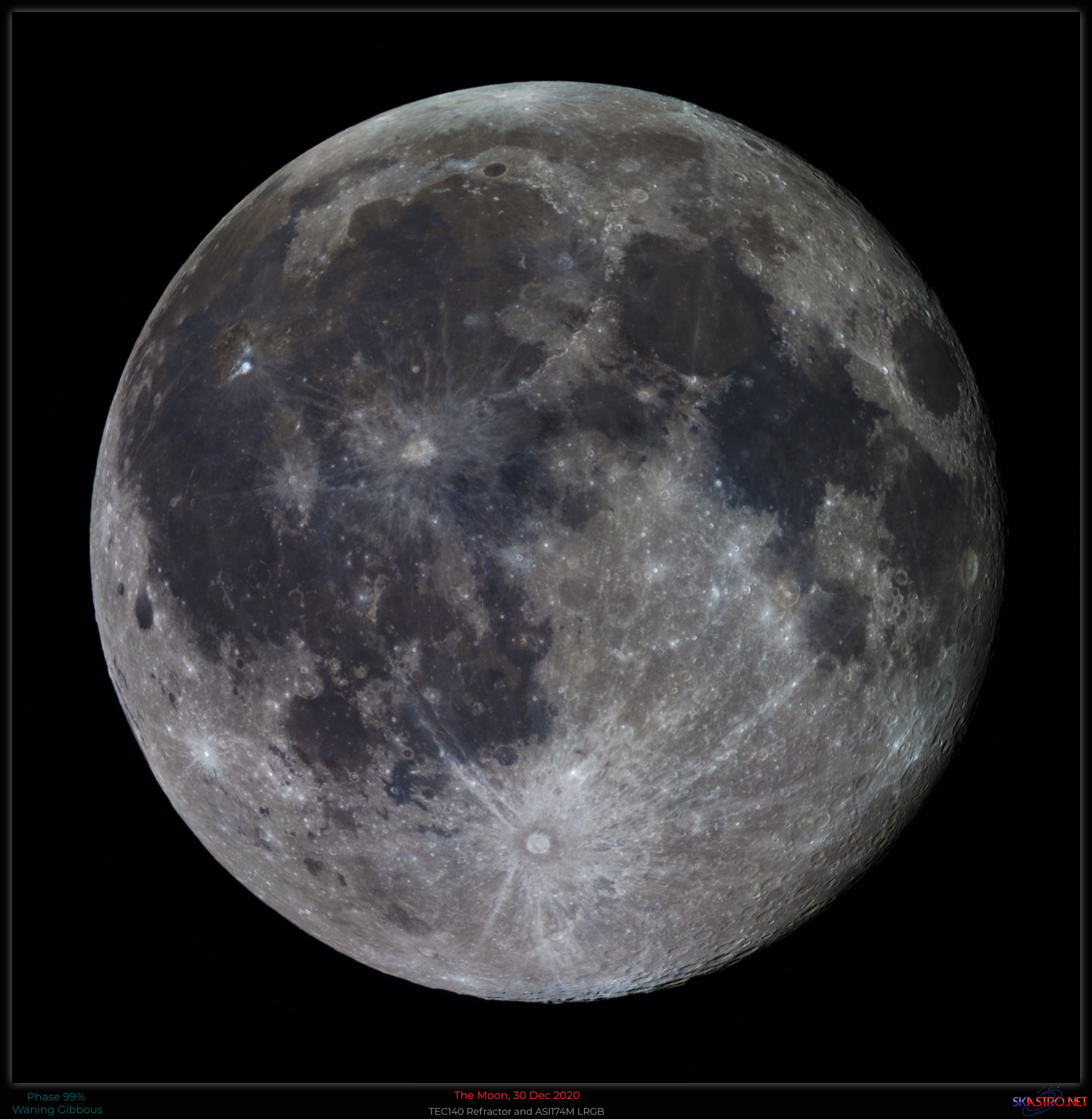
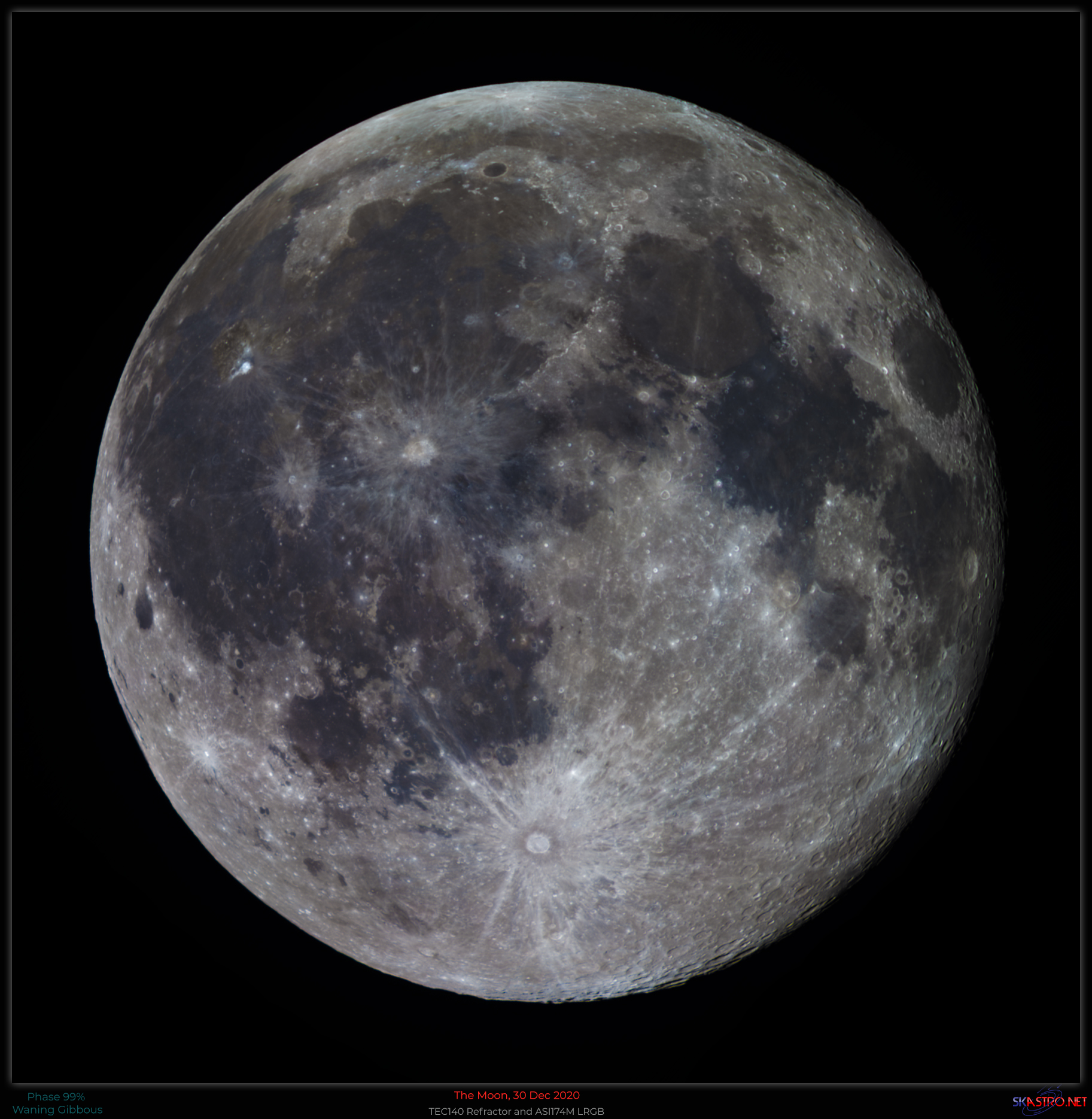
The Moon, 30 Dec 2020
The Moon at a 99% waning phase 30 Dec 2020 between 21:30 and 22:20. Note the bluish and tan colours of the mare (seas).
Technical Details
Imaged from my back garden in Nottingham, UK. The Moon was high up in the constellation of Cancer and seeing was very good - unusual in the UK. TEC140 refractor and ASI174M camera.
The image scale is such that I had to capture two runs with each filter to capture the North and The South parts of The Moon and then stitch the two together in Photoshop using the Merge tool. I used LRGB filters and captured 10000 frames in RGB and 20000 in luminance. Data set was in excess of 500 Gigabytes! I then used Autostakkert, Photoshop and PixInsight to process. Capture software in Sharpcap.