
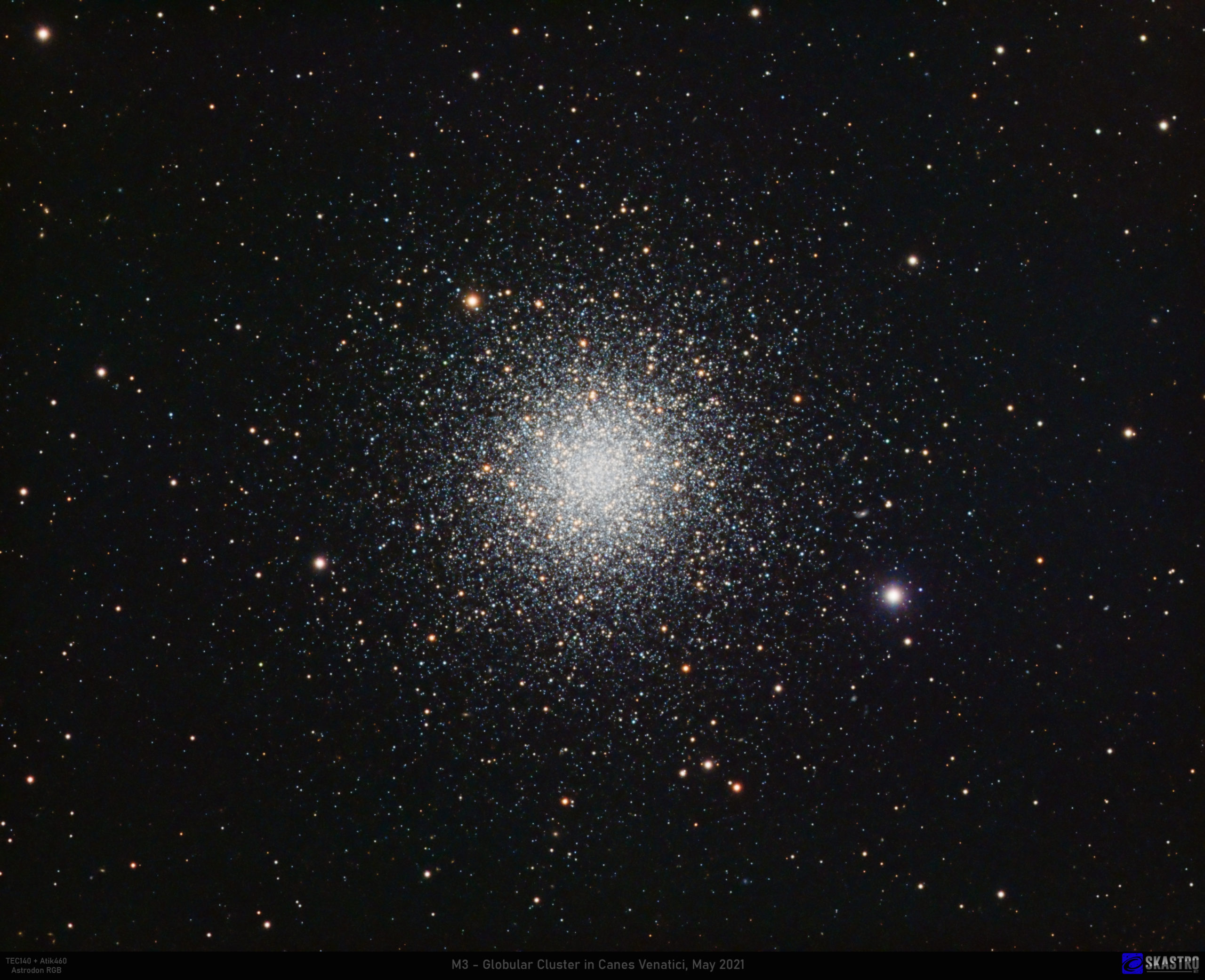
M3 Globular Cluster in Canes Venatici
Lorem ipsum dolor sit amet, consectetur adipiscing elit. Ut elit tellus, luctus nec ullamcorper mattis, pulvinar dapibus leo.

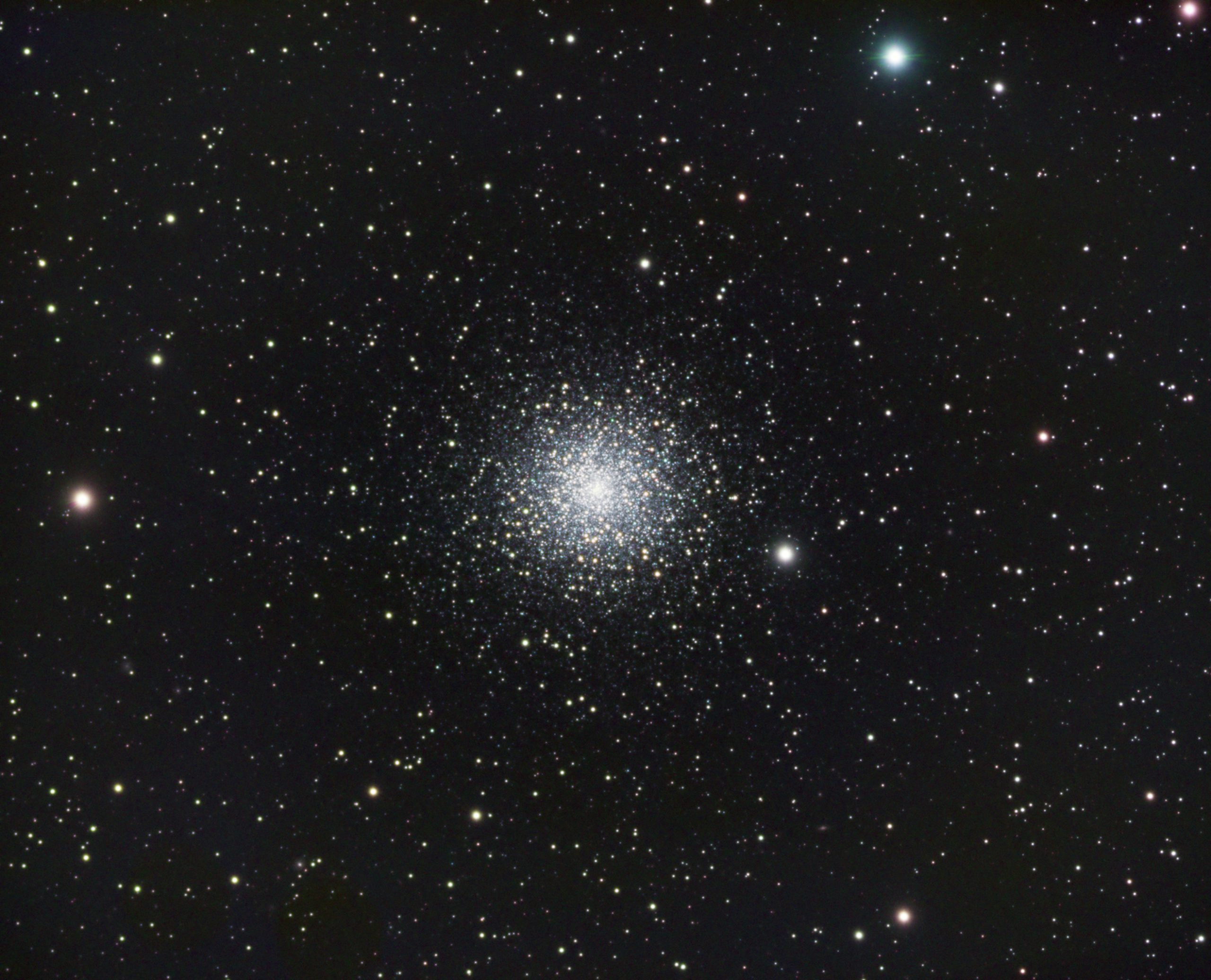
M15 The Globular Cluster in Pegasus
M15 is a magnificent Globular Cluster in the constellation of Pegasus, which after M13 and M92 is arguably the best one visible to Northern Hemisphere observers.
It is located about 34000 light years away and is about 125 light years in diameter with an age of 12 billion years, it is as old as the Milky Way itself.

Image Technical Data
Imaged with my TEC 140 refractor and Atik 460 CCD camera September 24th 2018. Mount is my MESU 200 guided with off-axis guiding.
Red 22 x 300s 1×1; Green 12 x 300s 1×1; Blue 19 x 300s 1×1
Total Integration of the data set is about four and a half hours. Note that I did not use a separate luminance channel and instead I binned each of the RGB channels 1x1. I remain to be convinced of the need to capture a separate luminance channel with either globular or open clusters.
Image processing is with PixInsight and data collected with Sequence Generator Pro.

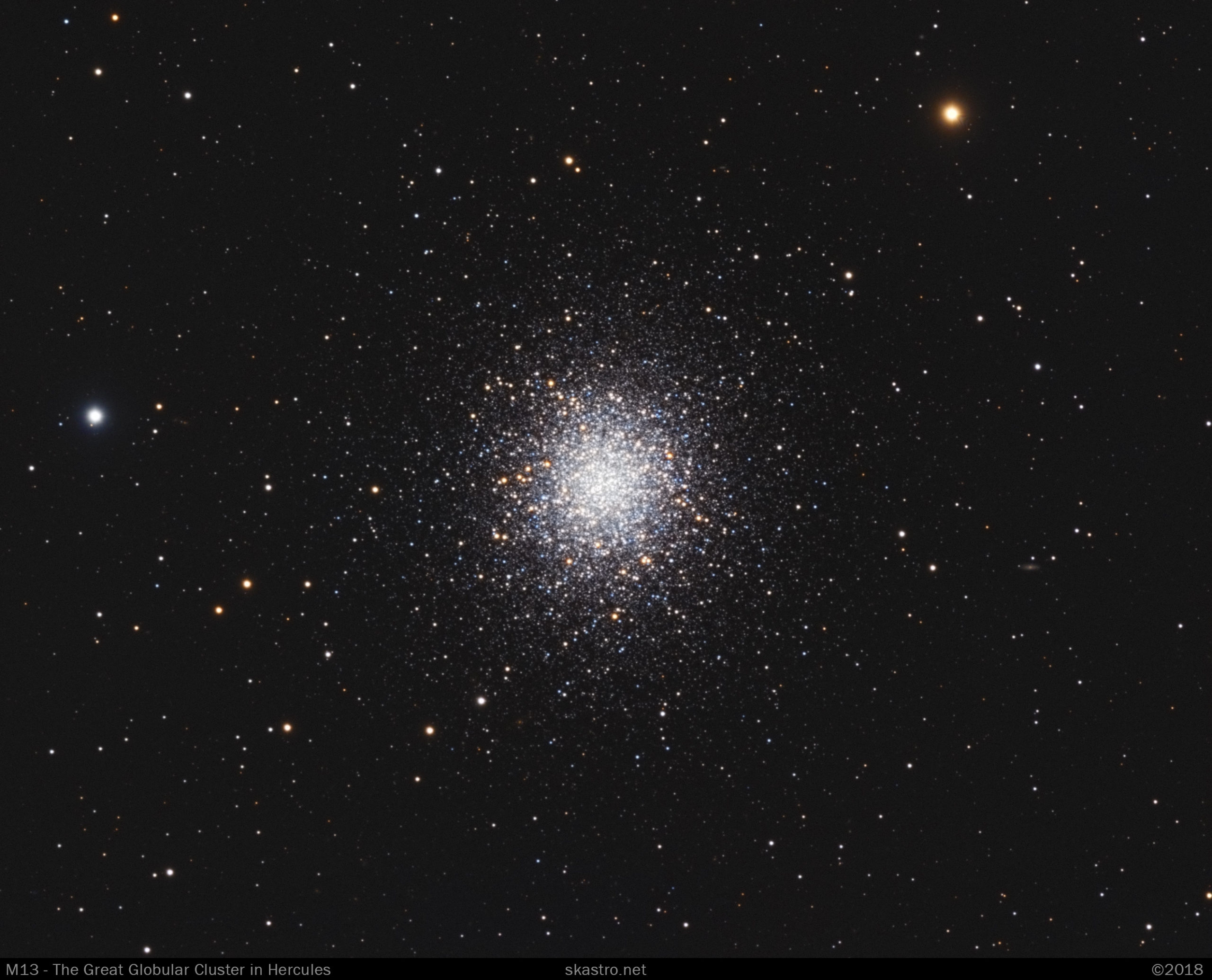
M13 - The Great Globular Cluster in Hercules
M13 is arguably the greatest of the Northern hemisphere globular clusters and, after Omega Centauri, the greatest globular cluster in the sky.
It is a located about 26000 light years away and has a diameter of about 120 light years. It is one of about 250 globular clusters that surround the nucleus of our galaxy. Most galaxies have globular clusters in orbit around them and the reason why is still unclear. What is clear is that the clusters and the stars within them are extremely old, in the region of ten billion years old or twice the age of the sun.
M13 is visible with the naked eye on a dark night as a fuzzy star. A telescope reveals its starry nature and a scope over 8 inches will show many stars and is an amazing site to behold.

The above image is a composite of LRGB data with one hour of data in each of the RGB channels and two hours in the luminance, everything binned 1x1, giving a total of five hours imaging time. TEC 140 refractor and Atik 460 camera CCD camera with Baader LRGB filters. on MESU 200 mount. The data was collected in 2018 and processed in PixInsight. HDR tool makes a big impact in bringing out the detail in the core of the cluster.
TIP: In this picture look for the "Propeller". Can you see it? :)

