
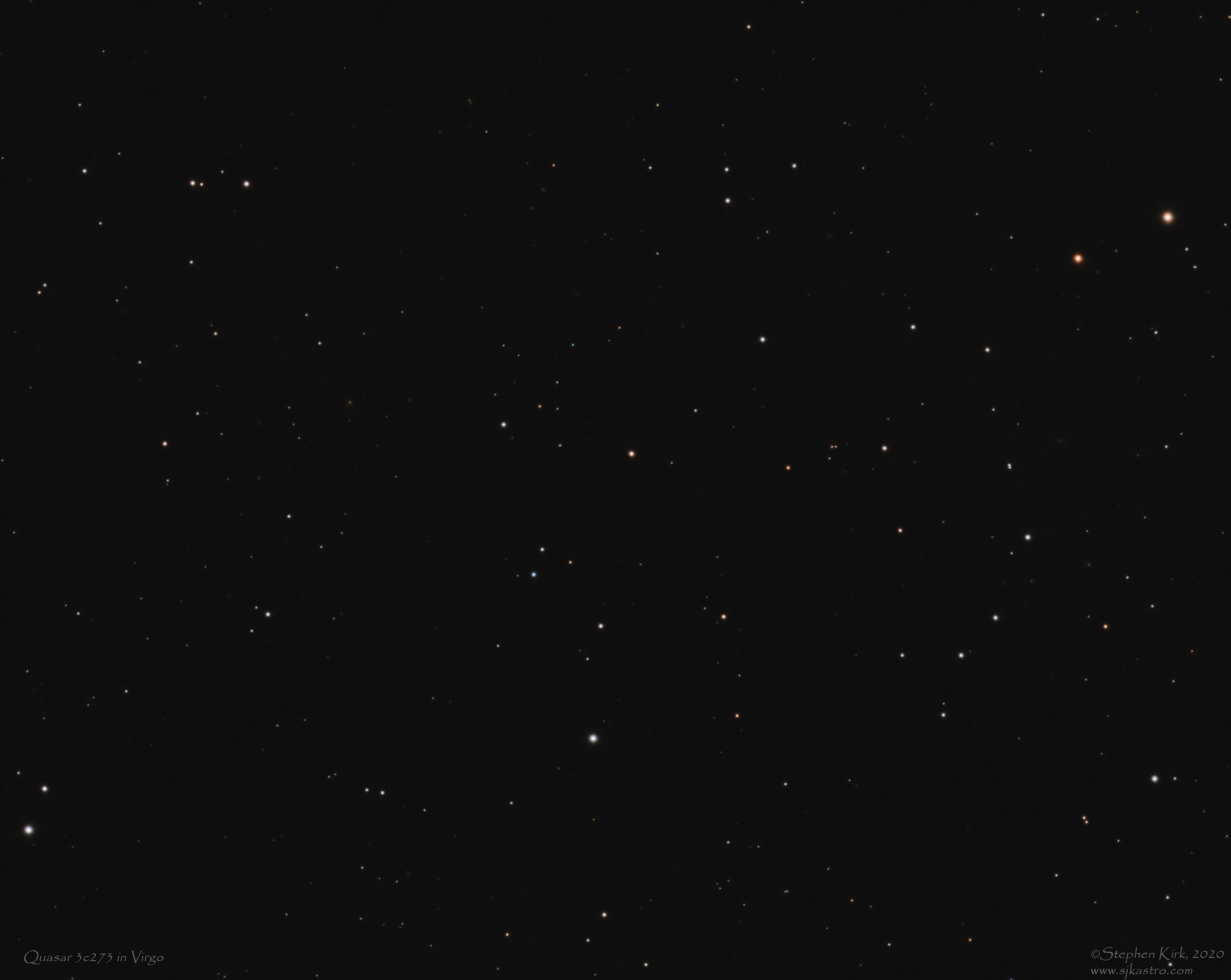
Quasar 3C273 in Virgo


Not the most exciting of images but significant for what is actually shown here. Just looking at the photo on the above left, you'd be forgiven for thinking this was just an image of a star field, a boring one at that. However, this is a picture of the Quasar 3C273 in Virgo, one of the most distant objects possible for an amateur astronomer with instruments available to the average amateur to see. Light left this object two billion years ago!
3C273 is the 273rd object in the Third Cambridge University catalogue of radio objects. It was discovered as an extremely bright source of radio waves long before it was identified visually. It was the first ever quasar to be discovered in 1959.
It represents an extremely active core of a very distant galaxy, so distant that we only see the core and not the outer parts of the galaxy because of the vast distance. Matter is circling around a supermassive black hole and is energised to such an extent that it is visible across the universe. Our own galaxy would not be visible at such a distance suggesting how incredibly bright the quasar actually is. We also know, through daily variations in the light intensity that the source cannot be more than a light-day in diameter!

Image shows the above image of 3C273 with other galaxies in the PGC catalogue (Principle Galaxies Catalogue) in the same field of view. 3c273 is PGC41121.
Image taken with a TEC 140 refractor in April 2020 (during Coronavirus lockdown in the UK). Thirty minutes each in R,G,B.as two minute exposures binned 1x1.

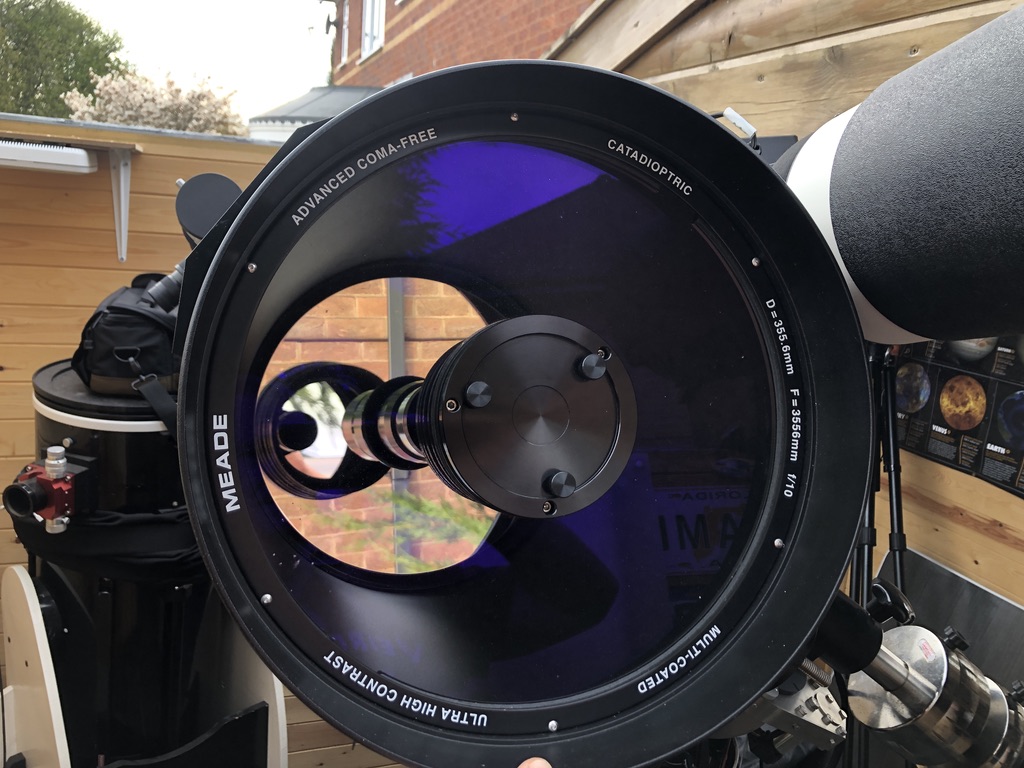
Meade 14" ACF
I bought the 14" ACF SCT Optical Tube Assembly (OTA) telescope in excellent condition in April 2019 second hand. These ACF (Advanced Coma Free) SCT scopes from Meade have an excellent flat field and my intention upon purchasing this scope was to use it for lunar and planetary visual work and also for some astrophotography.
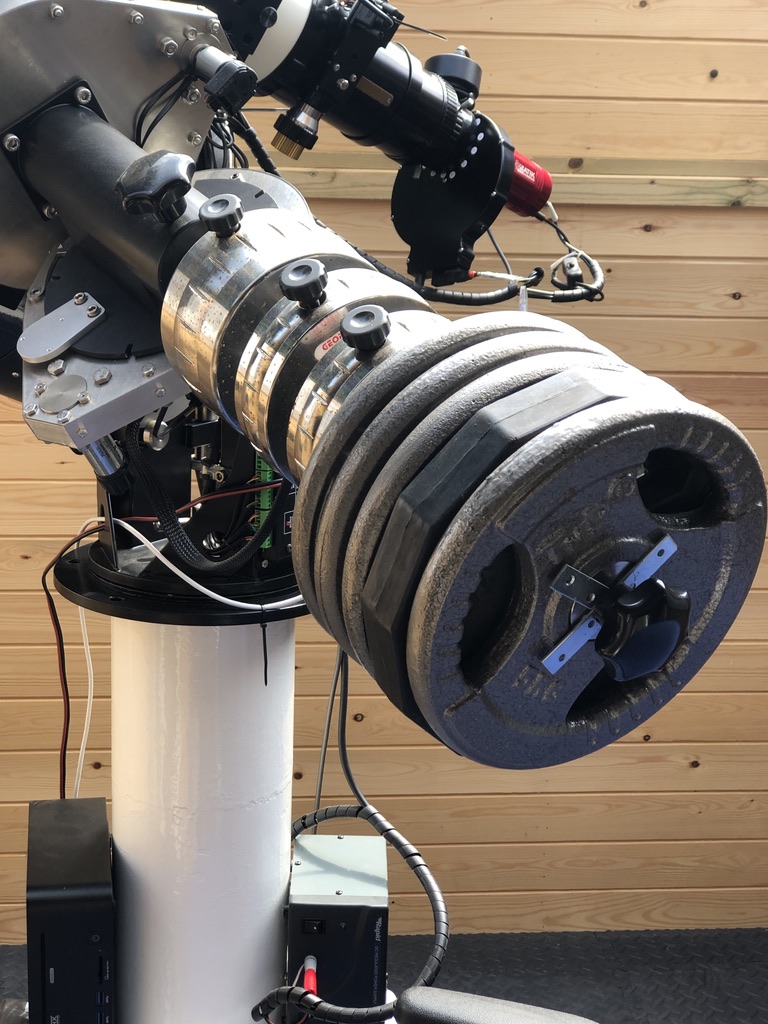
The SCT telescopes increase in size and weight is almost exponential with their increasing aperture. This scope is VERY heavy at almost 27kg and I had it mounted side-by-side with my [also heavy] TEC140. I needed almost 40kg of weights to balance this combination. It was very close to the MESU200's maximum weight carrying ability and caused the mount to shiver for a few moments after any physical touch of the mounted telescopes.
I originally intended a three scope combination with the Meade 14", TEC140 and my FSQ85, the latter two attached to the cameras since I only use these for astrophotography. However, no matter what I tried I could never get this combination to balance in all orientations. If I got it balanced in the parked position then they'd be unbalanced in the "point east
position". Get it right pointing east and the meridian flip would fail. It was like a game of whack-a-mole and a balance problem would repeatedly keep popping up no matter how I adjusted the scopes on their dovetails and in their saddle. In the end I abandoned mounting the FSQ85 and did a dual rig side-by-side with the Meade and the TEC140. Even this was never perfectly balanced and caused the MESUs friction drive to give way on some occasions and I'd awake in the morning following an all-night imaging run with the scopes pointing up at the zenith. Also, because the scopes were so heavy it was a challenge for the MESU to hold them perfectly steady.
I fitted the Meade with a Moonlite Crayford focuser and equipped it with motor focus. With such a long focal length and physical touching of the scope to focus it causes the observed object to wobble for a few seconds and makes focusing a challenge without motorfocus. The fitting of the motorfocus massively assists the usability of the scope. Indeed, I'd suggest just using the mirror focuser would be a very big ask when trying to fine focus.
Meade Side by Side with TEC140
Bottom of Meade 14"ACF
Side of Meade 14" ACF
Meade 14" ACF Corrector
Meade 14"ACF with Moonlite Crayford motor focus
Side View
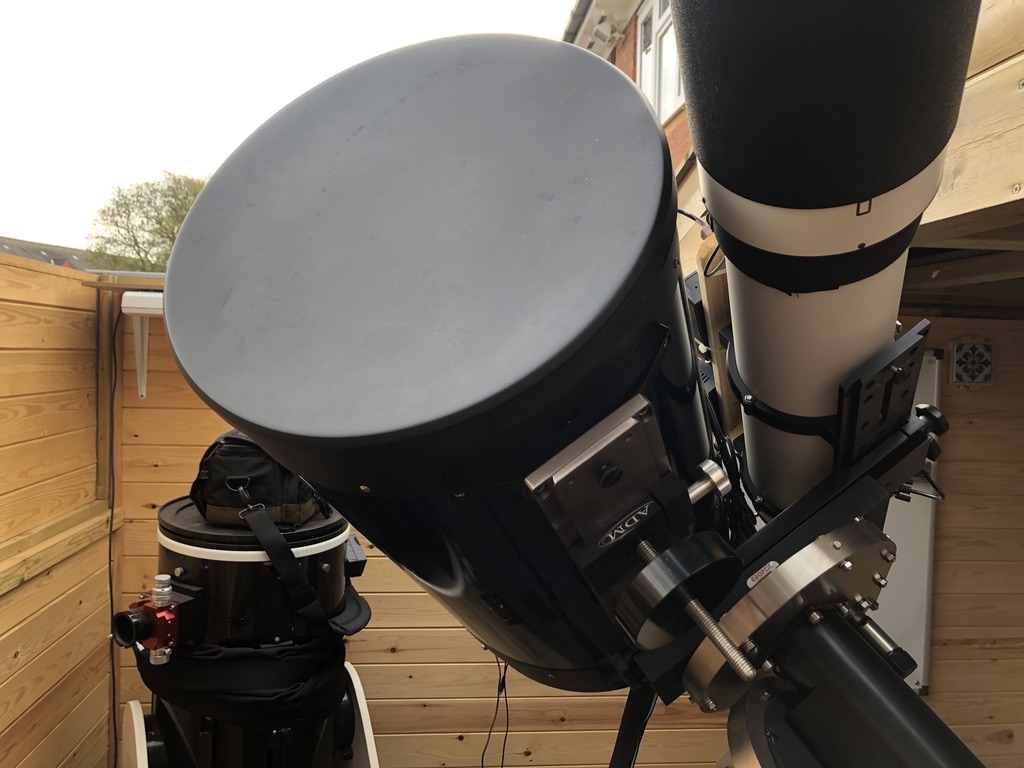
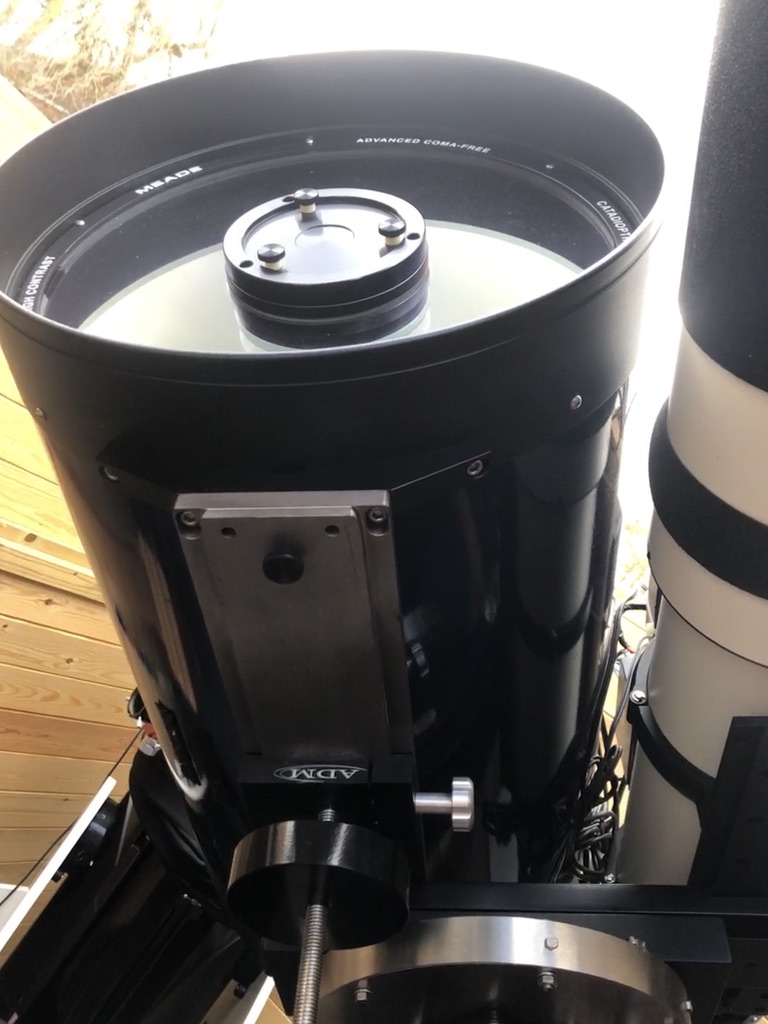


I sued the scope a lot on The Moon and for some deep sky observations. It excelled on objects such as M27 and M13 and other small objects needing a significant focal length.
However, my overall ownership was a bit of a disappointment and this is absolutely in no way a fault of this magnificent telescope. It is a result of my own aperture fever. Such a telescope in a Bortle 5 suburban sky is always going to be significantly handicapped and this indeed proved the case here. So much so in fact that I hardly even used it on faint galaxies because such objects are drowned out by the light pollution. Jupiter and Saturn were very poorly placed for observers at my latitude (53N) during my ownership so I never got chance to use it on those. In fact, I found my Celestron C925 showed as good a view in my skies. For these reasons, I sold the telescope, minus the focuser in May 2020, after a year of ownership. In the end I sold it to someone from Derbyshire Peak District who has dark skies. I was sad to see it go because in the right skies it will be magnificent.
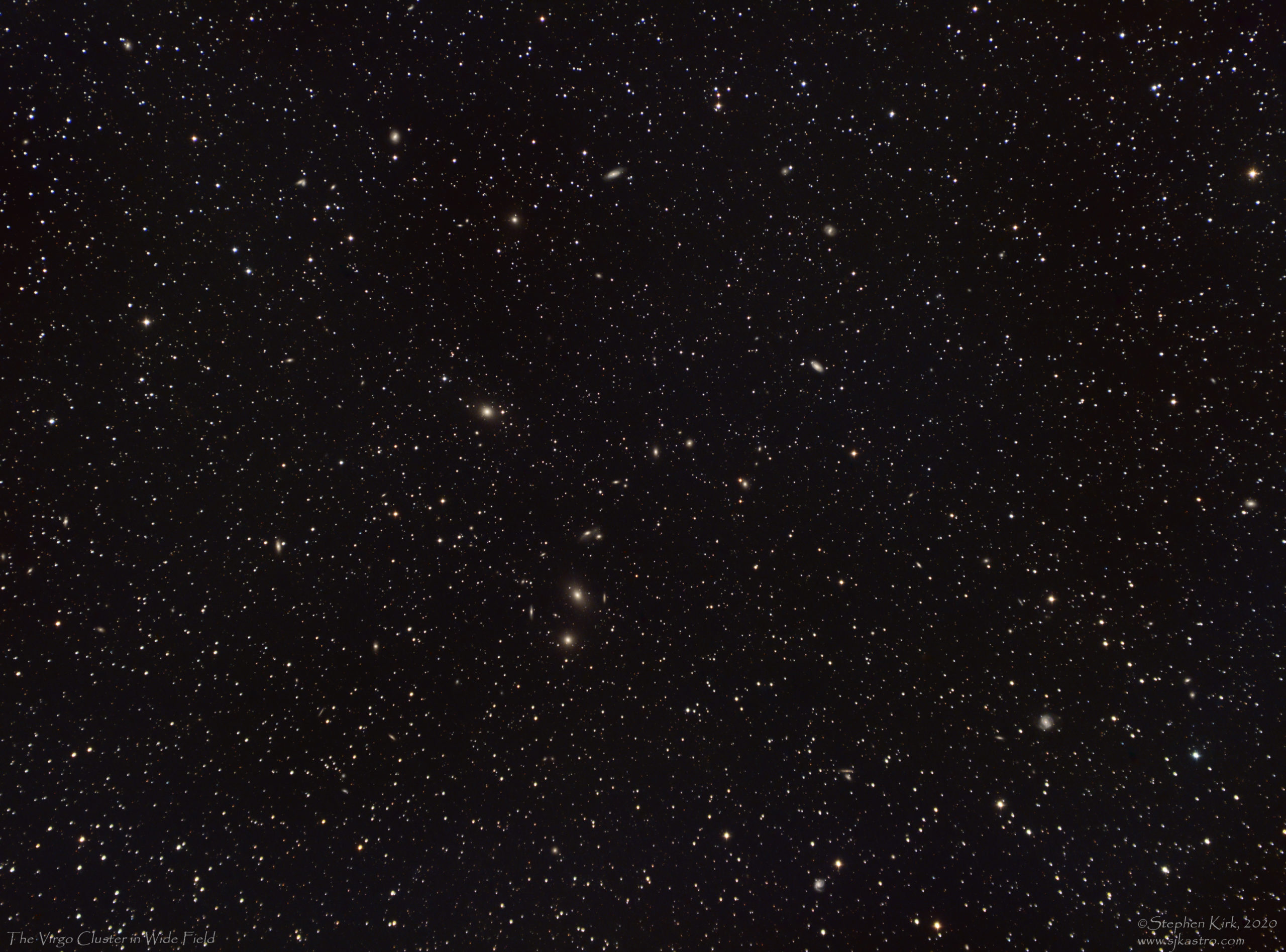
Virgo Cluster in Wide Field Setting
This is the Virgo Cluster of galaxies presented in a wide field setting. The cluster is a popular area for amateur astronomers and professionals alike and contains some very important galaxies, the most important of which is M87, the supergiant elliptical galaxy and one of the largest galaxies in the local universe.
You can see Markarian's Chain demonstrated at an unfamiliar angle in this picture.
The picture is comprised from data captured during late March 2020 and I used my Samyang 135mm DSLR lens connected to G2-8300 cooled CCD camera from Moravian Instruments and Astrodon RGB filters. The picture is comprised of 70 minutes (of five minute exposures binned 1x1) in each of the red, green and blue filters to give a total integration time of three hours and thirty minutes. The data was developed with PixInsight and Photoshop.


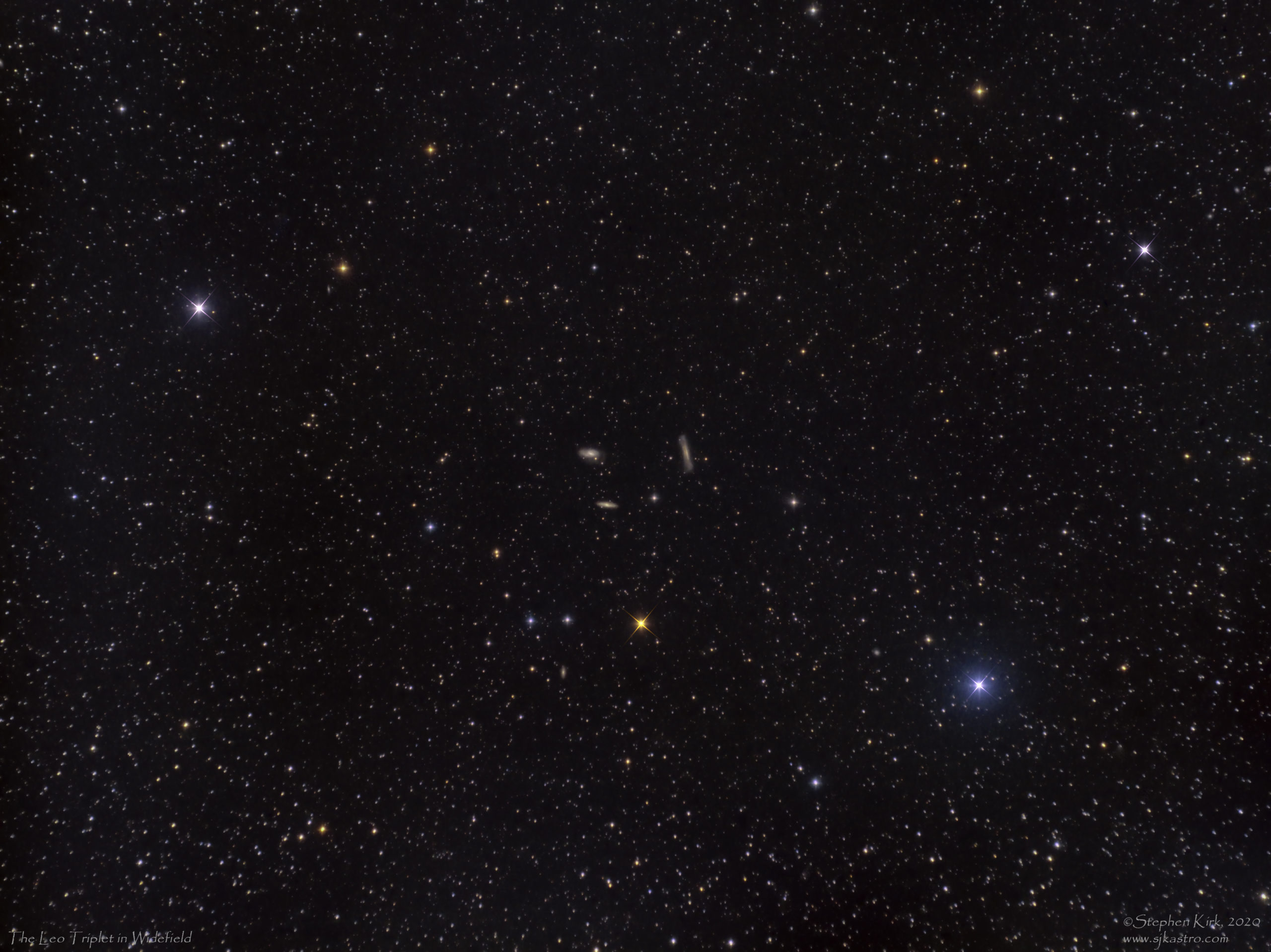
The Leo Triplet in a Widefield
The Leo Triplet is a popular trio of galaxies in the constellation of Leo, popular with amateur and professional astronomers alike. They are visible in the late winter and spring in the Northern Hemisphere. Consisting of M65, M66 and NGC 3628, the galaxies are about 35 million light years away. NGC 3628 was never given the distinction of as Messier number for some reason, even though it is as bright as the other two members.
The image was taken with my Samyang 135mm DLSR lens coupled with Moravian G2-8300 cooled CCD camera with Astrodon RGB filters. It consists of seventy minutes (5 minute exposures binned 1x1) in each of the red, green and blue filters to give a total integration time of three hours and thirty minutes.
The triplet was about 45 degrees above the horizon when the exposures were captured. IT was then processed with Pixinsight and Photoshop.


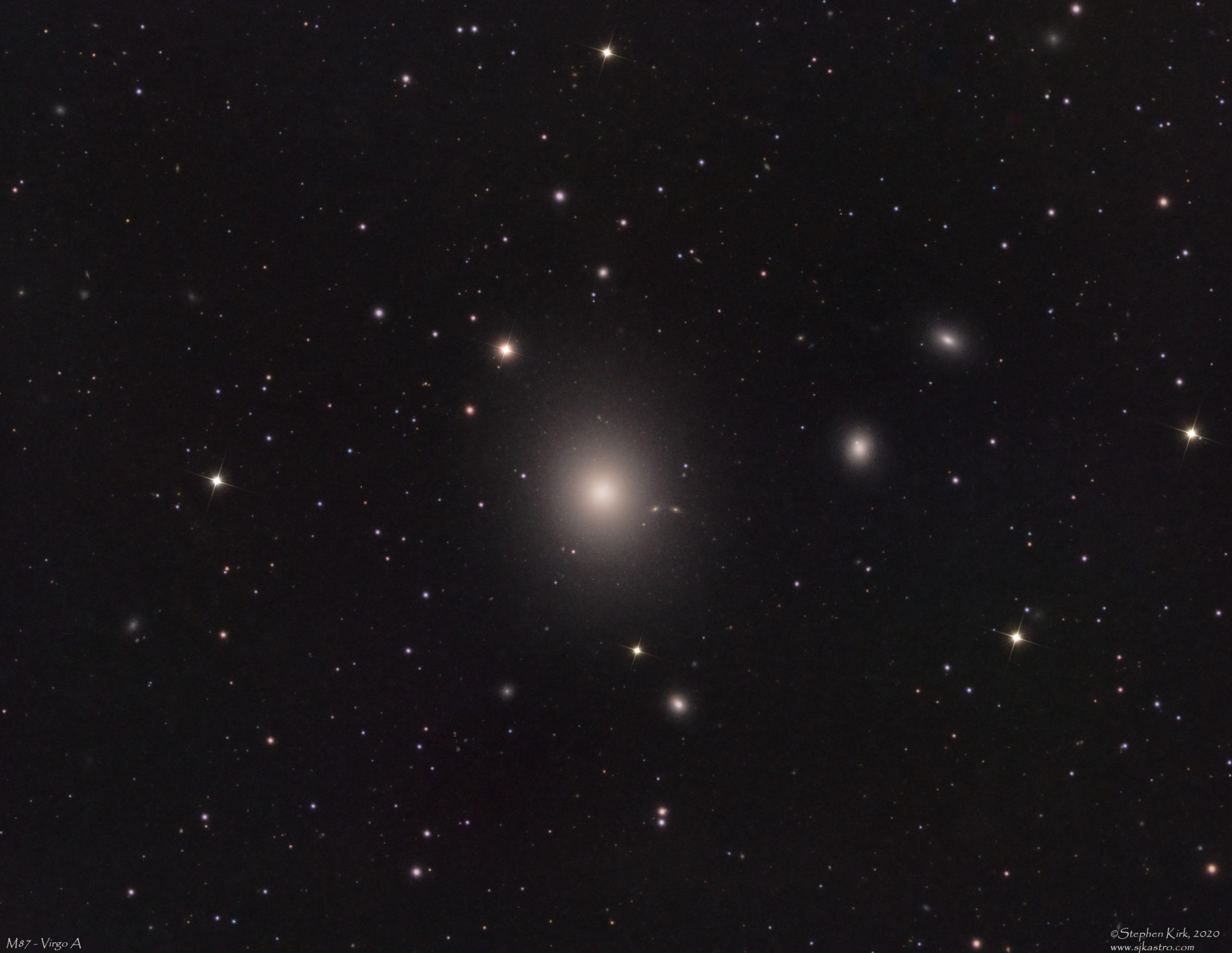
M87, The Giant Elliptical Galaxy in Virgo TEC 140

M87 is a supergiant elliptical galaxy at the heart of the Virgo cluster of galaxies and is visible in many pictures of the famous Markarian's Chain. It is about 65 million light years away and, after the Sun, is the brightest source of radio waves in the sky - at that vast distance! The galaxy is one of the most massive in the local universe at two hundred times the mass of our own Milky Way galaxy. M87 harbours one of the most massive Black holes in the Universe at 8 billion solar masses. The galaxy is surrounded by a swarm of globular clusters, about 12000 of them, compared to only 200 from our galaxy.
The galaxy is so large that from The Earth the extended galaxy is almost the size of the full moon.
Image Technical Data
Imaged from by back yard in Nottingham, UK with my TEC 140 refractor and Atik 460 CCD camera with Astrodon E series LRGB filters on my MESU mount. Data acquired April 2020 (middle of the Coronavirus lockdown in the UK) and is comprised of the following data - everything binned 1x1.
Lum > 12 x 600s ; Red > 12 x 300s ; Green 12 x 300s ; Blue 12 x 300s
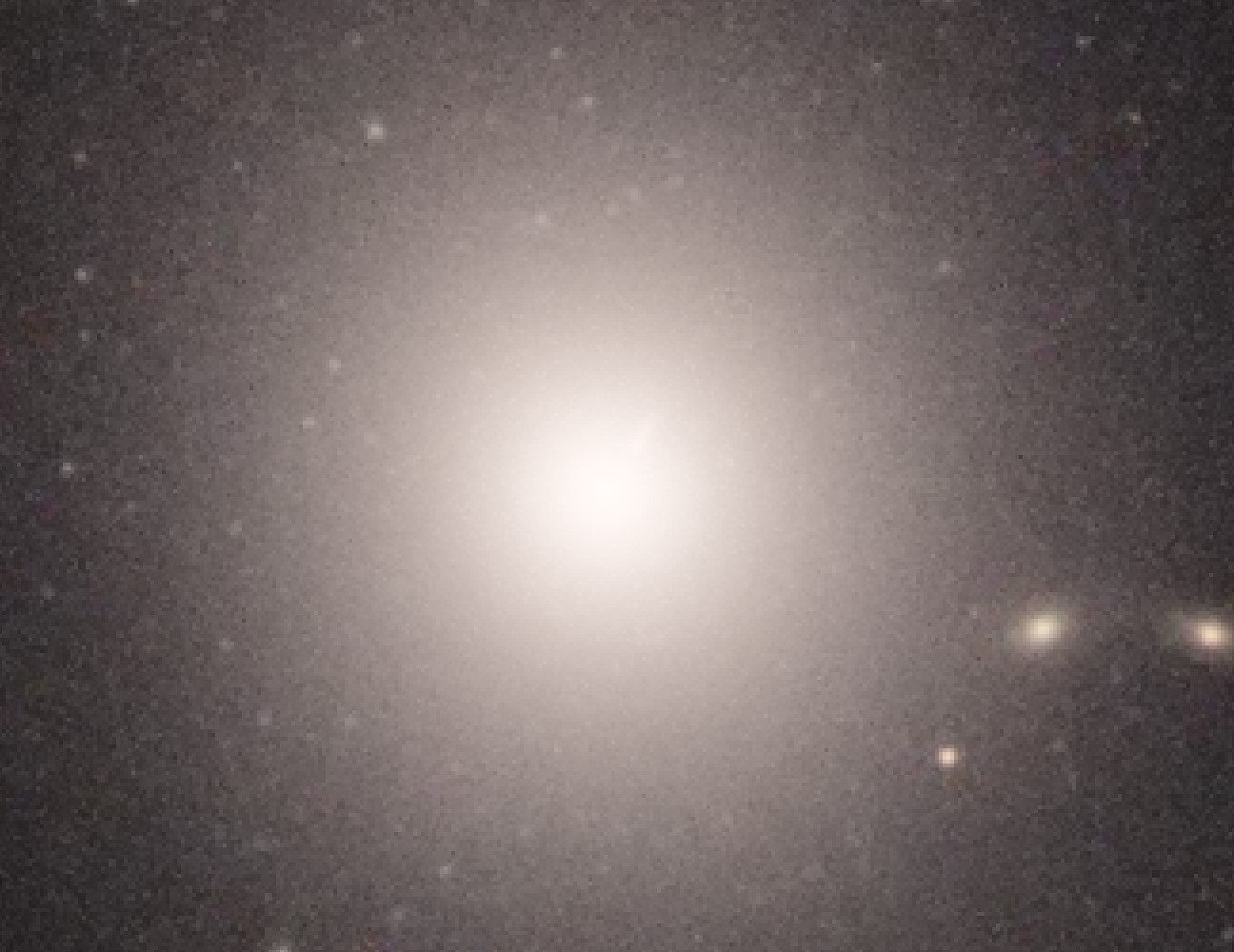
The closeup above shows the famous "jet" emanating from the central black hole (at "one o'clock" in this photo) in the core of the galaxy and the latest theories suggest this is radiation being emitted from the poles of the black hole at almost the speed of light.
Also can be seen in this picture some of the many globular clusters that orbit M87. Some of M87's globular clusters are hugely larger than the Milky Way's and are giant enough to be seen from 65 million light-years away. M87, in growing to be such a huge galaxy, is though to have consumed many other galaxies during its history and is thought to have robbed the globular clusters of the now dead galaxies.

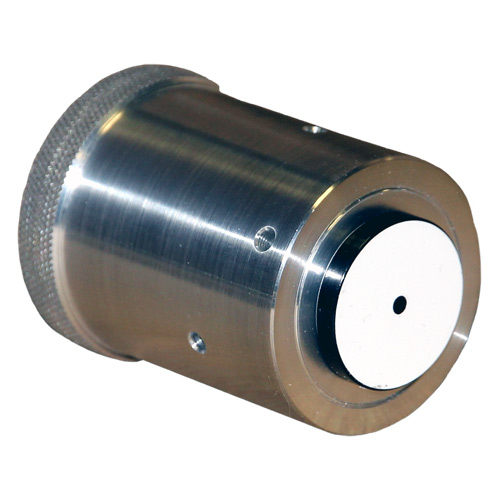
Howie Glatter Laser Collimator
In order to get the best from your observing and imaging sessions, your reflecting telescope needs to be properly collimated. In other words, the optical axis of the telescope must be optimised to reflect the light optimally. Newtonian and Ritchey- Chretien design scopes do not deliver a crisp and sharp image unless they are properly collimated. A laser collimator is a device that can aid in getting the telescope properly collimated.
I want to emphasise that I am not in any way paid in money or kind to write these words. I do this for the love of it and to help others and I have no connection whatsoever to the maker of these collimators.
Sadly, Howie Glatter himself passed away in 2016. He was a very kind man and was incredibly friendly, knowledgable and approachable. There was almost nothing he didn't know regarding the subject of collimation of telescopes! His company was taken over by Starlight Instruments. My review in the video below was made in 2013 and my example was made by the late Howie himself. However, the pedigree of Starlight Instruments, famous because of their focusers, would imply that the exactitude of Howie's methods are continued.
Rather than me type a novel here, please review the video. I think you will see that I am most impressed with my example!
Clear skies and happy collimating! :)
https://www.youtube.com/watch?v=I4YPT1aRf2U
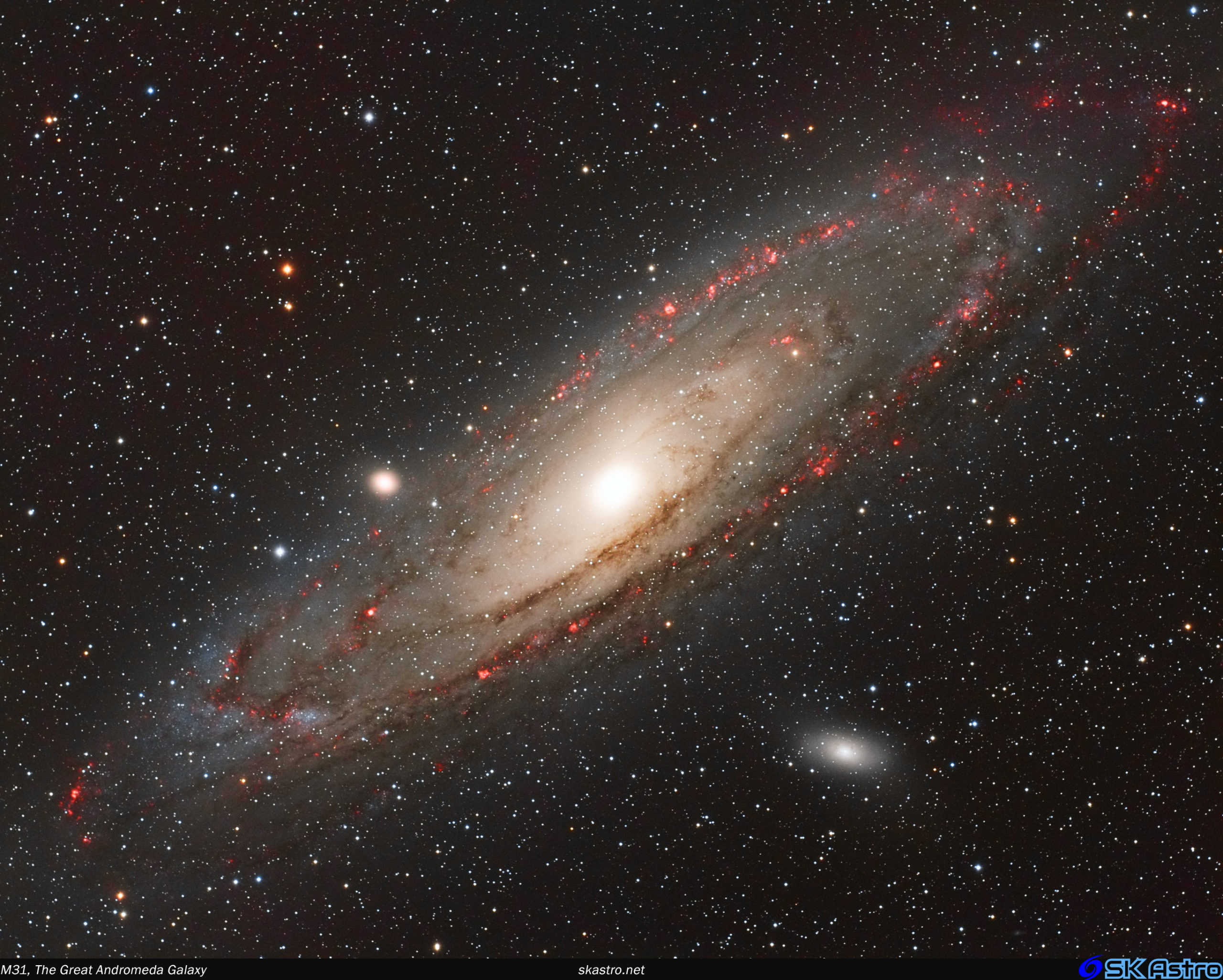
M31 - The Great Galaxy in Andromeda
Known since ancient times as a nebulous blob in the autumn and winter sky, M31 was the first galaxy to be recognised as a completely independent "island universe", wholly separate from our own Milky Way galaxy. This nature of M31 was only discovered in 1924.
M31 is slightly larger than our own galaxy and is located about 2.2million light years away.

The abovr image is comprised of a series of 600s exposures taken during 2017 and 2018 and is approximately ten hours worth of data through Baader LRGB and Ha (7nm) filters with a Takahashi FSQ85 telescope at native focal length and with G2-8300 camera.


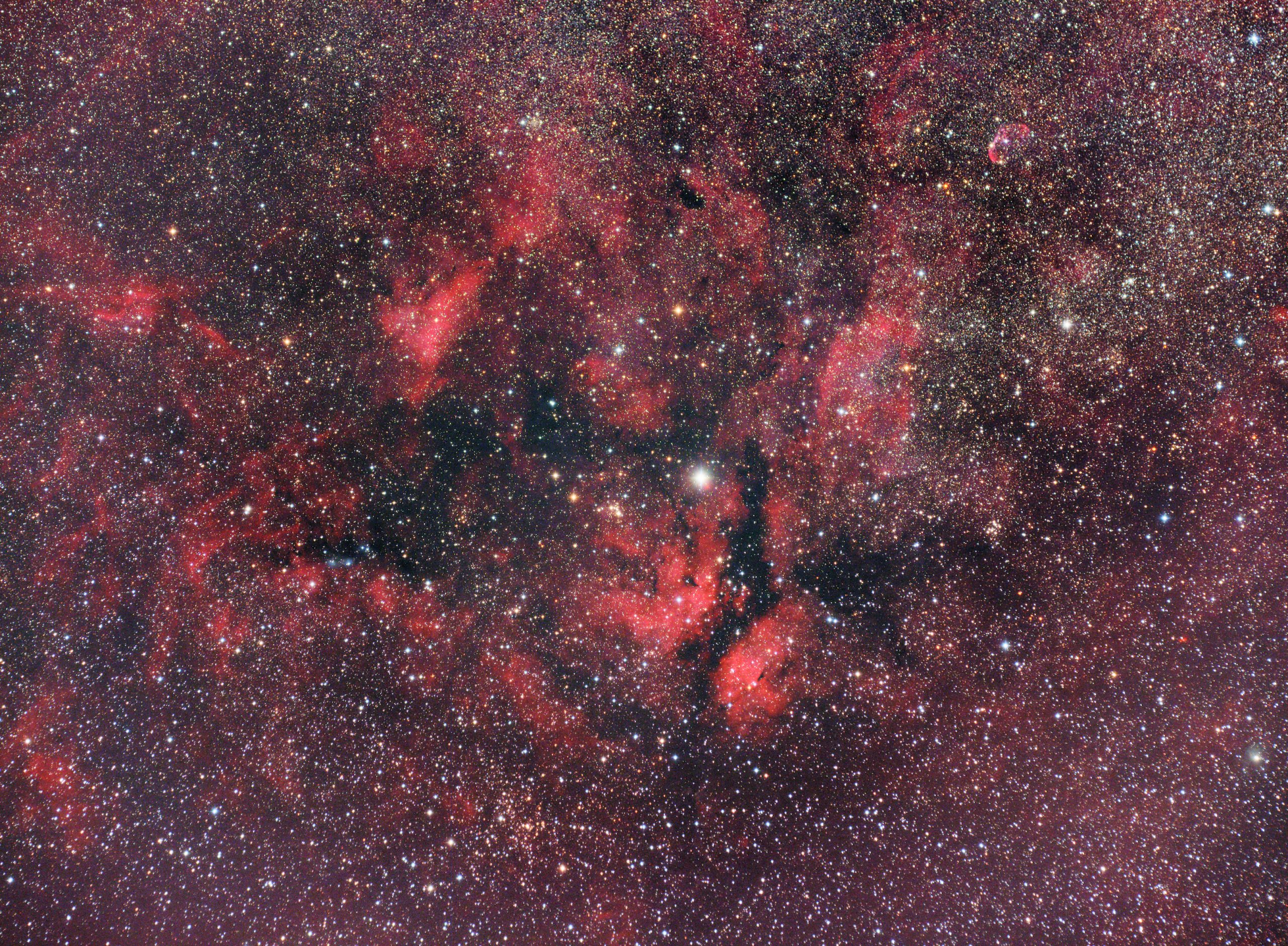
SADR Region of Cygnus
SADR is the central star of the Cross of Cygnus, between the arms of the cross. The constellation of Cygnus is supposed to represent a swan but to most people looks much more like a cross and consequently is often called The Northern Cross. The whole area abounds in nebulosity that is very easy to capture with a camera.
This image is taken with a Samyang 135mm DSLR lens and subtends a field of view of about 8 x 6 degrees across the sky and so the long axis of this image is about sixteen moon widths wide. This is a very large area of sky to capture in one image. It is was made from 12 x 3 minutes exposures in each of the Red, Green and Blue and also a luminance of 24 x 3 minute Hydrogen Alpha 3nm exposures to give a total integration (exposure) time of about three hours. The camera I used is the Moravian Instruments G2-8300 loaded with 31mm Astrodon LRGBHa3nm filters.
I captured it in my back yard on 26th April 2019 with my wide-area autofocus rig mounted atop a NEQ6 mount. The data was captured with SGP and processed with PixInsight and Photoshop.
I hope you like it! :)

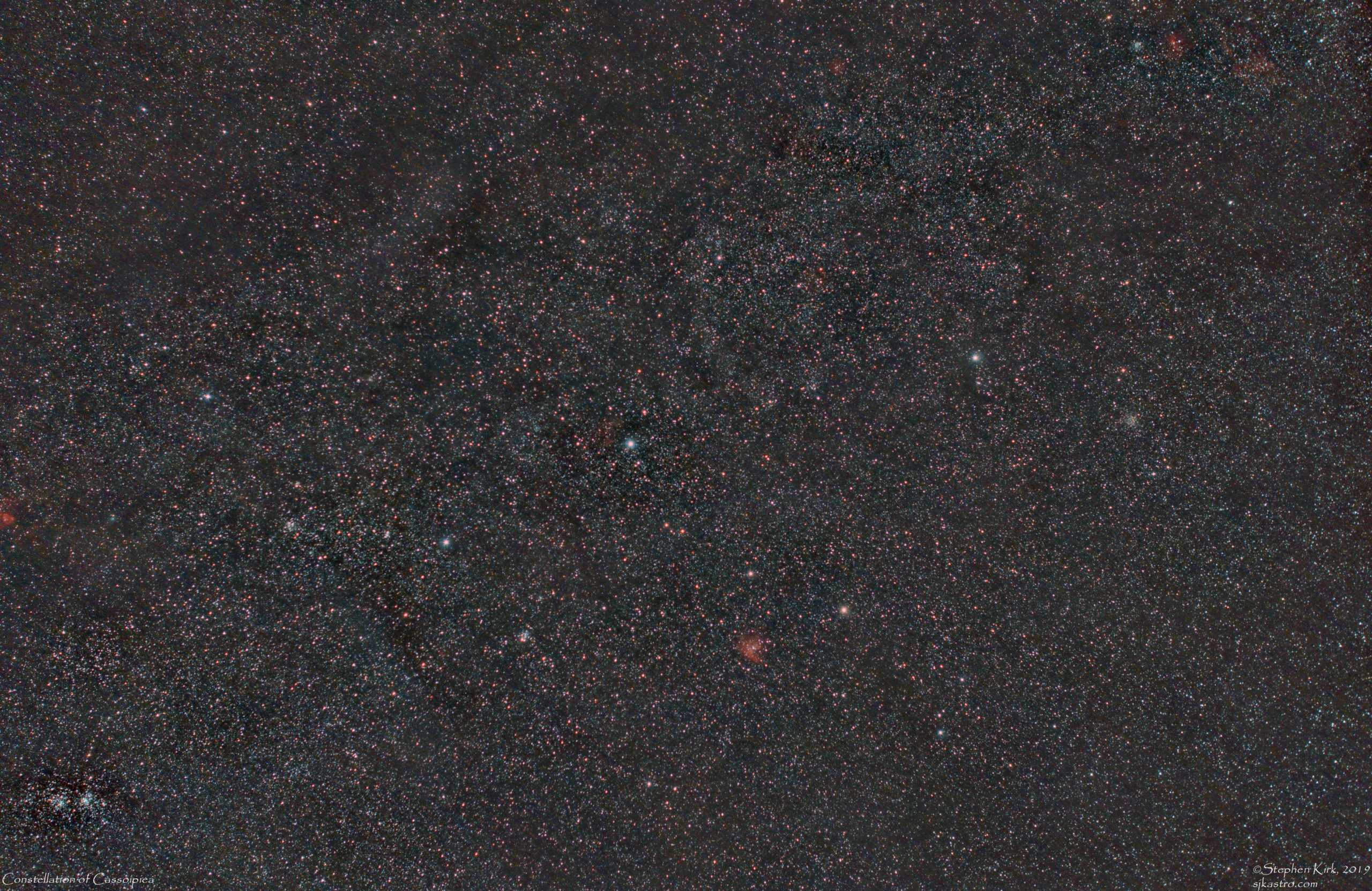
Cassiopeia
Share on facebook
Facebook
Share on twitter
Twitter
Share on pinterest
Pinterest
A far Northern constellation - circumpolar from my location in Nottingham - Cassiopeia lies in the middle of numerous star fields and nebulae fields, looking out from the core of the galaxy. The famous "W" shape is very recognisable and one of the first constellation that beginners to astronomy learn. It is rich in interesting nebulae, star clusters and other objects.

Image above was taken at the beginning of March 2020 when Cassiopeia was setting towards the North West. Conditions were not very good with the seeing and transparency being quite poor. Nevertheless, I managed to grab 45 x 60s exposures at ISO 800 and F4 with Canon 1100D and 50mm lens. Quite a quick and dirty picture and more exposure time would reveal much finer detail and nebulae details.Even in this image, you can see the huge number of objects withing the constellation, especially nebulae in the Sharpless Catalogue (Sh2).
Below is an annotated version of the above picture, showing some of the interesting objects and also an inverted view.


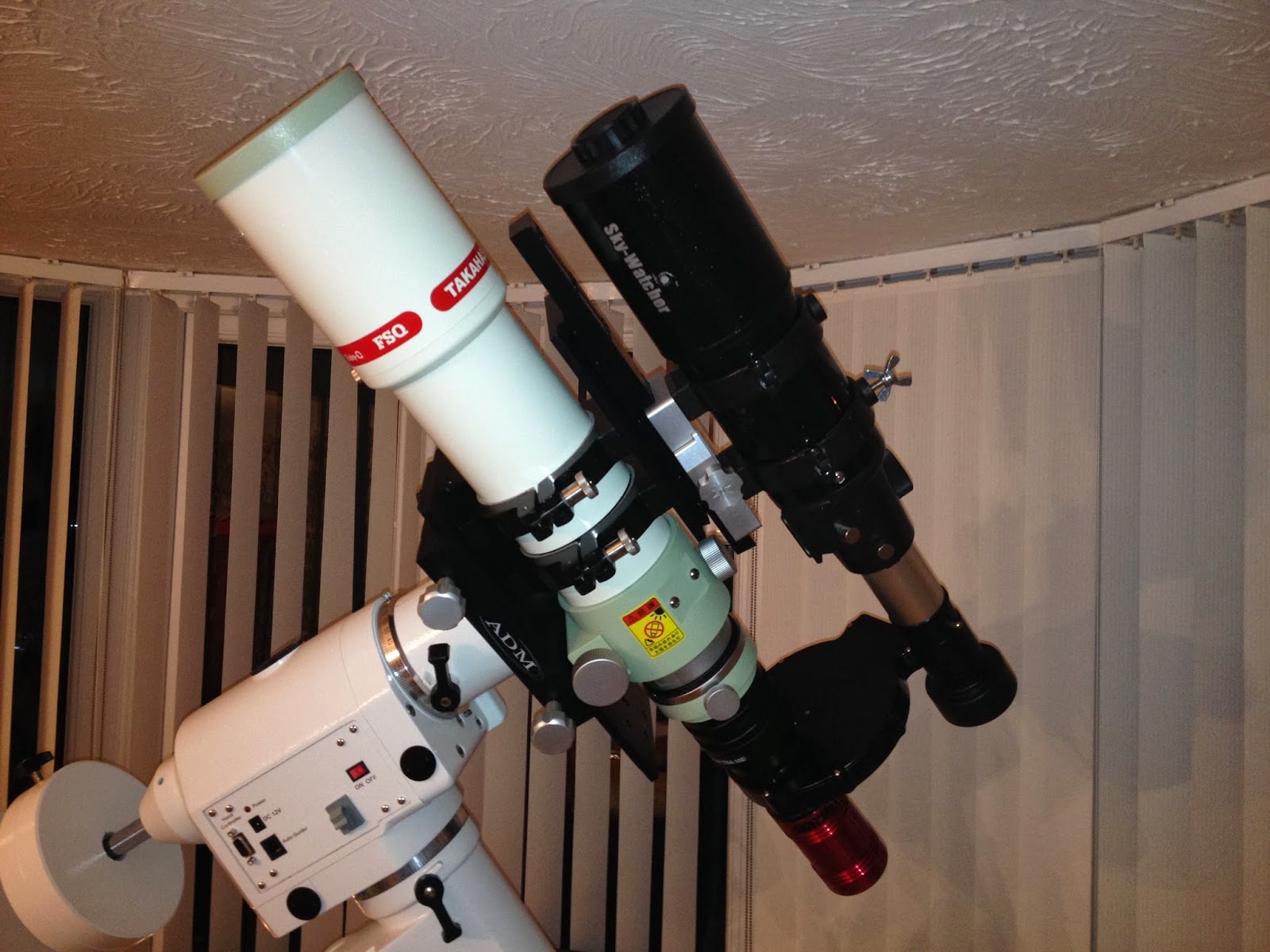
My Takahashi FSQ85 "Baby Q"
I bought my Takahashi FSQ-85EDX telescope from Ian King Imaging in November 2013 and bought it with the 0.73 reducer and numerous Takahashi adapters. I have not as yet used it reduced, only at the native F5.3. I am very impressed with the scope so far. It weighs only 4kg but feels so much more than that. The scope is a thing of beauty with impeccable paintwork and build quality. This is truly a scope to last a lifetime if cared for.
I went around the mental "shall I buy a 85 or 106" loop a million times. However, I already have a TEC 140 telescope to give me a smaller (or zoomed in) image scale for smaller objects like M81, M87 etc and the Abell galaxy clusters. I felt the FSQ-85 gave me better options for wide-field imaging of large targets like M31, M33, North American Nebula, Rosette Nebula etc.
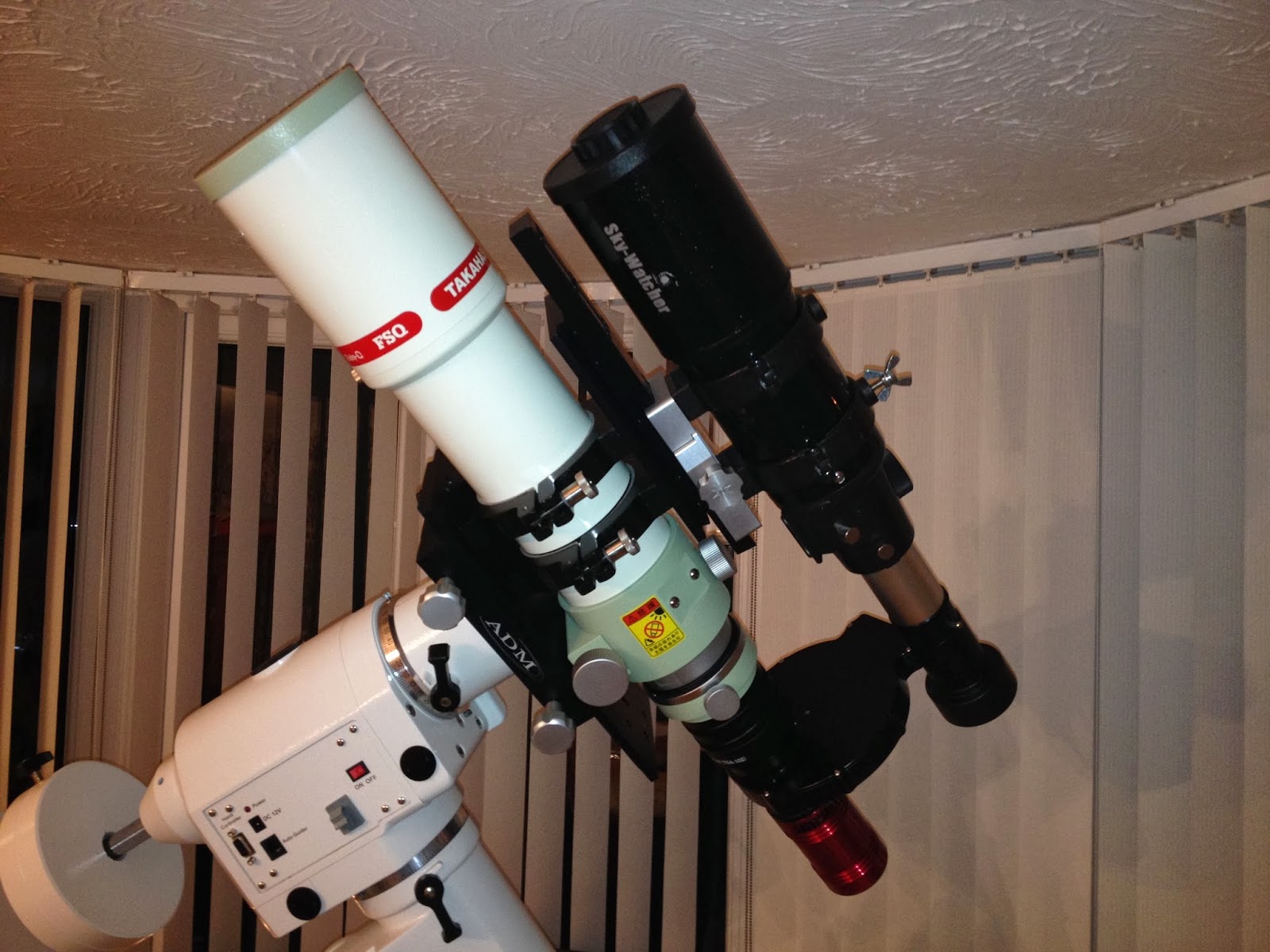
My FSQ-85 rig consists of a Skywatcher ST80 guide-scope with a QHY5 guide-camera. The whole shebang is mounted by ADM dovetails/bars/saddle onto a Skywatcher NEQ6 mount and I control it all via ASCOM/EQmod from my Dell D630 latitude laptop.
Here is a picture I did of M33 with 75 minutes of Luminance, binned at 1x1 and 20 mins each of RGB binned at 2x2. All this done on an Atik 460 at -21C. The seeing was terrible, the moon was rising and I was dodging clouds! To say the UK climate is challenging for Astro-Photography with our milky white skies and constant cloud is the understatement of the century!
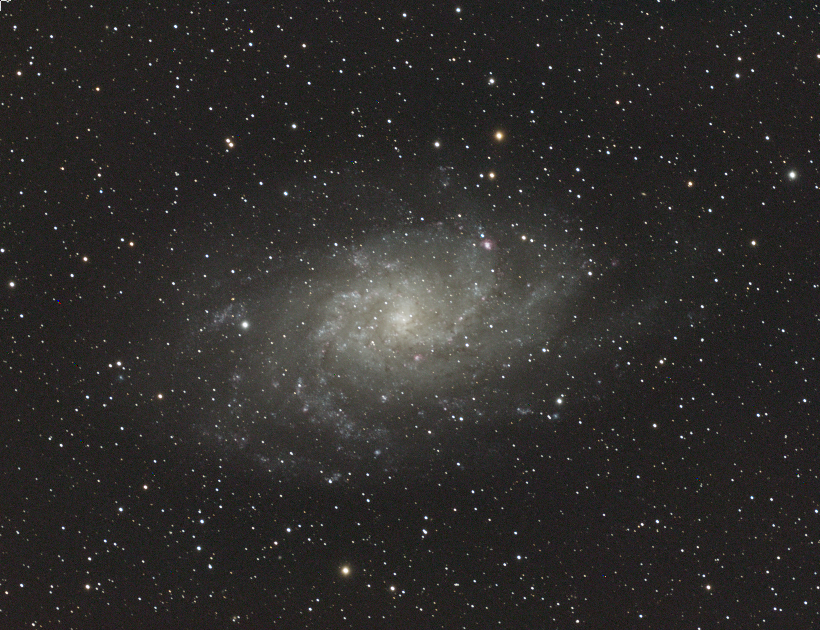
The image really needs more data in the colour channels and ideally some Ha as well to bring out some of the HII regions. But not too shabby at all for a first light I reckon under the circumstances. All four corners are nicely round.
All in all I am impressed. I intend to do some videos of how I mounted this scope so watch out for those. I also will do some articles on how the camera connects to the scope in both reduced and native guises with the different Takahashi adapters.