
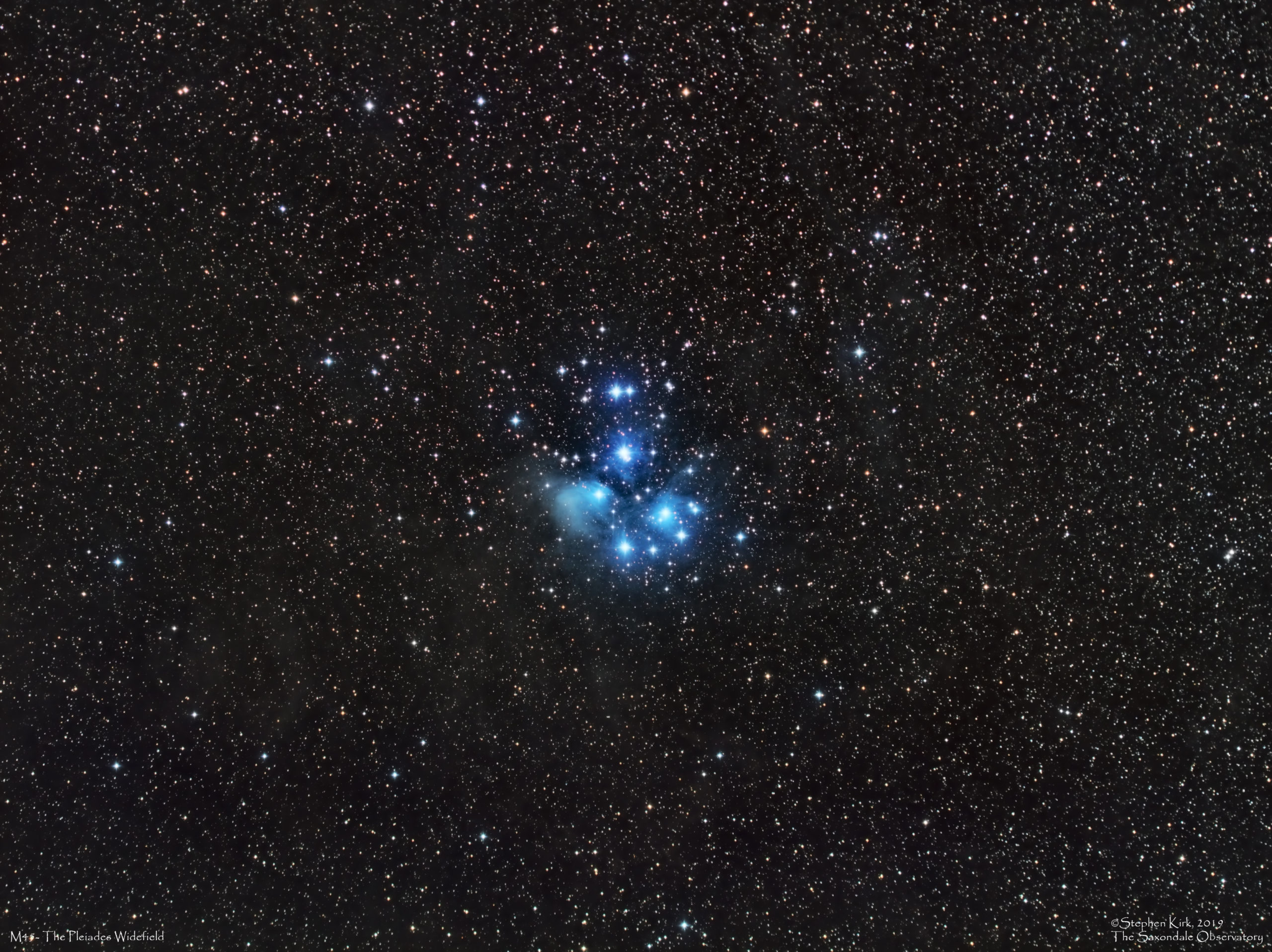
M45 in a Widefield

An image of the Pleiades taken with a Samyang 135mm lens and Astrodon RGB filters.
Field of view is approximately 6x4 degrees.
Taken 18 November 2019 and 10 x 180s exposures in each filter.


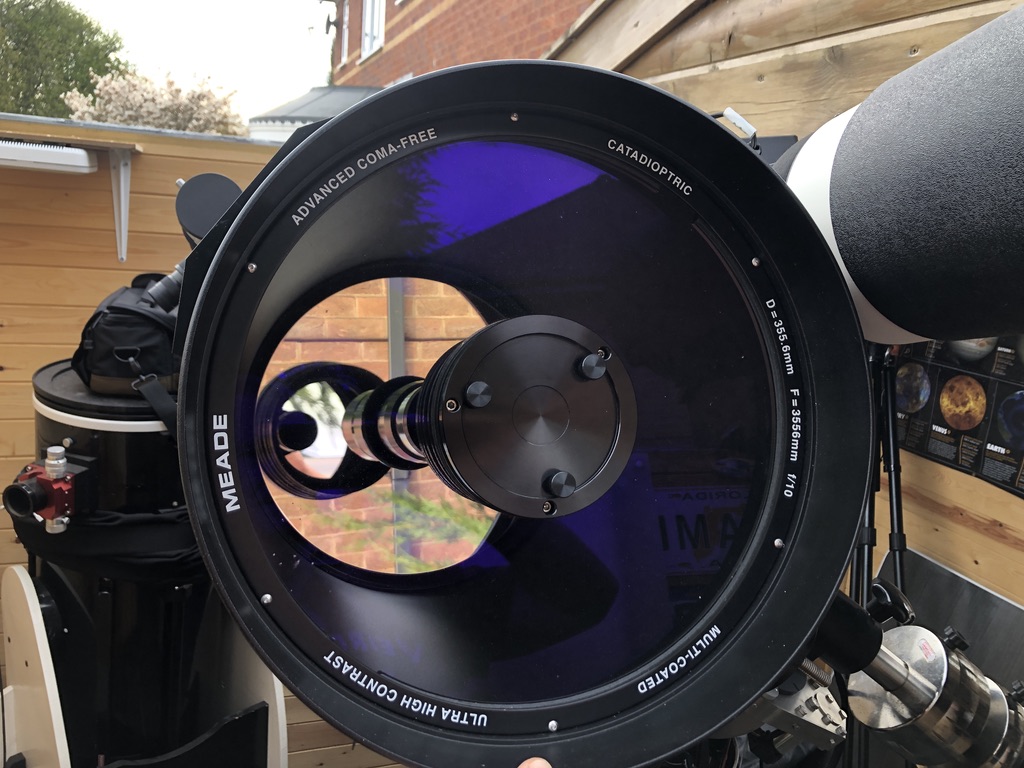
Meade 14" ACF
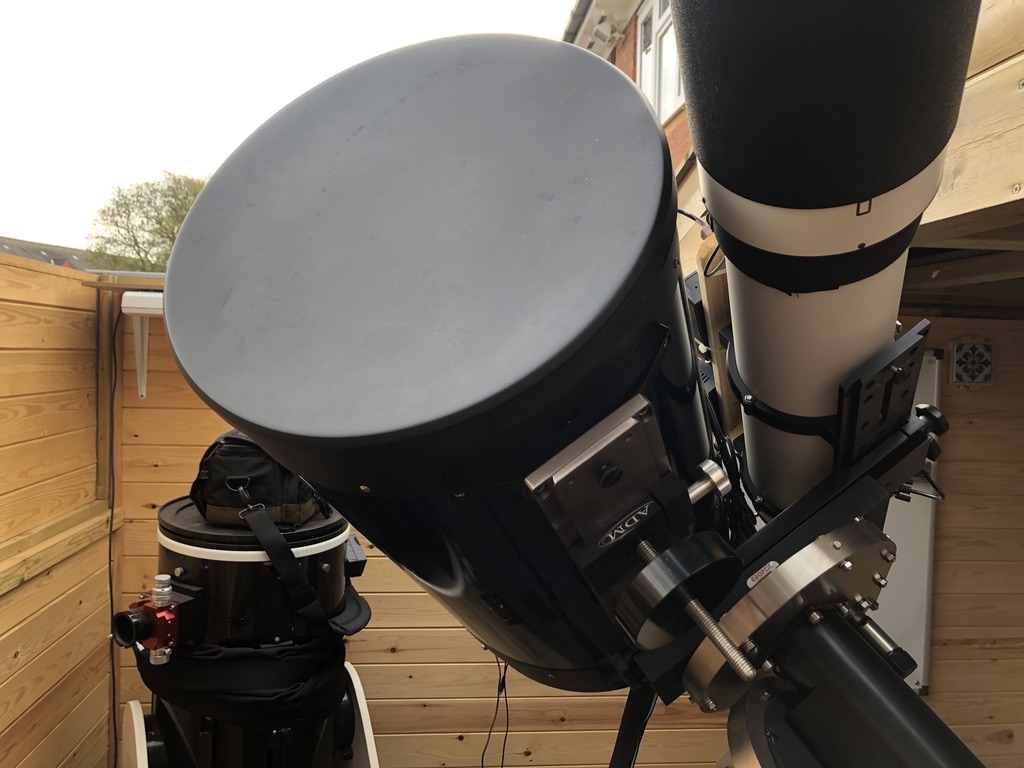
I bought the 14" ACF SCT Optical Tube Assembly (OTA) telescope in excellent condition in April 2019 second hand. These ACF (Advanced Coma Free) SCT scopes from Meade have an excellent flat field and my intention upon purchasing this scope was to use it for lunar and planetary visual work and also for some astrophotography.
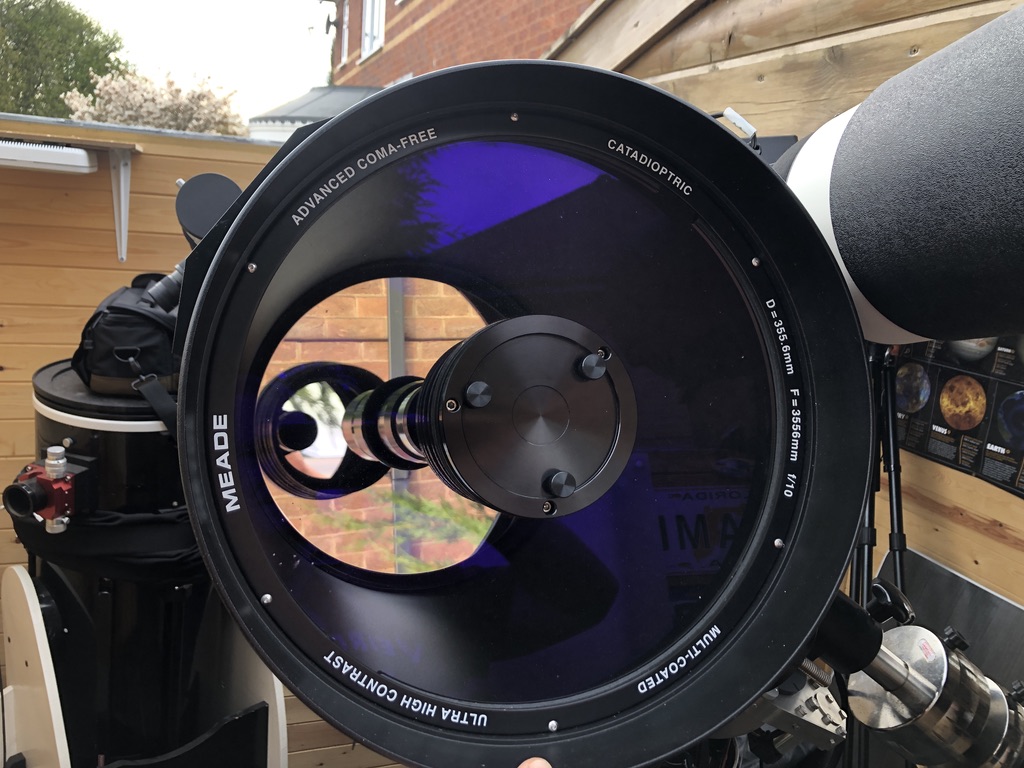
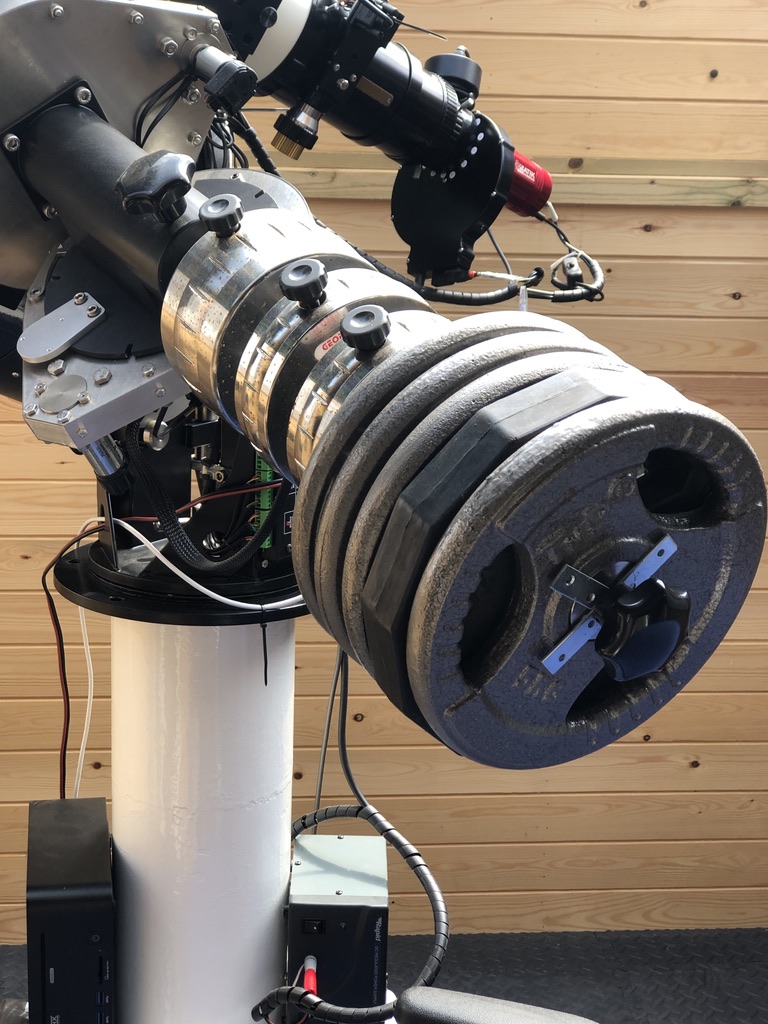
The SCT telescopes increase in size and weight is almost exponential with their increasing aperture. This scope is VERY heavy at almost 27kg and I had it mounted side-by-side with my [also heavy] TEC140. I needed almost 40kg of weights to balance this combination. It was very close to the MESU200's maximum weight carrying ability and caused the mount to shiver for a few moments after any physical touch of the mounted telescopes.
I originally intended a three scope combination with the Meade 14", TEC140 and my FSQ85, the latter two attached to the cameras since I only use these for astrophotography. However, no matter what I tried I could never get this combination to balance in all orientations. If I got it balanced in the parked position then they'd be unbalanced in the "point east
position". Get it right pointing east and the meridian flip would fail. It was like a game of whack-a-mole and a balance problem would repeatedly keep popping up no matter how I adjusted the scopes on their dovetails and in their saddle. In the end I abandoned mounting the FSQ85 and did a dual rig side-by-side with the Meade and the TEC140. Even this was never perfectly balanced and caused the MESUs friction drive to give way on some occasions and I'd awake in the morning following an all-night imaging run with the scopes pointing up at the zenith. Also, because the scopes were so heavy it was a challenge for the MESU to hold them perfectly steady.
I fitted the Meade with a Moonlite Crayford focuser and equipped it with motor focus. With such a long focal length and physical touching of the scope to focus it causes the observed object to wobble for a few seconds and makes focusing a challenge without motorfocus. The fitting of the motorfocus massively assists the usability of the scope. Indeed, I'd suggest just using the mirror focuser would be a very big ask when trying to fine focus.
Meade Side by Side with TEC140
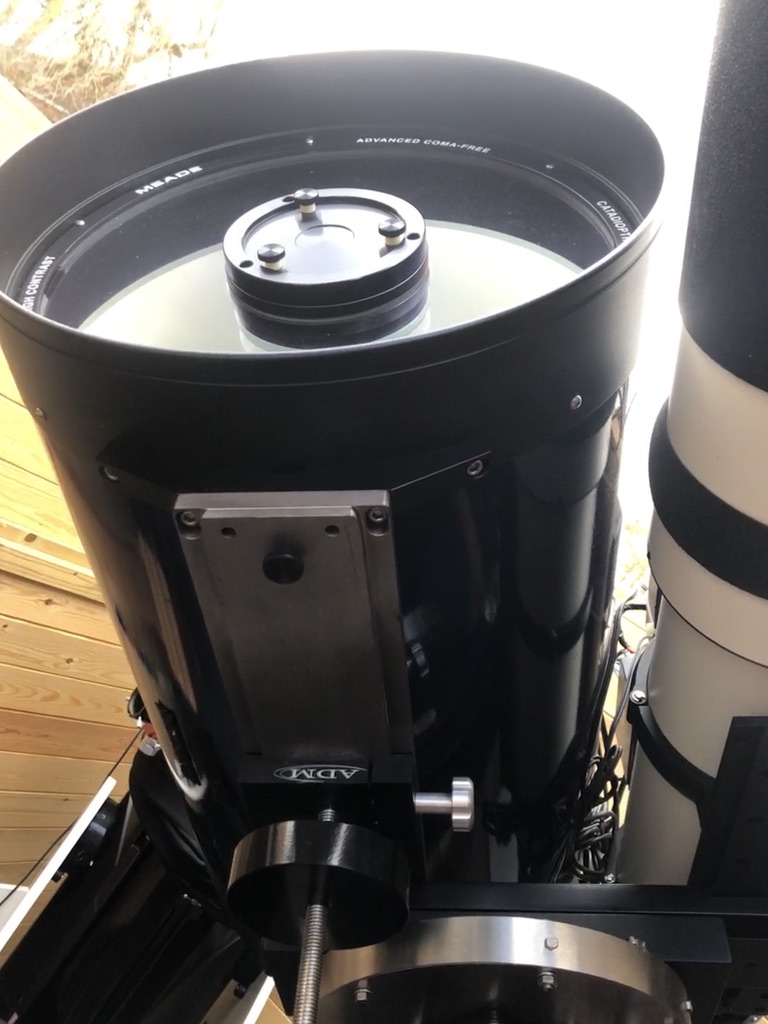
Bottom of Meade 14"ACF
Side of Meade 14" ACF
Meade 14" ACF Corrector
Meade 14"ACF with Moonlite Crayford motor focus
Side View
I sued the scope a lot on The Moon and for some deep sky observations. It excelled on objects such as M27 and M13 and other small objects needing a significant focal length.
However, my overall ownership was a bit of a disappointment and this is absolutely in no way a fault of this magnificent telescope. It is a result of my own aperture fever. Such a telescope in a Bortle 5 suburban sky is always going to be significantly handicapped and this indeed proved the case here. So much so in fact that I hardly even used it on faint galaxies because such objects are drowned out by the light pollution. Jupiter and Saturn were very poorly placed for observers at my latitude (53N) during my ownership so I never got chance to use it on those. In fact, I found my Celestron C925 showed as good a view in my skies. For these reasons, I sold the telescope, minus the focuser in May 2020, after a year of ownership. In the end I sold it to someone from Derbyshire Peak District who has dark skies. I was sad to see it go because in the right skies it will be magnificent.
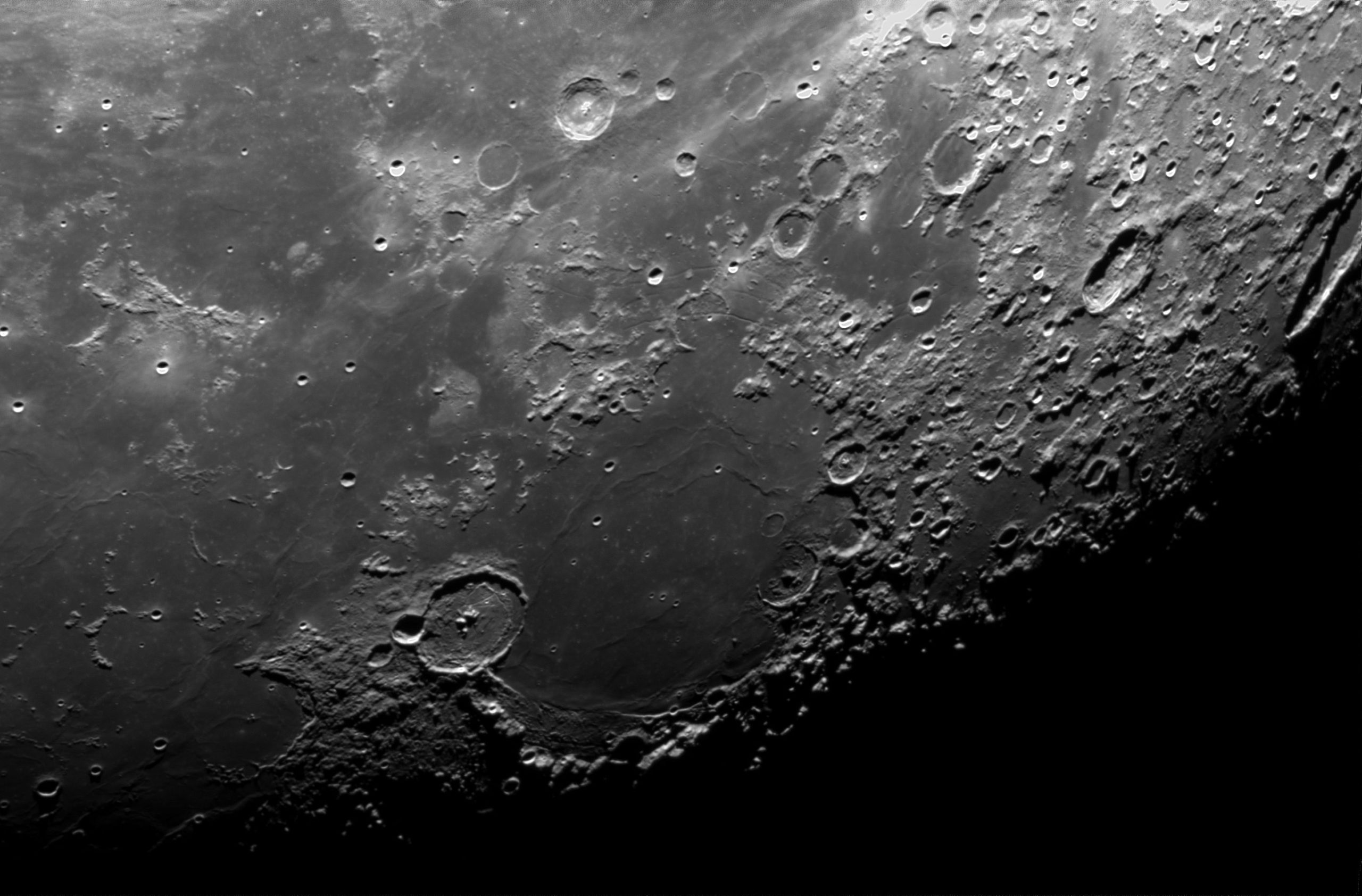
Lunar Pictures from January 2020
A few pictures of the moon that I took with my Meade 14 ACF SCT scope with a ASI 174MM camera in January 2020. The pictures utilised no filters at all.


The Meade 14" is an astounding scope that I liked very much. However, with a heavy heart I subsequently went on to sell this telescope since I felt that in my Bortle 5skies it doesn't offer any significant advantage over and above the Celestron C925; the latter scope being very much more manageable that the huge (and very heavy) 14" Meade. At some point in the future I may regret this decision since the scope excelled on the few occasions I took it to truly dark skies. However, I could not let my heart rule my head and I decided to sell it.
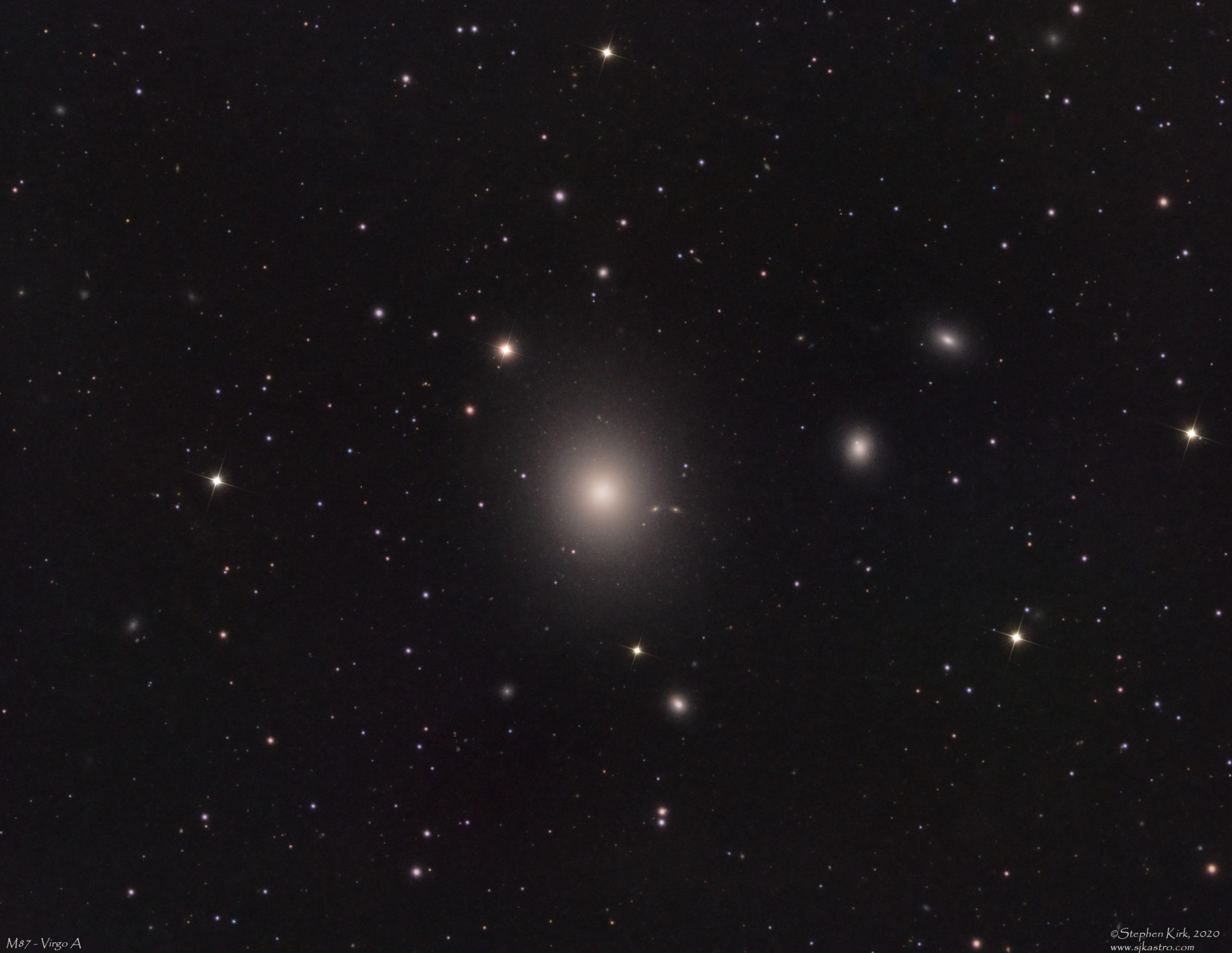
M87, The Giant Elliptical Galaxy in Virgo TEC 140

M87 is a supergiant elliptical galaxy at the heart of the Virgo cluster of galaxies and is visible in many pictures of the famous Markarian's Chain. It is about 65 million light years away and, after the Sun, is the brightest source of radio waves in the sky - at that vast distance! The galaxy is one of the most massive in the local universe at two hundred times the mass of our own Milky Way galaxy. M87 harbours one of the most massive Black holes in the Universe at 8 billion solar masses. The galaxy is surrounded by a swarm of globular clusters, about 12000 of them, compared to only 200 from our galaxy.
The galaxy is so large that from The Earth the extended galaxy is almost the size of the full moon.
Image Technical Data
Imaged from by back yard in Nottingham, UK with my TEC 140 refractor and Atik 460 CCD camera with Astrodon E series LRGB filters on my MESU mount. Data acquired April 2020 (middle of the Coronavirus lockdown in the UK) and is comprised of the following data - everything binned 1x1.
Lum > 12 x 600s ; Red > 12 x 300s ; Green 12 x 300s ; Blue 12 x 300s
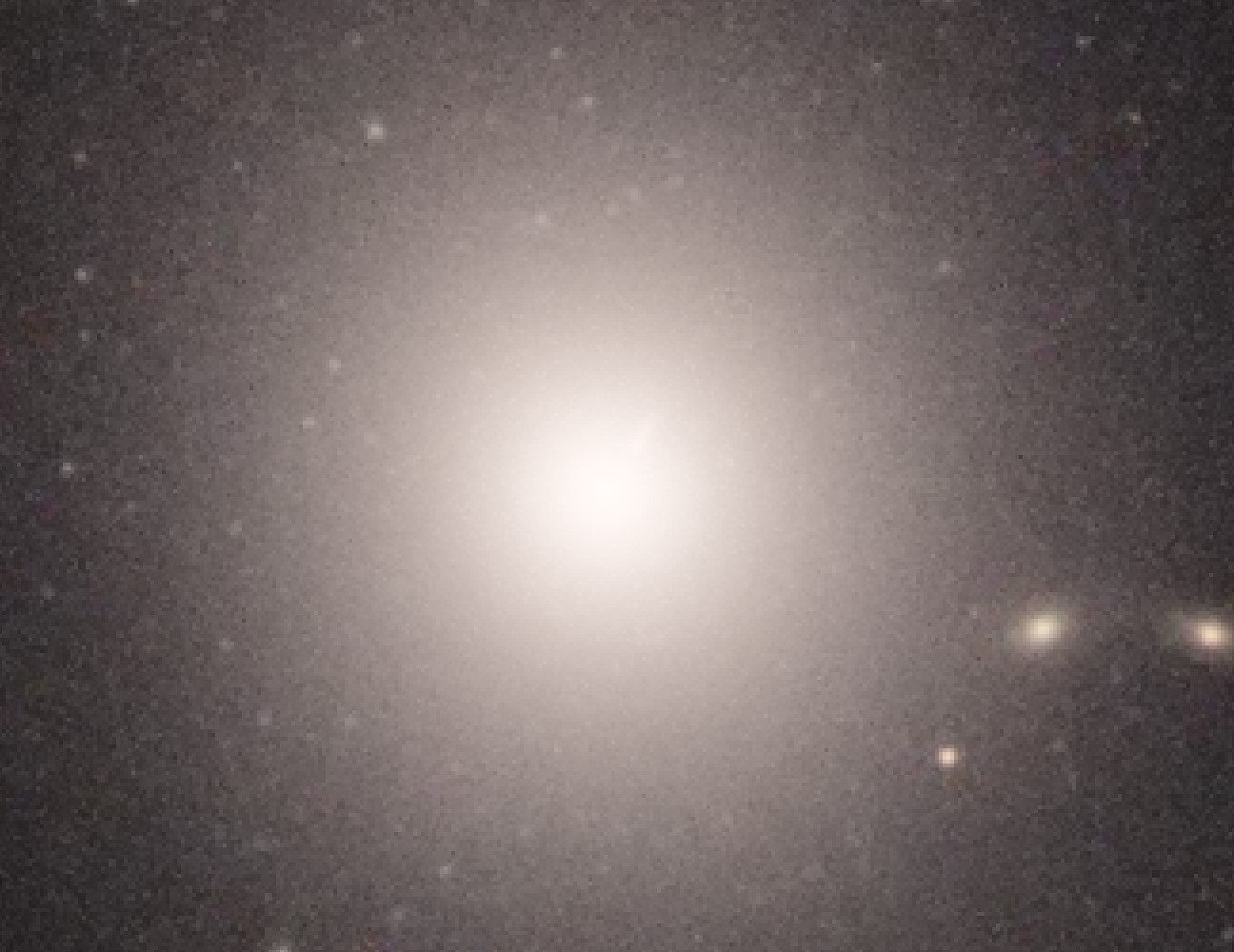
The closeup above shows the famous "jet" emanating from the central black hole (at "one o'clock" in this photo) in the core of the galaxy and the latest theories suggest this is radiation being emitted from the poles of the black hole at almost the speed of light.
Also can be seen in this picture some of the many globular clusters that orbit M87. Some of M87's globular clusters are hugely larger than the Milky Way's and are giant enough to be seen from 65 million light-years away. M87, in growing to be such a huge galaxy, is though to have consumed many other galaxies during its history and is thought to have robbed the globular clusters of the now dead galaxies.

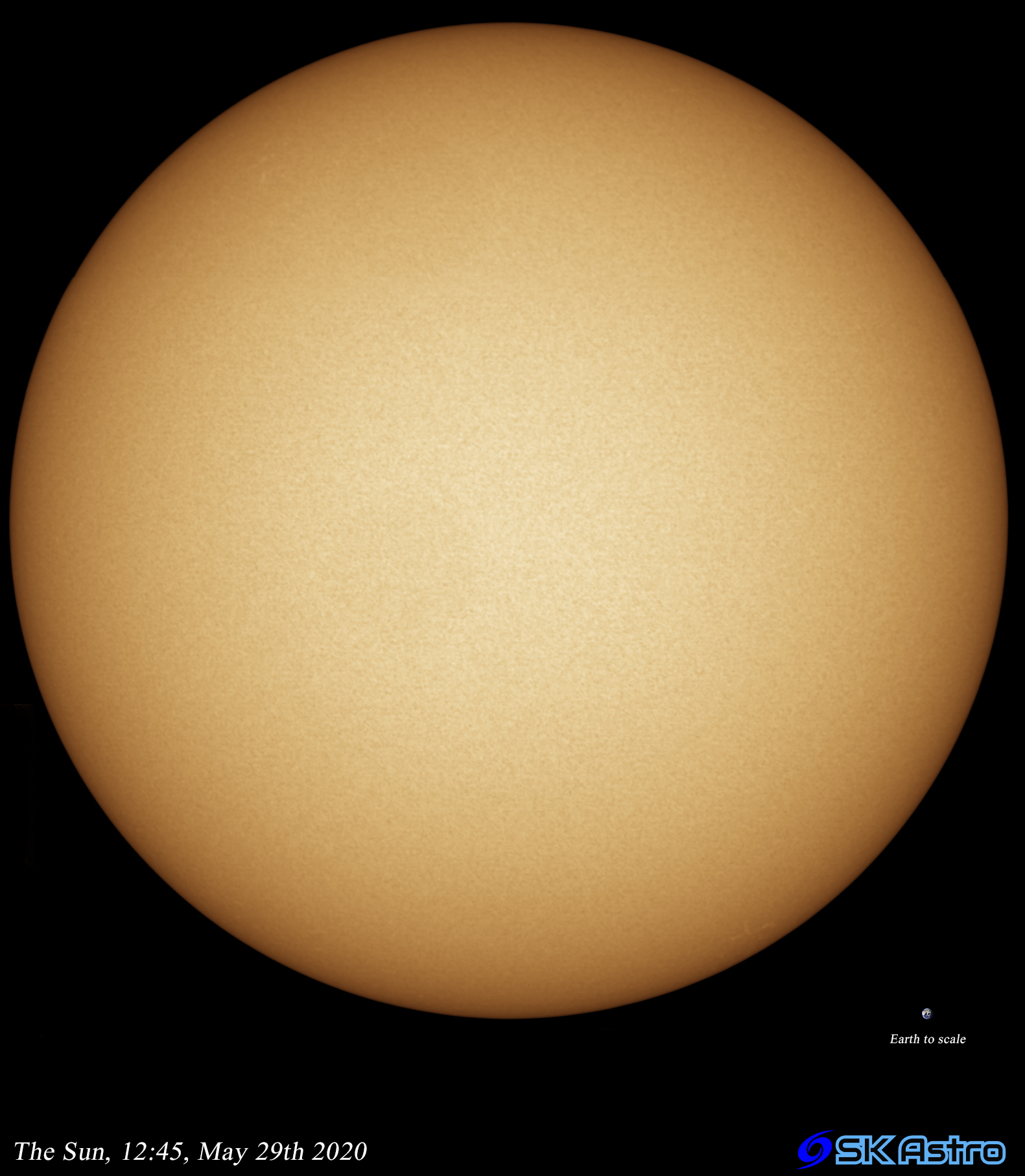
Sun 29th May 2020
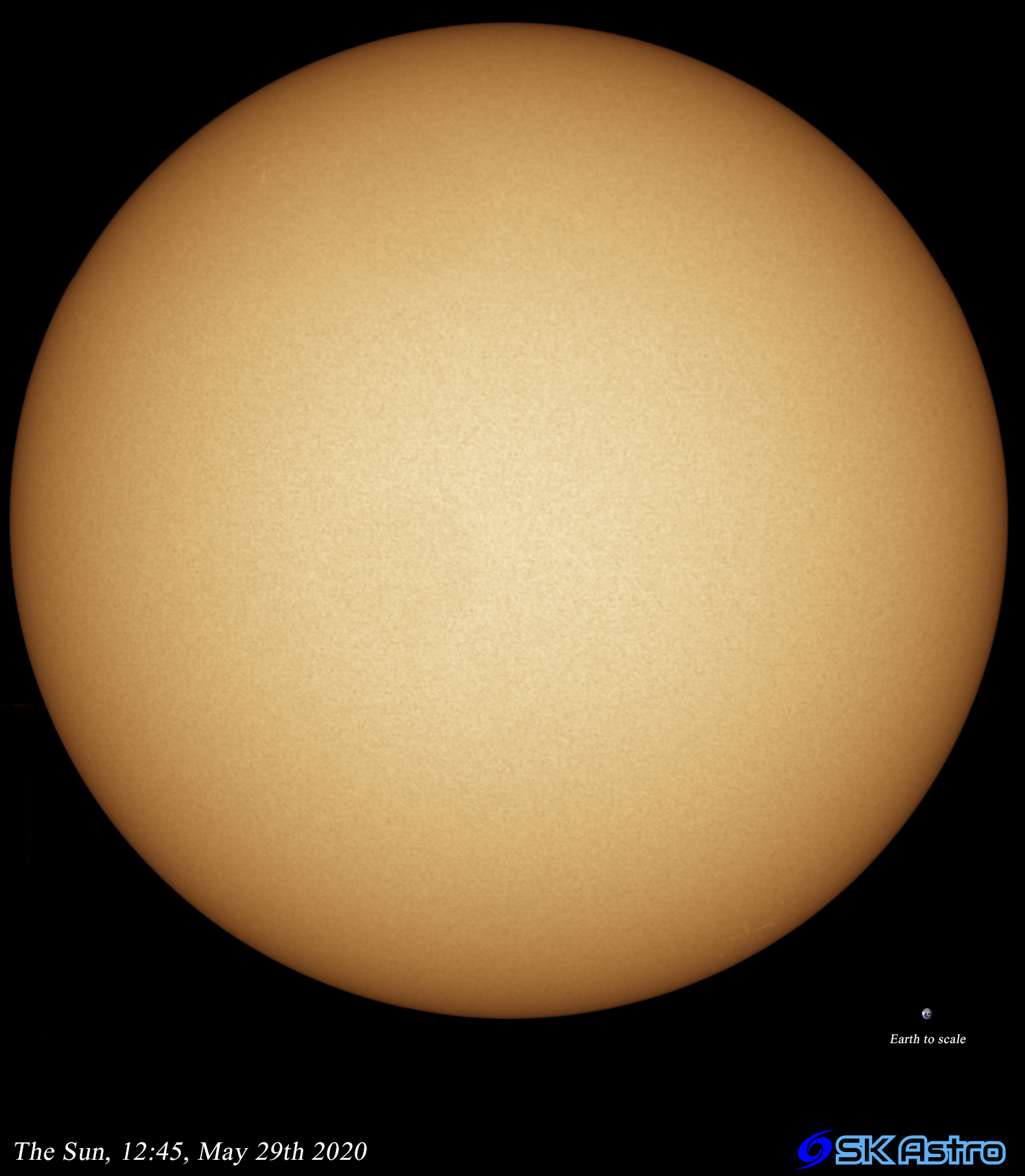
TEC140 refractor, Baader Herschel Wedge, ASI 174MM camera. Captured with Firecapture, Stacked with AutoStakkert, developed with PixInsight and Photoshop.
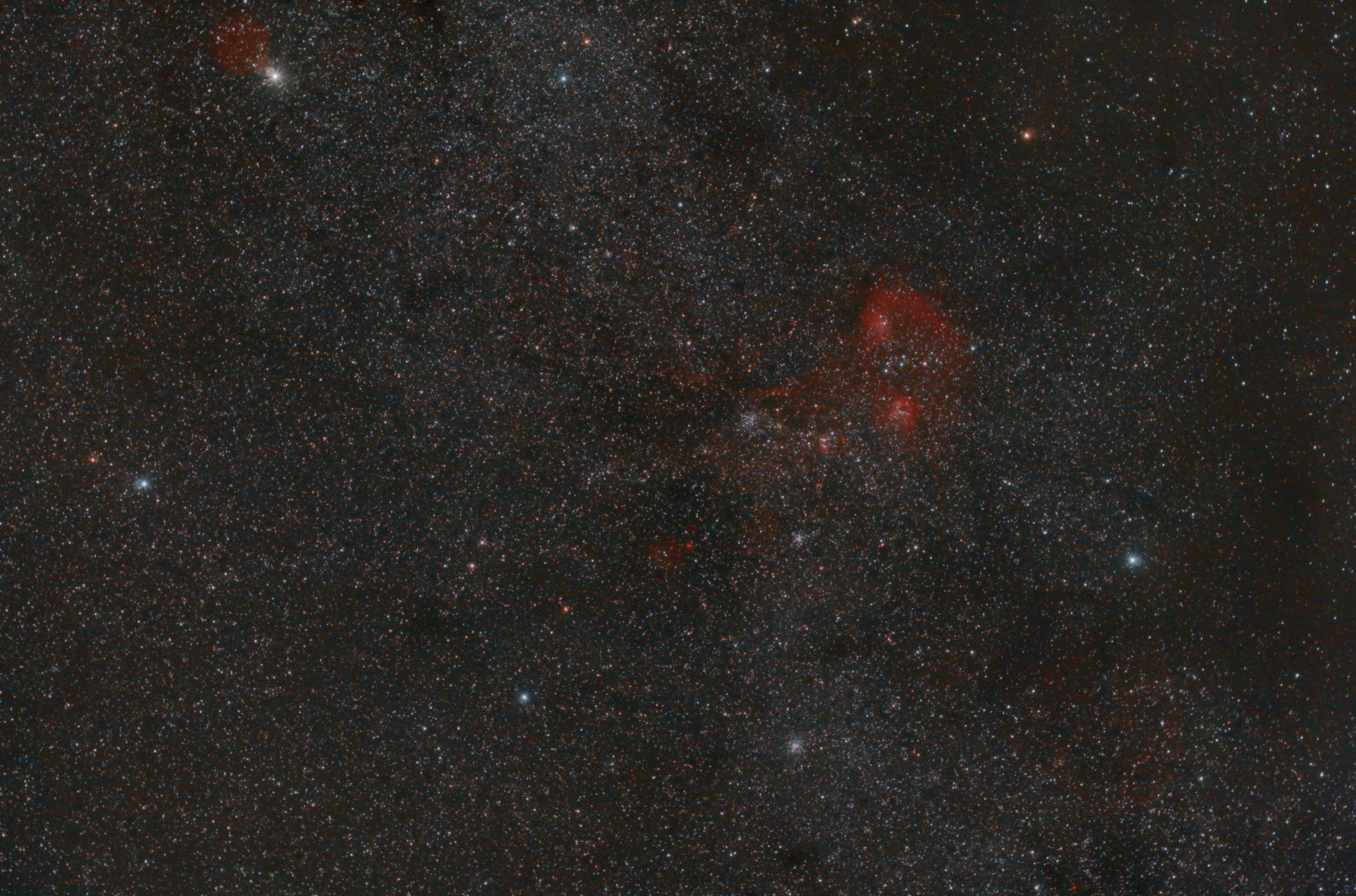
Auriga - The Charioteer
Auriga -
A famous constellation in the winter Northern Hemisphere sky, Auriga contains many very interesting objects and nebulae. Arguably the most important of these objects are the famous Open Clusters M36, M37 and M38, all of which I have imaged individually.
This image was taken in January 2020 from my backyard in Nottingham, UK on my modified (i.e. with the IR filter removed) Canon DSLR 1100D and a Canon 50mm lens. It is composed of 80 x 90s exposures at ISO 800 at F4, mounted on a Skywatcher Star Adventurer sky tracker mount. Astrophotography does not have to be expensive and you can achieve great things with a DSLR and a tracking mount!

Below, to the left, is an annotated version of the above picture and it shows many of the interesting objects present within the constellation of Auriga. You can see the many Sharpless catalog (Sh2) objects as well as the more famous Messier open clusters. To the right is a high contrast inverted view of the image.
I hope you like this page and found it useful.


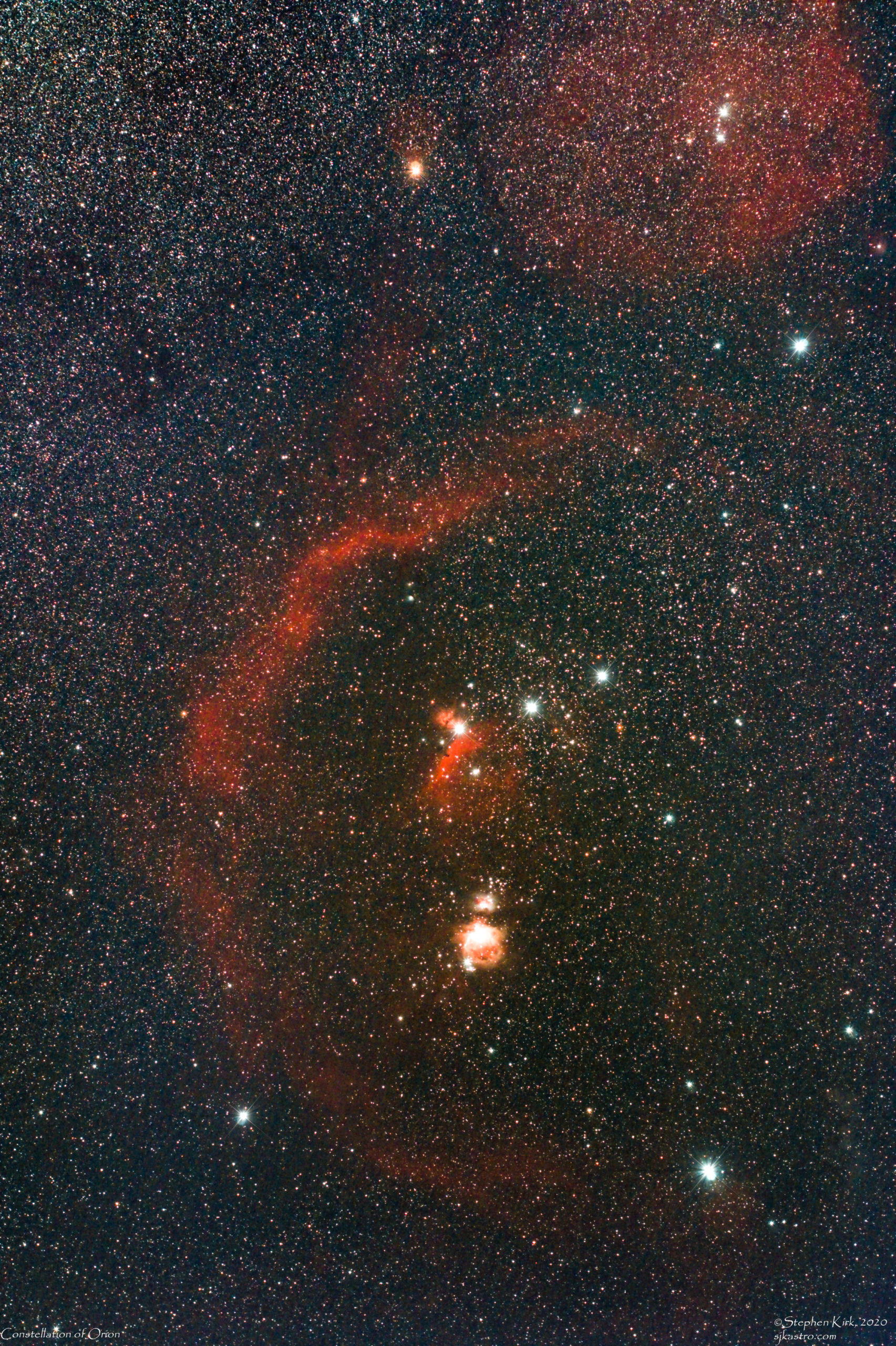
Orion
Orion
Dominating the Winter sky in the Northern Hemisphere, Orion is probably the most recognisable of constellations. It is full of very important and popular astronomy objects and stars.
The image here is a stack of 80 x 80 second exposures at F4 and ISO 800 taken in January 2020 from my backyard in Nottingham with a modified Canon 1100D and a 50mm lens. The camera followed the sky with a Star Adventurer tracker. It was cold and windy at the time I took the exposures. I stacked them with Deep Sky Stacker and processed with PixInsight and Photoshop.
You can see the arc of Barnard's Loop and The Orion Nebula and Horsehead Nebula. Also visible glowing faintly to the bottom right is the ghostly outline of the Witch Head Nebula.

Below is the annotated version showing many of the interesting stars and objects within Orion. Very obvious is the Great Orion Nebula and Barnard's loop.


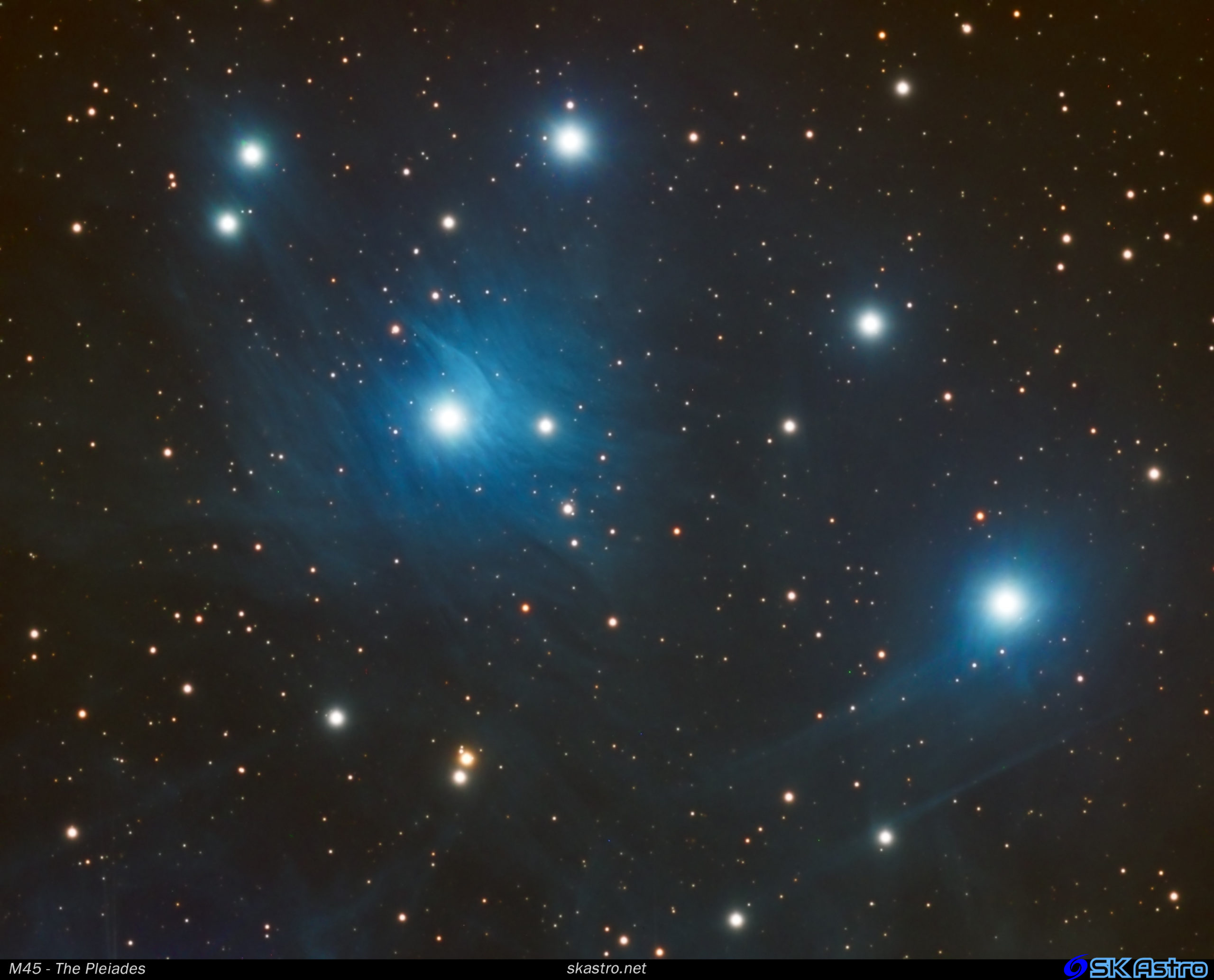
M45 The Pleiades
Introduction

Presented here is M45, the famous Pleiades Open Cluster of stars. Image was captured in one imaging run on the night of 18th December 2019. This image shows a small sub-section of The Pleiades, the "head". This main triangle shape of the bright stars Maia, Electra and Taygeta is visible to the naked eye.
Known since ancient times from cultures all over the world and even featured in prehistoric cave paintings, The Pleiades is a large, open cluster of stars in Taurus, visible late autumn and winter in the Northern Hemisphere
The Pleiades are actually composed of hundreds of stars, about 470 light years away. The cluster is vert young, about 20 million years, and is moving through a cloud of interstellar gas and dust. At some point many millions of years in the future, the stars will lose their mutual gravitational attraction an d will slowly disperse and start life on their own, orbiting the centre of the galaxy.


Technical Information
T: TEC 140 refractor
M: MESU200
C: ATIK 460 with Astrodon RGB
Twelve exposures in each filter, three minutes in length.
Total Integration time of 108 minutes, binned 1x1.


M36 Open Cluster in Auriga - FSQ85
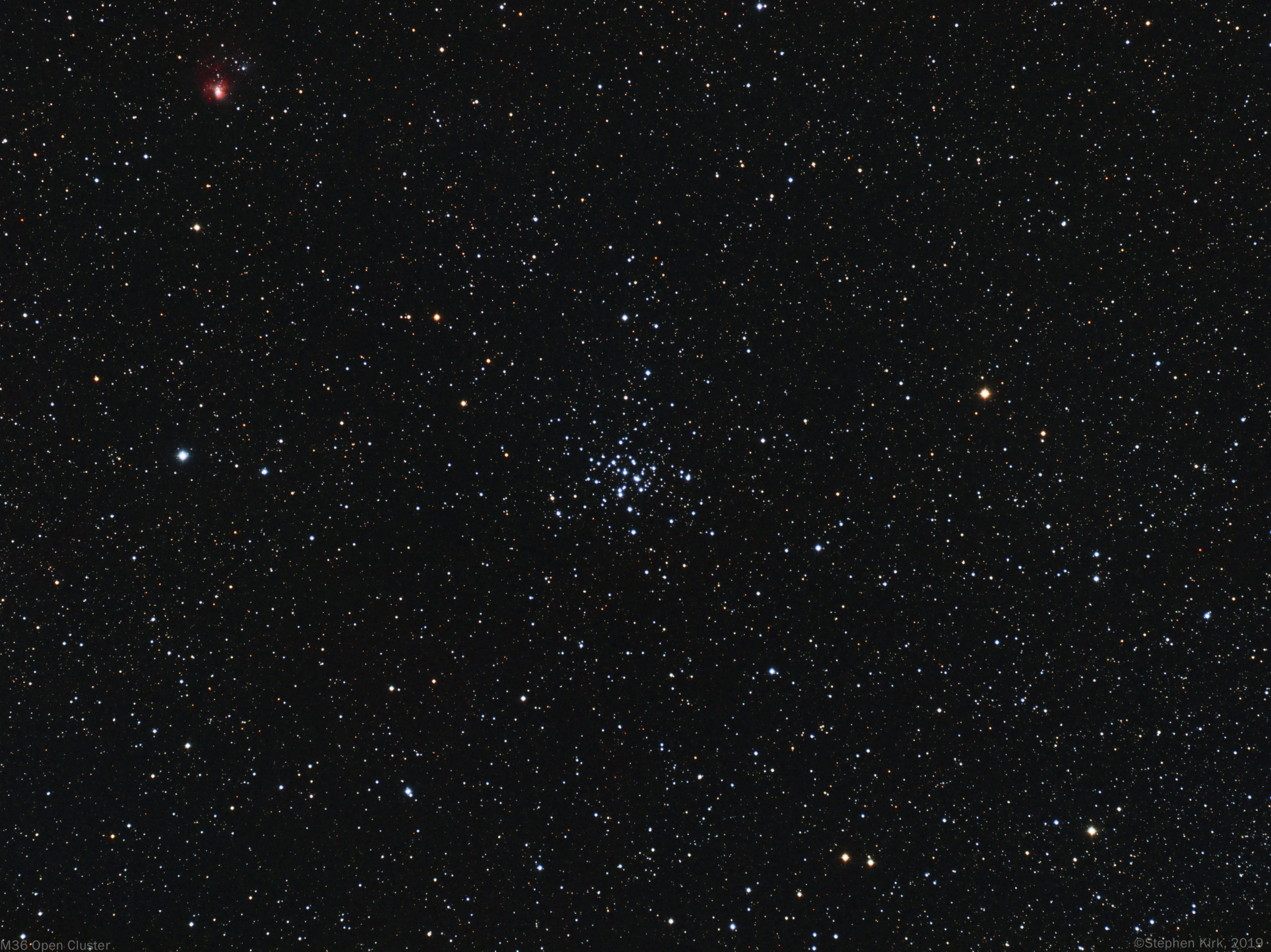
M36 is an Open Cluster of stars (as opposed to a Globular Cluster) in the Constellation of Auriga. M36 is high overhead in Europe during the nightimes of winter months and is one of three Messier Open Clusters in Auriga, the others being M37 and M38. All of these are visible in a small pair of binoculars as nebulous and fuzzy blobs. M36 and the other clusters make a fine site in a telescope and dozens of stars can be seen. Note also the Red nebula to the top left - NGC 1931 (Sh2-237). There are some tiny PGC catalogue galaxies, billions of light years away in this image.

This image was taken from by backyard in Nottingham, UK on the 24th January 2018 with my Takahashi FSQ85 refractor and Moravian instruments G21-8300 CCD camera with Astrodon RGB Generation 2 E series filters on MESU 200 mount. All data was binned 1x1.
Red > 12 x 120s ; Green 12 x 120s ; Blue 12 x 120s
Total Integration is about an hour and twelve minutes. Data captured with Sequence Generator Pro and processed in PixInsight and Photoshop.


Astrobin Image here: https://www.astrobin.com/fersyj/