
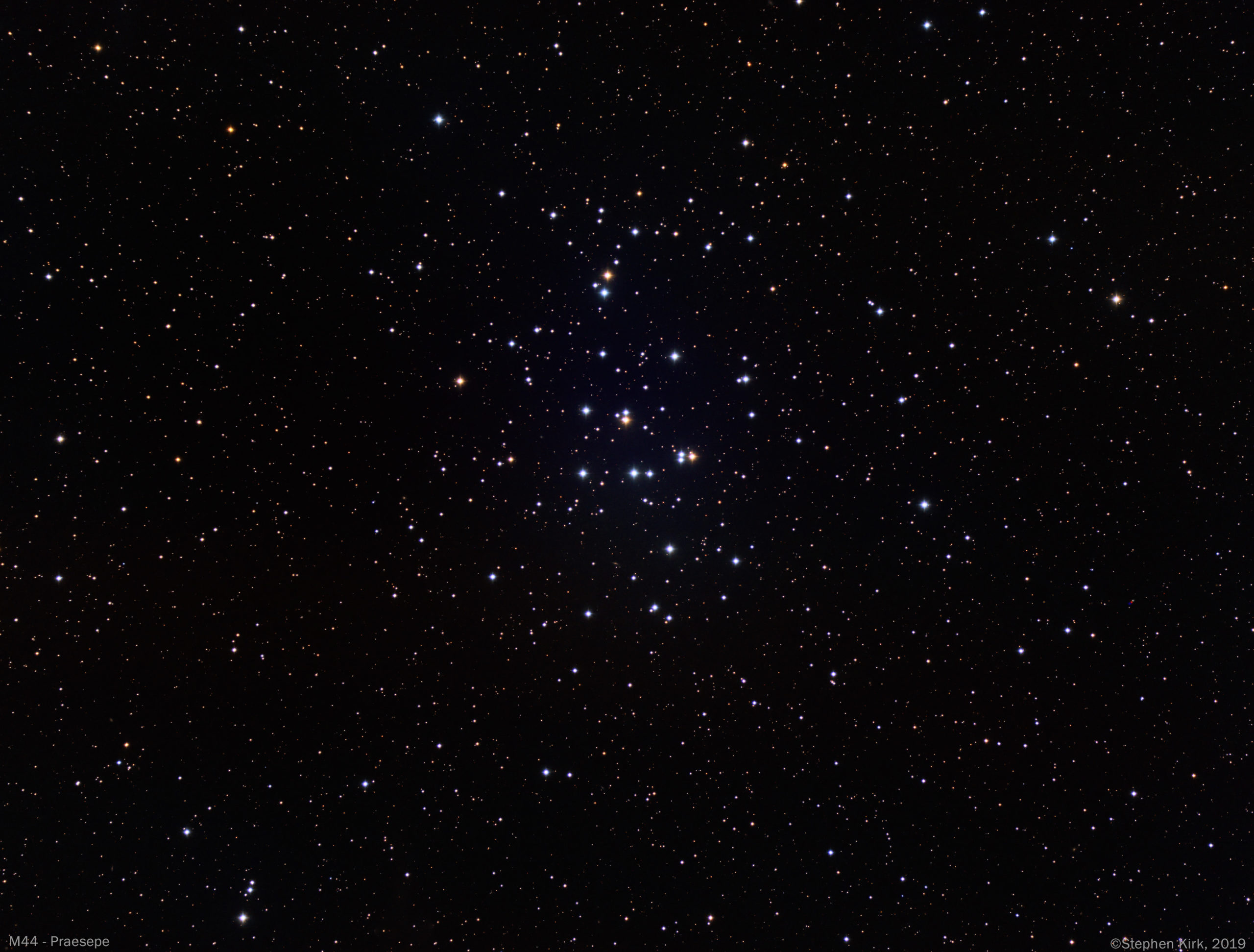
M44 - Praesepe - with FSQ85
M44 or "Praesepe" as it is called, is a famous open cluster visible in the late winter/ springtime in the constellation of Cancer - The Crab. It is often nicknamed The Beehive cluster since it resembles a swarm of bees when viewed in a wide-field telescope or binoculars. Along with M45 it is one of the most immediately breathtaking sights in the deep sky. At about 510 light years it is one of the closer Open Cluster to the Earth and is about 12 light years across and contains about 1000 stars. Note the tiny, distant galaxy in the bottom of the cluster PGC24400.

Image Technical Data
Imaged over two evenings, the 22 and 23 February 2019 from my backyard in Nottingham, UK. Conditions were far from ideal with a high, hazy mist that made transparency poor and subsequent processing difficult.
Captured with Takahashi FSQ85 and Moravian G2-8300 CCD camera with Astrodon RGB filters. All data binned 1x1:
Red > 14 x 120s ; Green > 16 x 120s ; Blue > 14 x 120s
Mounted on MESU 200 telescope mount and guided with OAG


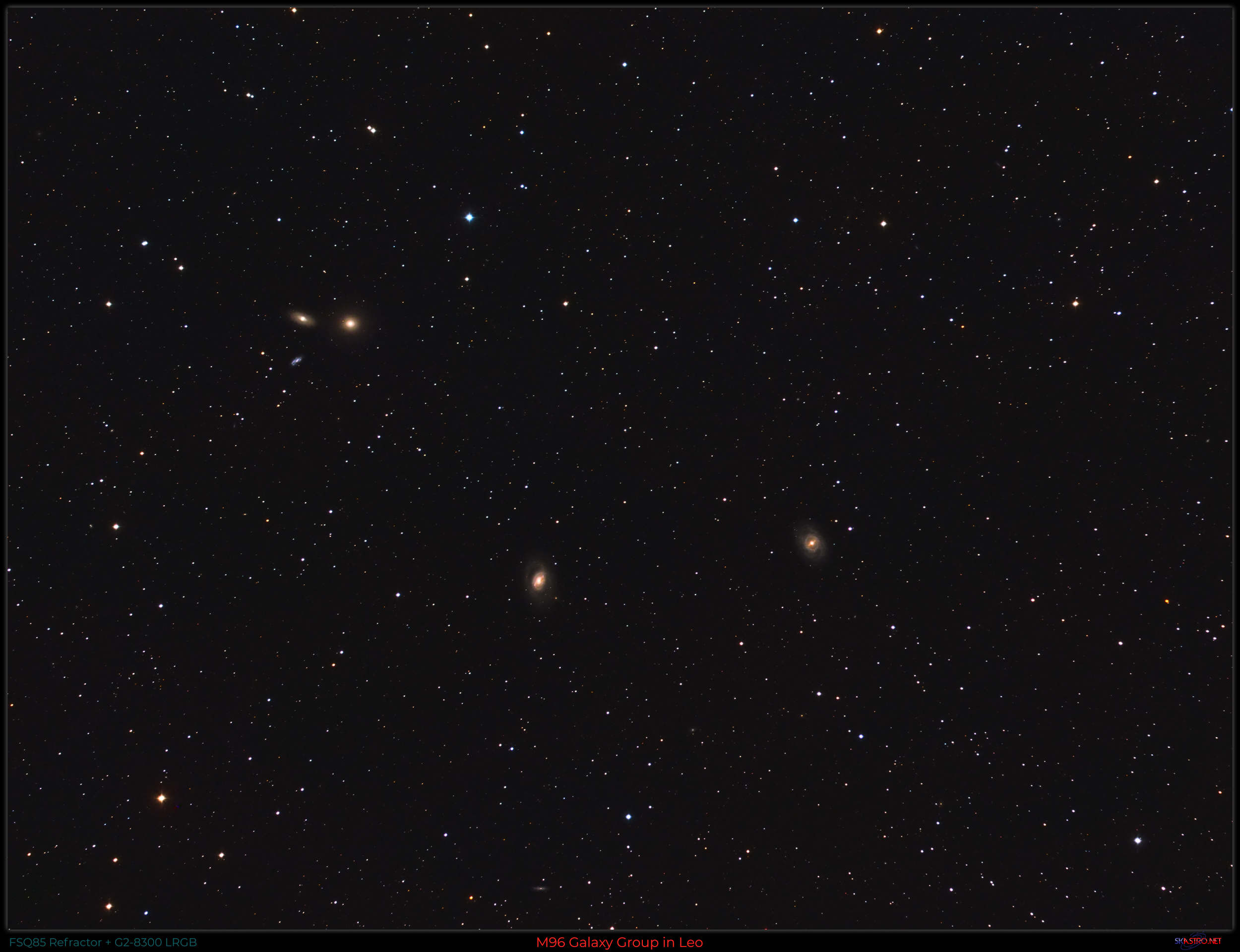
M96 Group in Leo - FSQ85
The M96 Group is a cluster of galaxies in the constellation of Leo. Not to be confused with the separate and arguably more famous Leo triplet. The M96 group contains three Messier galaxies (M95, M96 and M105) and many fainter galaxies in the background. The three main galaxies are about 35 million light years away and are easily visible in small telescopes.
Image Technical Data
Technical Information
Imaged from my backyard, March 2019, in Nottingham, UK. I used my FSQ85 refractor with 0.73 reducer and my Moravian instruments G2-8300 CCD camera and Astrodon LRGB filters. Mount is my MESU200 and guided with an Off-Axis guider. Image acquisition data:
Luminance 11 x 600s 1x1; Red 9 x 300s 2x2; Green 10 x 300s 2x2; Blue 10 x 300s 2x2

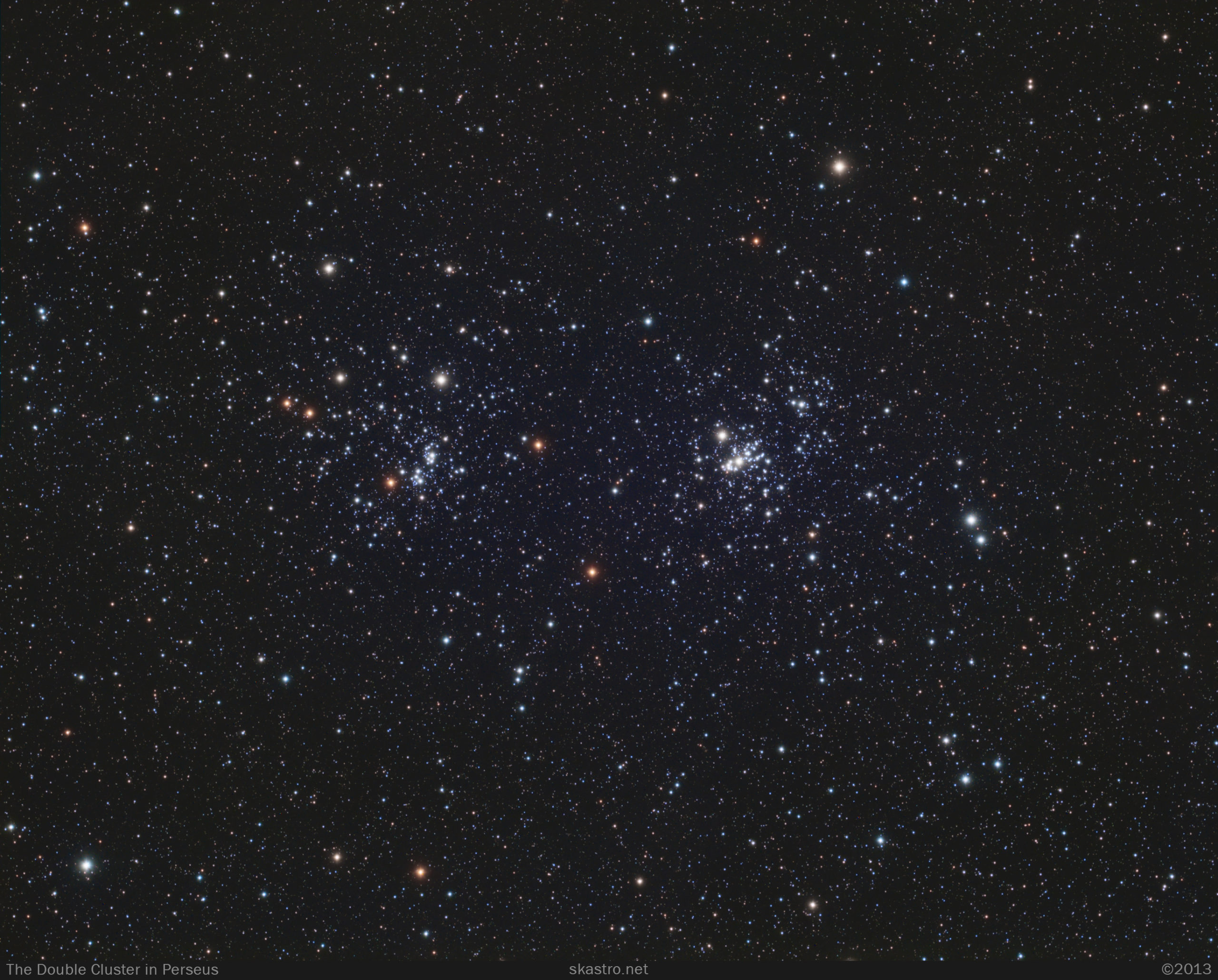
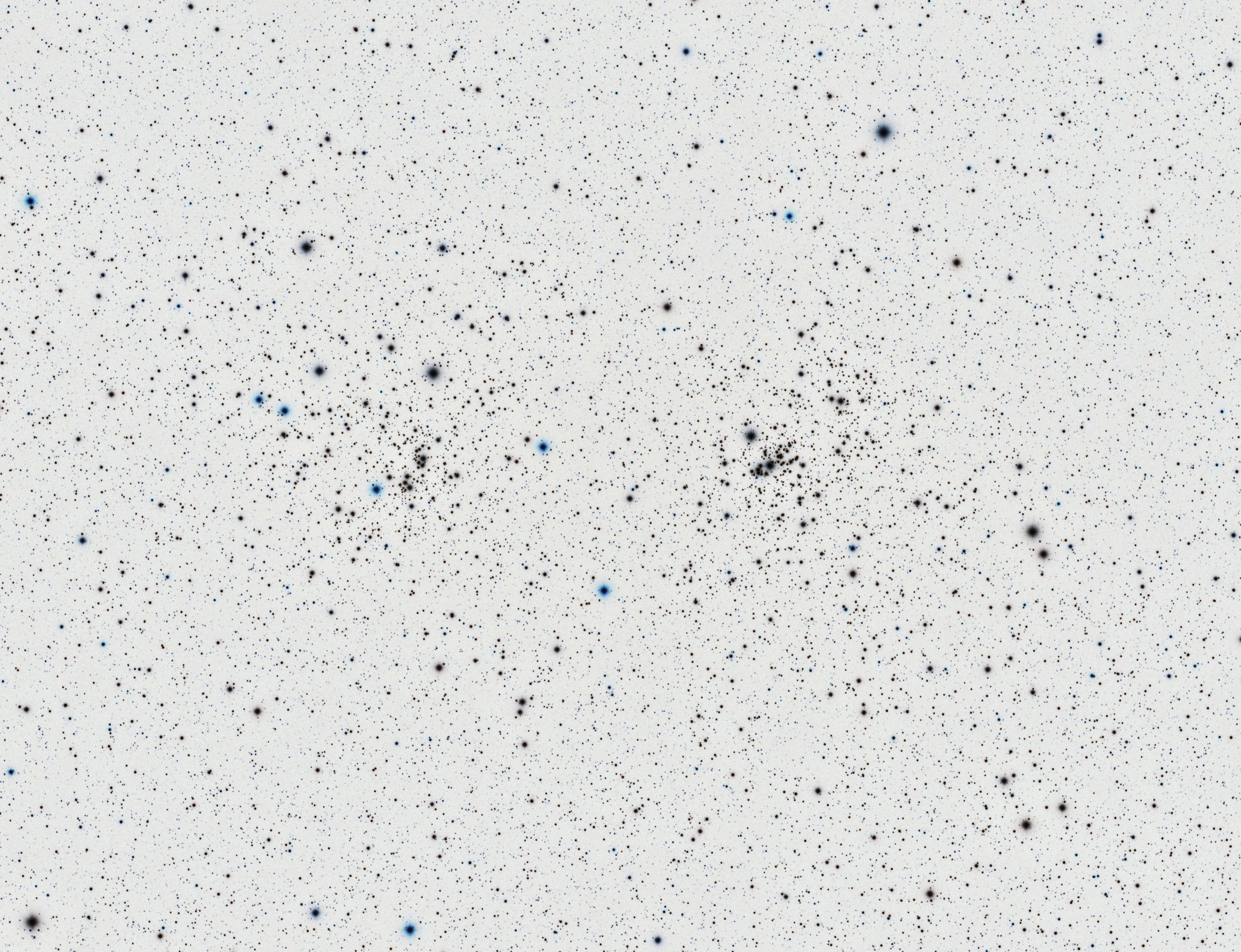
The Double Cluster

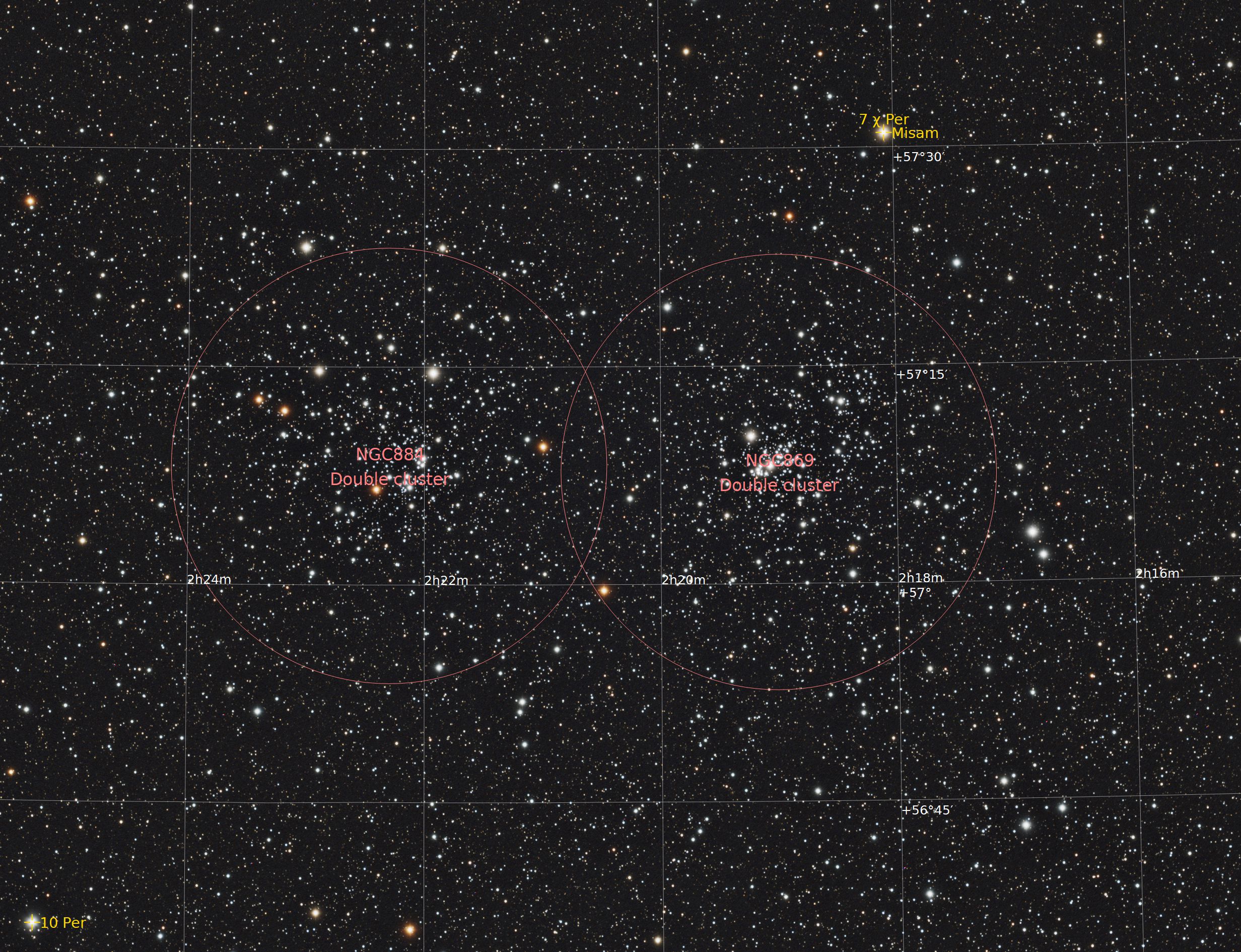
The Double Cluster is located in the constellation of Perseus, near the border with Cassiopeia and is composed of the two Open Clusters NGC869 and NGC 884. They are visible faintly to the naked eye on a dark night and a wide field eye piece shows them superbly in the telescope as does a pair of binoculars if you hold them steady.
The clusters are very distant from us at about 7500 light years and are located outwards in the Perseus spiral arm of the galaxy. Were they as close as The Pleiades (at 450 light years) they would dominate the night sky!
The above image was taken with my Takahashi FSQ85 refractor and Atik 460 CCD camera with Baader RGB filters and contains 45 minutes of exposures in each of the RGB channels. I took these exposures in 2013 and this was the first light of this telescope.
Markarian's Chain
A famous string of galaxies in the constellation of Virgo, named after the astronomer Benjamin Markarian who first discovered their common motion. The chain contains several Messier catalogue objects and is visible in the late winter and spring in the Northern Hemisphere. The galaxies are located between 65-75 million light years away and are nice objects to observe with a telescope if you can do so from a dark sight.
This image was created from a data set acquired in Spring 2019 with my FSQ85 refractor.
Image is centred on "The Eyes" of NGC4435 and NGC4438 just below dead centre of the image. At the bottom is the monstrous supergiant elliptical galaxy M87, the most massive object in the local universe harbouring the famous black hole recently imaged with the event horizon telescope.
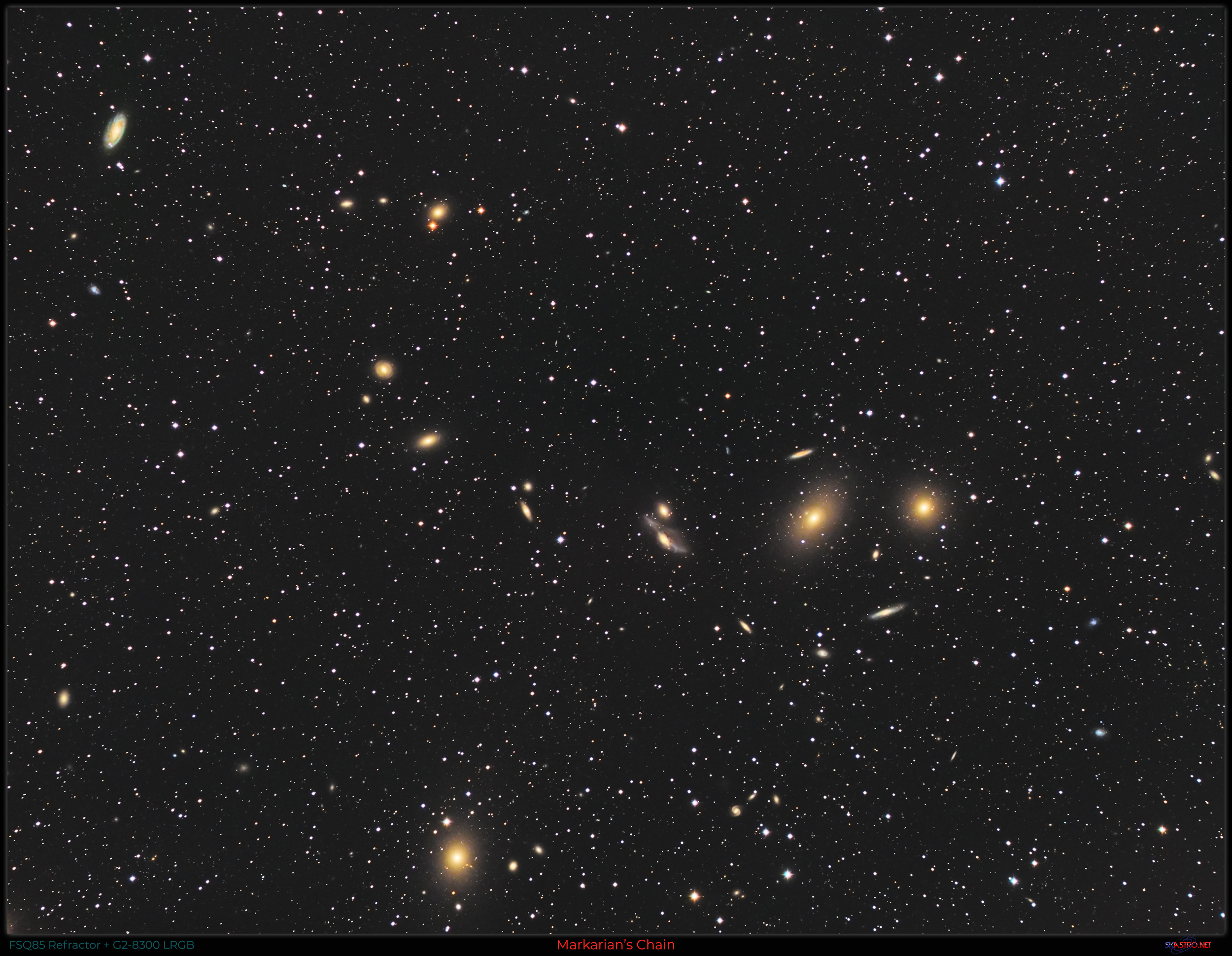
Below is an inverted version that help show the galaxies with more contrast.

Technical Information
The data set was acquired with my FSQ85 refractor with the 0.73 reducer and Moravian Instruments G2-8300 CCD camera with Astrodon LRGB filters.
Data set is as follows: Lum > 26 x 600s ; Red 14 x 300s ; Green > 14 x 300s ; Blue > 14 x 300s
Everything binned 1x1 on my MESU 200 mount and using off axis guiding. The data was acquired in two nights. The data is processed with PixInsight and Photoshop.
Below are two annotated versions; a simpler version showing the main Messier, NGC and IC catalogues and then, at the bottom, a version adding the hundreds of PGC (Primary Galaxy Catalogue) objects deep in the universe many of which are billions of light years away.


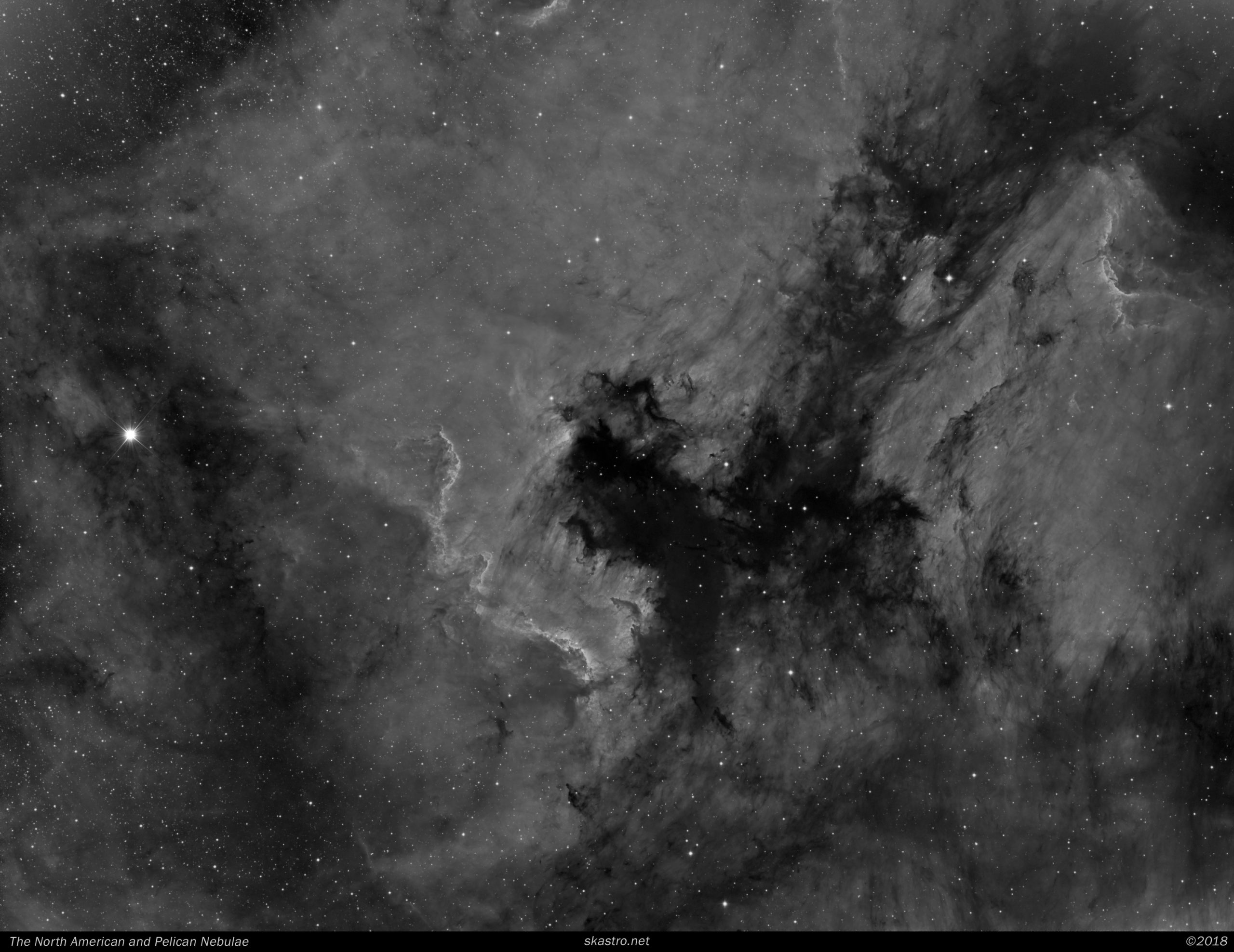
The North American and Pelican Nebulae in Hydrogen Alpha
The North American Nebula and the adjacent Pelican nebula to the right of it are popular objects of the summer and autumn sky in the Northern Hemisphere. Both of these objects are aptly named because the nebula to the left really does look like the continent of North America being looked at by a pelican to the right!
This post discusses a version of these objects in the light of Hydrogen Alpha 3nm only. You can see the vast amount of detail that is emitted at this wavelength by the clouds of hydrogen that the nebulae are composed from.
This picture is composed of 48 x 600s exposures with a Takahashi FSQ85 refractor and Moravian G2-8300 CCD camera with an Astrodon 31mm 3nm Ha filter and the Takahashi 0.73 reducer. The image discussed here is a pure Ha monochrome image but I also combined this data set with RGB colour data as well that you can see here.

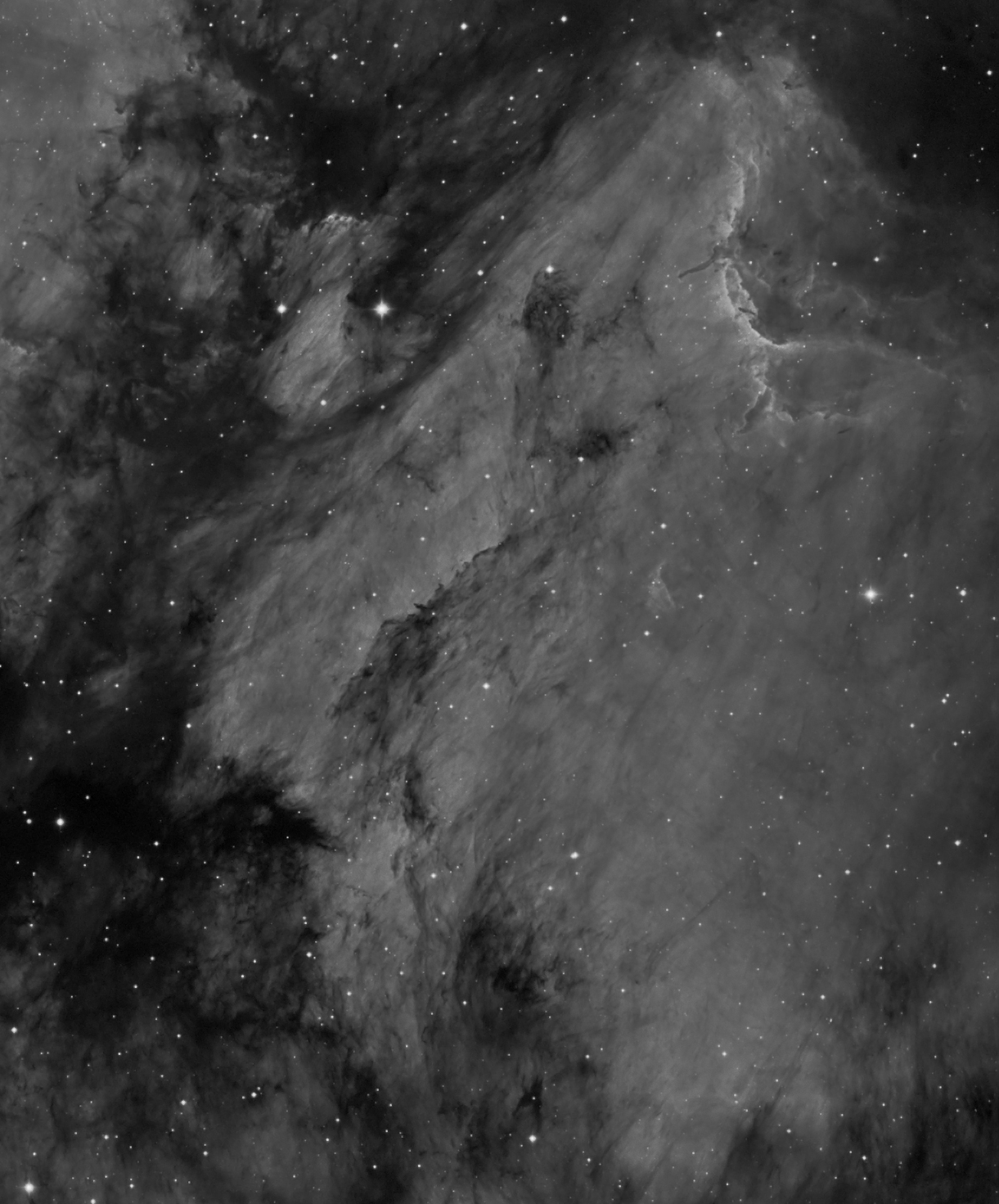
A snippet of the above picture showing The Pelican nebula.
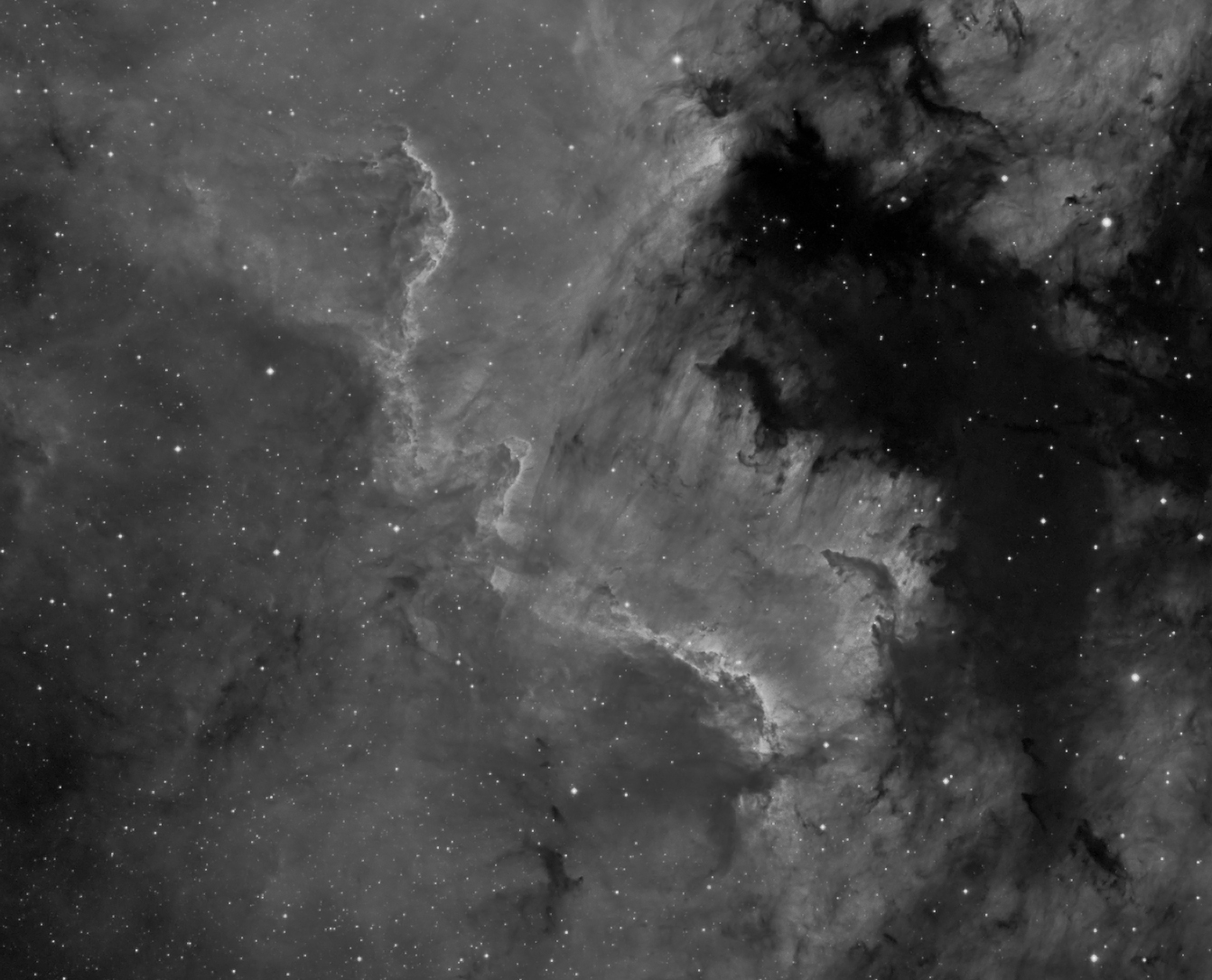
This shows the portion of the nebula commonly known as "The Wall"
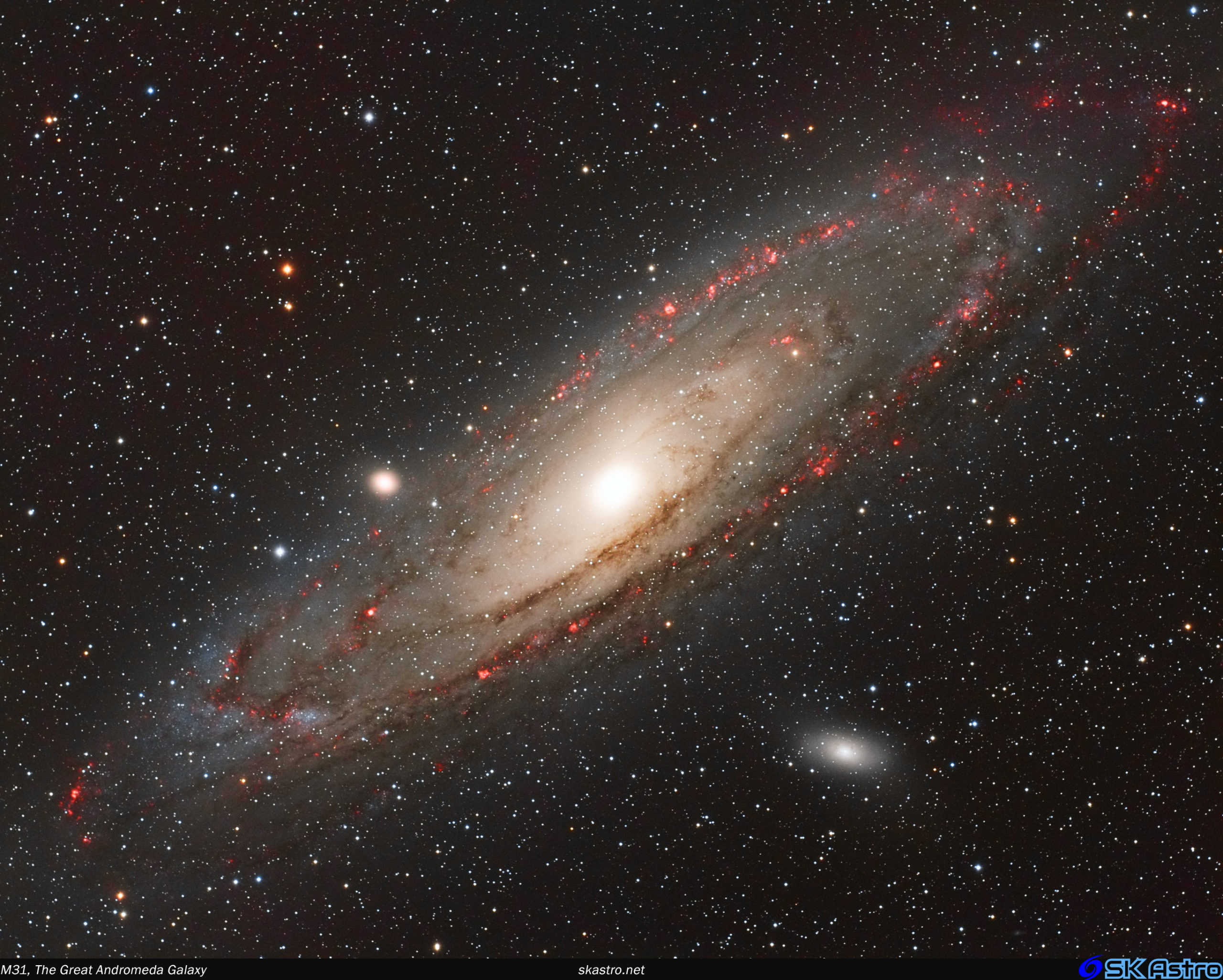
M31 - The Great Galaxy in Andromeda
Known since ancient times as a nebulous blob in the autumn and winter sky, M31 was the first galaxy to be recognised as a completely independent "island universe", wholly separate from our own Milky Way galaxy. This nature of M31 was only discovered in 1924.
M31 is slightly larger than our own galaxy and is located about 2.2million light years away.

The abovr image is comprised of a series of 600s exposures taken during 2017 and 2018 and is approximately ten hours worth of data through Baader LRGB and Ha (7nm) filters with a Takahashi FSQ85 telescope at native focal length and with G2-8300 camera.


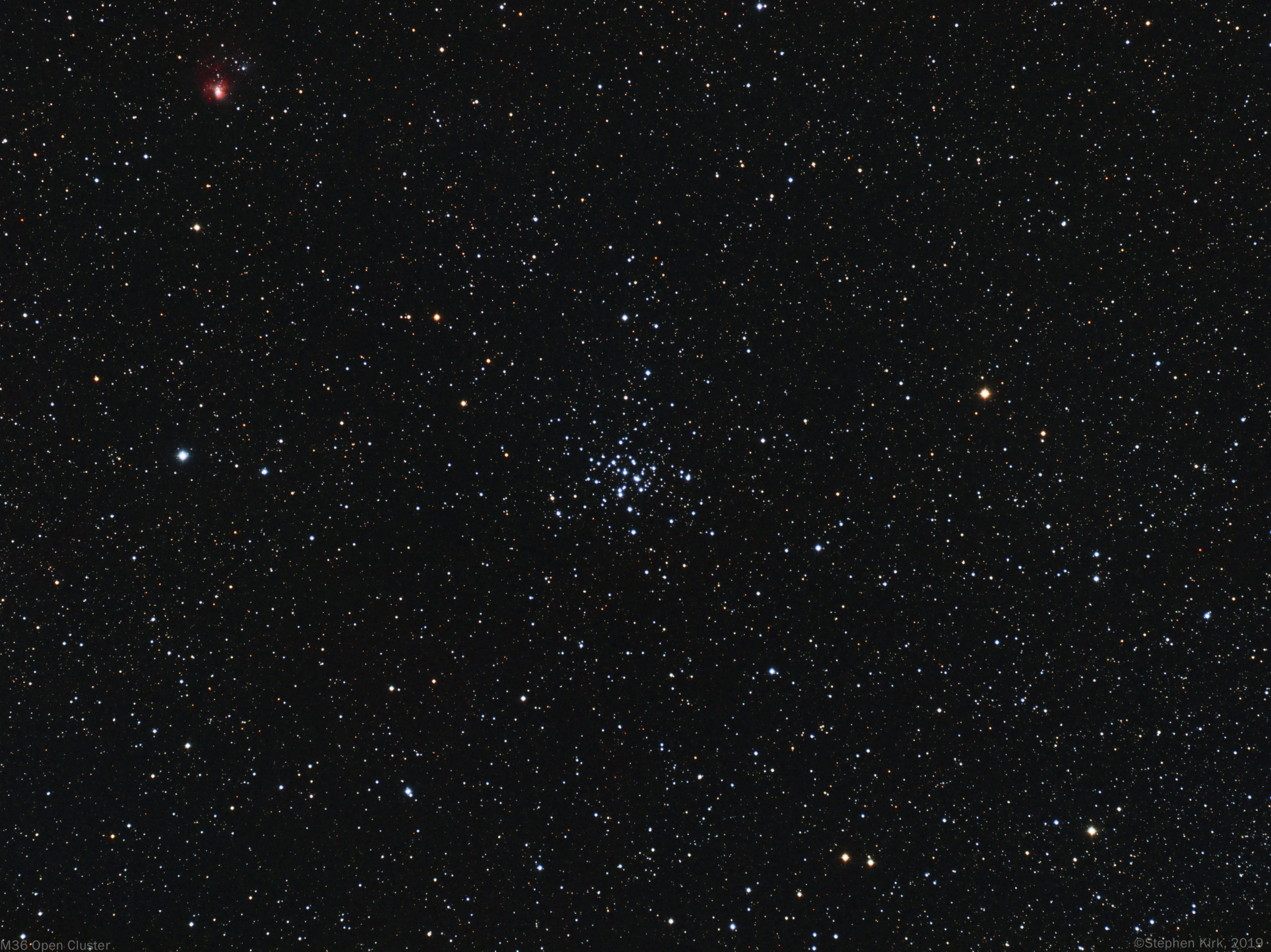
M36 Open Cluster in Auriga - FSQ85
M36 is an Open Cluster of stars (as opposed to a Globular Cluster) in the Constellation of Auriga. M36 is high overhead in Europe during the nightimes of winter months and is one of three Messier Open Clusters in Auriga, the others being M37 and M38. All of these are visible in a small pair of binoculars as nebulous and fuzzy blobs. M36 and the other clusters make a fine site in a telescope and dozens of stars can be seen. Note also the Red nebula to the top left - NGC 1931 (Sh2-237). There are some tiny PGC catalogue galaxies, billions of light years away in this image.

This image was taken from by backyard in Nottingham, UK on the 24th January 2018 with my Takahashi FSQ85 refractor and Moravian instruments G21-8300 CCD camera with Astrodon RGB Generation 2 E series filters on MESU 200 mount. All data was binned 1x1.
Red > 12 x 120s ; Green 12 x 120s ; Blue 12 x 120s
Total Integration is about an hour and twelve minutes. Data captured with Sequence Generator Pro and processed in PixInsight and Photoshop.


Astrobin Image here: https://www.astrobin.com/fersyj/
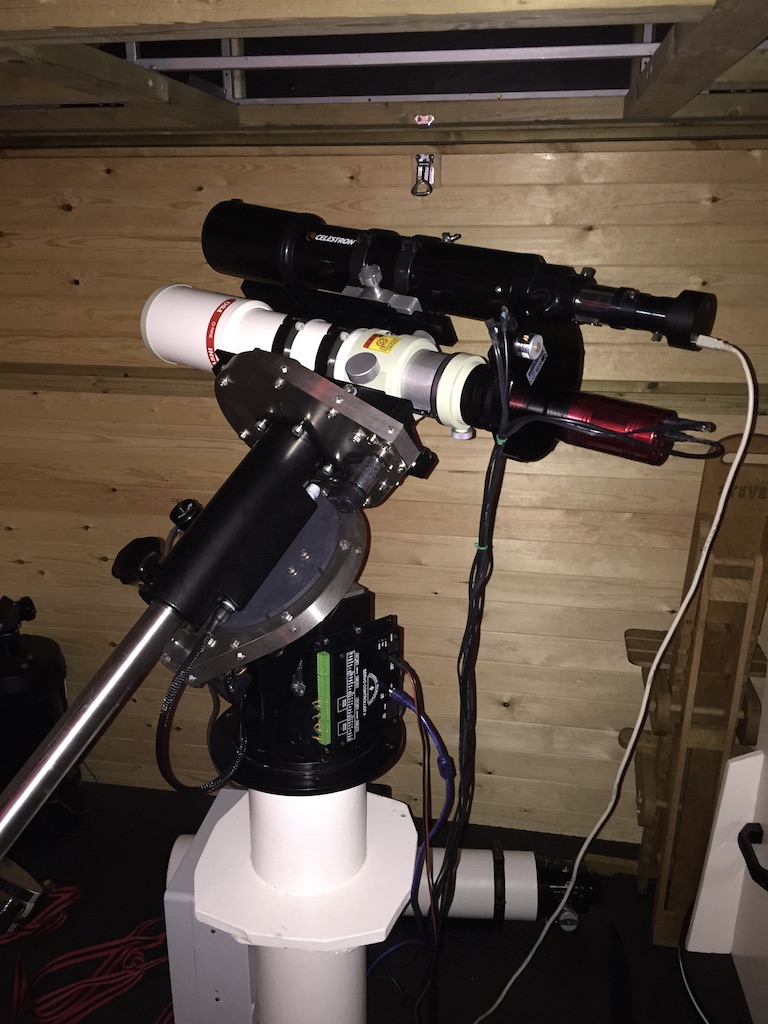
Further Experience with Takahashi FSQ85 Baby Q
I have had the scope for three weeks now and have used it three times. That's good going in the UK in case you possibly thought that's bad; it's not uncommon to wait for six weeks for a first light in our cloudy climate! Anyway, leaving aside the usual British moans about our weather......
The FSQ is so easy to use. Just point it, focus and forget. I am using Baader LRGB filters in 1.25" guise in an Atik EFW2 filter wheel. These filters are stated to be parfocal. However, with my Skywatcher ED80 telescope I found they were not. The focus wandered slightly between the filters. I normally focus on the Luminance channel first. I then grab LRGB in that order. But by the time I got to the blue filter I found stars were becoming bloated, not massively - but enough to take the edge off the picture. This problem is definitely not an issue with the ED80 stock focuser - I could adjust that sufficiently to make it rock solid - but is more attributed to the differing light wavelengths coming to a minutely different focus with the ED80 primary objective, blue is always affected worse. This is hardly surprising at the ED80 price point and indeed, the ED80 is an excellent telescope for its price. When using the FSQ though the focus is perfect on all LRGB filters and is as perfect on all four corners of the image. It just makes the scope so easy to use. I sincerely hope this is also the case when I get some Baader narrowband filters as well. However. considering the FSQ is ten times the cost of the ED80 is it ten times better? Of course not. That is not the way of things - it is diminishing returns at this end of the market as is the case with any other premium product. You pay a massive amount more to make it 20% better.
The FSQ-85 focuser is heavy and robust. However, a slight word of caution here that knocks a mark off the score for the FSQ-85. I have found that with my filter wheel and camera attached (EFW2+Atik460 = just over 1kg so hardly that heavy) I find that I need to have some focus knob lock applied or else the focuser can start to very slowly slip when pointed at over 50 degrees or so above the horizon. This came as a bit of a surprise to me since I have read some web articles that state the focus lock can be fully undone and the focuser does not slip even when pointed vertically. This is not my finding; I need some focuser lock applied to "brake" the slip and can then use the fine focuser. That makes me give the scope 9/10. Otherwise it would have got a perfect 10/10. I penalise it a full mark since the focuser action is a critical part of using a scope and at this price point I should not be expected to start shelling out yet more money for after market focusers or fiddling with tightening screws etc. This is a Rolls-Royce scope; you don't buy a Roller and expect to be under the hood tinkering on day 1. I need to do some further research into this. Maybe the focuser can be "tightened" perhaps..... Or maybe my expectations are unrealistic and this is the whole point of having the focus lock. To be fair the use of the lock screw is pretty intuitive and easy. Had it not been I would have sent the scope back (EDIT 2016 - I now use a Lakeside autofocus system that prevents any wander of the focus)
What is very commendable about the FSQ is the accuracy of the Camera Angle adjuster and focuser working together. So, when I achieve precise focus and then need to turn the CAA to frame the subject (something that I will be doing all the time) the focus does not shift even a fraction. I checked it out by slewing the scope to a bright star and putting on the Bahtinov mask after so adjusting the CAA after previous focus - the focus had not moved at all. That shows how accurately the scope and its bits are made.
I have used the FSQ on two objects so far, in both cases at native focal length - I have yet to use it with the reducer even though I bought the reducer with the scope. I grabbed further data on M33 Triangulum galaxy to add to the image on my previous post and I also grabbed RGB on the Double Cluster.
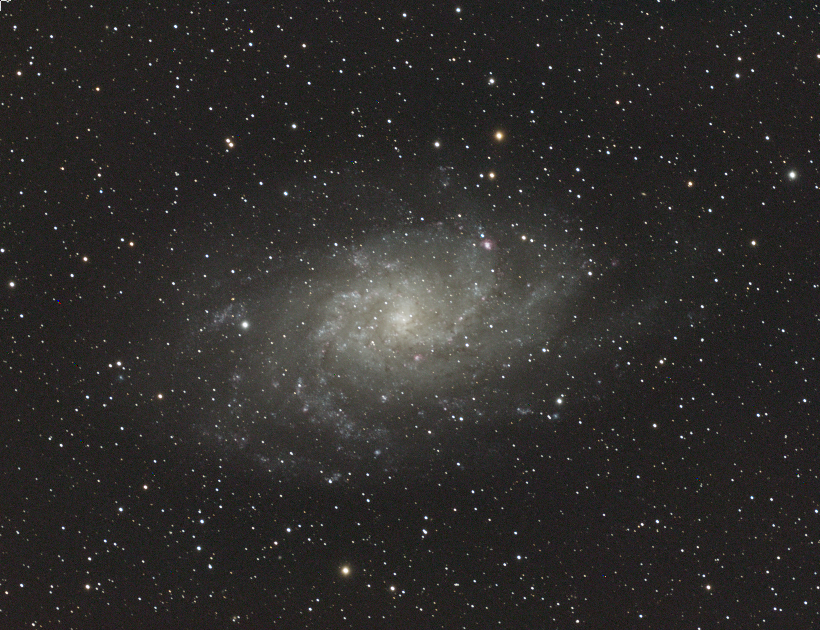
This image of M33 in Triangulum (lower quality here as a jpeg) has two hours of Luminance and 90 minutes each of RGB. The Luminance was 1x1 binned and the RGB was 2x2. The data was captured on the evenings of 21 and 25 November 2013 from my back yard (semi light polluted). I also should really have been using my IDAS Hutech Light pollution filter! All processing was in Pixinsight. The image needs more data to really let the spiral arms and the HII regions jump out. It could use some Ha as well. Nevertheless, it is coming along nicely I think. The two data sets are closely aligned and that will allow me to grab a whole lot more data. Next time it is clear I will grab a lot more luminance and Red data. Indeed, I might push the subs out to 15 minutes. What stops me doing that normally is that Nottingham is under the flight path for US West Coast flights from Heathrow that tend to plague my exposures! It hurts throwing away otherwise perfect 15 minute subs! However, I have recently discovered that Pixinsight's Windsorised Sigma clipping routines are extremely effective at removing plane and satellite trails, especially if I use dithering during capture.
The important thing to note is the stars are nice and round in the corners so the scope is performing very well! You can see this image at higher resolution here.
Next up is the Double Cluster in Perseus. This data was captured on 4th December 2013, again from my back yard. This time though I used the IDAS LP filter and this has reduced light pollution light splatter very effectively.
Star field pictures show errors in an optical system all too readily and I am very pleased the FSQ came through this test very well, despite very mediocre seeing on the night. Here are 30 minutes per RGB channel at 5 minutes exposures, binned 1x1. Higher resolution of this image is here. There is no luminance here at all. Also, no flats here since I mistakenly captured the flats at 2x2 binning as I normally bin 2x2 on RGB! Doh... Oh well, it still came out quite well with Pixinsight's DBE tool to remove the vignetting.
So, to sum up, I am very pleased with the scope so far. It is optically wonderful. It looks the part and I have great pride in owning it. The build quality is superb. The focuser is good and robust but has slight slippage that has taken the edge off a tiny, weeny bit.
Would I buy again? Absolutely! This is scope for life and look forward to doing some great things with it. I might even buy a FSQ-106 to go with it as well ;)
Next blog entries will be how I connect all the bits together to connect to my Atik EFW2 at both native and reduced. Another blog entry will be about how I mounted the scope to my NEQ6 and guide-scope.
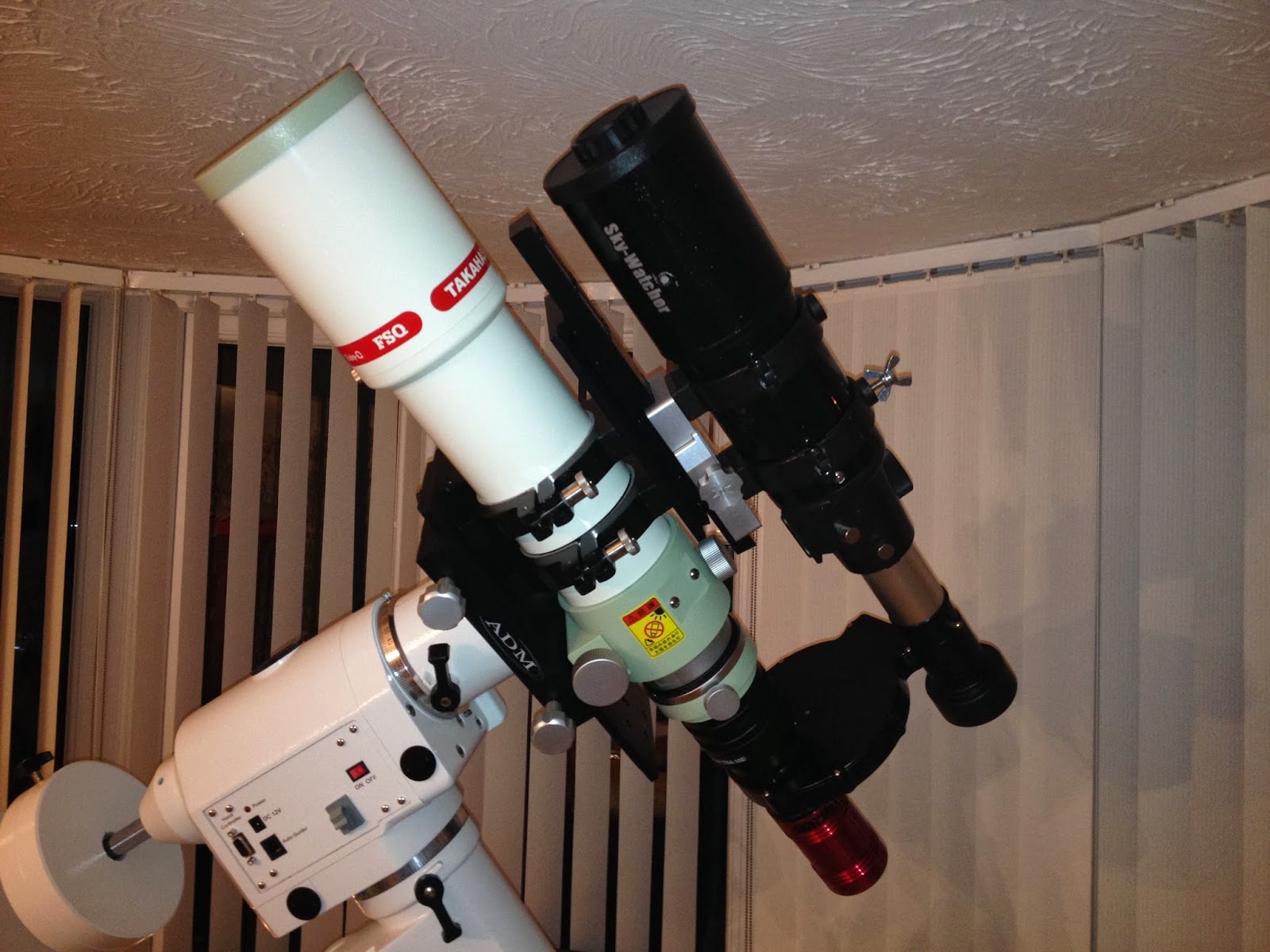
My Takahashi FSQ85 "Baby Q"
I bought my Takahashi FSQ-85EDX telescope from Ian King Imaging in November 2013 and bought it with the 0.73 reducer and numerous Takahashi adapters. I have not as yet used it reduced, only at the native F5.3. I am very impressed with the scope so far. It weighs only 4kg but feels so much more than that. The scope is a thing of beauty with impeccable paintwork and build quality. This is truly a scope to last a lifetime if cared for.
I went around the mental "shall I buy a 85 or 106" loop a million times. However, I already have a TEC 140 telescope to give me a smaller (or zoomed in) image scale for smaller objects like M81, M87 etc and the Abell galaxy clusters. I felt the FSQ-85 gave me better options for wide-field imaging of large targets like M31, M33, North American Nebula, Rosette Nebula etc.
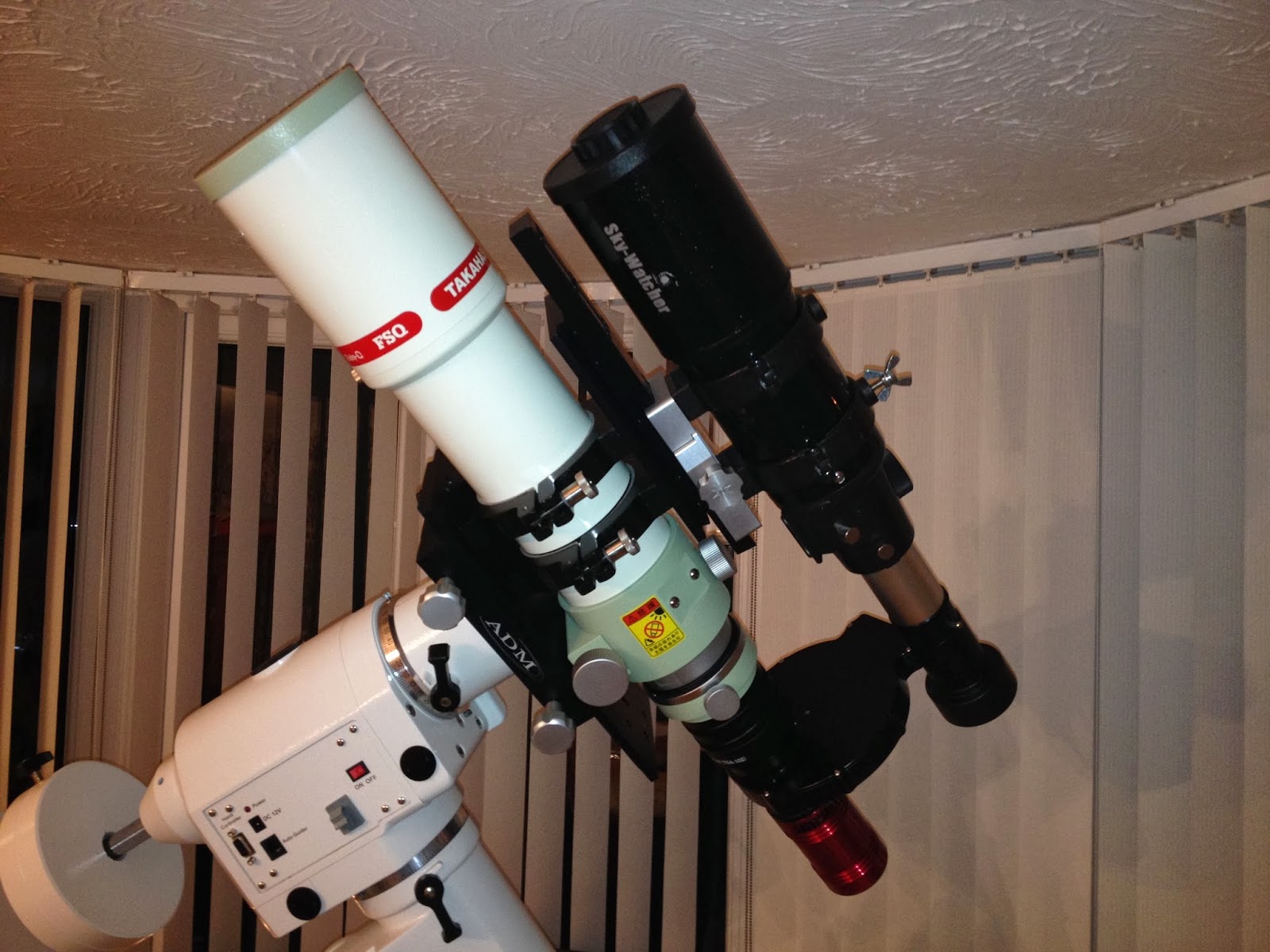
My FSQ-85 rig consists of a Skywatcher ST80 guide-scope with a QHY5 guide-camera. The whole shebang is mounted by ADM dovetails/bars/saddle onto a Skywatcher NEQ6 mount and I control it all via ASCOM/EQmod from my Dell D630 latitude laptop.
Here is a picture I did of M33 with 75 minutes of Luminance, binned at 1x1 and 20 mins each of RGB binned at 2x2. All this done on an Atik 460 at -21C. The seeing was terrible, the moon was rising and I was dodging clouds! To say the UK climate is challenging for Astro-Photography with our milky white skies and constant cloud is the understatement of the century!
The image really needs more data in the colour channels and ideally some Ha as well to bring out some of the HII regions. But not too shabby at all for a first light I reckon under the circumstances. All four corners are nicely round.
All in all I am impressed. I intend to do some videos of how I mounted this scope so watch out for those. I also will do some articles on how the camera connects to the scope in both reduced and native guises with the different Takahashi adapters.