
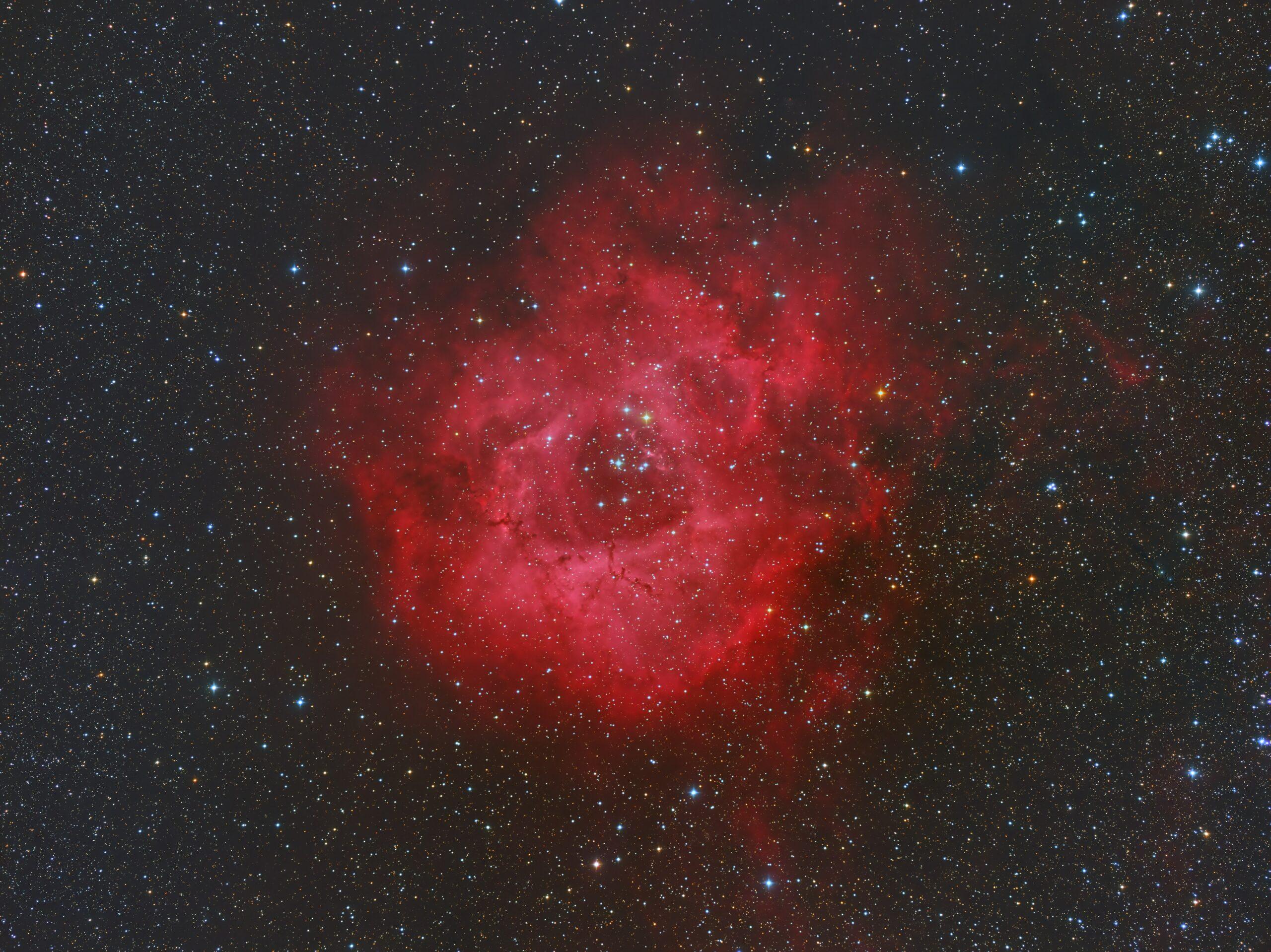
The Rosette Nebula FSQ85
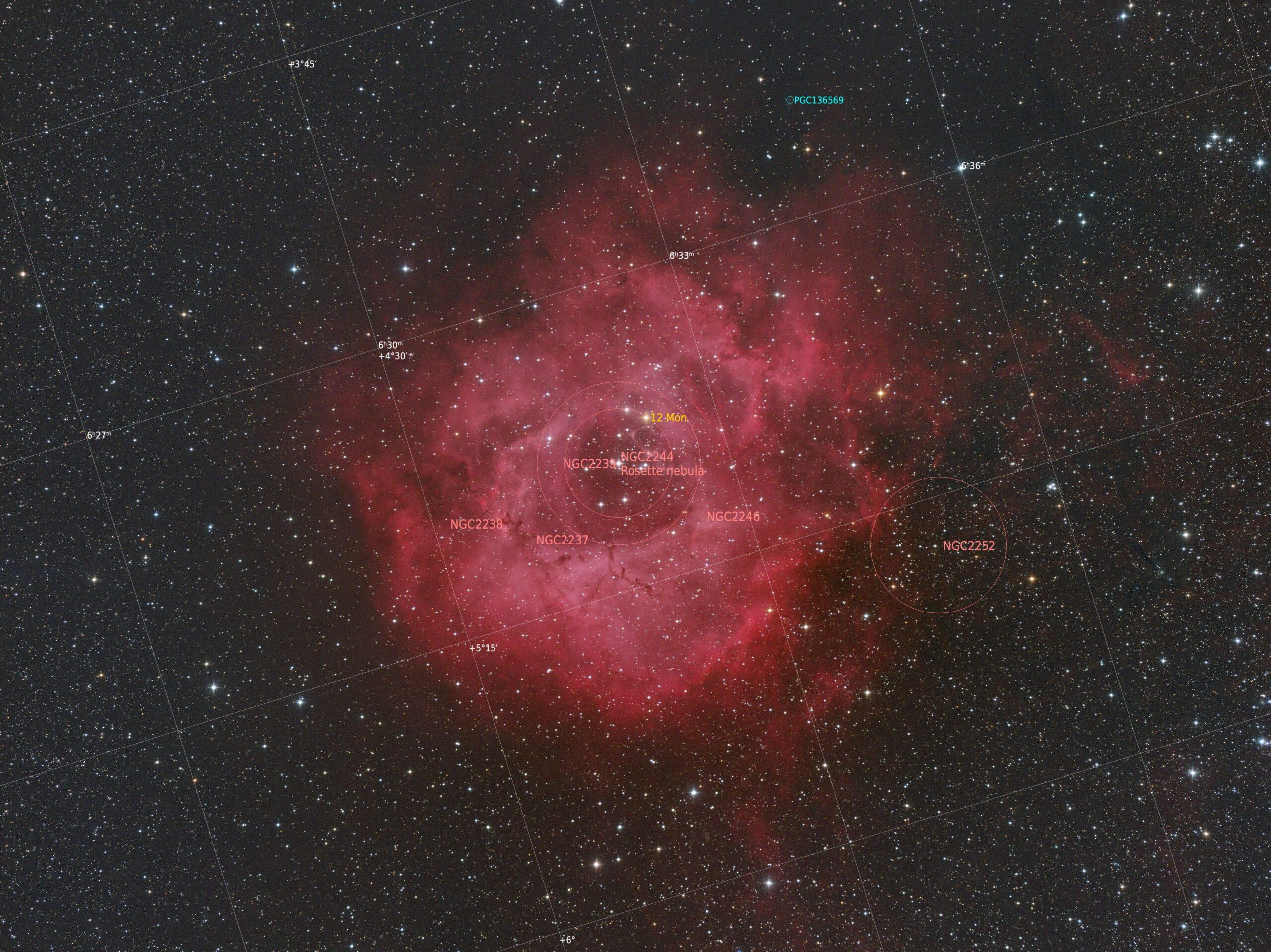
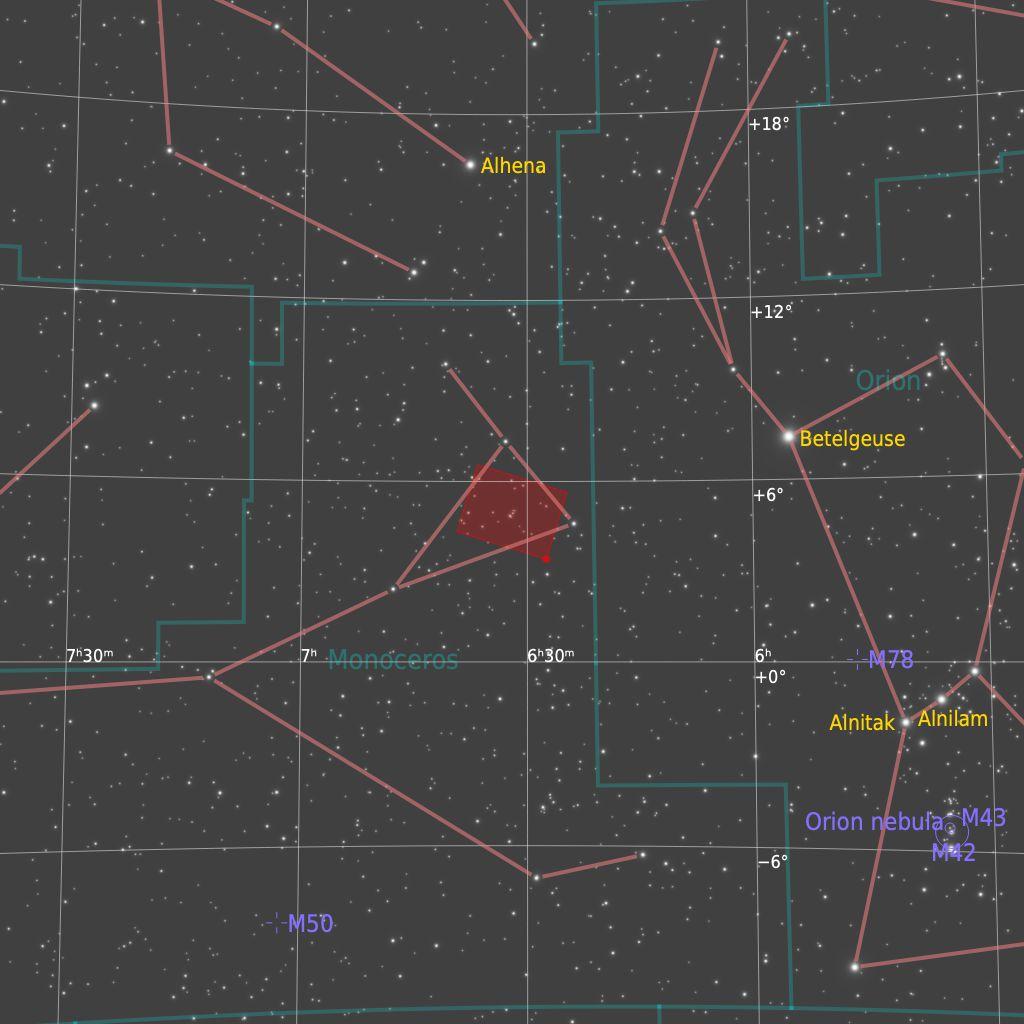
The Rosette Nebula is a huge emission nebula in the Orion arm of the galaxy located in the constellation of Monoceros. It is about 5500 light years away and about 150 light years across and stars are being born from the hydrogen that comprises the nebula.
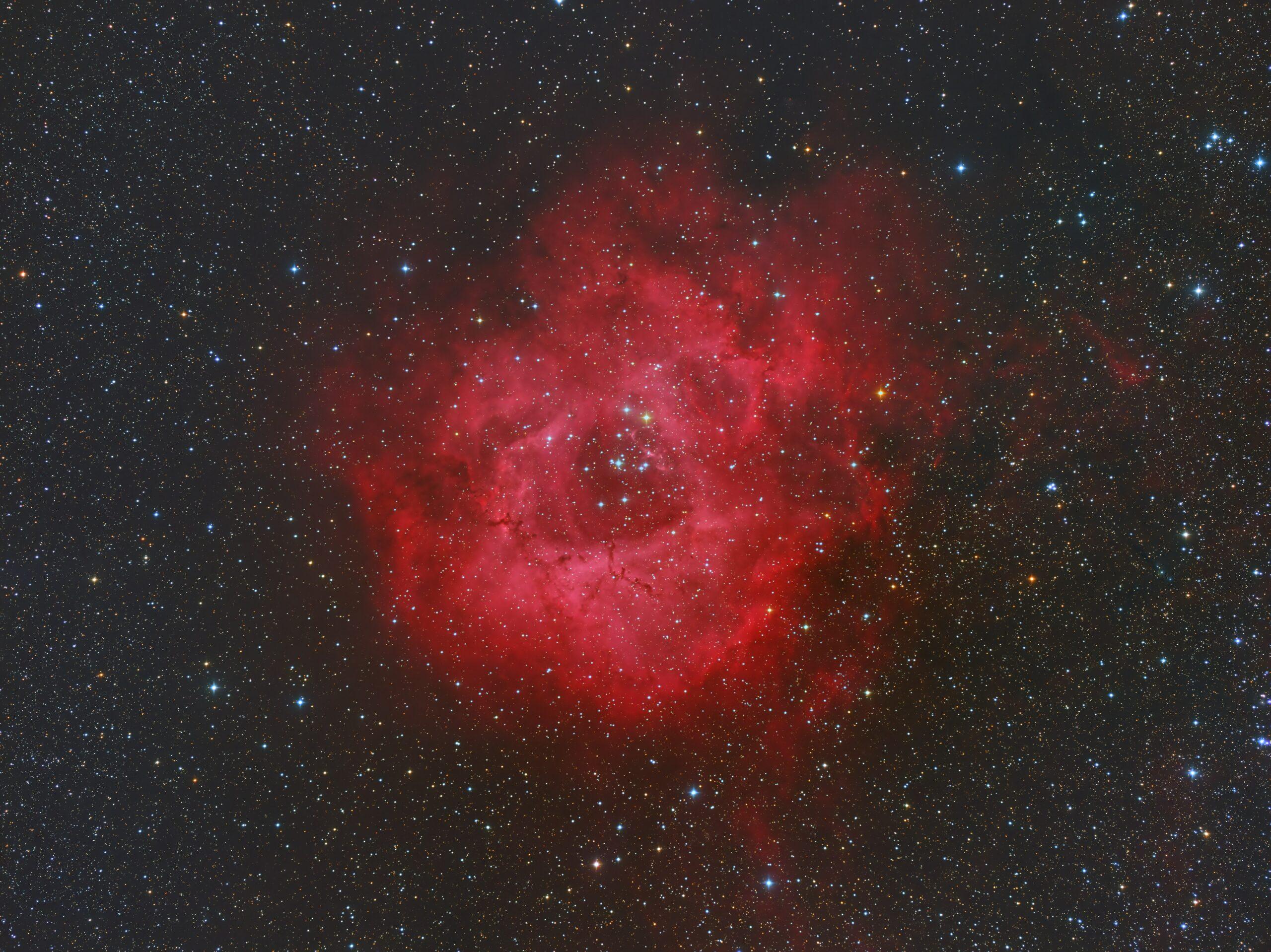
Image Technical Data
Imaged with Takahashi FSQ85 at native focal length with my Moravian Instruments G2-8300 cooled CCD camera and Astrodon RGBHa filters. Data collected from my backyard observatory on 8th January 2018.
Image data is as follows (Ha is 1x1 and RGB is 2x2)
Ha > 14 x 1200s ; Red > 17 x 300s ; Green 12 x 300s ; Blue > 20 x 300s

As can be seen above, the Ha image is extremely detailed and shows a huge amount of detail. This is 3.5 hours of exposures through the Astrodon 3nm Ha filter.

Above is the RGB only image which is binned 2x2. It is a good picture in its own right but it is a bit flat and lacks the pizazz and sparkle of the Ha image. It is the combination of the Ha and the RGB that creates the colourful and detailed main image at the top. There are many ways this combination can be achieved. Here, I did it all in PixInsight whereas on some other pictures I used PI and Photoshop. What I did here was when in the linear state used the emission line script to add the Ha data to the red part of the image. Then after stretching the images I used the NBRGB script to combine the images in the linear state.

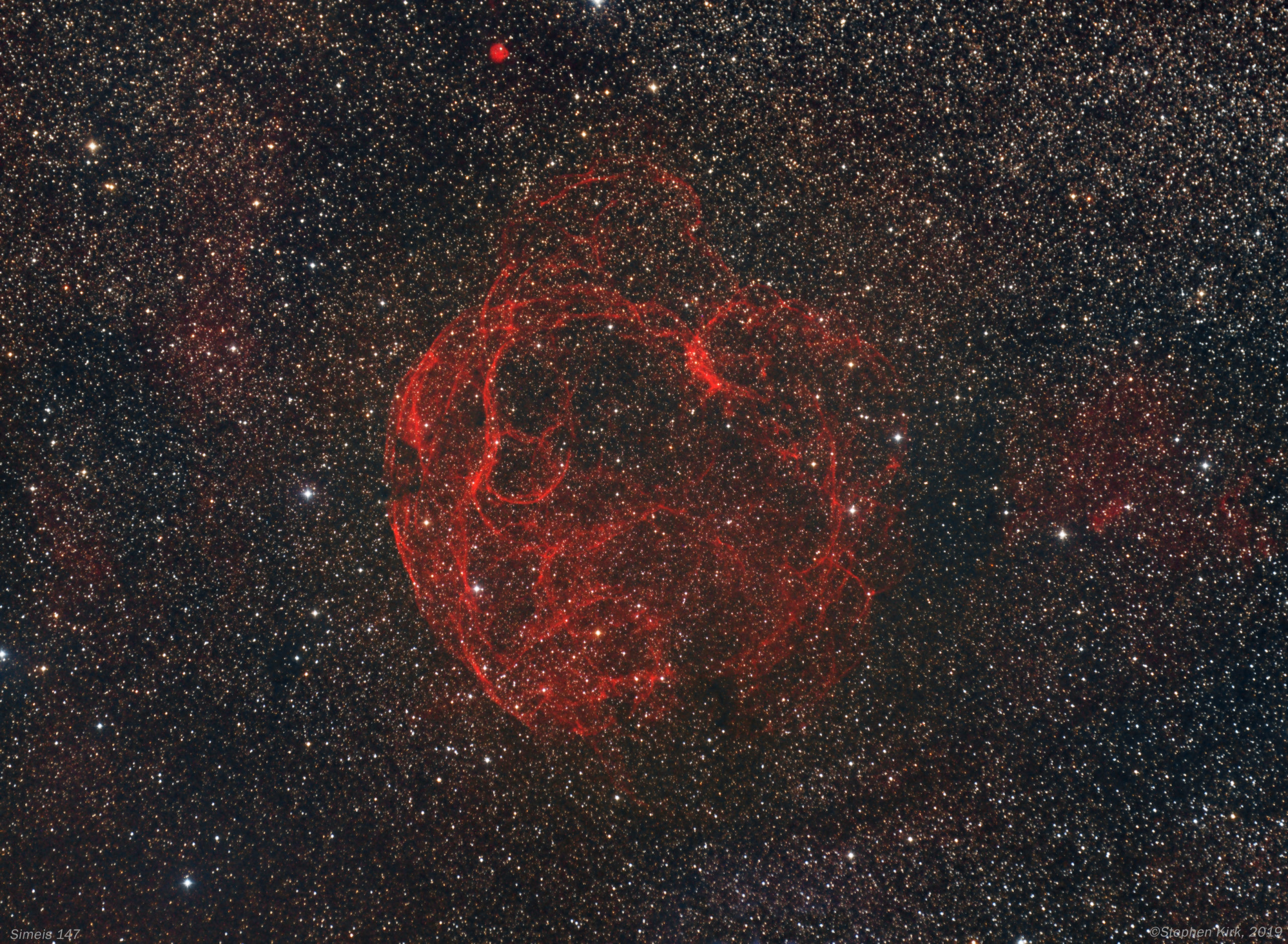
Simeis 147 (Samyang 135 mm)
Simeis 147 (Sharpless Sh2-240) sometimes called The Spaghetti Nebula is a supernova remnant of a star that exploded forty thousand years ago. It sits across the border of Taurus and Auriga and is a huge object, about six moon widths across. It is located about 3000 light years away. Because of its extremely low surface brightness it was only discovered as recently as 1952. It is an exceptionally difficult object to observe visually and to have any hope of seeing it with your own eyes at the eyepiece requires extremely dark skies (Bortle 1), specialist filters, immaculate seeing and transparency and extreme dark adaption of your eyes. This rules out almost anywhere near civilisation. Personally speaking, I have never known any astronomer who has seen it visually. Even with photography it requires very long exposure times to bring out any detail.

Image Technical Data
This image was created with my wide-field rig in my backyard in Nottingham UK (Bortle 5 on the dark sky scale) on the 20 and 21 December 2019. It is such a wide-field object that I used my Samyang 135mm lens and Moravian Instruments G2-8300 cooled CCD camera with Astrodon RGB and Ha(3nm) filters. This delivers a FoV of 8x6 degrees.
All exposures binned 1x1:
Ha (3nm) > 22 x 300s ; Red > 8 x 300s ; Green > 9 x 300s ; Blue > 10 x 300s
The total integration time is four hours so far and this is a rather short time for this object. More data would bring out finer structures in the nebula. As a result, I may revisit this at some point and add to the data set already acquired. However, the current result is not so bad for the limited amount of data so far captured. Simeis 147 is so faint that it can consume as much data as you can throw at it and I have seen images of it with 30,40 and even 50 hours of data!
The Image data is captured with Sequence Generator Pro and processed with PixInsight and Photoshop CC.
Other versions of this object often include an Oxygen channel (OIII) because supernova remnants are rich in Hydrogen and Oxygen. I may capture this channel too at some point.

Above is the RGB only data. As you can see, there is very little to show for the data collected. It is when you blend this RGB with the Ha channel data below - especially with the red channel - that the detail in the main picture in this post at the top is revealed.


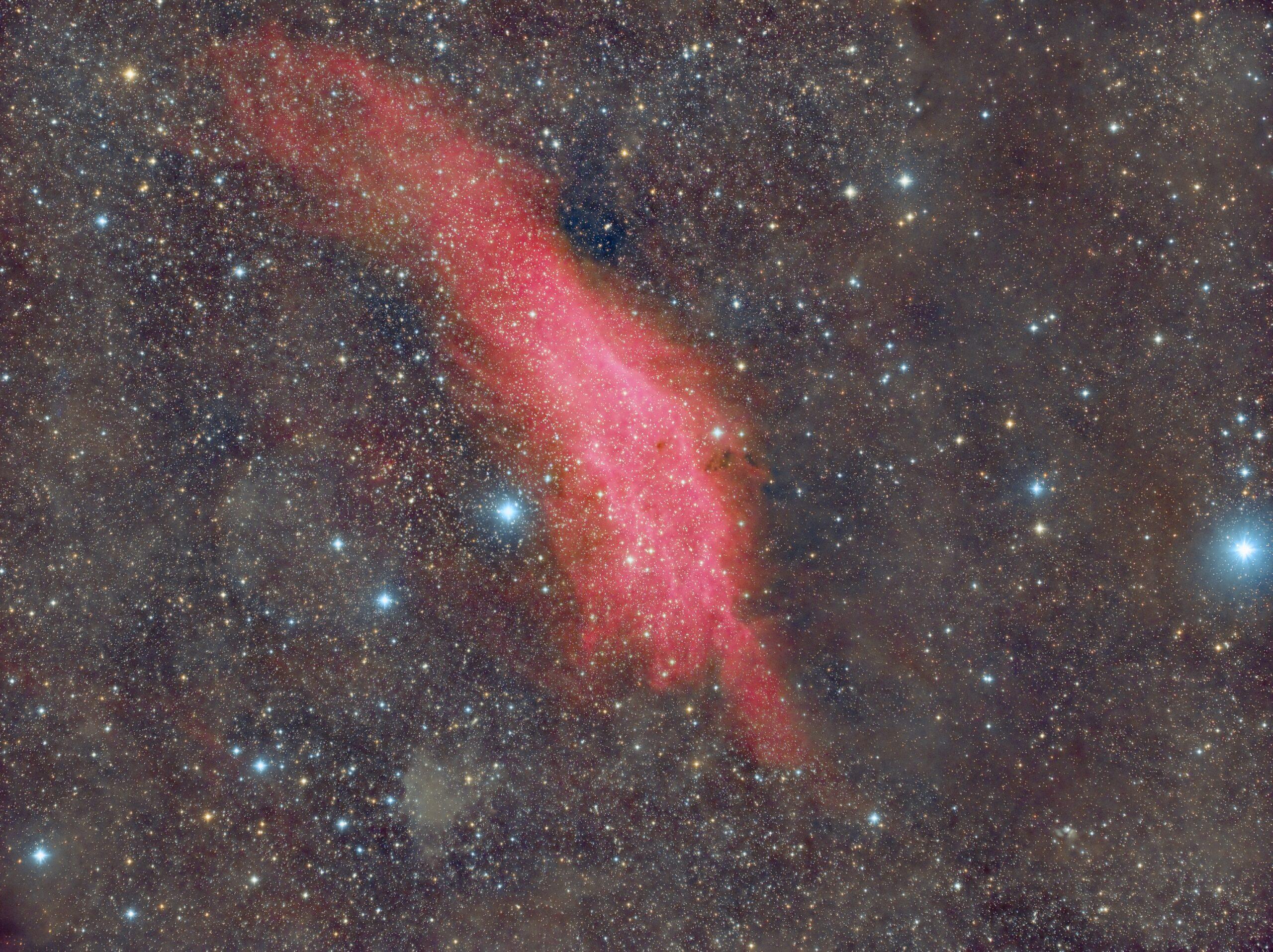
The California Nebula
The California Nebula - NGC 1499 - is a vast hydrogen gas emission nebula about 1000 light years away in the constellation of Perseus. It is named as such because of its vague resemblance to the US state of California.
It is a very large, faint and diffuse object, about four times the diameter of the moon. It is almost completely invisible visually without specialist filters and was not discovered until the advent of astrophotography in 1884. The nebula shines by reflecting the light of the bright star Markib. It shines red because Hydrogen atoms, when excited by nearby bright sources like stars, emit or re-radiate light at the 656nm wavelength which is in the red part of the spectrum to our eyes.

Image Technical Data
The California Nebula is so large that most telescopes cannot get the nebula in the field of view, nowhere near in fact. It is of course possible to create multi-panel mosaic images but these take a great deal of imaging sky time, something in very short supply in the UK rain and cloud infested skies! DSLR lenses are perfect for this type of wide field imaging, however. This image is almost eight degrees across by six degrees and was made with my wide field DSLR lens portable set up in my backyard, December 7th 2019. Samyang 135mm DSLR lens connected to Moravian Instruments G2-8300 cooled CCD camera and Astrodon E-series RGBHa (3nm) filters, all mounted on my Skywatcher NEQ6 mount.
All exposures binned 1x1:
Red > 14 x 300s ; Green > 8 x 300s ; Blue > 8 x 300s ; Ha(3nm) > 18 x 300s
To give a total integration time of four hours.
Captured with Sequence Generator Pro and processed with PixInsight.


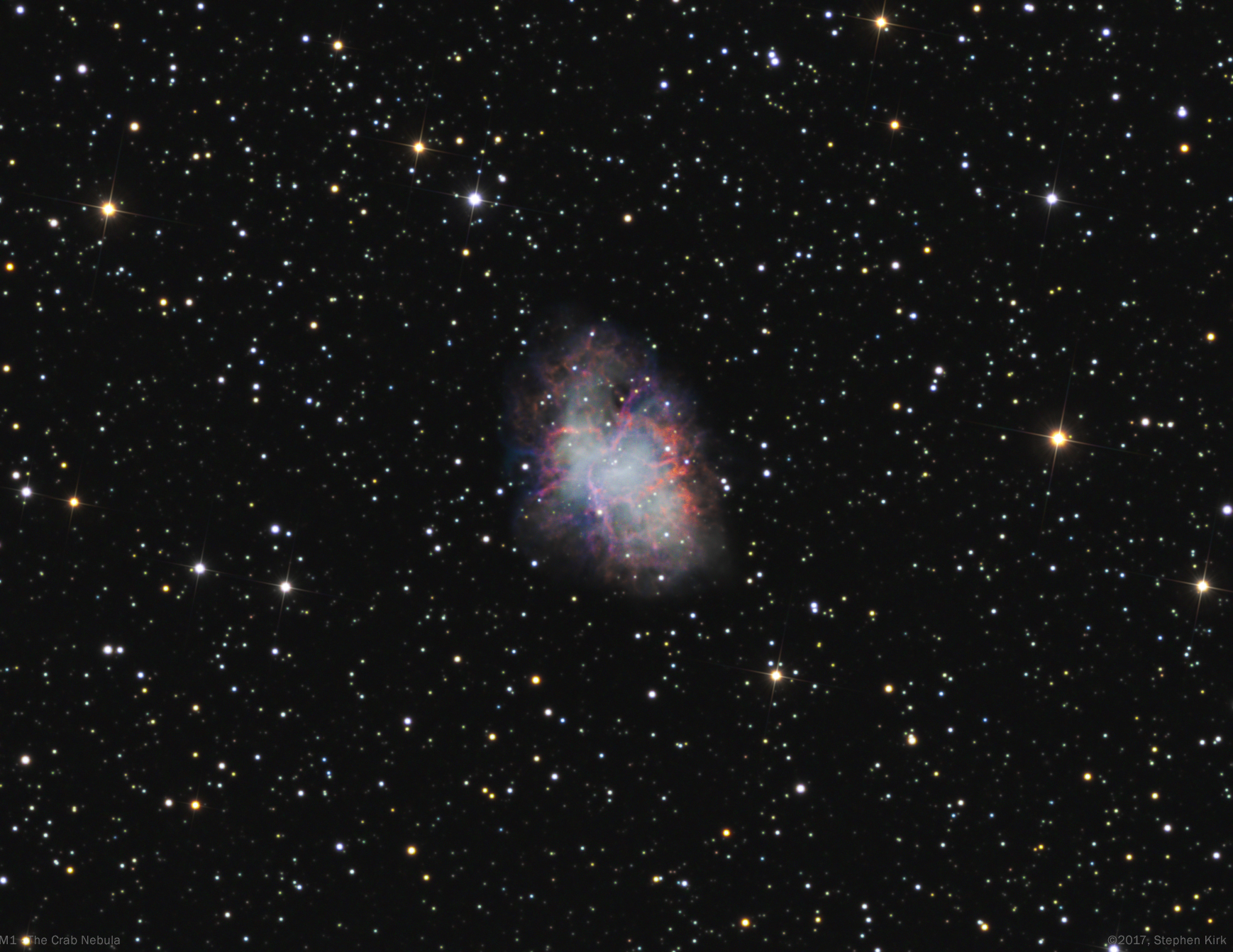
M1 - The Crab Nebula TEC140
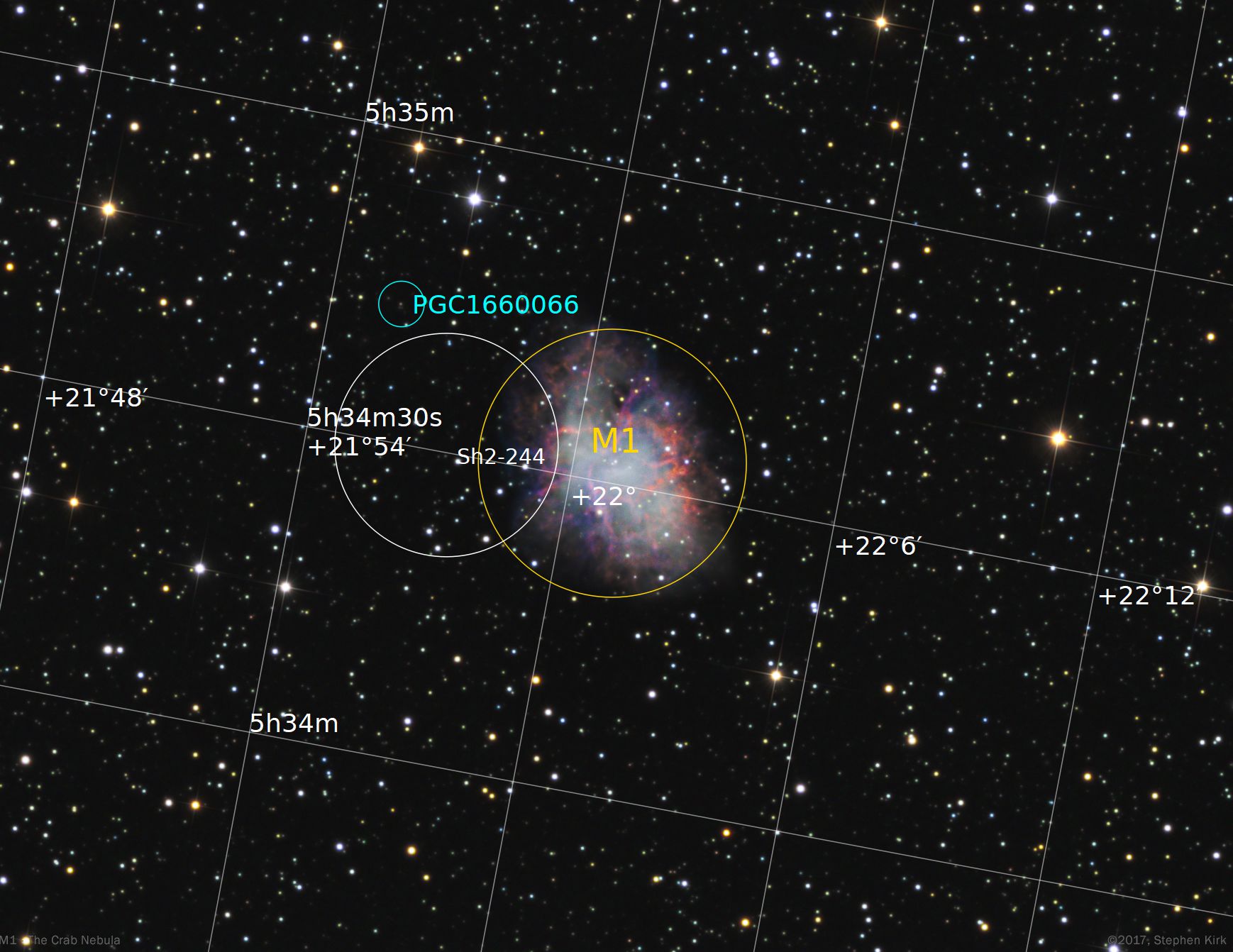
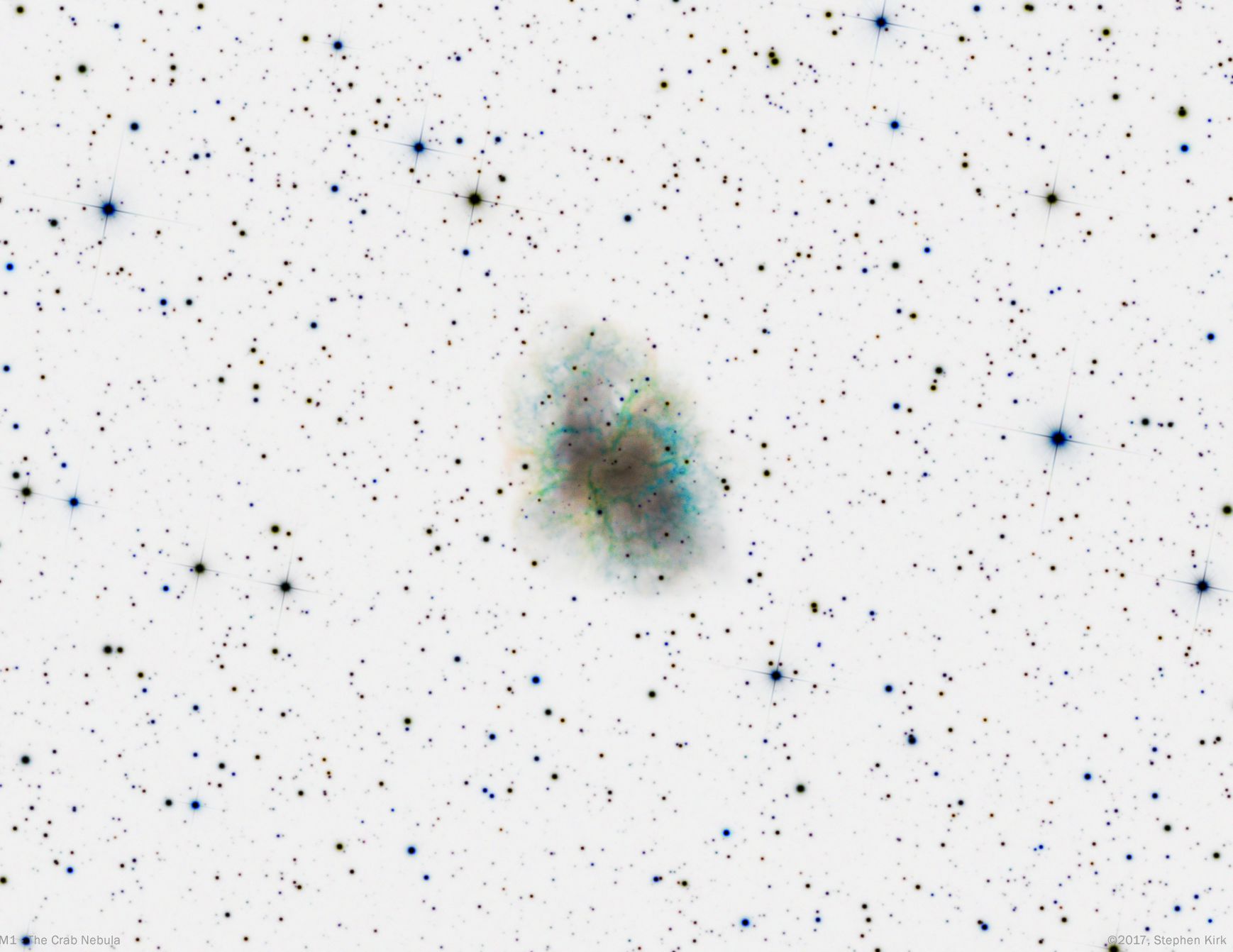
The Crab Nebula - M1 - is the expanding remains of a supernova that was seen in 1054 throughput medieval Europe, The Middle East and China. The nebula is very distant at about 6500 light years and lies in the Perseus Arm of our galaxy, further out from The Galaxy's core than The Sun. It is called The Crab because William Parsons from his Irish observatory who first viewed it in 1840 thought it resembled the outline of a crab and the name has stuck. The object was first observed in the 1731 and was linked to the Supernova of 1054 as recently as 1913. Earlier photographic plates from the 1950's and those taken today show a definite expansion in the nebula in the intervening 70 years.
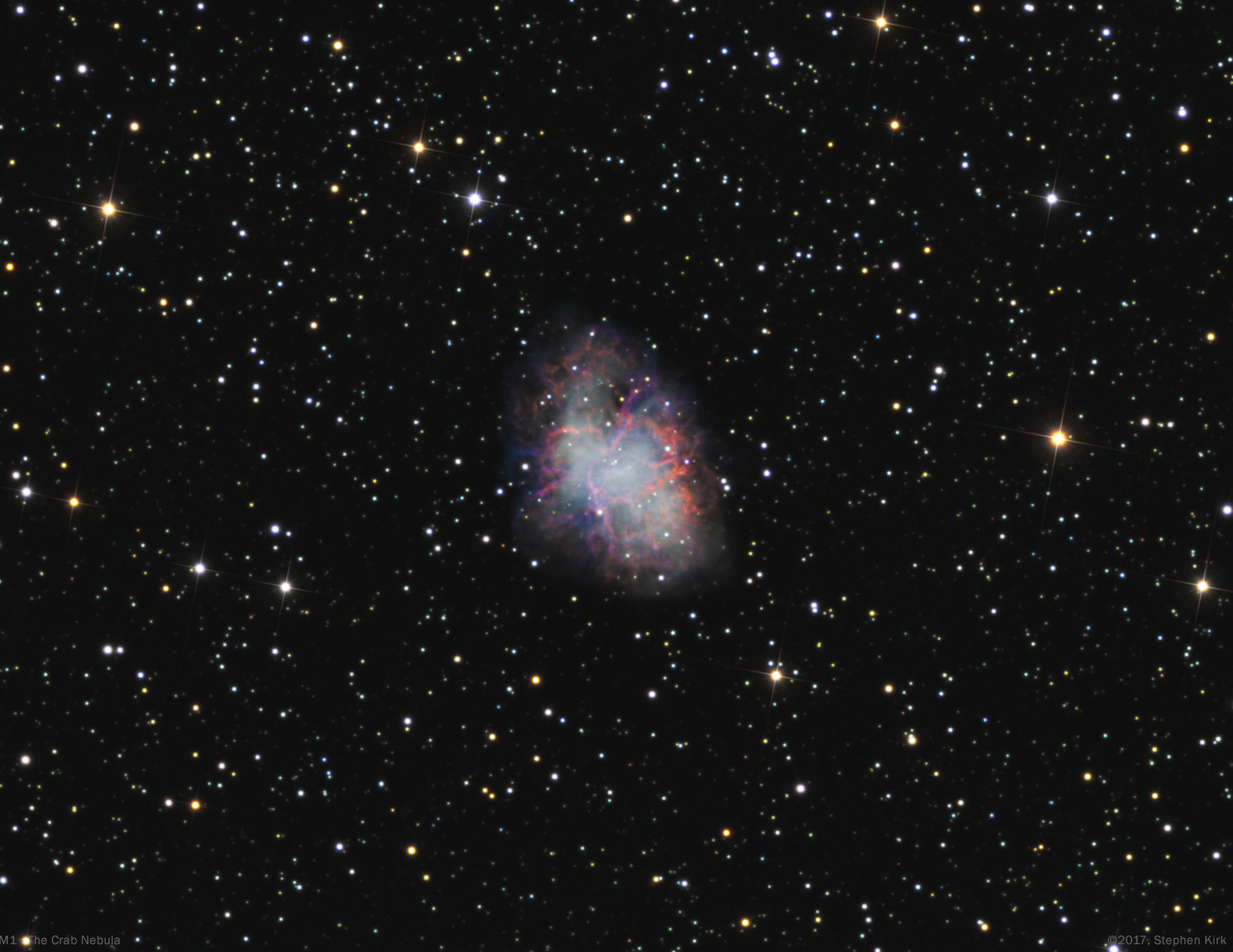
Image Technical Data
Imaged from my backyard in Nottingham, UK in the winter of 2017 with my TEC 140 refractor and Atik 460 cooled CCD camera and Baader LRGB filters. I used a NEQ6 mount guided with OAG.
All images data binned 1x1:
Lum > 10 x 900s ; Red > 15 x 300s ; Green 15 x 300s ; Blue > 19 x 300s
Image capture with APT and processing in PixInsight and Photoshop CC.
The Veil Nebula - Samyang 135mm Lens
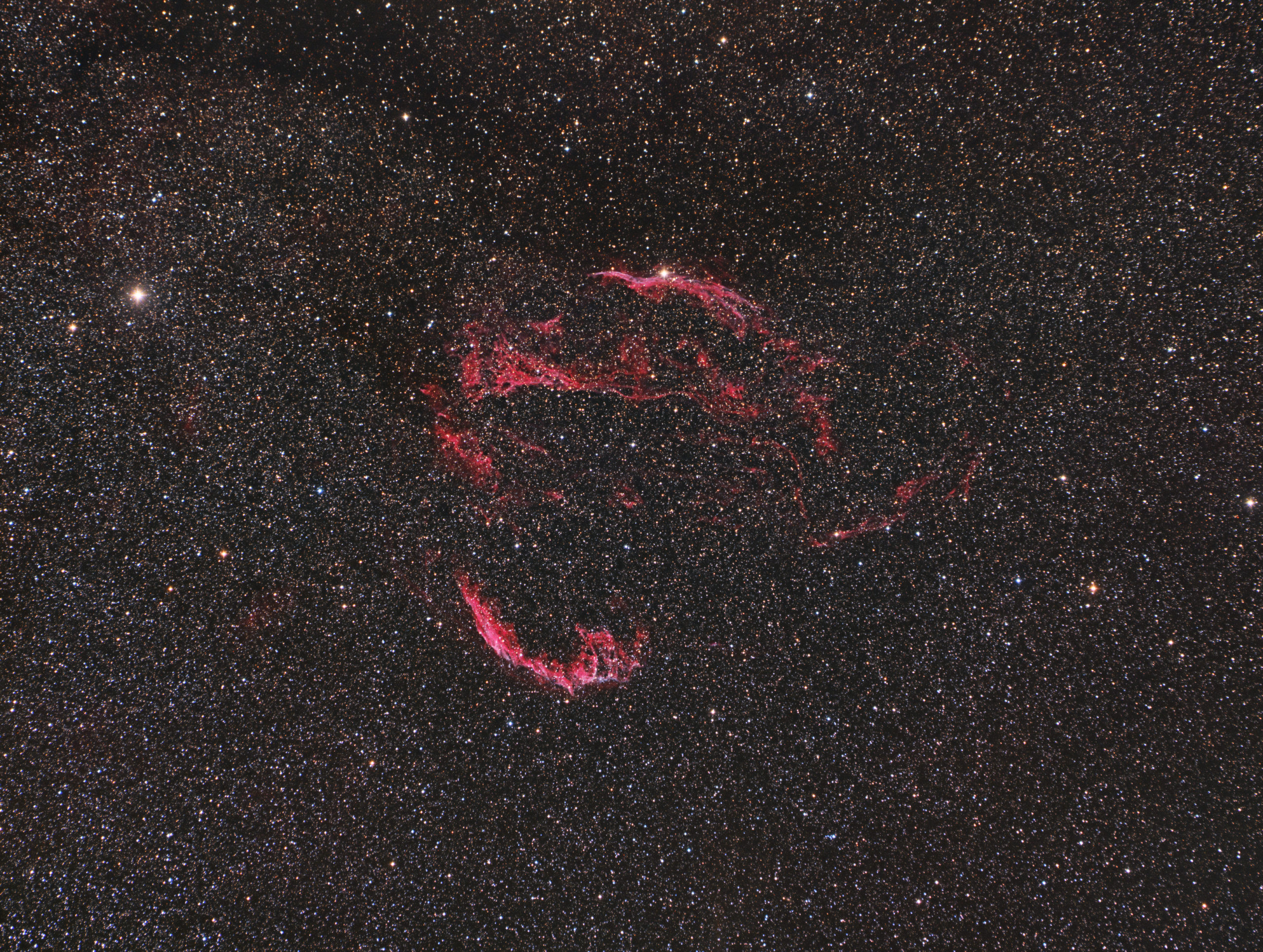
The Veil Nebula in Cygnus is the remnant of a supernova of a star about 20 times the mass of the sun that exploded about 20000 years ago. The nebula is a huge, very faint and diffuse object, about six moon widths in diameter and is located about 2500 light years away. Very few telescopes can capture the entire Veil Nebula complex due to the huge angular size that it presents on the sky and creating a multi-frame mosaic is a very time consuming process, especially in the UK where clear nights are such a rare and premium time. This makes DSLR lenses ideal and few are better or as cost effective as the Samyang 135mm that was used to capture this image.
Image Technical Details
The image was captured from my backyard in Nottingham in the UK on the nights of the 13th and 14th September 2020. I left the systems capturing data overnight on an automated basis capturing the Veil nebula and several other targets whilst I was asleep in bed :). I used a Samyang 135mm lens (Samyang = Rokinon in the US/Canada) connected to my Moravian Instruments G2-8300 CCD camera with Astrodon RGBHa (3nm) filters on my NQ6 mount. All exposures binned 1x1:
Red > 14 x 300s ; Green > 14 x 300s ; Blue > 14 x 300s ; Ha > 31 x 300s
Total Integration time of just over six hours. The total width of the image is about 8 degrees by 6 degrees with a resolution of 8.5 arcsec/pixel.


Above are the Ha images made with the Astrodon 3nm Ha filter in the 31mm version. You can see the exquisite detail this filter picks out.

The RGB image is made from 42 x 300s exposures. It carries the colour of the image but is boosted by the blending of the Ha data which adds the punch and vibrancy of the master image at the top of the page.


The Heart and Soul Nebulae Samyang 135mm
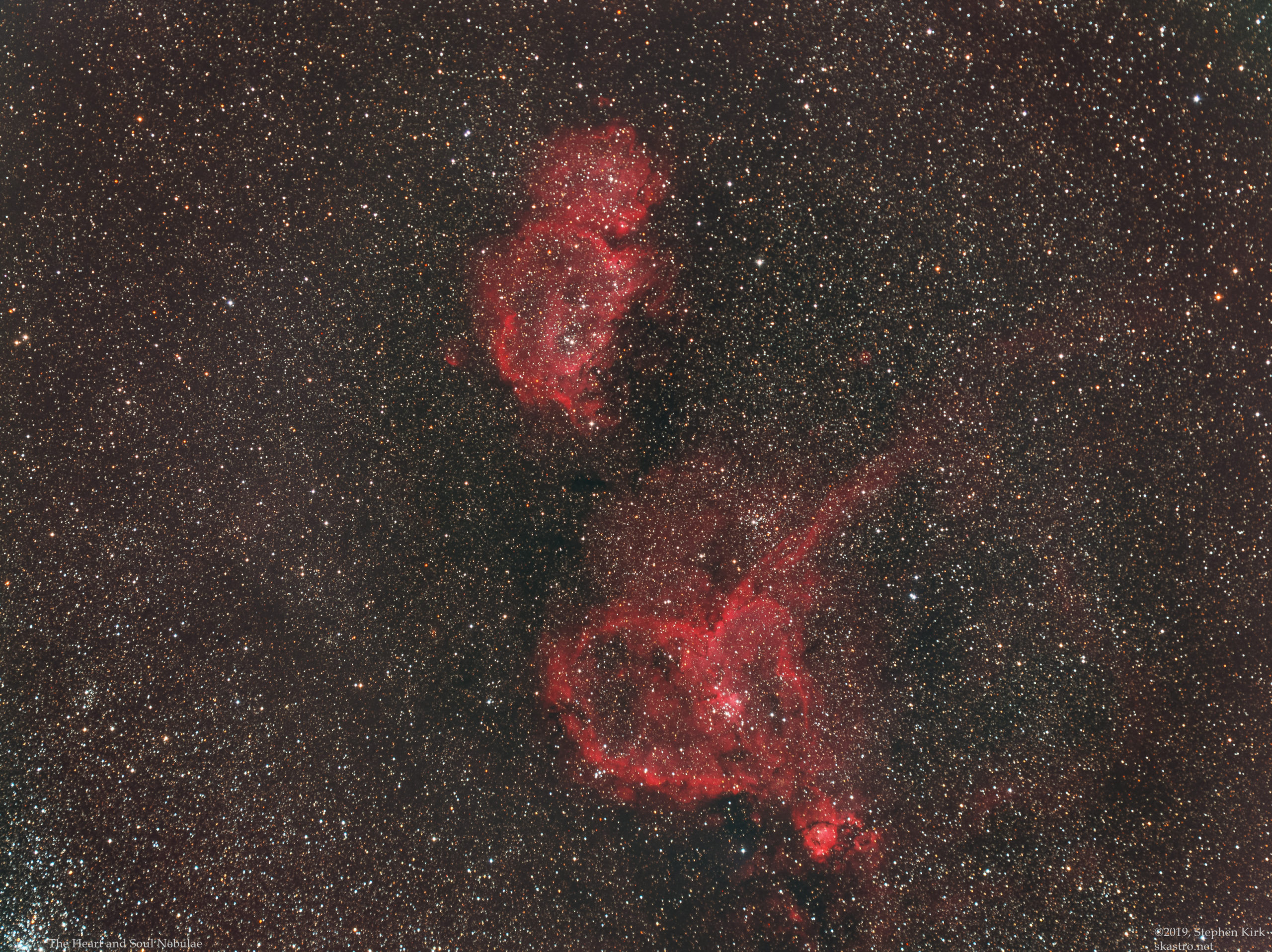
The Heart and Soul Nebulae are a well known and famous pairing of Nebulae in the late summer/autumn sky of the Northern Hemisphere. These nebulae are located far away - 7500 light years - in the Perseus arm of the galaxy, further out from the core of the galaxy than the Sun and are vast star forming regions rich in Hydrogen Alpha that gives the images the intense red glow.
All image data collected with a Samyang 135mm lens at F2.8 with a Moravian G2-8300 CCD camera. Below is the RGB image gathered with Astrodon RGB filters. All binned 1x1: Red 14 x 300s; Green 13 x 300s; Blue 14 x 300s. This gives an RGB integration time of 210 minutes or three and a half hours.
The picture looks nice but it does lack punch and vibrancy as it stands. It needs the addition of the Hydrogen Alpha data that will enhance the details.

Below is the Hydrogen Alpha channel that consists of 36 x 300s exposure with an Astrodon 3nm Ha filter with Samyang 135mm and G2-8300 CCD camera, collected with an Astrodon 31mm 3nm Ha filter. The amount of detail in this image is very evident. Below this is a starless version of the Ha image used to blend into the RGB image.


I finally created the blended HaRGB images by using layers of the Ha channel blended at different opacities as overlay and lighting layers in Photoshop. This gives the best of both worlds; the colour present in the RGB and the detail in the Ha image. The total integration time of the image is about six and a half hours.

Finally an annotated version of the image showing many Sharpless Catalog (Sh2) objects present.

The Heart and Soul Nebulae Samyang 135mm
The Heart and Soul Nebulae are a well known and famous pairing of Nebulae in the late summer/autumn sky of the Northern Hemisphere. These nebulae are located far away - 7500 light years - in the Perseus arm of the galaxy, further out from the core of the galaxy than the Sun and are vast star forming regions rich in Hydrogen Alpha that gives the images the intense red glow.
All image data collected with a Samyang 135mm lens at F2.8 with a Moravian G2-8300 CCD camera. Below is the RGB image gathered with Astrodon RGB filters. All binned 1x1: Red 14 x 300s; Green 13 x 300s; Blue 14 x 300s. This gives an RGB integration time of 210 minutes or three and a half hours.
The picture looks nice but it does lack punch and vibrancy as it stands. It needs the addition of the Hydrogen Alpha data that will enhance the details.
Below is the Hydrogen Alpha channel that consists of 36 x 300s exposure with an Astrodon 3nm Ha filter with Samyang 135mm and G2-8300 CCD camera, collected with an Astrodon 31mm 3nm Ha filter. The amount of detail in this image is very evident. Below this is a starless version of the Ha image used to blend into the RGB image.
I finally created the blended HaRGB images by using layers of the Ha channel blended at different opacities as overlay and lighting layers in Photoshop. This gives the best of both worlds; the colour present in the RGB and the detail in the Ha image. The total integration time of the image is about six and a half hours.
Finally an annotated version of the image showing many Sharpless Catalog (Sh2) objects present.
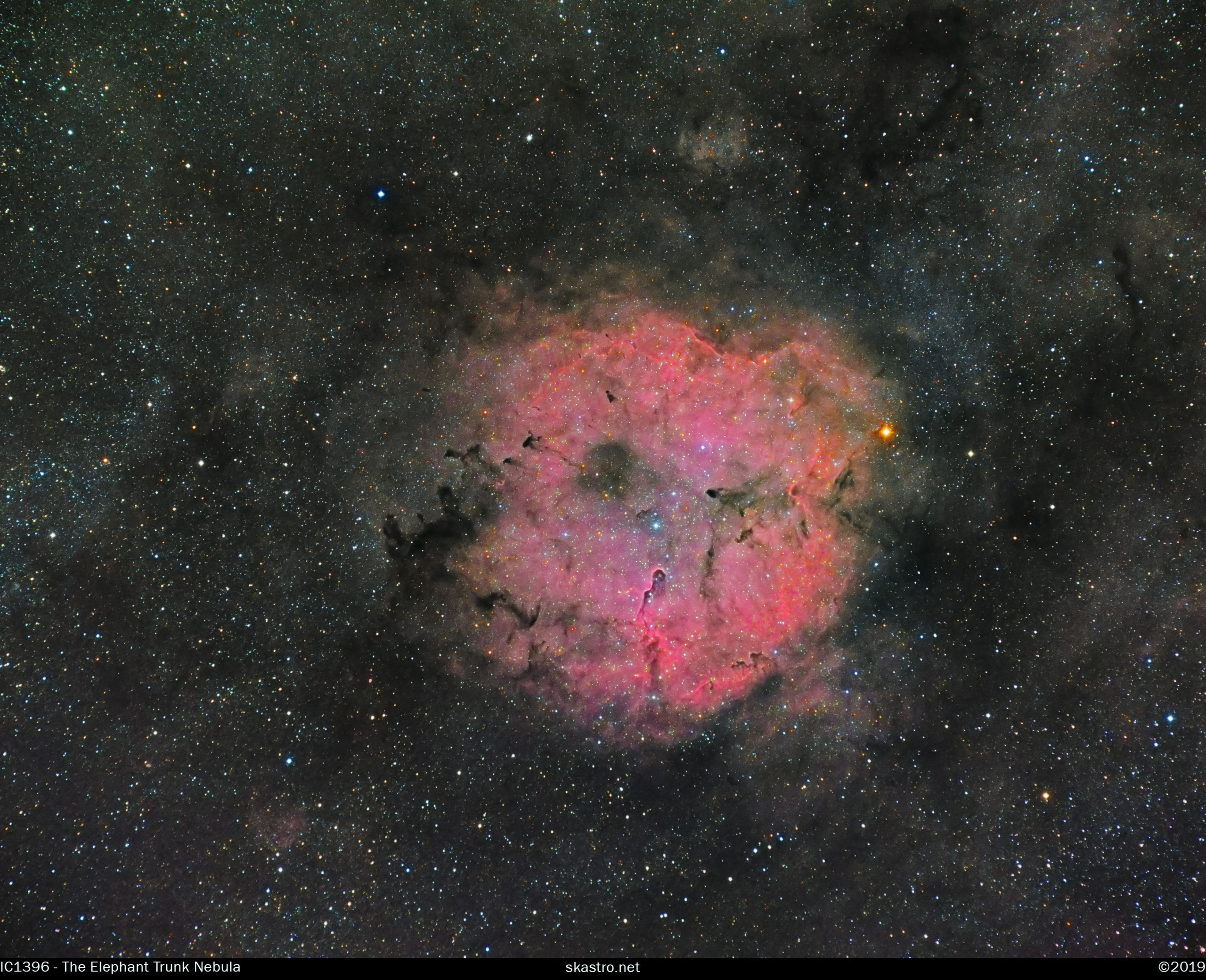
IC1396 with Samyang 135mm

IC1396 - "the Elephant's Trunk Nebula" is a huge emission nebula in the constellation of Cepheus, about 2500 light years away. It has a huge angular diameter of about 2 x 3 degrees so it requires a wide field telescope/lens to capture it in its entirety.
It is a very popular imaging target both in a wide field setting like this picture and also as close up views of the "trunk" that you can see in the image at the 6 o'clock position.


Image Technical Data
Image data acquired September 13th 2019 from my backyard in Nottingham, UK. This image was taken with my Samyang 135mm lens with G2-8300 CCD camera and Astrodon RGBHa filters on NEQ6 mount. Everything is 300s in this image and binned 1x1:
Ha (3nm) x 13; Red x 12; Green x 8; Blue x 14
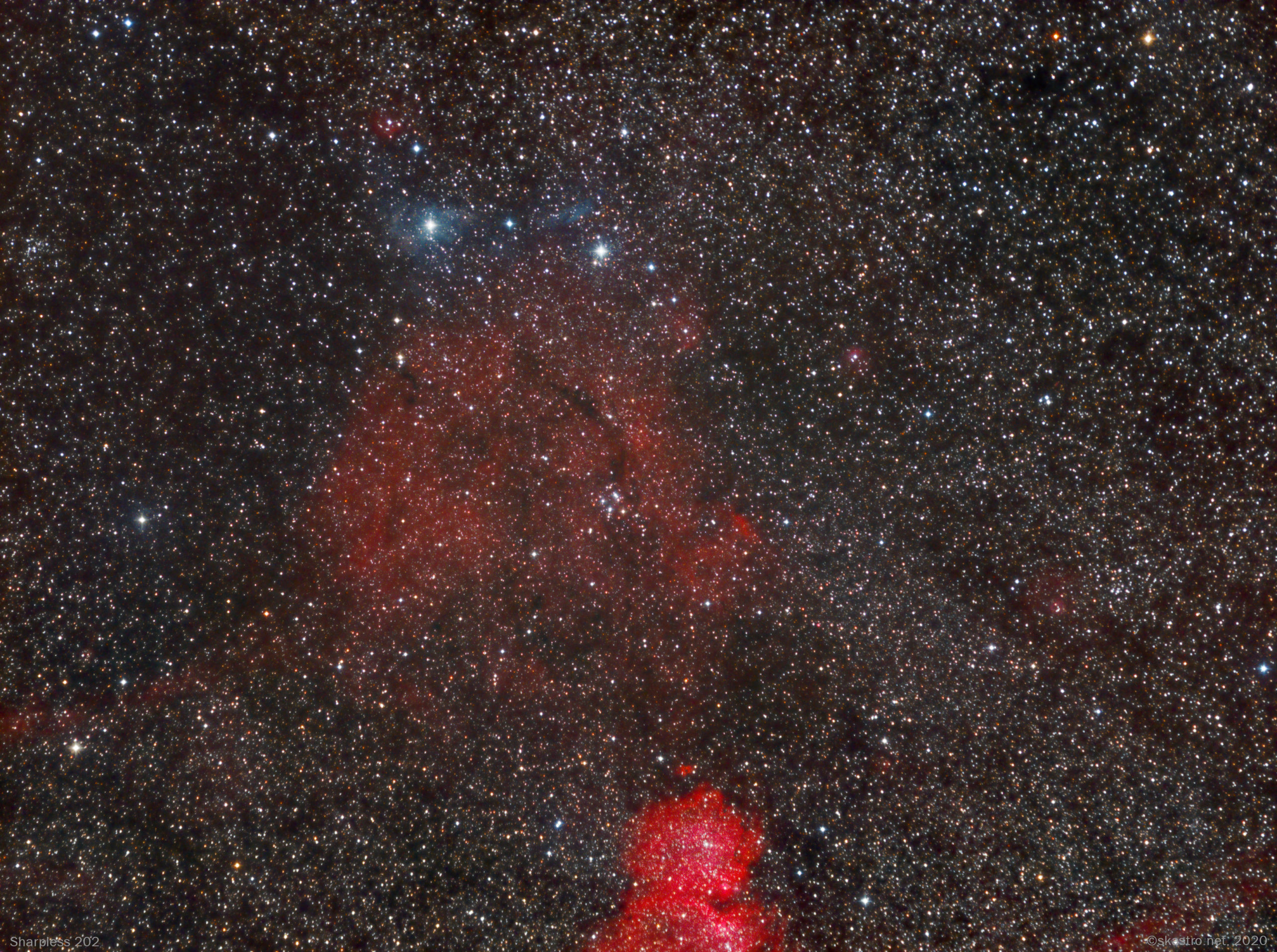
Sh2-202 (Sharpless 202) Samyang 135mm

This image shows Sh2-202 glowing to the left of centre with the top of the Soul Nebula at the bottom. Several other Sharpless Catalogue objects are also visible together with a few objects from the VdB catalogue.

Image Technical Data
This image was captured from my back yard with my widefield rig consisting of my Samyang 135mm lens with Moravian Instruments G2-8300 CCD camera and Astrodon RGBHa filters. I used my NEQ6 mount. The data was acquired when the object was overhead from Nottingham UK on 29 November 2019. All data acquired in one imaging run and all exposures binned 1x1 and 300seconds:
Ha(3nm) 180 mins, Red>50mins, Blue>45mins,Green>45mins
I hope you like it!
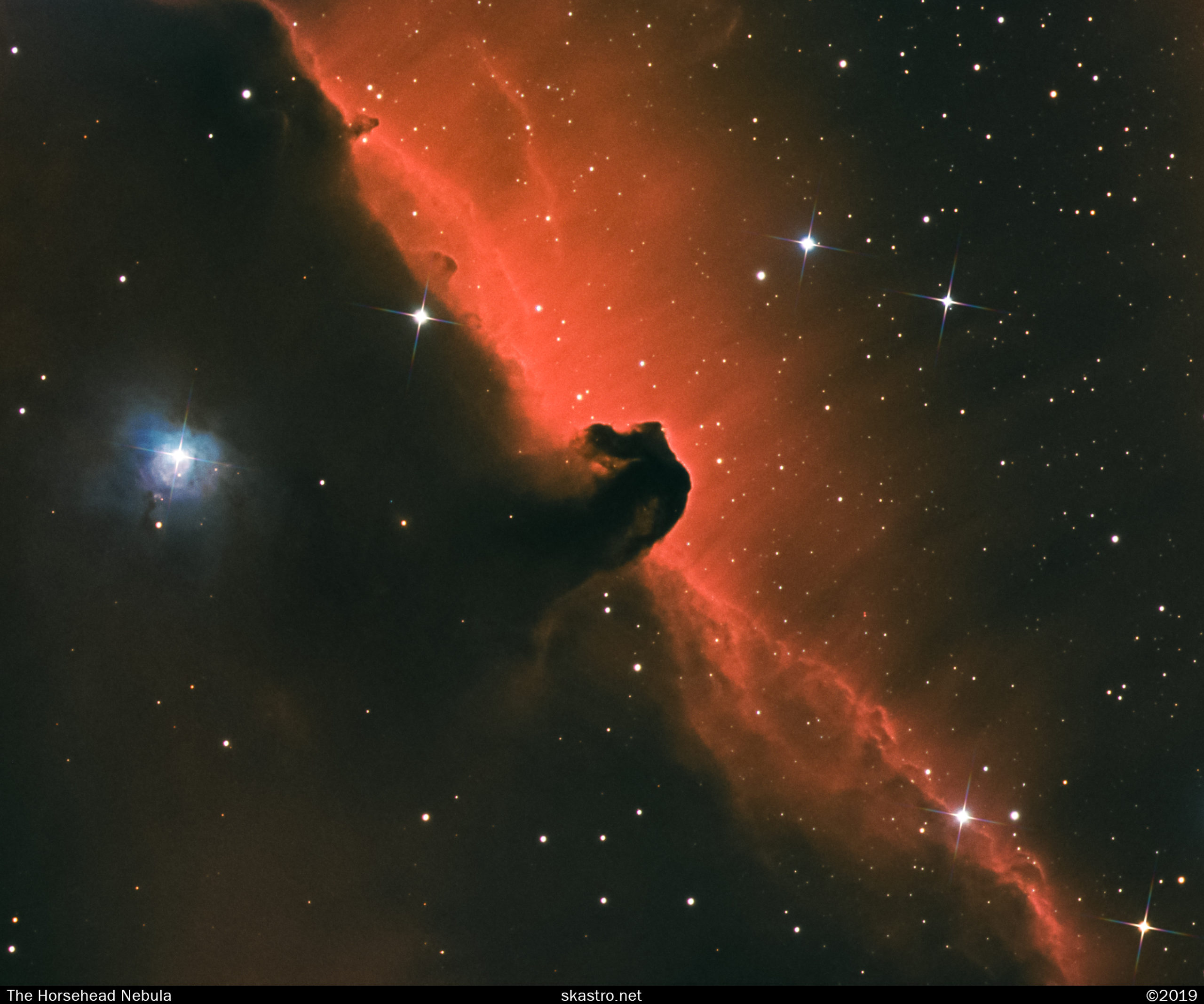
The Horse head Nebula

A famous, indeed iconic nebula in the constellation Orion, The Horsehead was not even discovered until 1888 with the advent of astro photography. It is very faint to see visually with a telescope.
The image above was captured with my TEC 140 refractor and Atik 460 CCD camera with Astrodon RGB and Ha(3nm) filters. It contains a total of 120 minutes of Ha data and 45 minutes each of RGB data, everything binned 1x1 with 5 minutes exposures.