
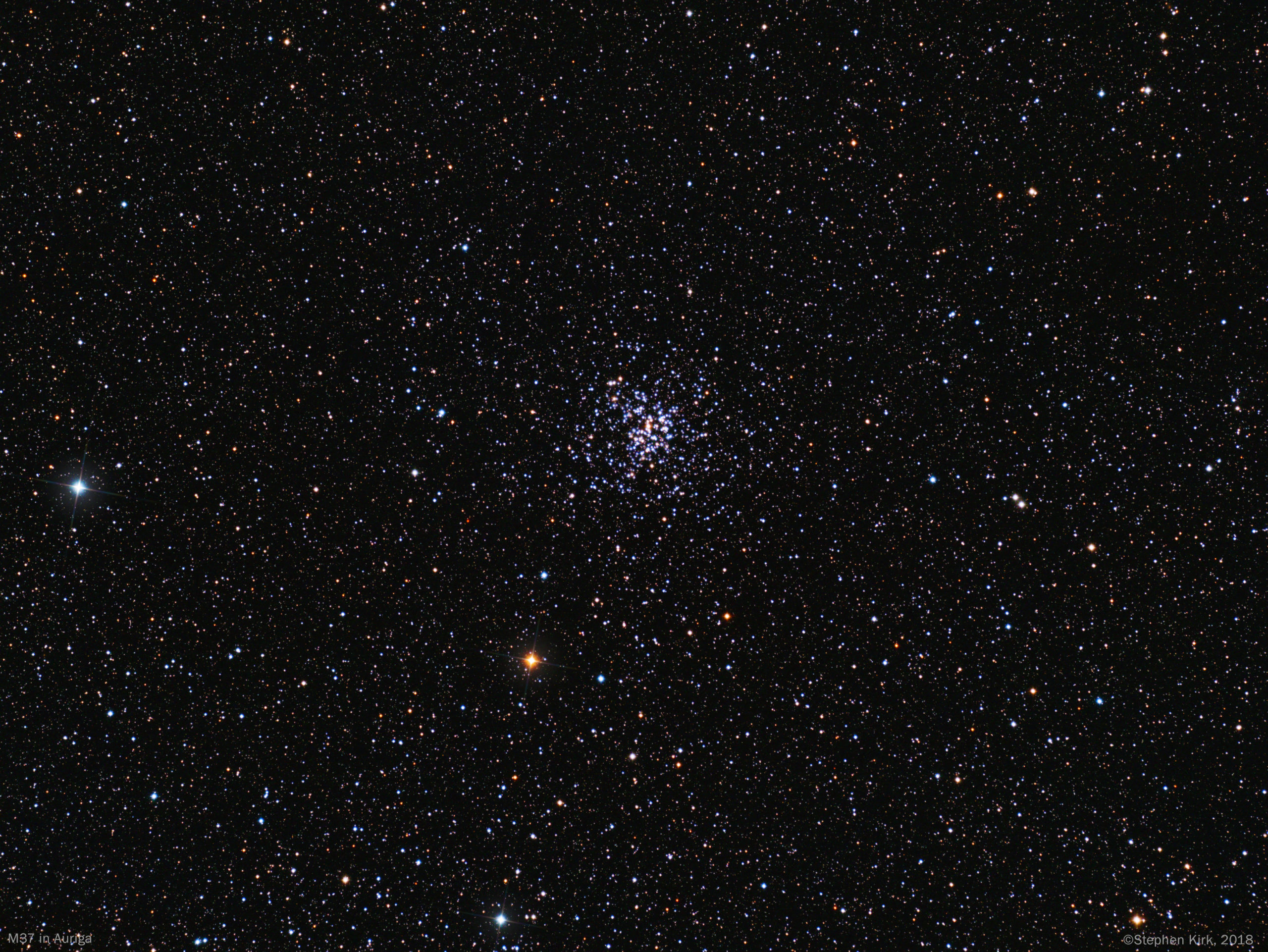
M37 - Open Cluster in Auriga with FSQ85
M37 is one of the three Messier Open Clusters in the Constellation of Auriga - the other two being M36 and M38. It is about 4500 light years away and contains several red giant stars, visible in this image, making it the richest of the three Auriga Messier Open Clusters. M37 appears high overhead from my 53 degree norther location during the winter months making it an ideal target for visual observations and imaging. It makes a fine site in a telescope and appears as a fuzzy ball in a pair of binoculars.

Image Technical Data
Imaged from my backyard in Nottingham, UK on the 9th February 2018. I used my Takahashi FSQ85 refractor and Moravian G2-8300 cooled CCD camera with Astrodon RGB filters. All expsoures are binned 1x1.
Red > 12 x 120s ; Green > 12 x 120s ; Blue > 12 x 120s


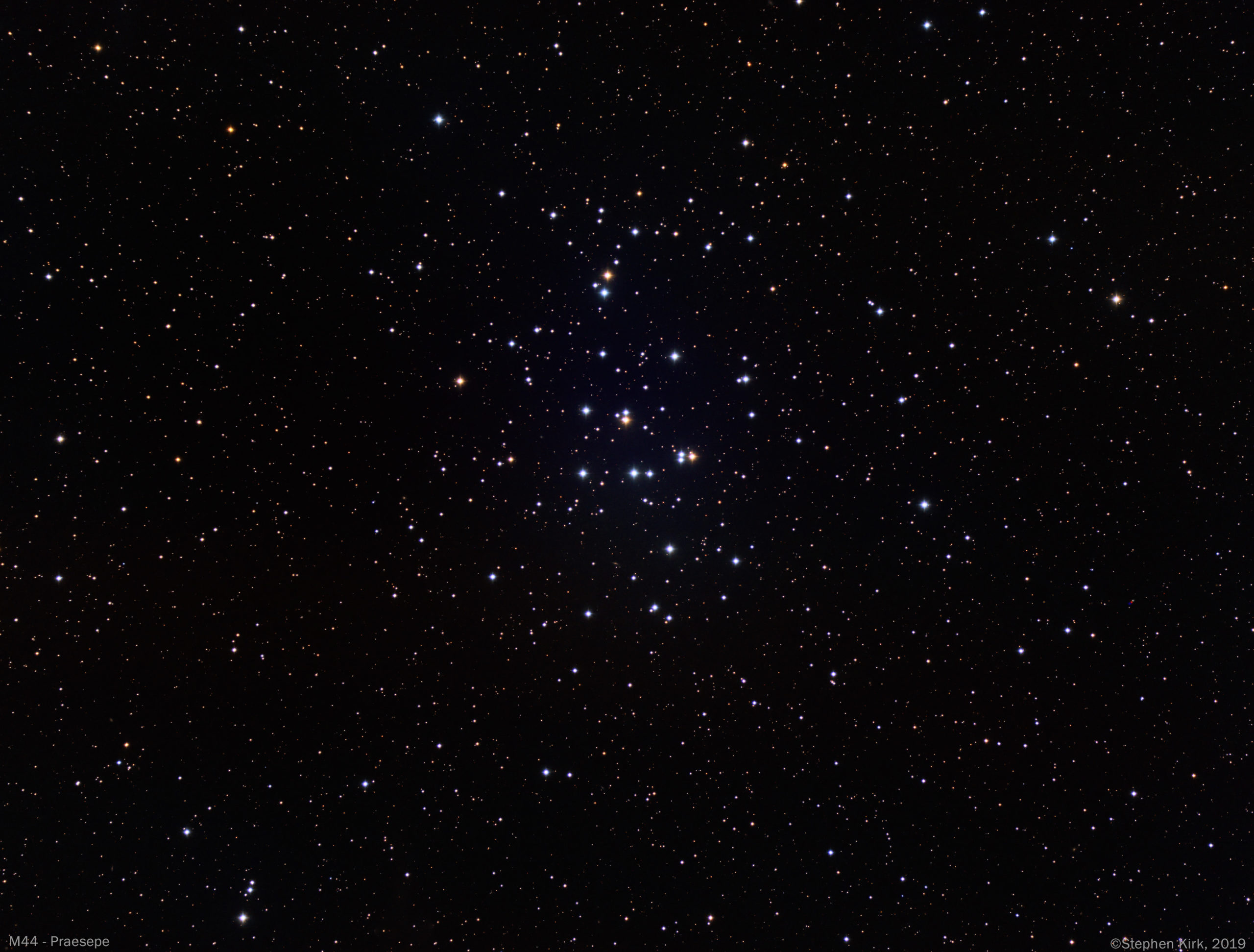
M44 - Praesepe - with FSQ85
M44 or "Praesepe" as it is called, is a famous open cluster visible in the late winter/ springtime in the constellation of Cancer - The Crab. It is often nicknamed The Beehive cluster since it resembles a swarm of bees when viewed in a wide-field telescope or binoculars. Along with M45 it is one of the most immediately breathtaking sights in the deep sky. At about 510 light years it is one of the closer Open Cluster to the Earth and is about 12 light years across and contains about 1000 stars. Note the tiny, distant galaxy in the bottom of the cluster PGC24400.

Image Technical Data
Imaged over two evenings, the 22 and 23 February 2019 from my backyard in Nottingham, UK. Conditions were far from ideal with a high, hazy mist that made transparency poor and subsequent processing difficult.
Captured with Takahashi FSQ85 and Moravian G2-8300 CCD camera with Astrodon RGB filters. All data binned 1x1:
Red > 14 x 120s ; Green > 16 x 120s ; Blue > 14 x 120s
Mounted on MESU 200 telescope mount and guided with OAG

