
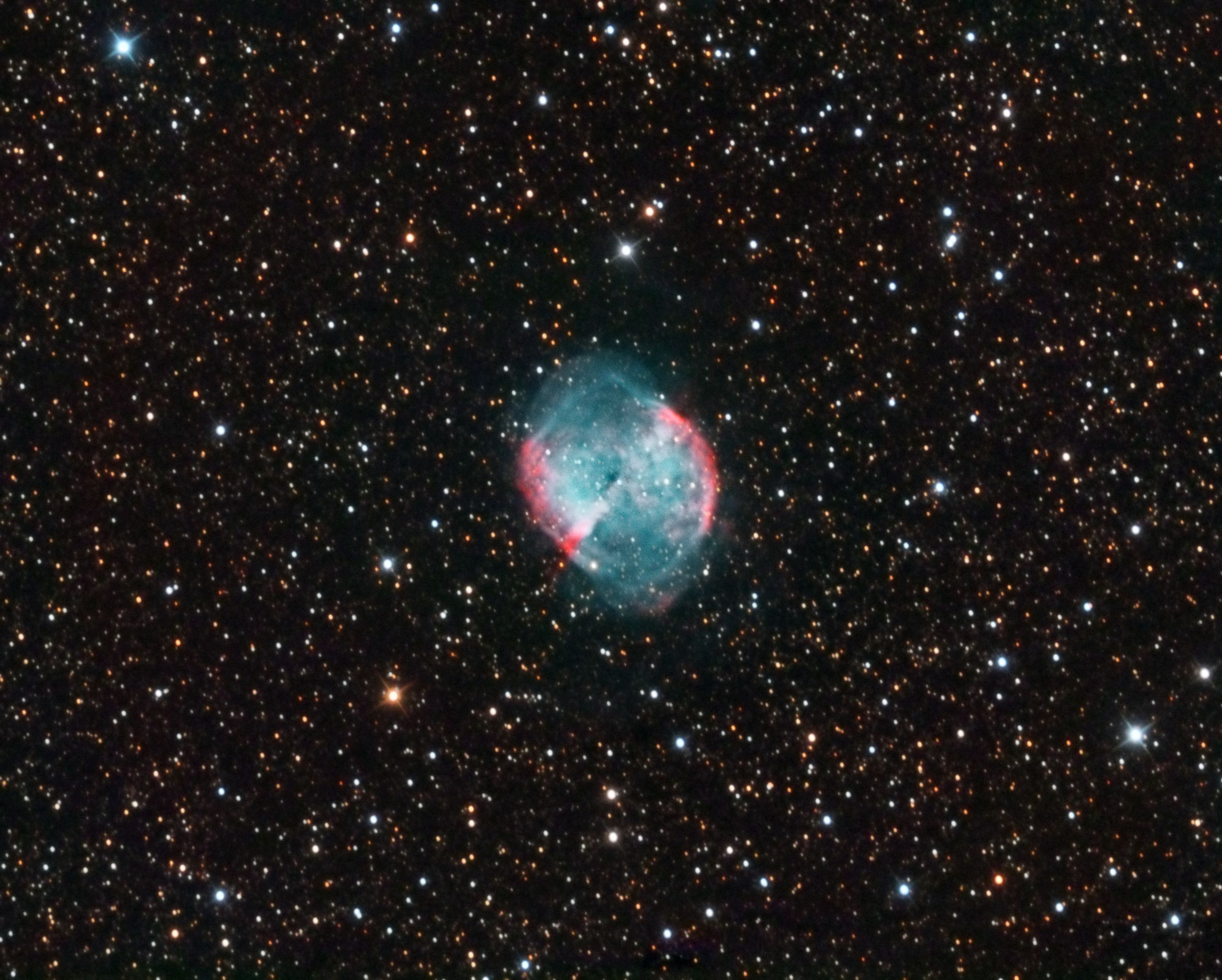
M27 - My First LRGB CCD Picture
M27 is known as The Dumbbell Nebula and is a planetary nebula in the constellation of Vulpecula - The Fox. It is located about 1250 light years away and represents the outer ejected gas envelope of a dying star.
This is the first image I took with my CCD camera - Atik460 - on the 28th October 2013. This is a lovely object in the summer and early autumn skies and is very pleasing visually in a pair of binoculars or a telescope. Its brightness and vivid colour make it a perennial favourite object for astro imagers.
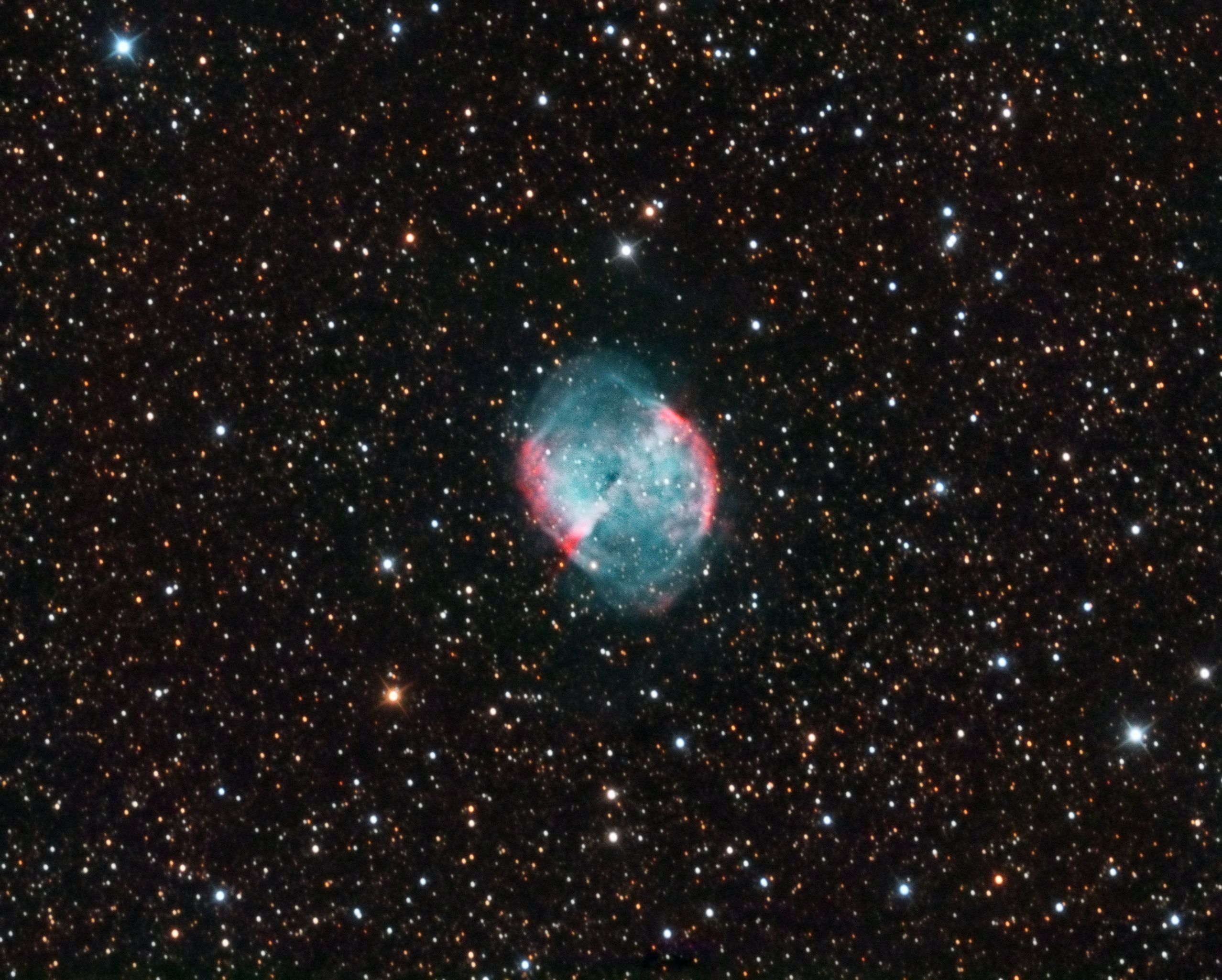
Image Technical Data
This is a small dataset taken with my superb Skywatcher ED80 Black Diamond refractor and Atik 460 CCD camera with Baader LRGB filters on an NEQ6 mount, guided with a Skywatcher guidescope and QHY5 (I still have and use this guide setup). This is a superb imaging setup and despite its modest cost is capable of great results. I upgraded the ED80 to a Takahashi FSQ85 and sold the ED80. Be assured though, the super ED80 is capable of 90% of what the FDSQ can do at 10% of the cost. I kind of regret selling that ED80 now.
Luminance 8 x 300s 1x1; Red 6x 180s 1x1; Green 7 x 180s 1x1; Blue 7x 180s 1x1
Developed in PixInsight - first picture I ever developed with this software.
It looks quite nice for an early effort.
P.S. This excellent Atik 460 CCD camera and EFW2 filter wheel is still going strong after seven years of use (writing this in August 2020). I had to have a port repair on the EFW2's mini-USB port under Atik's fabulous customer service in 2019 but other than that no issues whatsoever with the camera or filter wheel. I have since upgraded the filters to Astrodon E series Gen2 LRGBHaOIII filters.

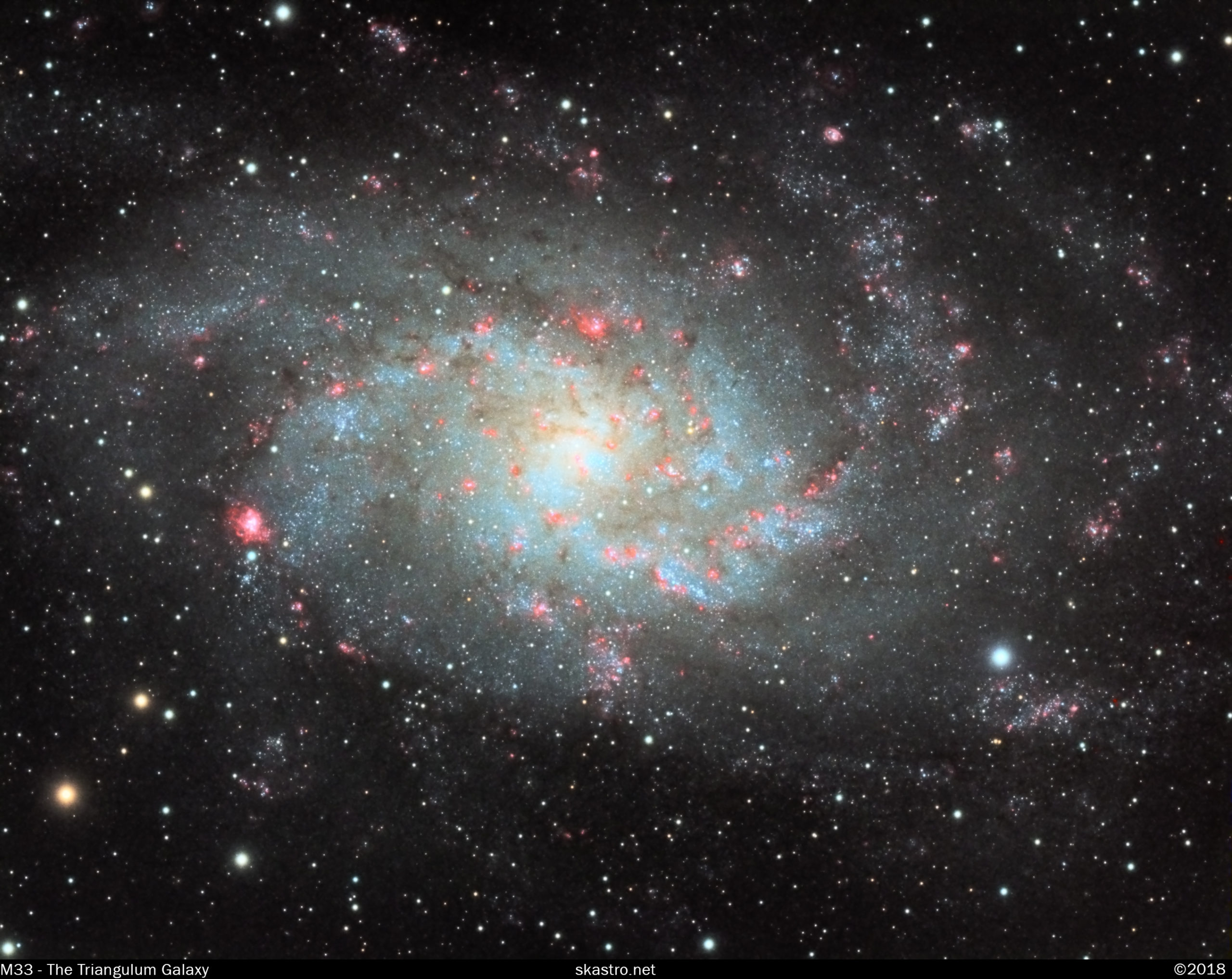
M33 With TEC140 Refractor
I have completed several images of the famous Triangulum Galaxy - M33, over the years. This is one of the most photographed objects in the sky and with good reason; it is a beautiful face on spiral galaxy that is the second closest major galaxy after Andromeda. It is bright and colourful and responds well to all types of imaging, whether with a DSLR or CCD, camera lens or telescope. It is probably the second "go to" target to photograph for astro photography beginners after the Andromeda galaxy.
The image below is a version captured with the TEC 140 refractor and Atik 460 CCD camera and is the total of about 12 hours of LRGBHa data captured from my backyard observatory in Nottingham, UK in 2018. You can see it fills the frame very nicely.


Image Technical Data
Image acquired spring 2018 and 2019 seasons over several capture sessions due to very wet and persistent cloudy weather) in my backyard in Nottingham, UK. It was acquired with TEC 140 refractor with Atik 460 CCD camera and Baader HaLRGB filters on my MESU 200 mount. Guiding was via off-axis guider.
A modest data set with everything binned 1x1 so as not to need so much luminance so a bit of an experiment! Did it work?
Luminance 10 x 300s 1×1; Red 9x 300s 1x1; Green 10x 300s 1×1; Blue 9x 300s 1x1; Ha 12 x 900s 1x1
Data processed with PixInsight and Photoshop and data collected with SGP Pro and guided with PHD2.
Here is another version of M33 with a wider field FSQ85 refractor:
https://thekirkshouse.com/m33-the-triangulum-galaxy/