
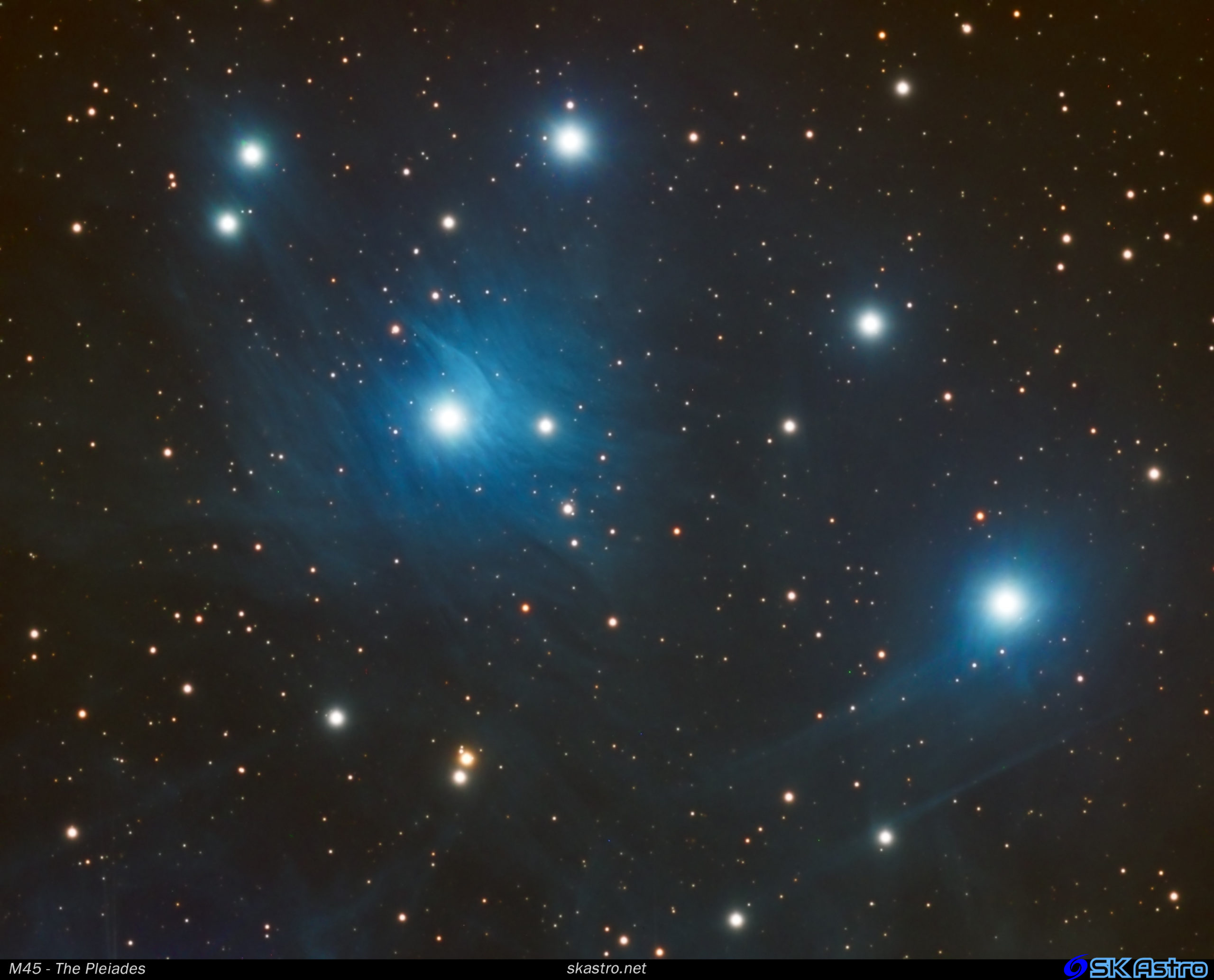
M45 The Pleiades
Introduction

Presented here is M45, the famous Pleiades Open Cluster of stars. Image was captured in one imaging run on the night of 18th December 2019. This image shows a small sub-section of The Pleiades, the "head". This main triangle shape of the bright stars Maia, Electra and Taygeta is visible to the naked eye.
Known since ancient times from cultures all over the world and even featured in prehistoric cave paintings, The Pleiades is a large, open cluster of stars in Taurus, visible late autumn and winter in the Northern Hemisphere
The Pleiades are actually composed of hundreds of stars, about 470 light years away. The cluster is vert young, about 20 million years, and is moving through a cloud of interstellar gas and dust. At some point many millions of years in the future, the stars will lose their mutual gravitational attraction an d will slowly disperse and start life on their own, orbiting the centre of the galaxy.


Technical Information
T: TEC 140 refractor
M: MESU200
C: ATIK 460 with Astrodon RGB
Twelve exposures in each filter, three minutes in length.
Total Integration time of 108 minutes, binned 1x1.

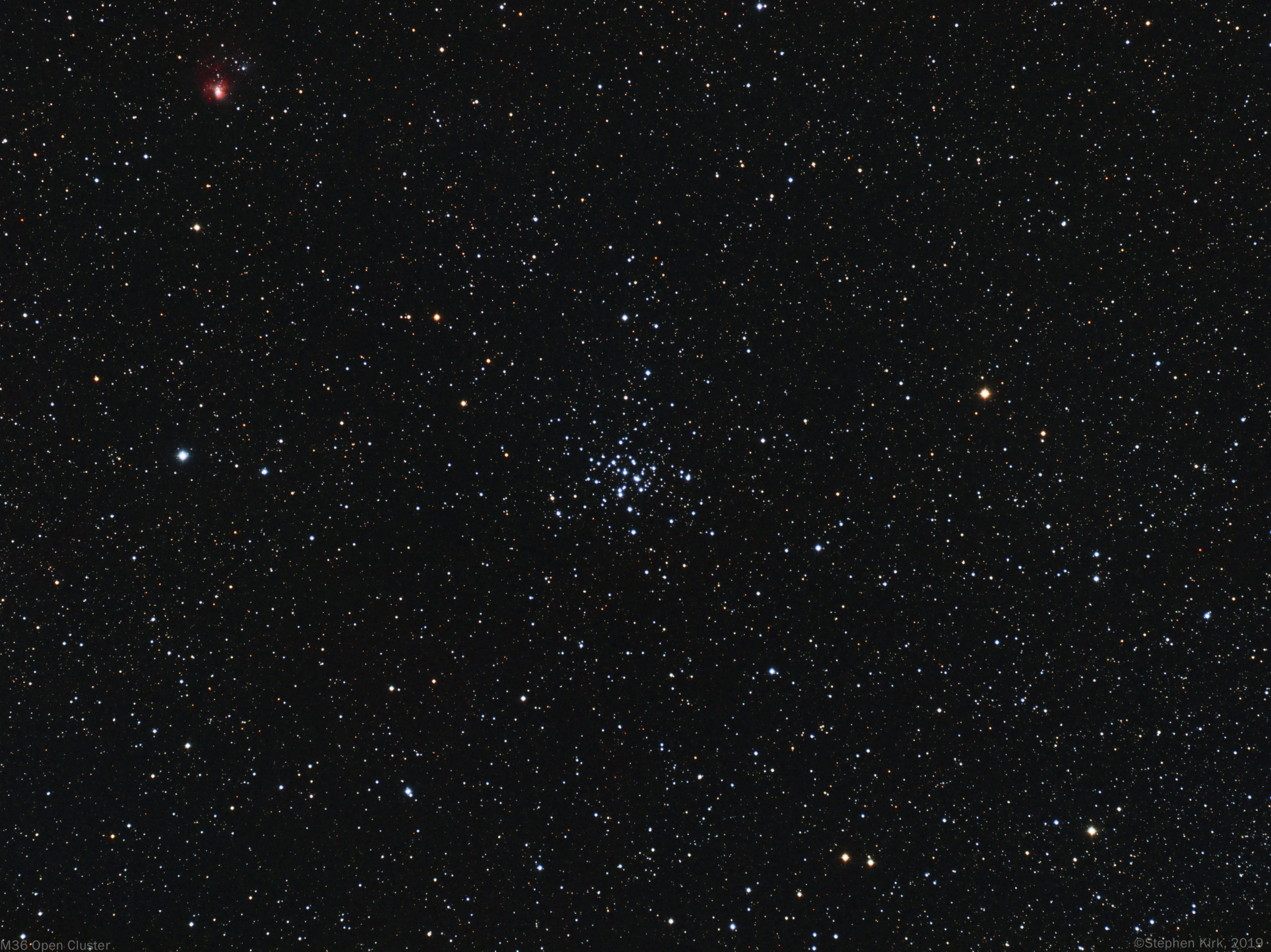
M36 Open Cluster in Auriga - FSQ85
M36 is an Open Cluster of stars (as opposed to a Globular Cluster) in the Constellation of Auriga. M36 is high overhead in Europe during the nightimes of winter months and is one of three Messier Open Clusters in Auriga, the others being M37 and M38. All of these are visible in a small pair of binoculars as nebulous and fuzzy blobs. M36 and the other clusters make a fine site in a telescope and dozens of stars can be seen. Note also the Red nebula to the top left - NGC 1931 (Sh2-237). There are some tiny PGC catalogue galaxies, billions of light years away in this image.

This image was taken from by backyard in Nottingham, UK on the 24th January 2018 with my Takahashi FSQ85 refractor and Moravian instruments G21-8300 CCD camera with Astrodon RGB Generation 2 E series filters on MESU 200 mount. All data was binned 1x1.
Red > 12 x 120s ; Green 12 x 120s ; Blue 12 x 120s
Total Integration is about an hour and twelve minutes. Data captured with Sequence Generator Pro and processed in PixInsight and Photoshop.


Astrobin Image here: https://www.astrobin.com/fersyj/