
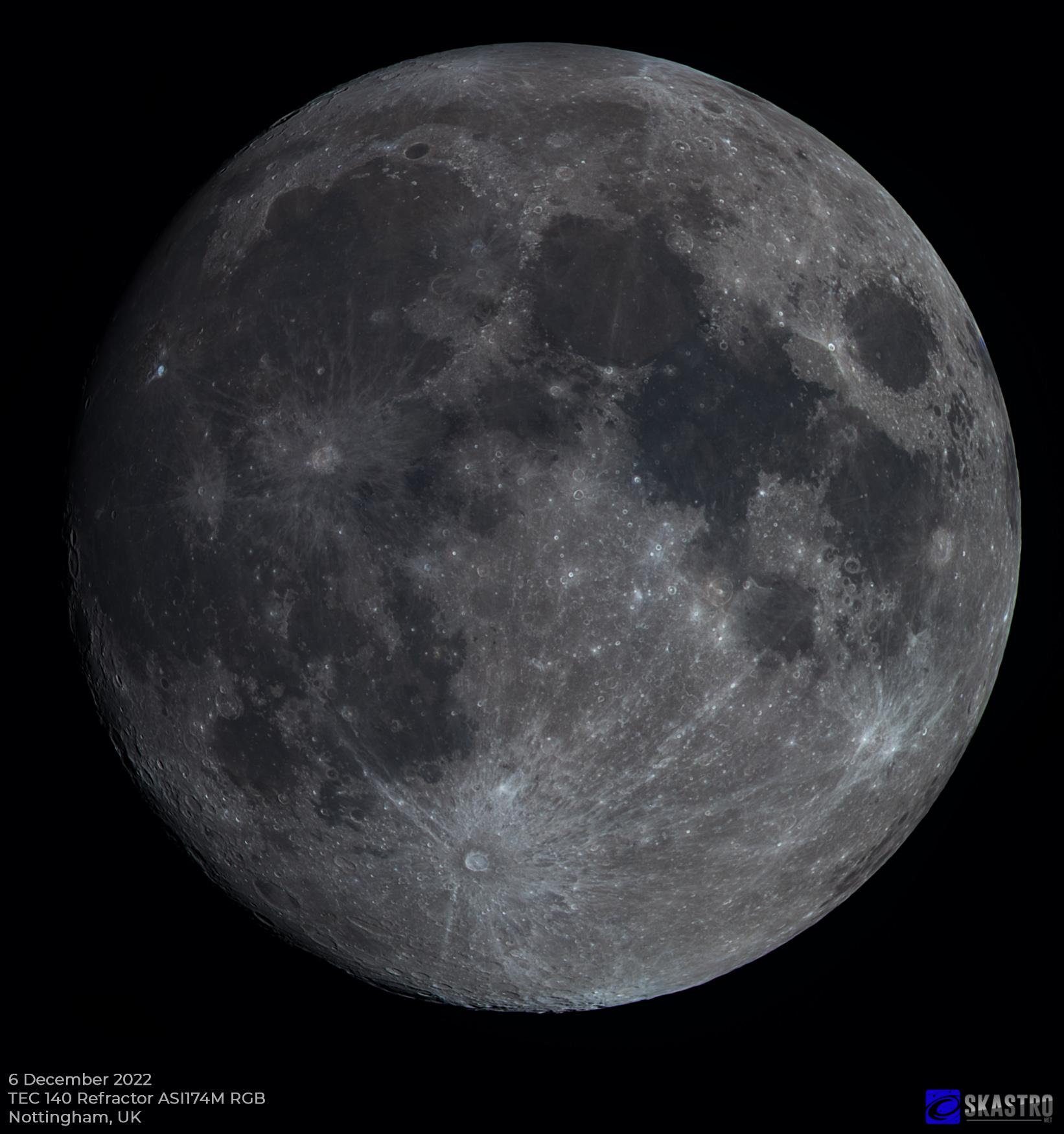
December Moon with TEC140 Refractor
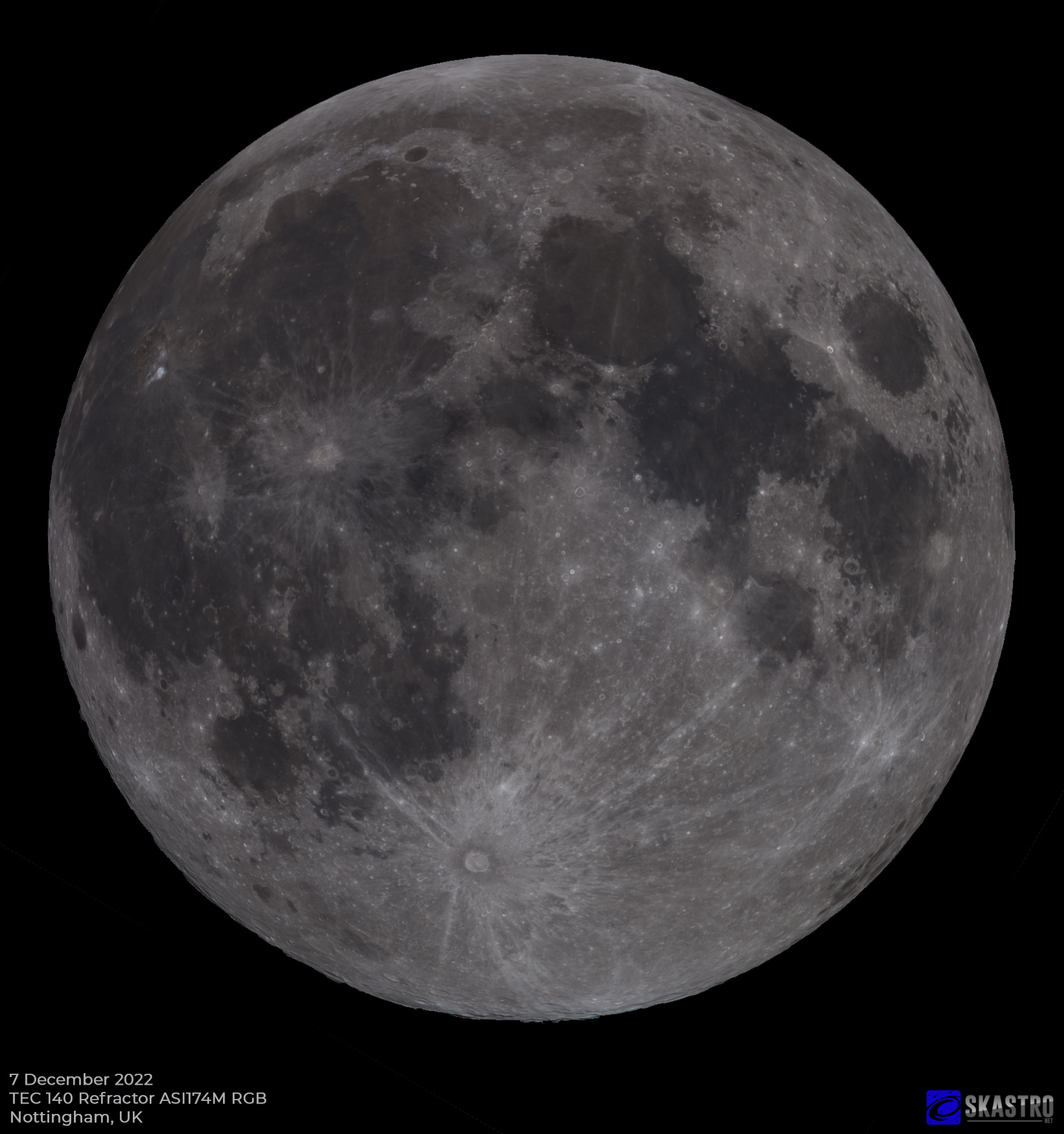
The Moon with my TEC140 December 2022.
Images taken on the 6th and the 7th. The 6th was not quite a full moon and the 7th was just a few hours past full. On the picture on the left you can see that the circle of the moon's disk is not quite full between the 6 and 11 O'clock positions.
Both images were taken with my TEC140 refractor and ASI174M camera through Baader RGB filters.
Each capture was of 5000 frames and the seeing was quite good so that I could utilise the best 50% of frames of each capture run. Because of the Field of View with the combination of the F8 focal length of the TEC140 and the chip size of the AIS174M, each capture run through each filter was comprised of a North and South run. I then stitched the two together in Photoshop.
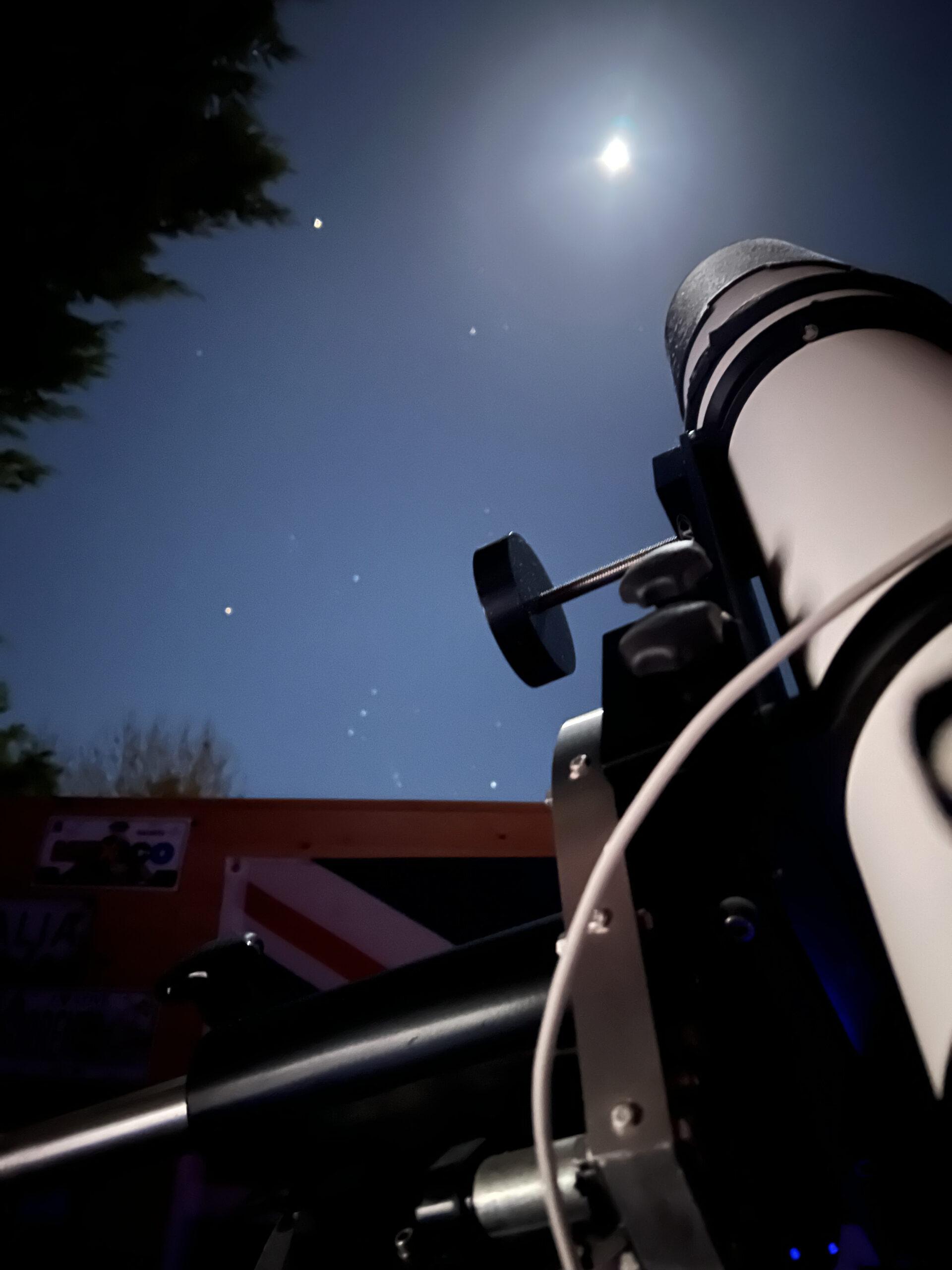
Weather conditions were extremely cold at about -2C when the captures were taken on the early evenings of the 6th and 7th December. The Moon was very high in Taurus.
From my backyard in Nottingham, UK. My skies are at Bortle 5 in terms of light pollution.

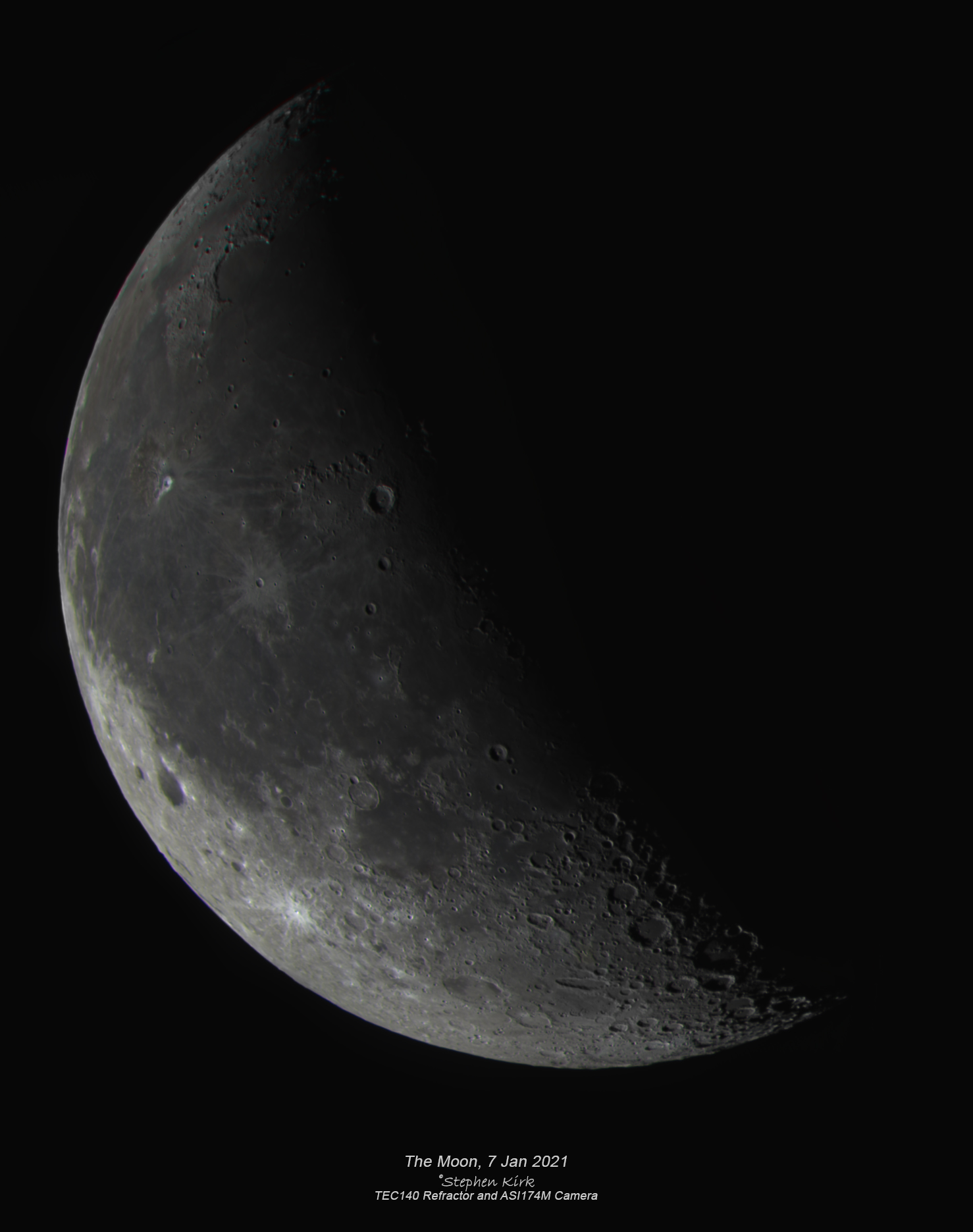
The Moon, 7 January 2021
I had to get up early in the morning to get this picture of The Moon. I set my alarm and got up at 05:00 which took considerable motivation, especially since it was -6C! I don't capture many last quarter and later moon pictures because the Moon is only ever visible in that phase early in the morning and working full time it is not easy to be getting up very early when you have to do lots of driving. However, conditions for astronomy in the UK have been exceptionally poor for the last six months of 2020 and I am desperate to be able to image anything at all!
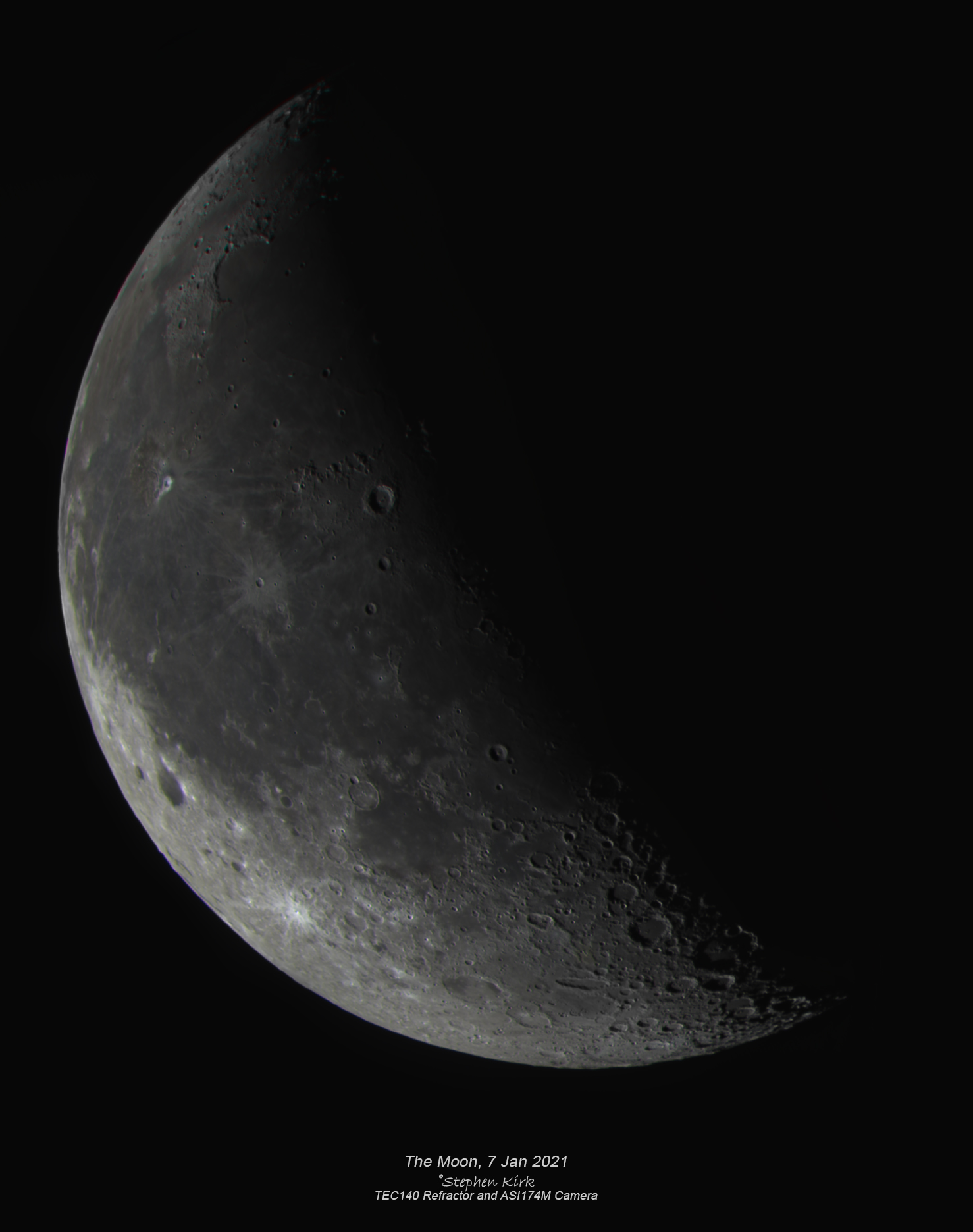
Technical Details
The Moon was in Scorpio, low down to The South from my location, and seeing was average with the Moon at such a low altitude Phase is 38% waning.
Imaged from my back garden with my TEC 140 refractor and ASI174M camera with LRGB filters. I captured 10000 frames in each of R,G and B and 25000 in luminance. The .SER files were quite jumpy with The Moon being at quite a low altitude and so I used about 50% of the frames from each recording. I captured with Sharpcap and then processed with Autostakkert, PixInsight and Photoshop.
I hope you like it!
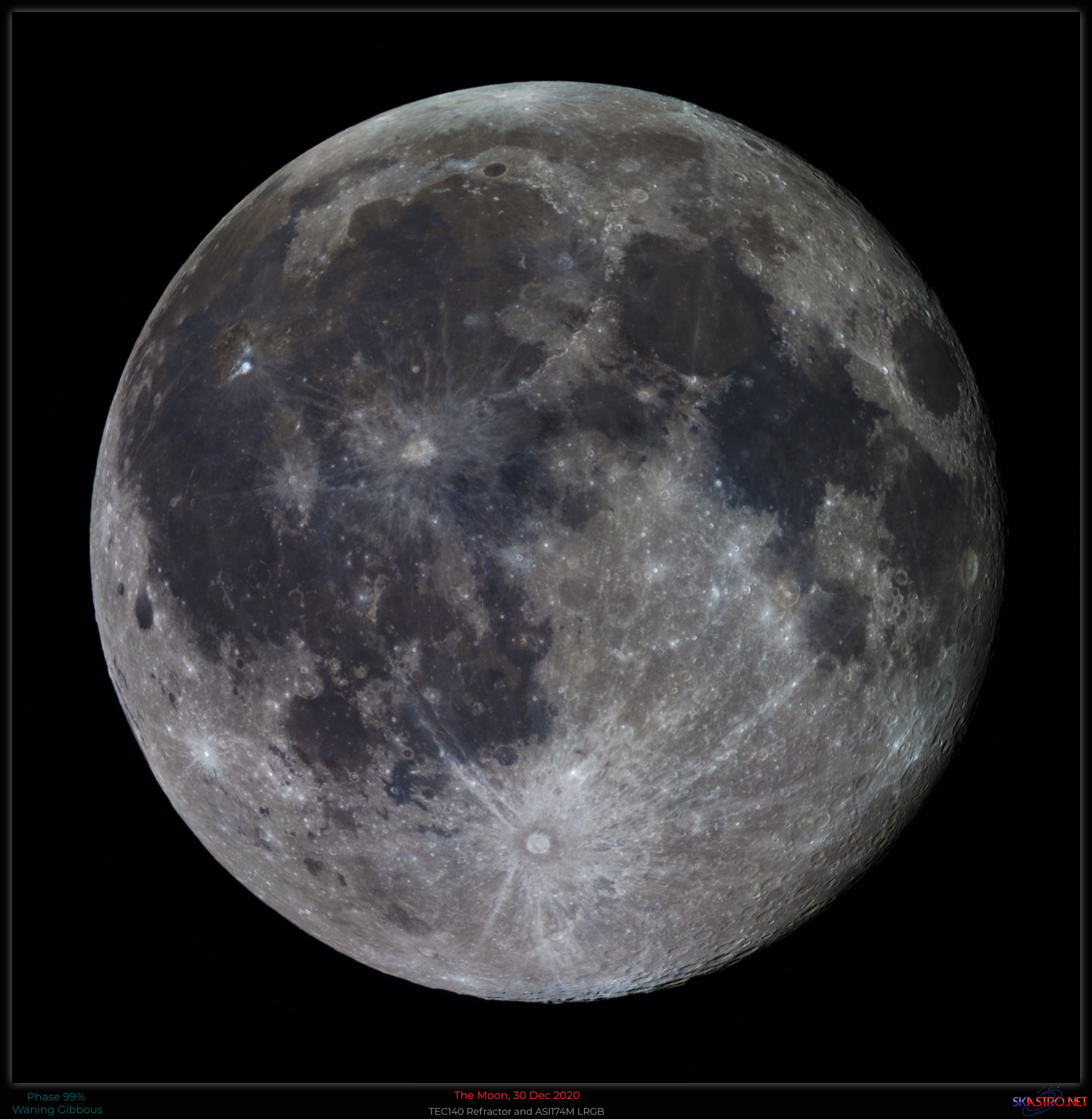
The Moon, 30 Dec 2020
The Moon at a 99% waning phase 30 Dec 2020 between 21:30 and 22:20. Note the bluish and tan colours of the mare (seas).
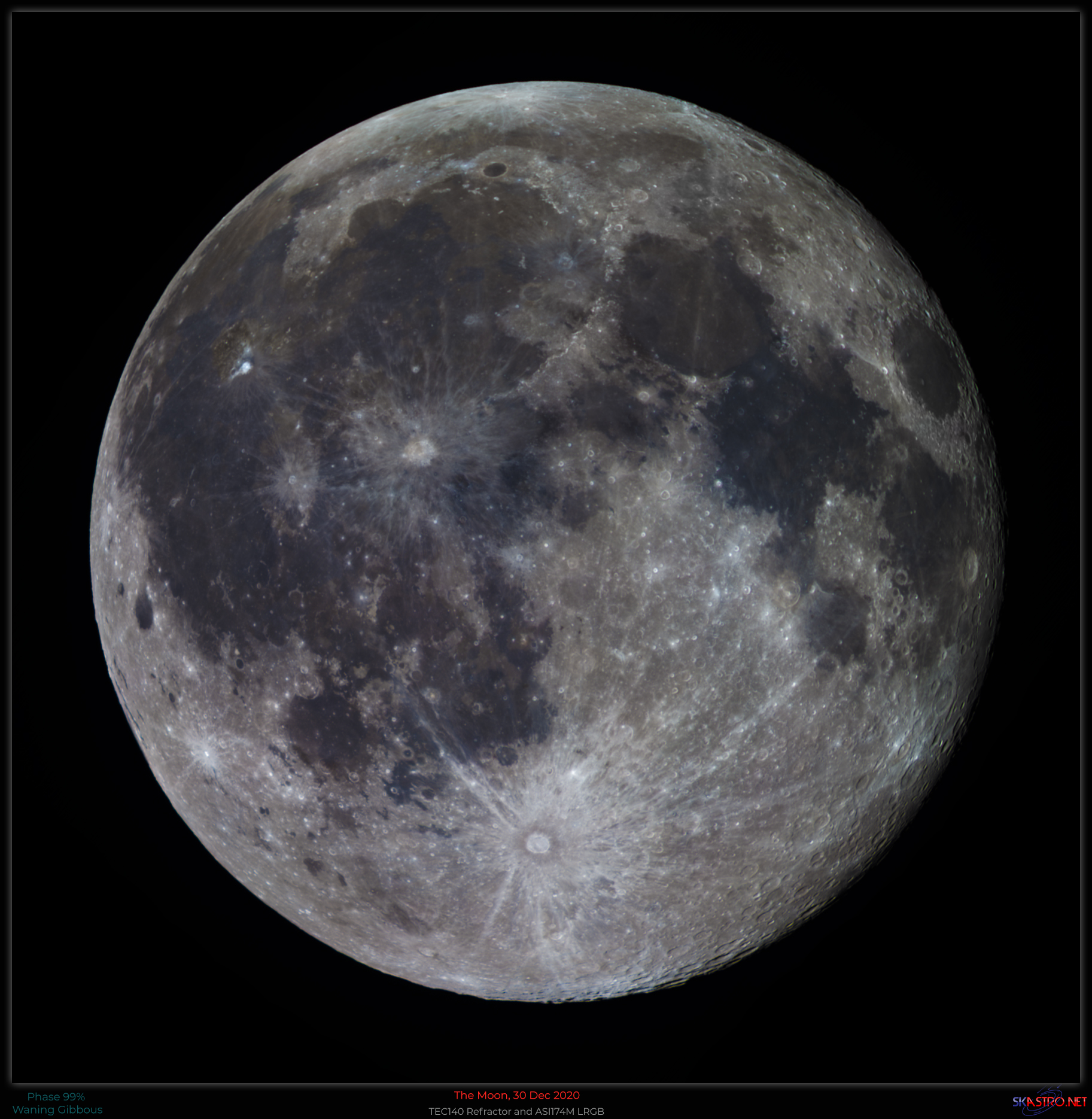
Technical Details
Imaged from my back garden in Nottingham, UK. The Moon was high up in the constellation of Cancer and seeing was very good - unusual in the UK. TEC140 refractor and ASI174M camera.
The image scale is such that I had to capture two runs with each filter to capture the North and The South parts of The Moon and then stitch the two together in Photoshop using the Merge tool. I used LRGB filters and captured 10000 frames in RGB and 20000 in luminance. Data set was in excess of 500 Gigabytes! I then used Autostakkert, Photoshop and PixInsight to process. Capture software in Sharpcap.
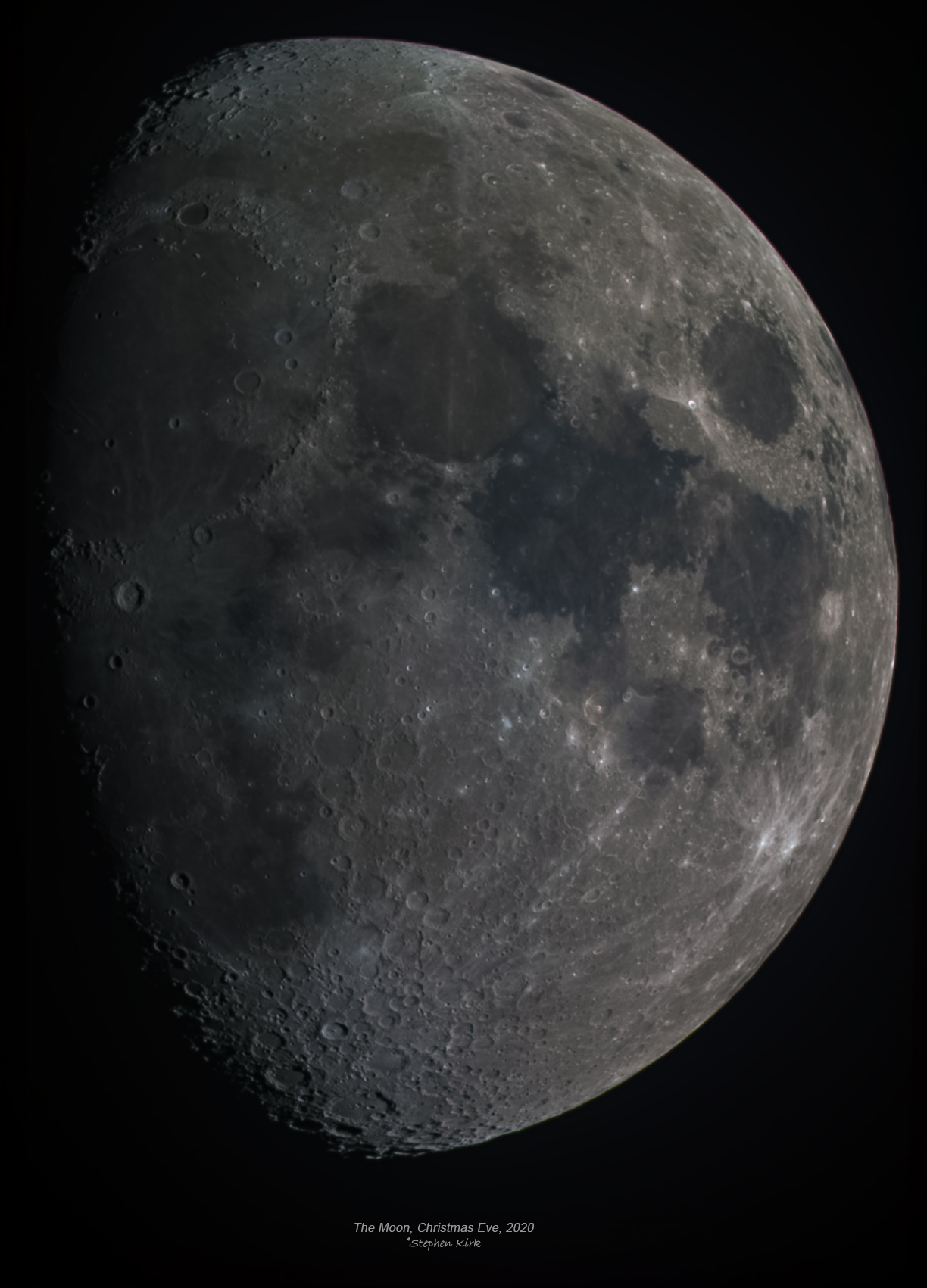
The Moon, 24 Dec 2020 LRGBHa with TEC140
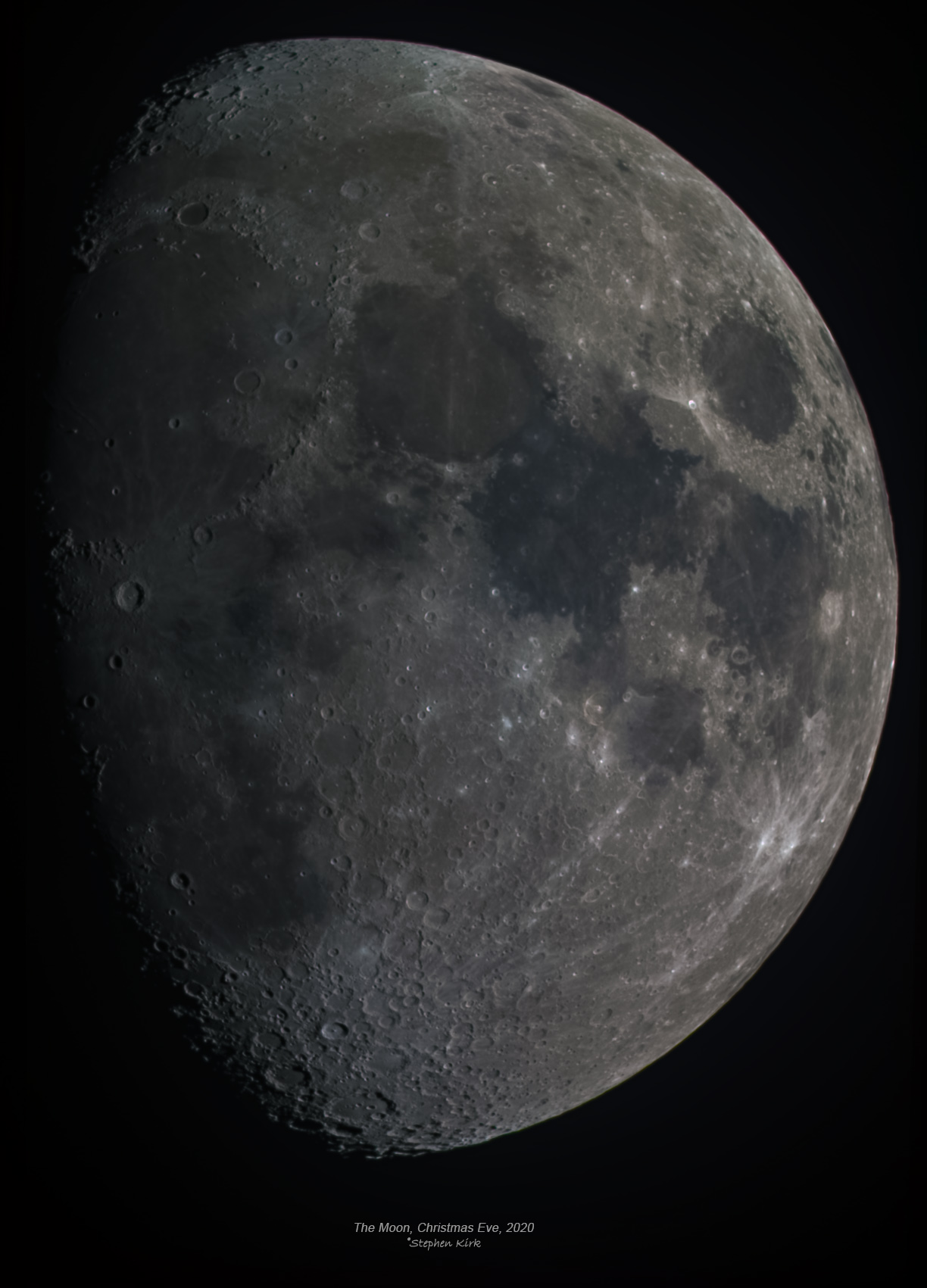
Technical Details
This image of The Moon is a composite picture taken with my TEC140 refractor and an ASI174M high speed mono camera through Baader LRGB and Neodymium filters - the same filters that can be used for Deep Sky imaging (and I have used them for exactly that purpose too).
Moon is in a 73% waxing gibbous phase in the constellation of Taurus.
I captured 2000 frames through the Baader luminance filter and another 2000 through the neodymium filter. I then registered and combined the master image from each of these with Pixelmath with scaling. I used Multi-Scale linear transformation to sharpen the image and a very slight HDR transformation to bring out the fainter detail. This created the master luminance.
Each master R, G and B sub is the best 50% of 5000 frames. I registered the separate RGB channels with the master luminance and then used channel combination to make an RGB image after linear fitting them as individual master subs to attain the same intensity across the three channels. All these steps done with PixInsight.
I then combined the master Luminance with the master RGB to create the picture above in Photoshop with a slight tweak of the vibrance and saturation with Camera Raw filter.
I hope you like it! It is fun and enjoyable creating these lunar images.
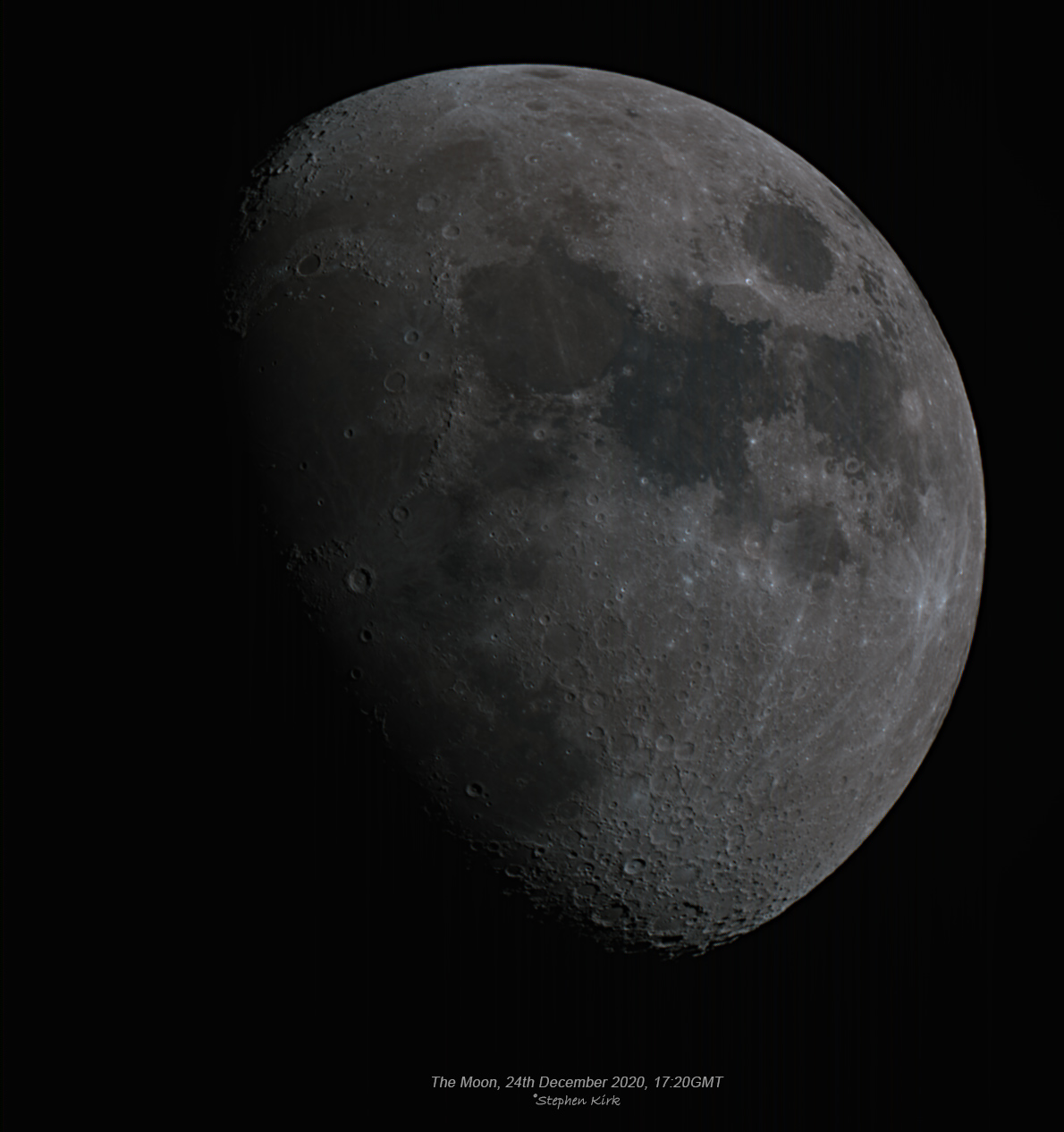
The Moon, 24 Dec 2020, FSQ85 and QHY268C
This is a one shot colour picture of The Moon through my Takahashi FSQ85 telescope and my QHY268C colour camera. Seeing between bouts of cloud dodging was quite good with very little in the way of shimmering. This is the best 40% of 5000 frames captured with Fire Capture. I did not use the full resolution of the QHY268's 6000x4000 sensor, I just captured the central 1600x1200. Unusual to see the FSQ85 used as a planetary or lunar scope but it does excel at this as well as deep sky astrophotography work. It is also a very good instrument for visual observations.
Processed with Autostakkert, PixInsight and Photoshop. I hope you like it. It could do with a bit more colour to bring out the colour in the Mare (sea) regions.
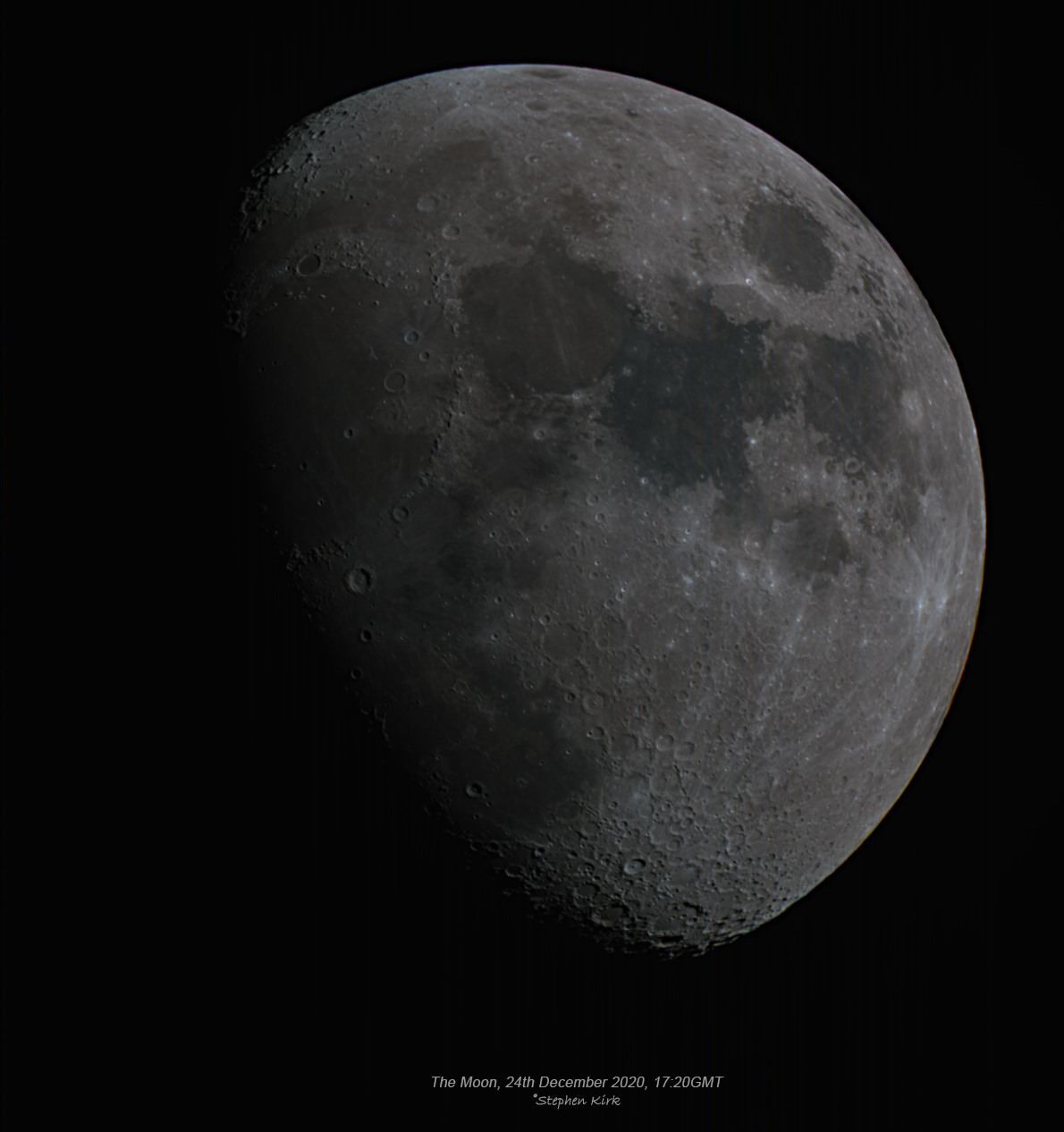
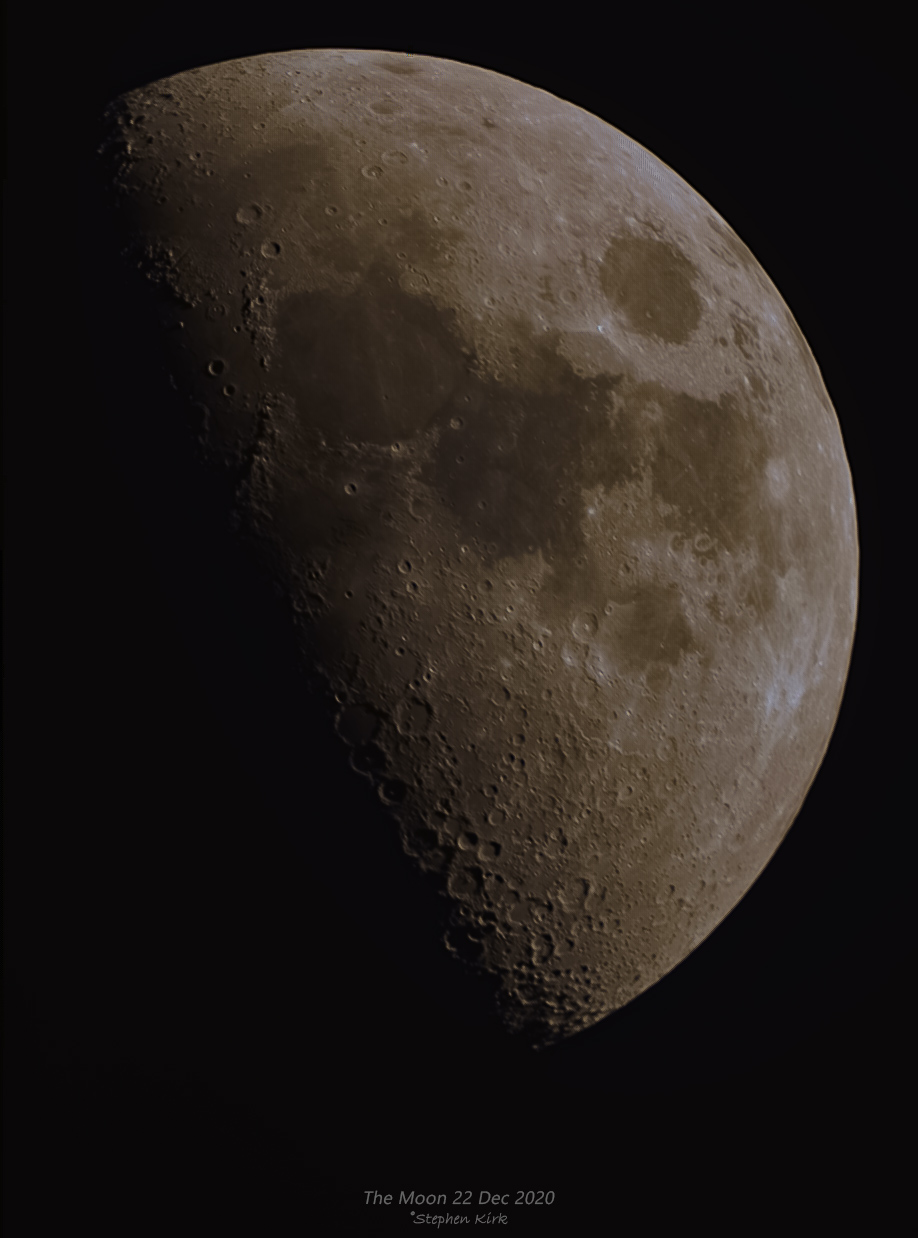
The Moon
The Moon was at about first quarter when I captured this image. There are a lot of firsts in this image when capturing as I discuss below.
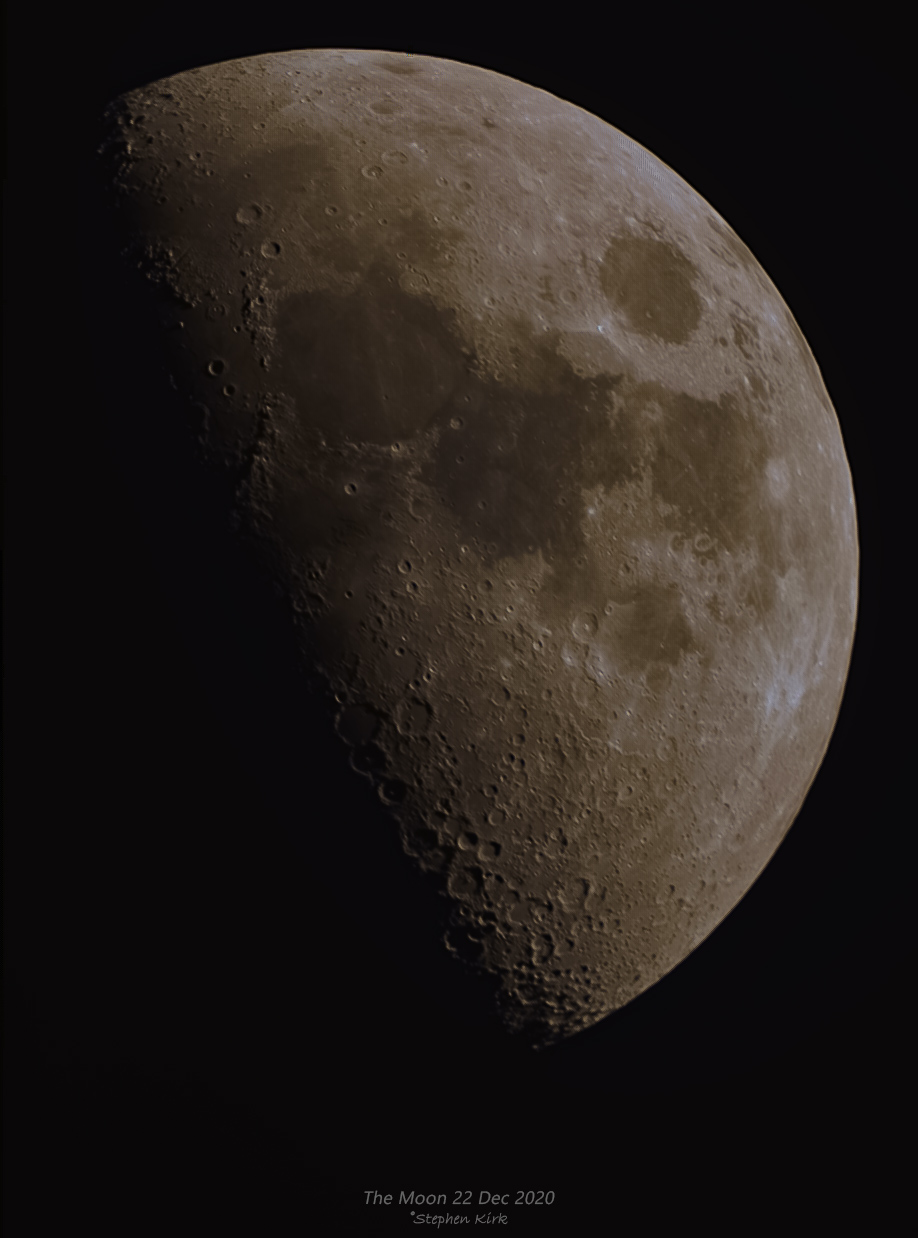
First up, this is the first time I used the QHY268C for planetary photography in video mode. Before now, I always used this camera in long exposure mode. I think the camera works very well and when I cropped the capture area down to 1600x1200 from its native 6000x4000, I was capturing16fps in Sharpcap, which is quite reasonable.
Secondly, this is the first time I used my Takahashi FSQ85 as a planetary/lunar scope. I think it worked our pretty well. I would normally have moved the camera over to the TEC140 or even the C925 SCT scope, however, I do not yuet have the adapters for the QHY268C to do that just yet.
Technical Details
As mentioned, imaged with FSQ85 and QHY268C. I used Lakeside motorfocus and captured 2000 frames in Sharpcap - another first use of this software (excellent) and utilised the best 35% of the frames in Autostakkert.
I used Photoshop to process the outputr from Autostakkert. Try as I might, and despite colour correction, I still think there is a slight green tinge to The Moon in this image so I will experiment with some different processing techniques.
EDIT: I am leaving the image as is but the reason for the green tinge is because I did not equalise the RGB channel intensities properly. There are several ways to achieve this. You can use linear fit in PixInsight and use the weakest median channel as the master with which to equalise the other two channels. Or, again with PixInsight, you could combine the RGB with channel combination with the channel intensities as they emerge from the stacking program and then do a colour combination to equalise the three channels. Or, you could use autocolour in Photoshop to achieve the colour calibration. Actually, there is a fourth way too, bu using Helmut Bornemann's autocolour script in PixInsight.
http://www.skypixels.at/pixinsight_scripts.html
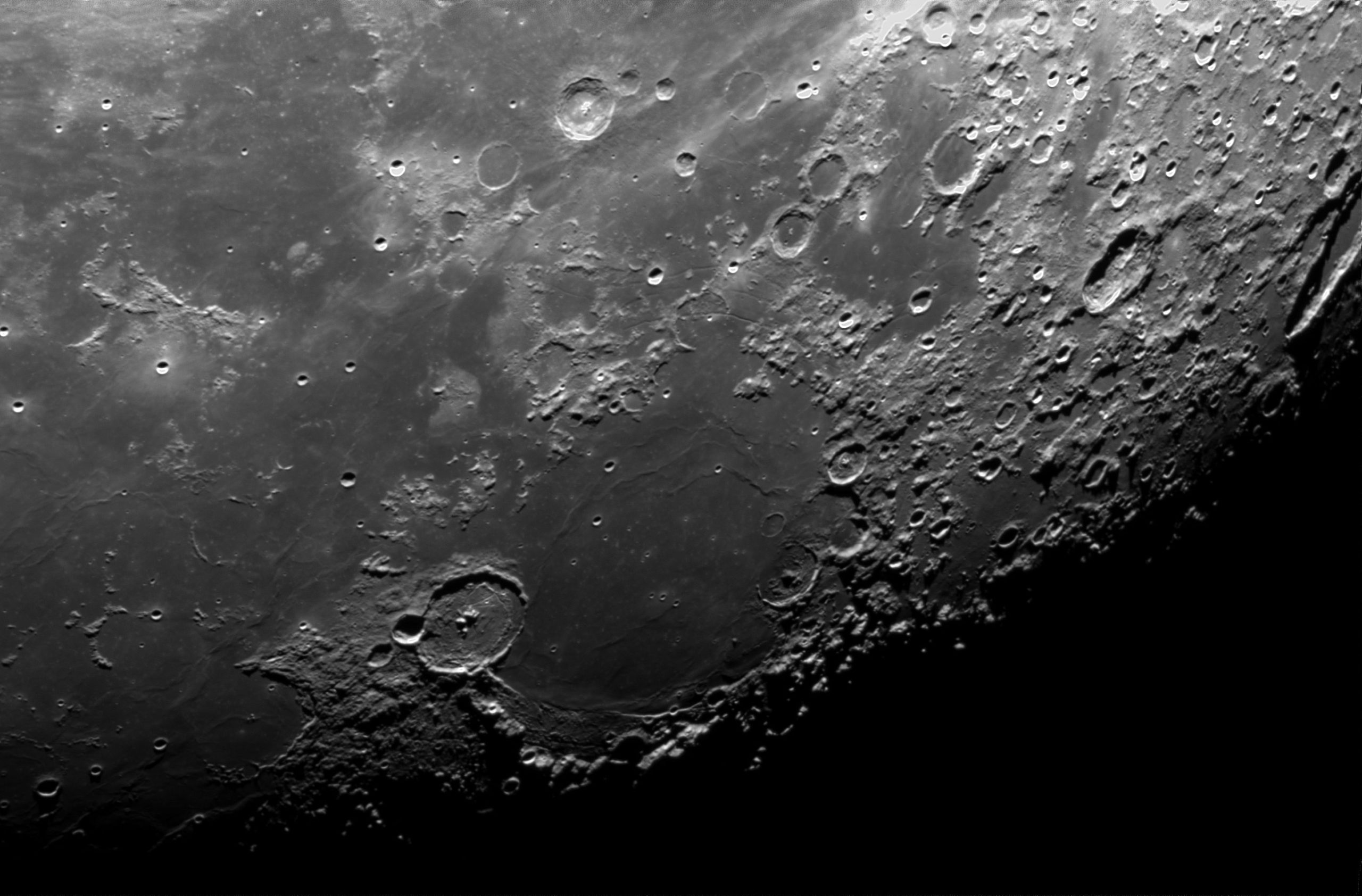
Lunar Pictures from January 2020
A few pictures of the moon that I took with my Meade 14 ACF SCT scope with a ASI 174MM camera in January 2020. The pictures utilised no filters at all.


The Meade 14" is an astounding scope that I liked very much. However, with a heavy heart I subsequently went on to sell this telescope since I felt that in my Bortle 5skies it doesn't offer any significant advantage over and above the Celestron C925; the latter scope being very much more manageable that the huge (and very heavy) 14" Meade. At some point in the future I may regret this decision since the scope excelled on the few occasions I took it to truly dark skies. However, I could not let my heart rule my head and I decided to sell it.