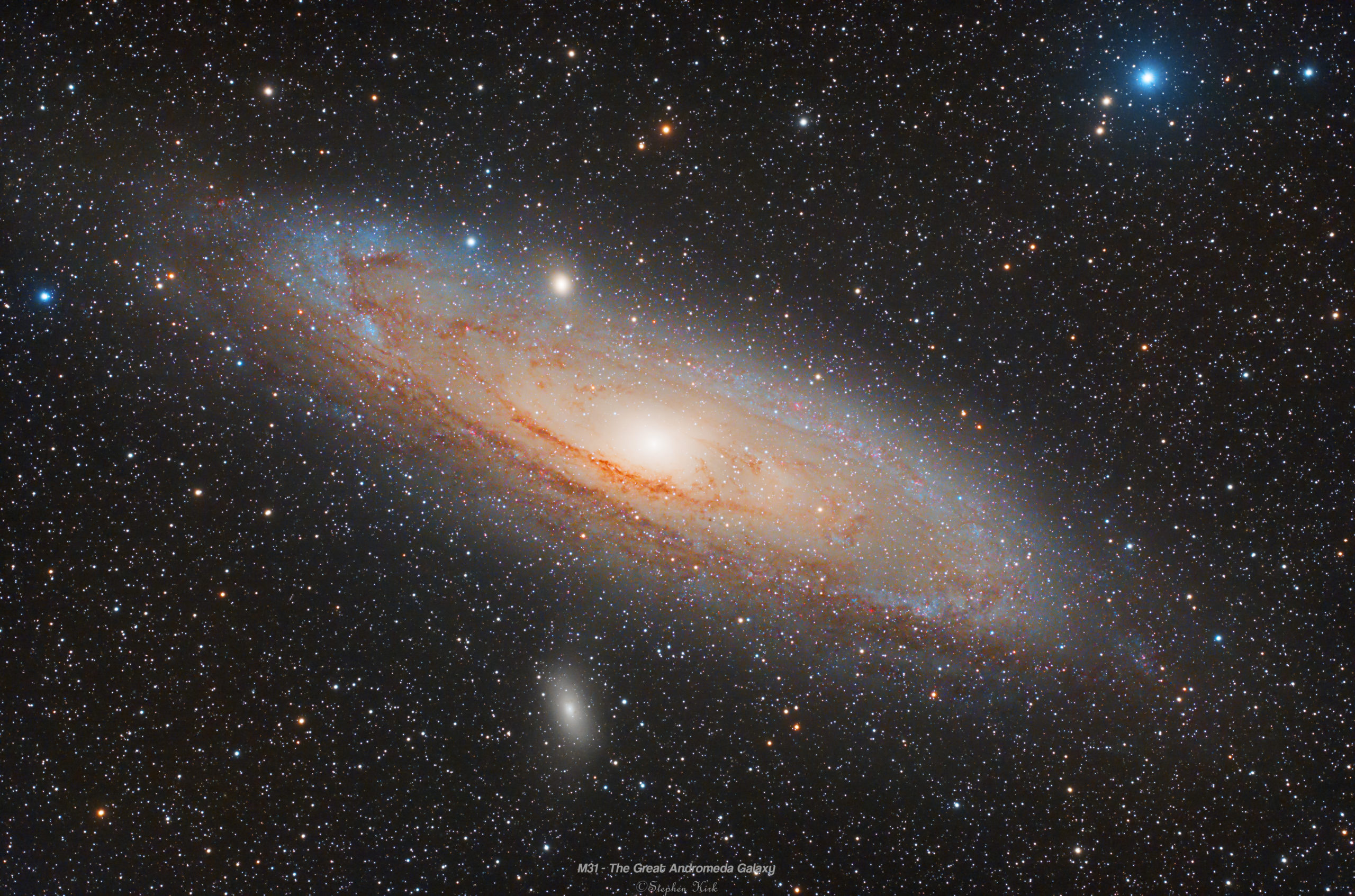
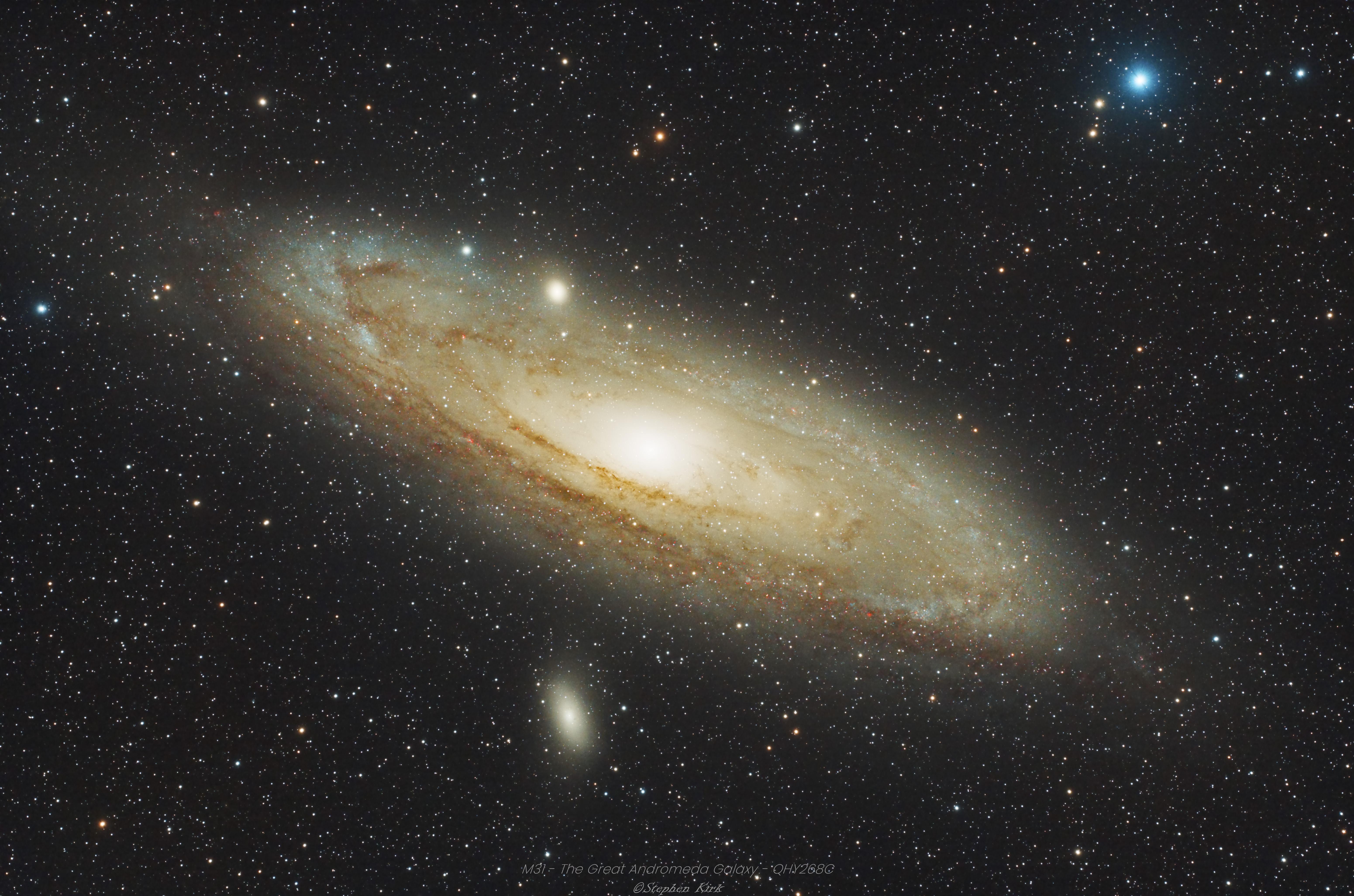
M31 with QHY268C
I have imaged M31 several times before and on this occasion I thought I'd turn the QHY268C onto the galaxy.

This image is made up from a total of 82 exposures, each of 180 seconds for a total integration time of about 2.5 hours.
I used my Takahashi FSQ85 refractor at its native focal length. I used an LDAS 2" light pollution filter in front of the camera to try and cut through the light pollution a bit.
Imaged from my backyard in Nottingham, October 2020 on MESU 200 mount and OAG used with an ASI 120mm guidecam.
Data captured with Sequence Generator PRo and processed in Pixinsight and Photoshop CC.

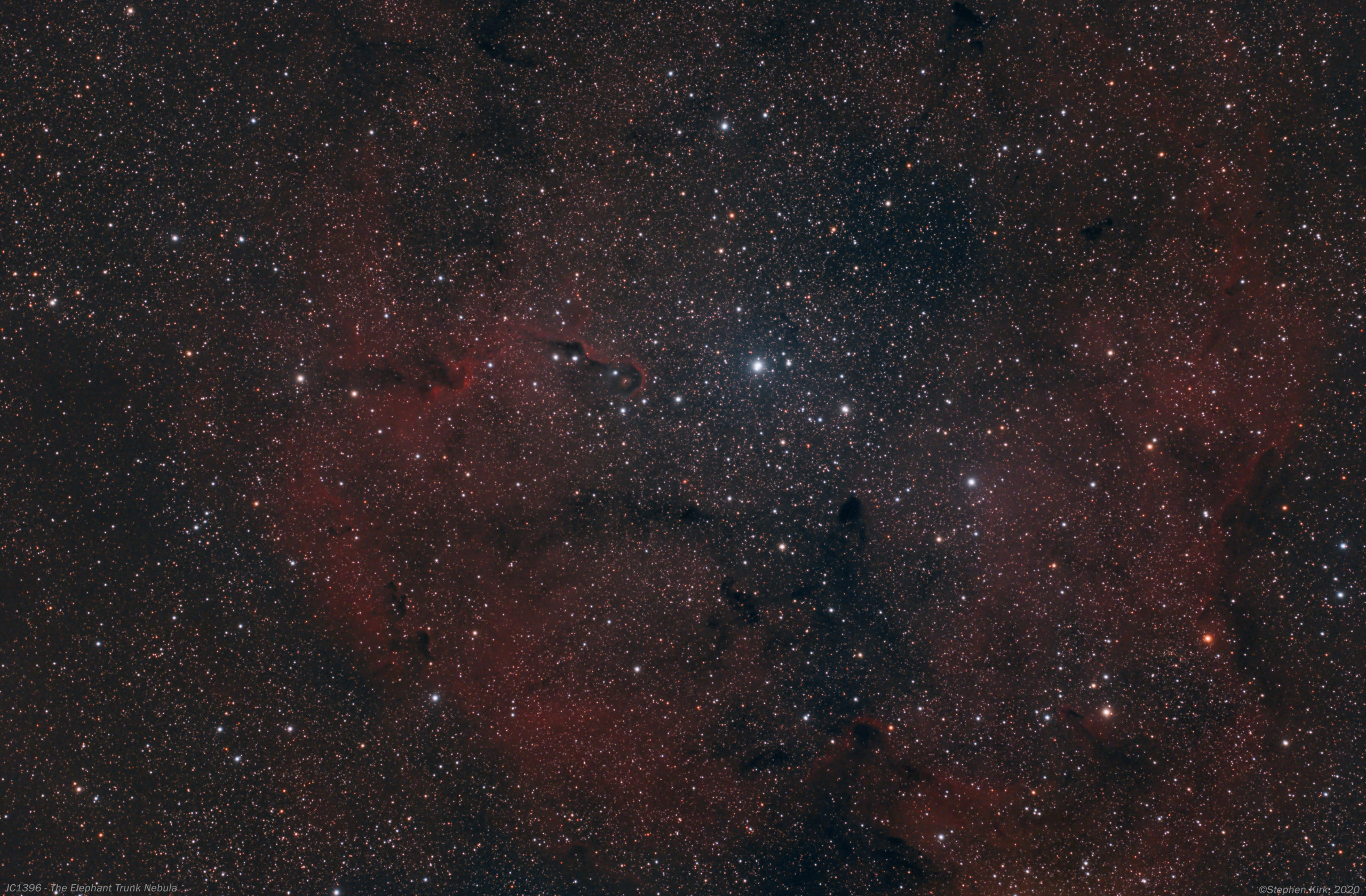
IC1396 - Elephant Trunk Nebula

I have imaged IC1396 before. It passes directly overhead at my location in Nottingham, UK.
Imaged here on 14-15 October 2020 with FSQ85 refractor and QHY268C OSC camera on MESU 200 mount.
A total of 55 x 240s exposures. Developed in PixInsight and Photoshop CC. Image capture with Sequence Generator Pro.

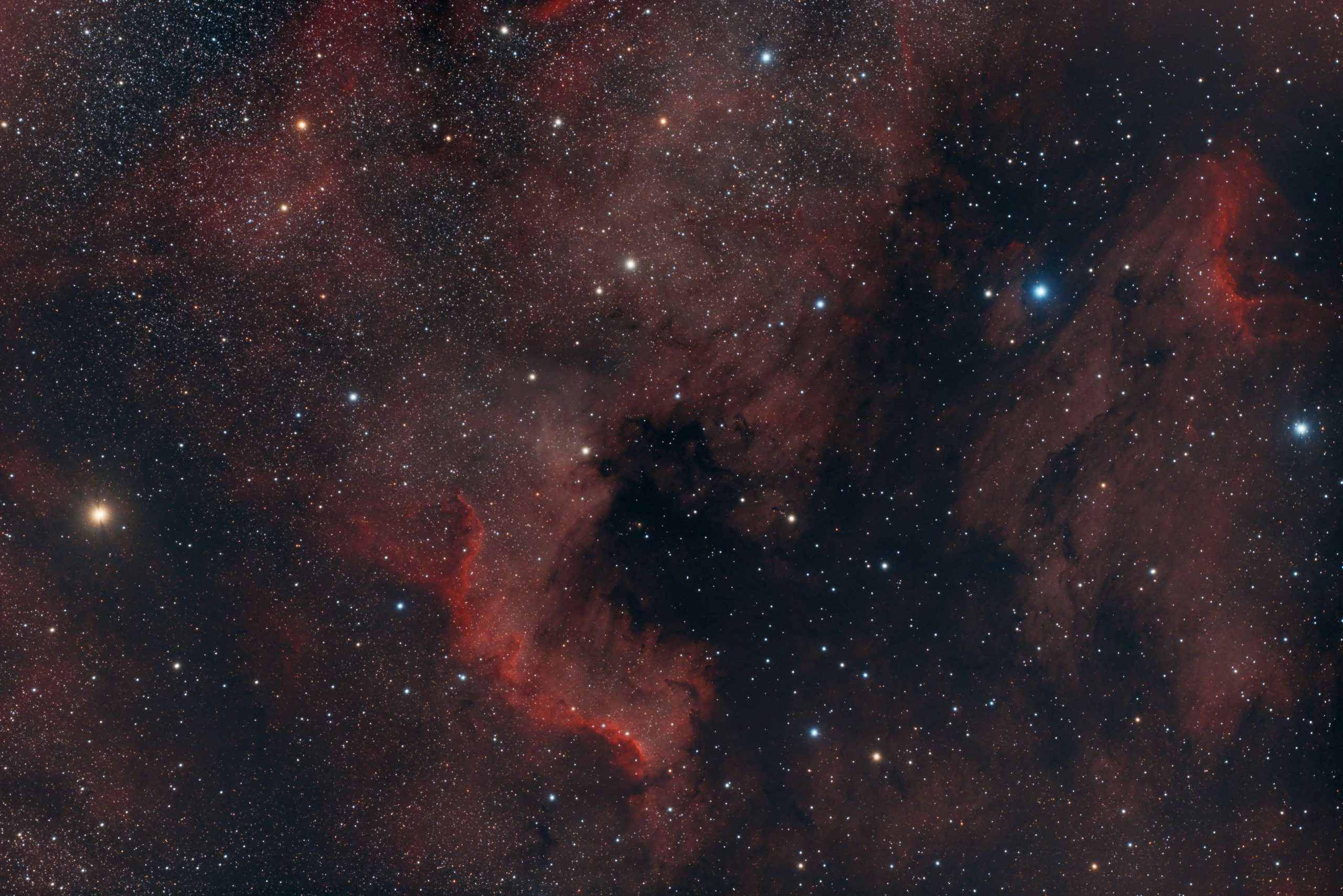
First Light Image From QHY268C and FSQ85

Full Size Image here (opens in a new tab).
This my first semi-completed image from the QHY268C and so far I am impressed with its performance. I discuss unboxing the camera and also how I connect it to the FSQ85 in other posts on my site.
This image - above - of The North American and Pelican Nebulae is a stack of 47 x 180s exposures at Gain 0 and Offset 30 at -15C on my Takahashi FSQ85. This is my first deep-sky CMOS camera and I had to research how to preprocess the data from the camera and I will discuss this in another post.
Since I acquired the camera and in keeping with the "new gear curse", I have been constantly frustrated by wet weather and cloudy skies for almost a month. The 47 exposures for this image were spread out over about seven imaging sessions, sometimes with as few as four exposures per session, such as been cloudy nature of the skies of late where I live - Nottingham, UK. I'd set up, get everything running and then it would cloud over.

I'm really happy how clean the images look as you can see from the single 180 exposure above. Very little processing work is needed to bring out the detail in good data. I was a bit concerned initially about the visual appearance of the master dark but it did the job of removing the artefacts in the lights.
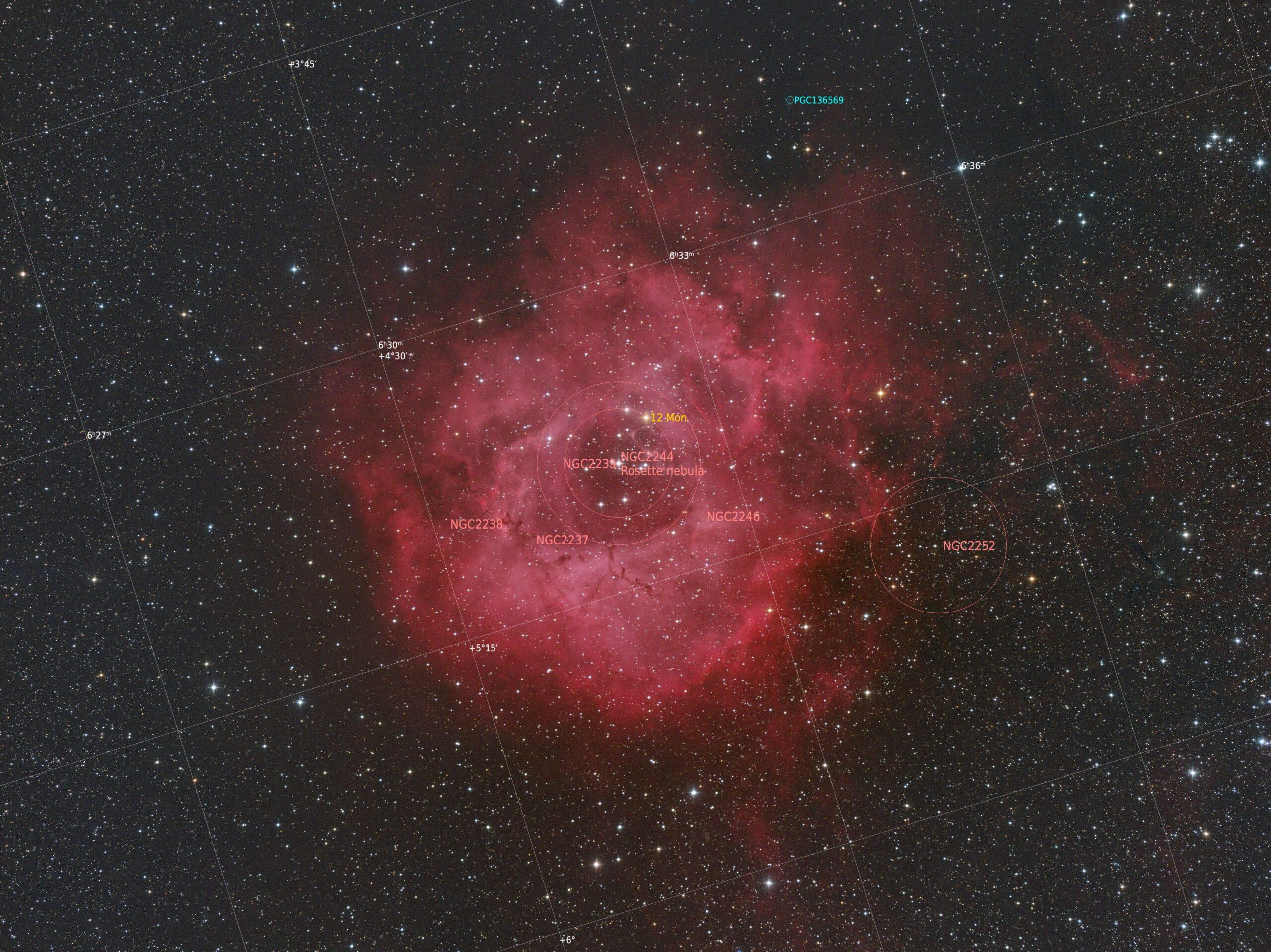
Below is an annotated version of the main picture at top.

The relatively large APS-C sensor, 16-bit resolution and high pixel count, allied to very low noise and zero amp glow make this camera an incredibly powerful proposition. I understandf QHY and ZWO are about to release a mono version of this camera shortly.
I think it is not unreasonable to say the era of CCD in amateur photography is pretty much over with these incredibly powerful and cost effective CMOS cameras being released nowadays (Oct 2020).
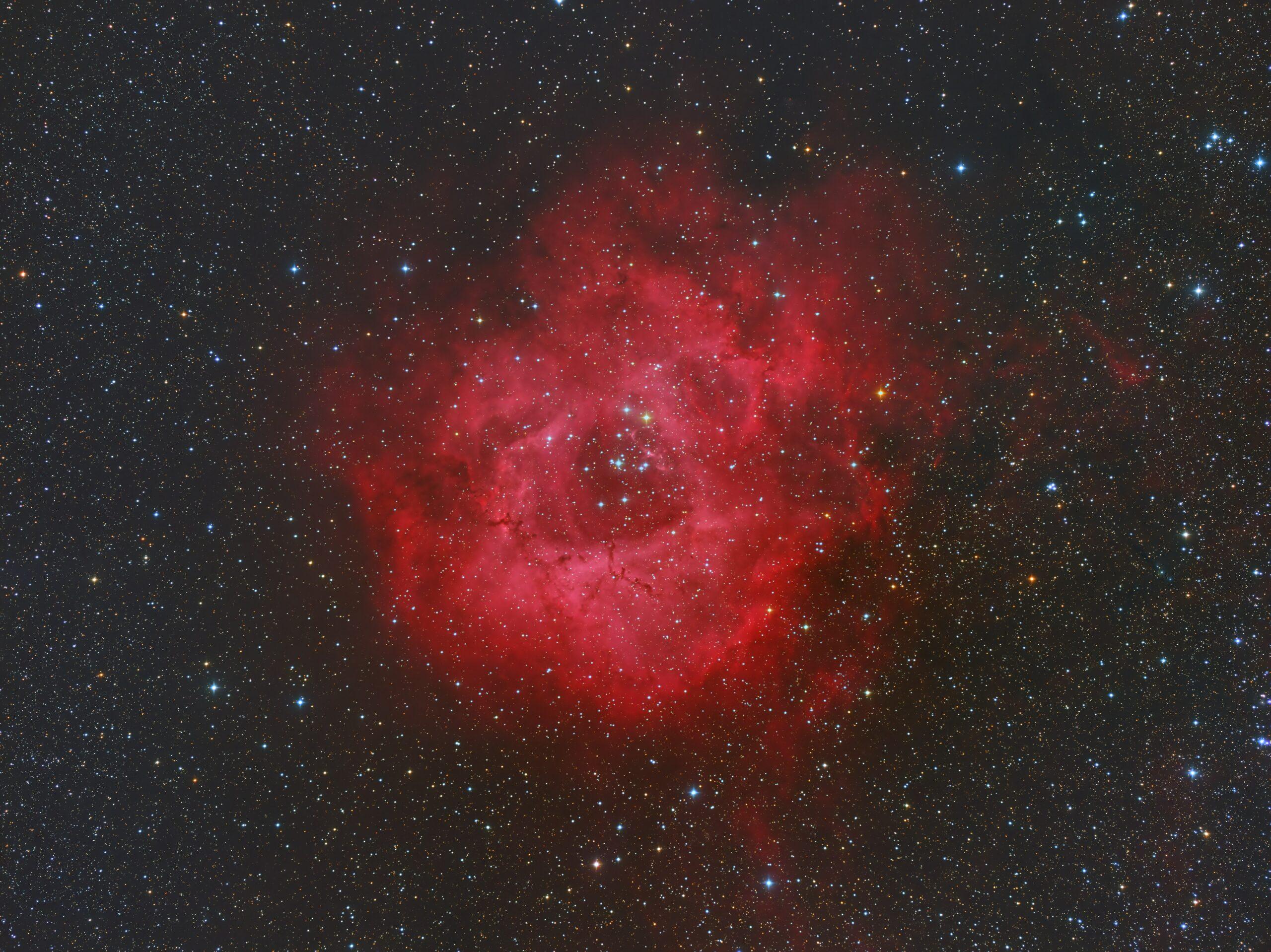
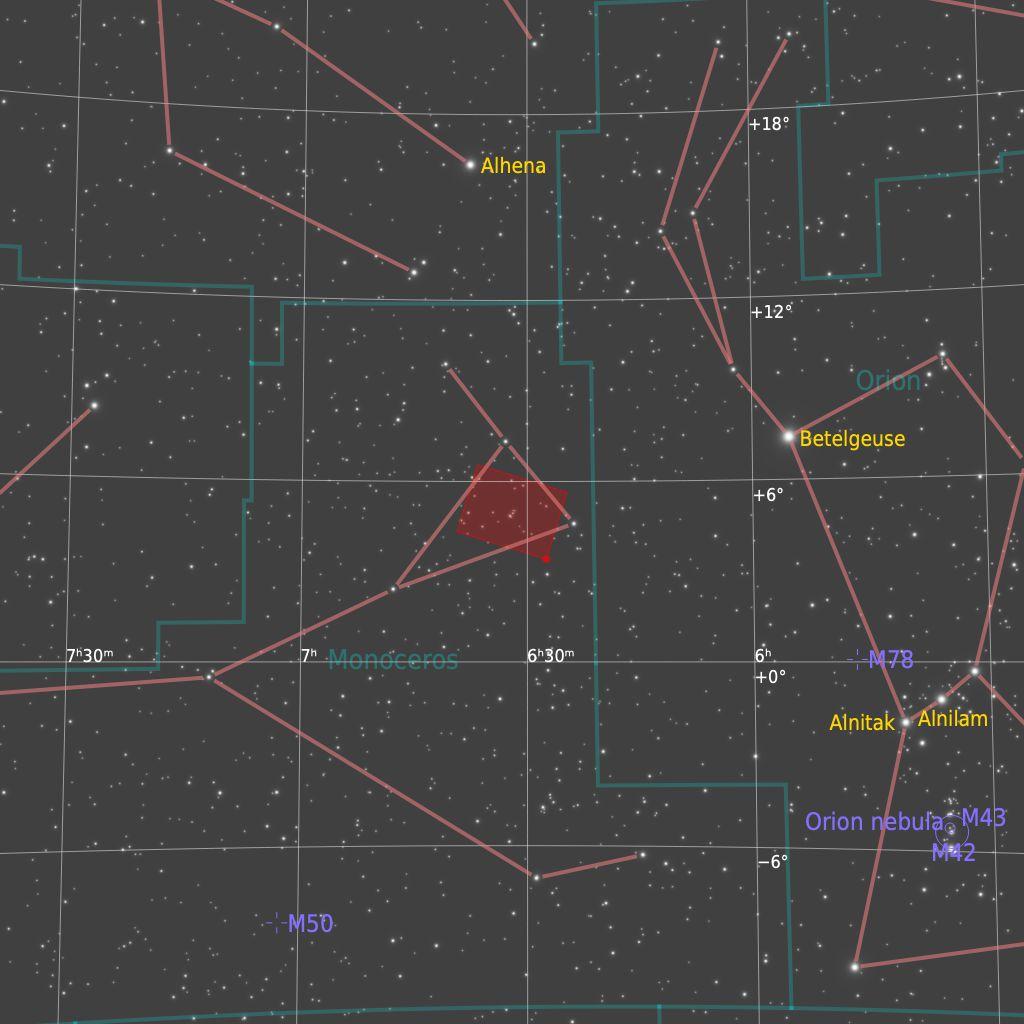
The Rosette Nebula FSQ85
The Rosette Nebula is a huge emission nebula in the Orion arm of the galaxy located in the constellation of Monoceros. It is about 5500 light years away and about 150 light years across and stars are being born from the hydrogen that comprises the nebula.
Image Technical Data
Imaged with Takahashi FSQ85 at native focal length with my Moravian Instruments G2-8300 cooled CCD camera and Astrodon RGBHa filters. Data collected from my backyard observatory on 8th January 2018.
Image data is as follows (Ha is 1x1 and RGB is 2x2)
Ha > 14 x 1200s ; Red > 17 x 300s ; Green 12 x 300s ; Blue > 20 x 300s

As can be seen above, the Ha image is extremely detailed and shows a huge amount of detail. This is 3.5 hours of exposures through the Astrodon 3nm Ha filter.

Above is the RGB only image which is binned 2x2. It is a good picture in its own right but it is a bit flat and lacks the pizazz and sparkle of the Ha image. It is the combination of the Ha and the RGB that creates the colourful and detailed main image at the top. There are many ways this combination can be achieved. Here, I did it all in PixInsight whereas on some other pictures I used PI and Photoshop. What I did here was when in the linear state used the emission line script to add the Ha data to the red part of the image. Then after stretching the images I used the NBRGB script to combine the images in the linear state.
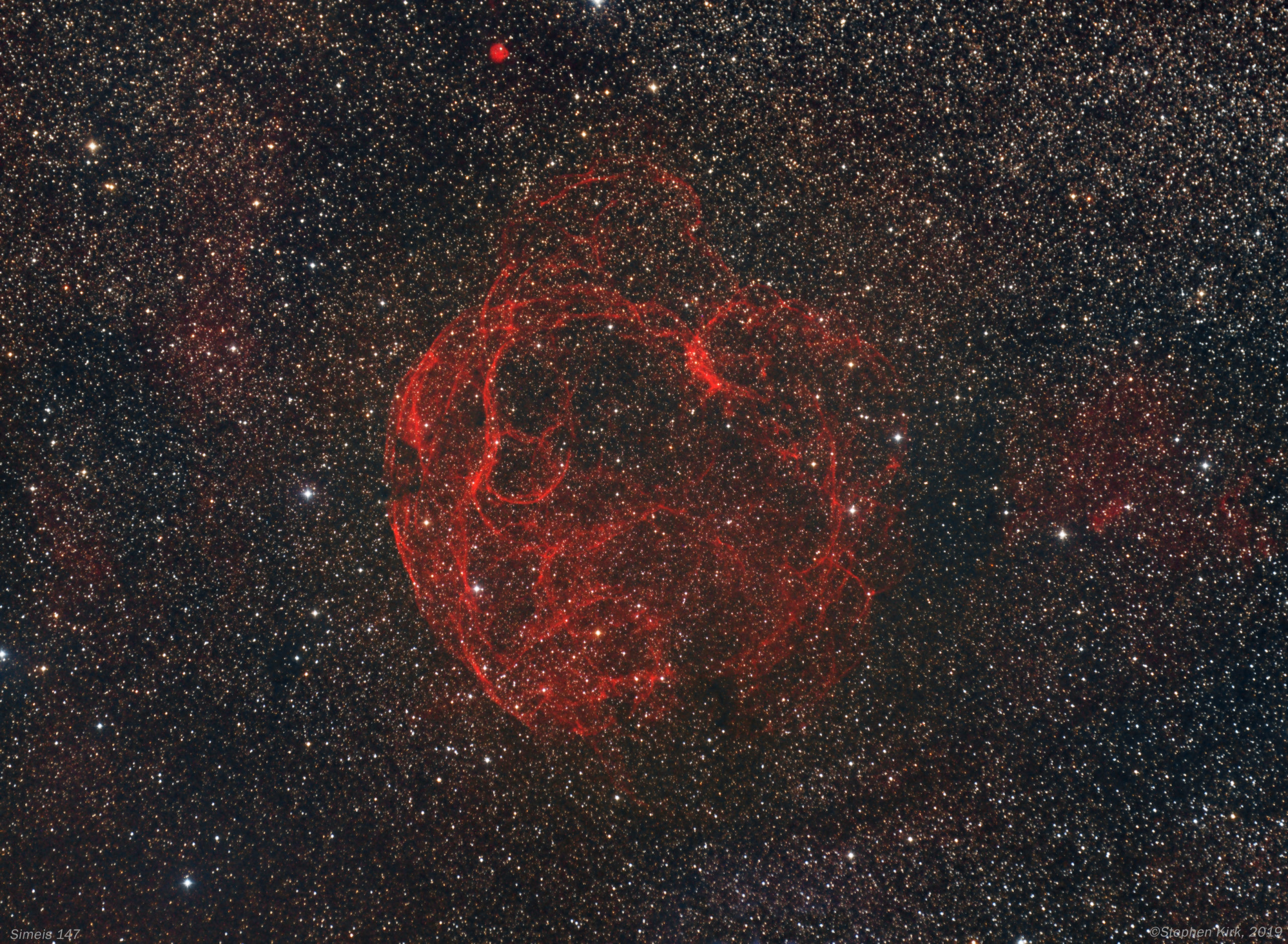
Simeis 147 (Samyang 135 mm)
Simeis 147 (Sharpless Sh2-240) sometimes called The Spaghetti Nebula is a supernova remnant of a star that exploded forty thousand years ago. It sits across the border of Taurus and Auriga and is a huge object, about six moon widths across. It is located about 3000 light years away. Because of its extremely low surface brightness it was only discovered as recently as 1952. It is an exceptionally difficult object to observe visually and to have any hope of seeing it with your own eyes at the eyepiece requires extremely dark skies (Bortle 1), specialist filters, immaculate seeing and transparency and extreme dark adaption of your eyes. This rules out almost anywhere near civilisation. Personally speaking, I have never known any astronomer who has seen it visually. Even with photography it requires very long exposure times to bring out any detail.

Image Technical Data
This image was created with my wide-field rig in my backyard in Nottingham UK (Bortle 5 on the dark sky scale) on the 20 and 21 December 2019. It is such a wide-field object that I used my Samyang 135mm lens and Moravian Instruments G2-8300 cooled CCD camera with Astrodon RGB and Ha(3nm) filters. This delivers a FoV of 8x6 degrees.
All exposures binned 1x1:
Ha (3nm) > 22 x 300s ; Red > 8 x 300s ; Green > 9 x 300s ; Blue > 10 x 300s
The total integration time is four hours so far and this is a rather short time for this object. More data would bring out finer structures in the nebula. As a result, I may revisit this at some point and add to the data set already acquired. However, the current result is not so bad for the limited amount of data so far captured. Simeis 147 is so faint that it can consume as much data as you can throw at it and I have seen images of it with 30,40 and even 50 hours of data!
The Image data is captured with Sequence Generator Pro and processed with PixInsight and Photoshop CC.
Other versions of this object often include an Oxygen channel (OIII) because supernova remnants are rich in Hydrogen and Oxygen. I may capture this channel too at some point.

Above is the RGB only data. As you can see, there is very little to show for the data collected. It is when you blend this RGB with the Ha channel data below - especially with the red channel - that the detail in the main picture in this post at the top is revealed.


The California Nebula
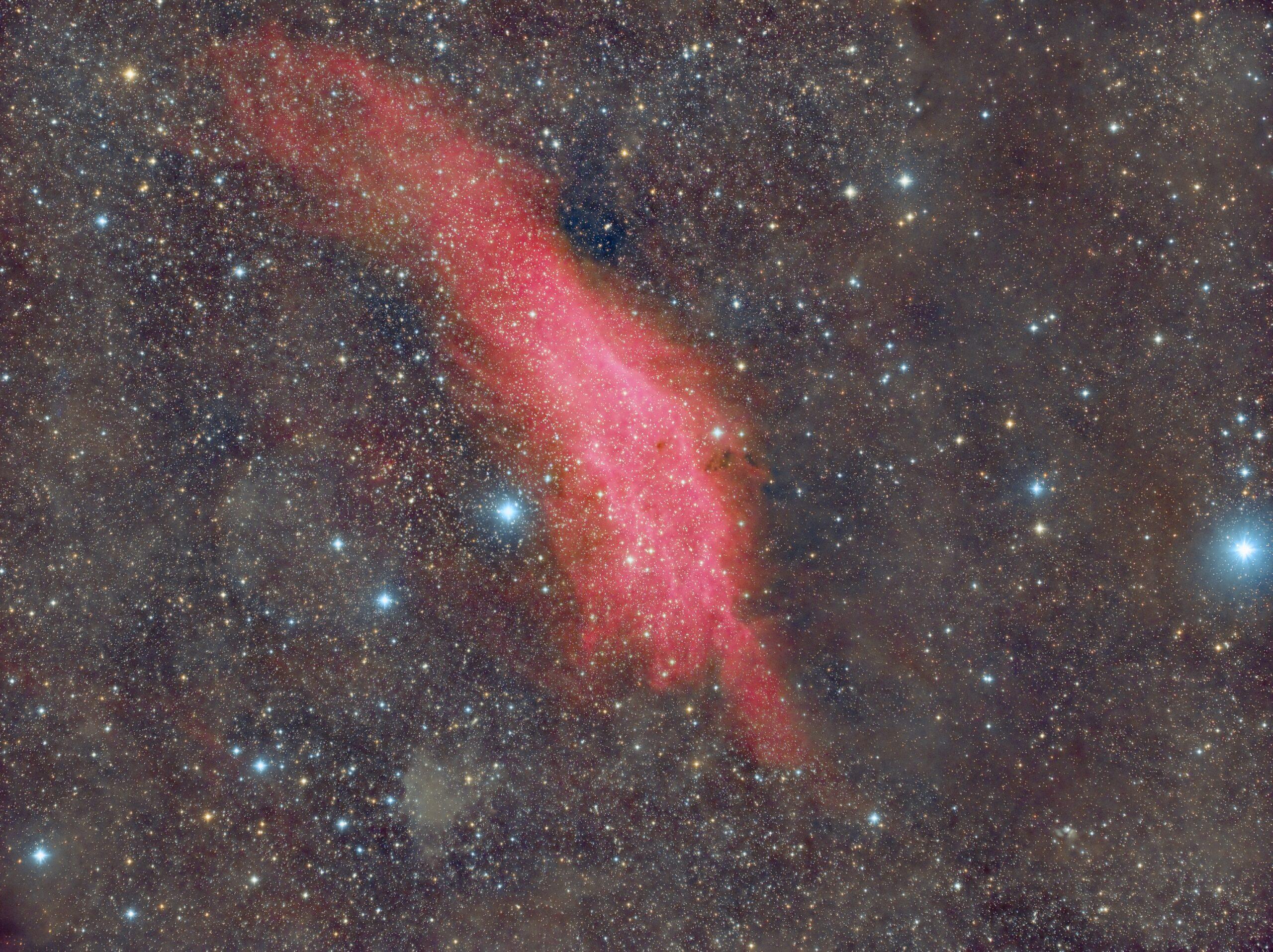
The California Nebula - NGC 1499 - is a vast hydrogen gas emission nebula about 1000 light years away in the constellation of Perseus. It is named as such because of its vague resemblance to the US state of California.
It is a very large, faint and diffuse object, about four times the diameter of the moon. It is almost completely invisible visually without specialist filters and was not discovered until the advent of astrophotography in 1884. The nebula shines by reflecting the light of the bright star Markib. It shines red because Hydrogen atoms, when excited by nearby bright sources like stars, emit or re-radiate light at the 656nm wavelength which is in the red part of the spectrum to our eyes.

Image Technical Data
The California Nebula is so large that most telescopes cannot get the nebula in the field of view, nowhere near in fact. It is of course possible to create multi-panel mosaic images but these take a great deal of imaging sky time, something in very short supply in the UK rain and cloud infested skies! DSLR lenses are perfect for this type of wide field imaging, however. This image is almost eight degrees across by six degrees and was made with my wide field DSLR lens portable set up in my backyard, December 7th 2019. Samyang 135mm DSLR lens connected to Moravian Instruments G2-8300 cooled CCD camera and Astrodon E-series RGBHa (3nm) filters, all mounted on my Skywatcher NEQ6 mount.
All exposures binned 1x1:
Red > 14 x 300s ; Green > 8 x 300s ; Blue > 8 x 300s ; Ha(3nm) > 18 x 300s
To give a total integration time of four hours.
Captured with Sequence Generator Pro and processed with PixInsight.


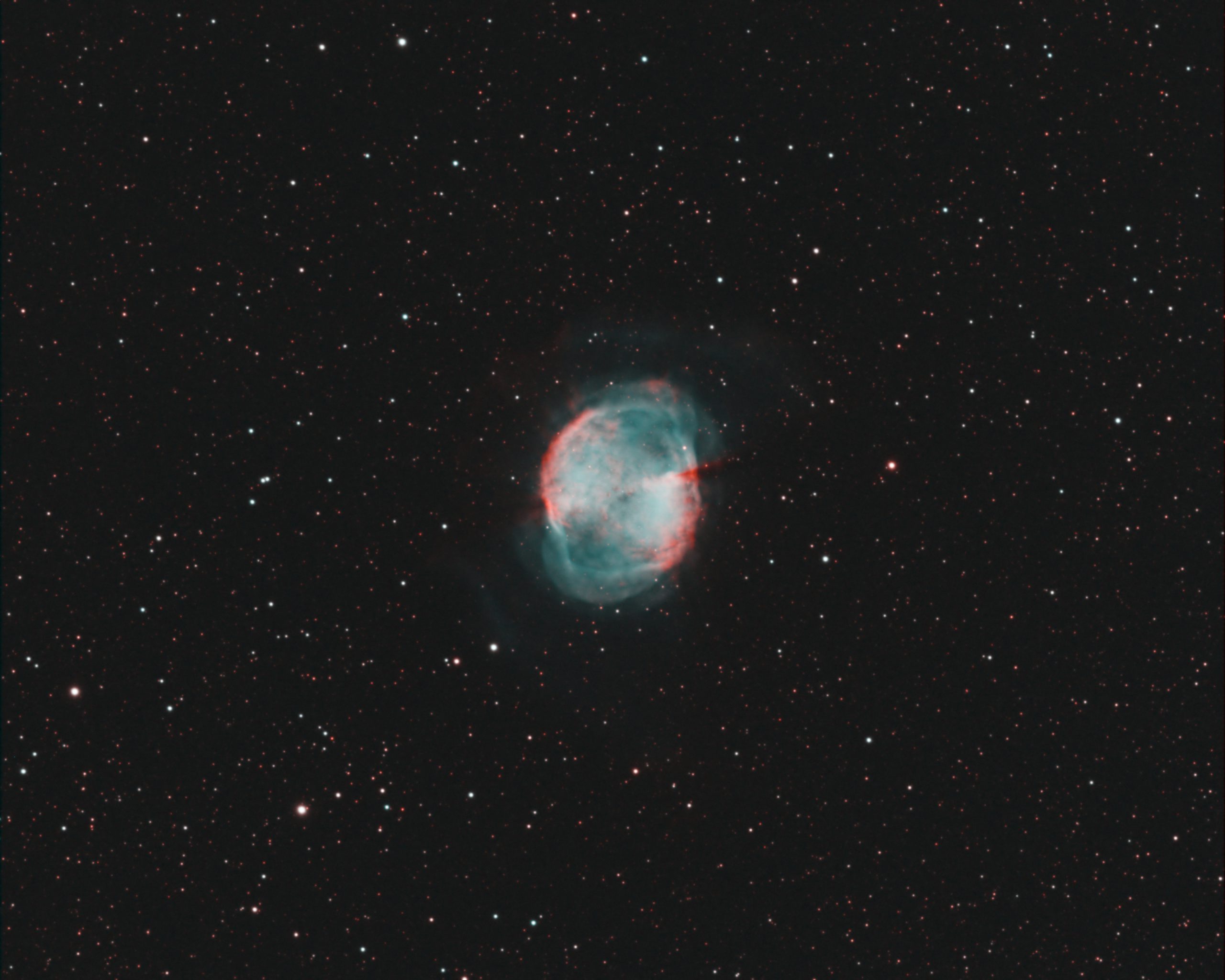
M27 in The Hubble "HOO" Palette (TEC140)
M27 is a famous planetary nebula in the constellation of Vulpecula, The Fox. Despite its name, it has nothing whatever to do with planets, it is instead the remnants of a dying star that has cast off its outer atmosphere when nuclear reaction can no longer sustain it. Our Sun will look like this in five billion years from afar.
M27 is a fine object to view through a telescope. I have also imaged M27 several times over the years. Here for example.
The rendition on this page shows M27 in the HOO or Hydrogen-Oxygen-Oxygen palette which maps the Ha channel to Red and green and Blue to OIII (Oxygen 3). Planetary nebula are rich in Oxygen since it is one of the elements synthesised in the nuclear fusion processes as the star dies.

Image Technical Data
Imaged from my backyard observatory in Nottingham, UK, August 2019. I used my TEC 140 refractor and Atik 460 CCD camera and Astrodon HA (3nm) and OIII (3nm) filters - very expensive filters too! This was all mounted on my MESU 200 and guided with my OAG.
All data is binned 1x1:
Ha > 18 x 300s ; OIII > 12 x 300s
This is quite a short integration but the result is quite nice I think. This is largely down to the utterly superb Astrodon filters and the extremely tight 3nm emission passband.
I did not blend the data Ha, OIII, OIII >>> one on one to R, G, B Insteads I used the following PixelMath formula:
Red > Ha(i.e. one to one)
Green > (OIII * 0.85) + (Ha * 0.15)
Blue > (OIII * 0.8) + (Ha * 0.2)
Then add them all together to give the colour result. Making only small changes to the formulae can make quite a large difference to the outcome and will emphasis the green, blue or red more depending on which colour formula you wish to adjust.
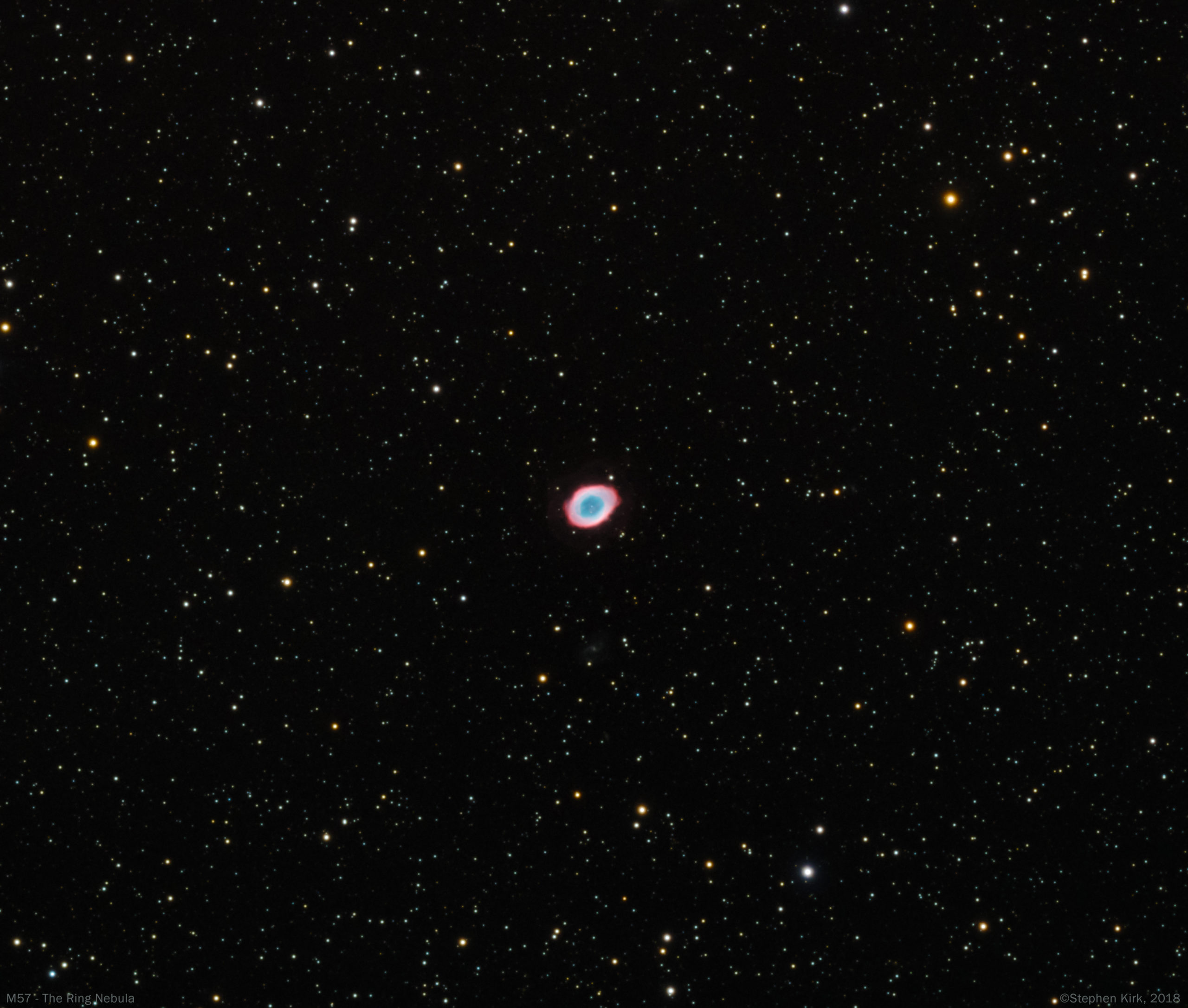
M57 - The Ring Nebula In Lyra - TEC140
A famous planetary nebula in the Northern Hemisphere of the sky in the summer constellation of Lyra. One of four planetary nebulae in the Messier catalog of deep sky objects, the other three being M27, M76 and M97. It is visible in a small telescope as a faint ring. M57 is about 2500 light years away and it is the outer envelope shed off by a dying star, the star itself can be seen right in the middle of the nebula. The Sun will look like this from afar when it does the same in about five billion years from now. More massive stars do not die in this fashion but explode in a cataclysmic event called a supernova; M1 being one such example.
In the image below, look for the ghostly outer ring surrounding the main "ring" of the nebula.

Image Technical Data
Imaged from my backyard in Nottingham, UK with my TEC 140 refractor and Atik 460 cooled CCD camera over three nights in August 2018 with Astrodon LRGBHa filters. mounted on MESU 200 and guided with OAG.
Everything binned 1x1
Lum > 13 x 600s ; Red > 12 x 300s ; Green 12 x 300s ; Blue > 12 x 300s ; Ha > 12 x 300s
Total integration > 6 hours )just over)
Captured with Sequence Generator Pro and processed with PixInsight and Photoshop CC.
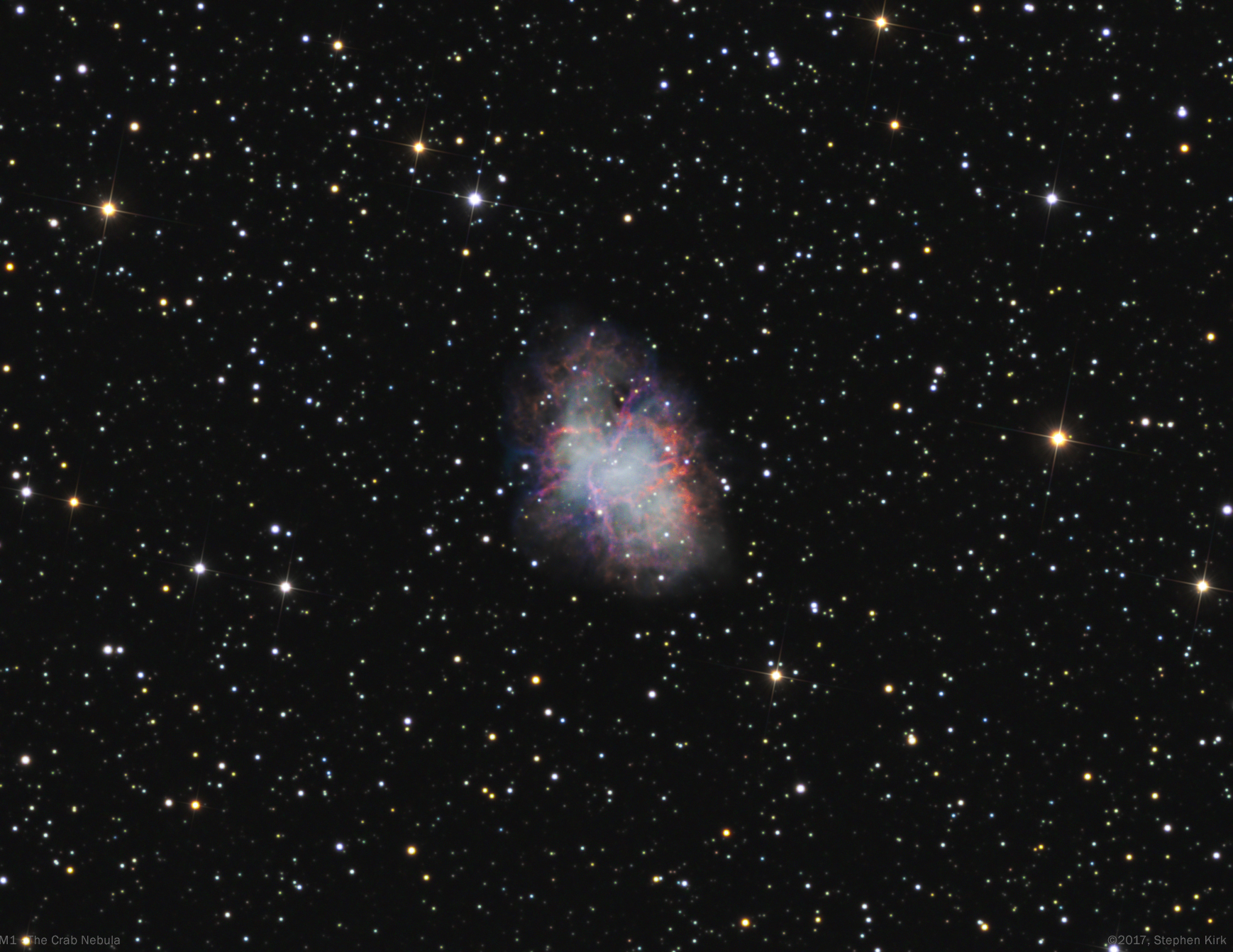
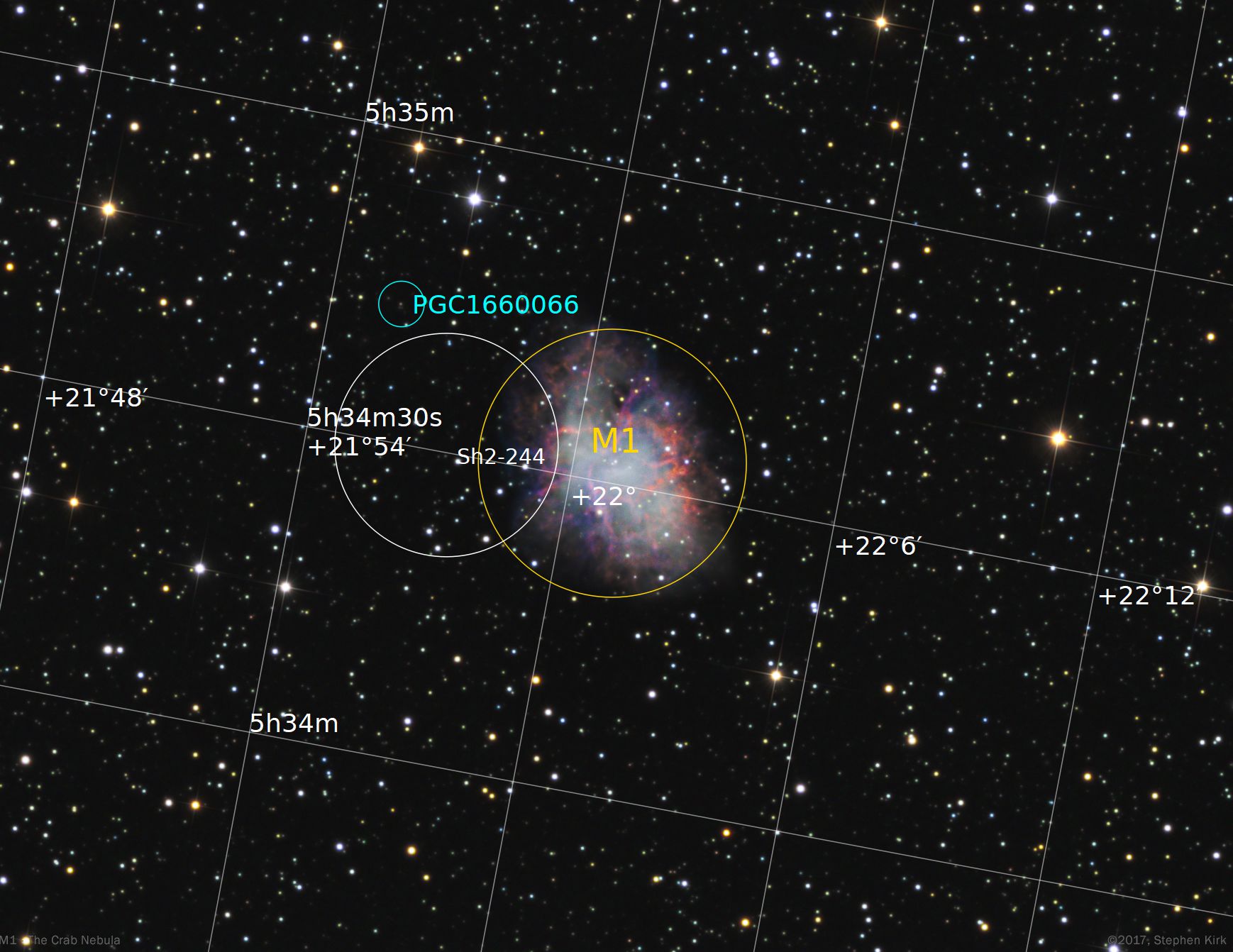
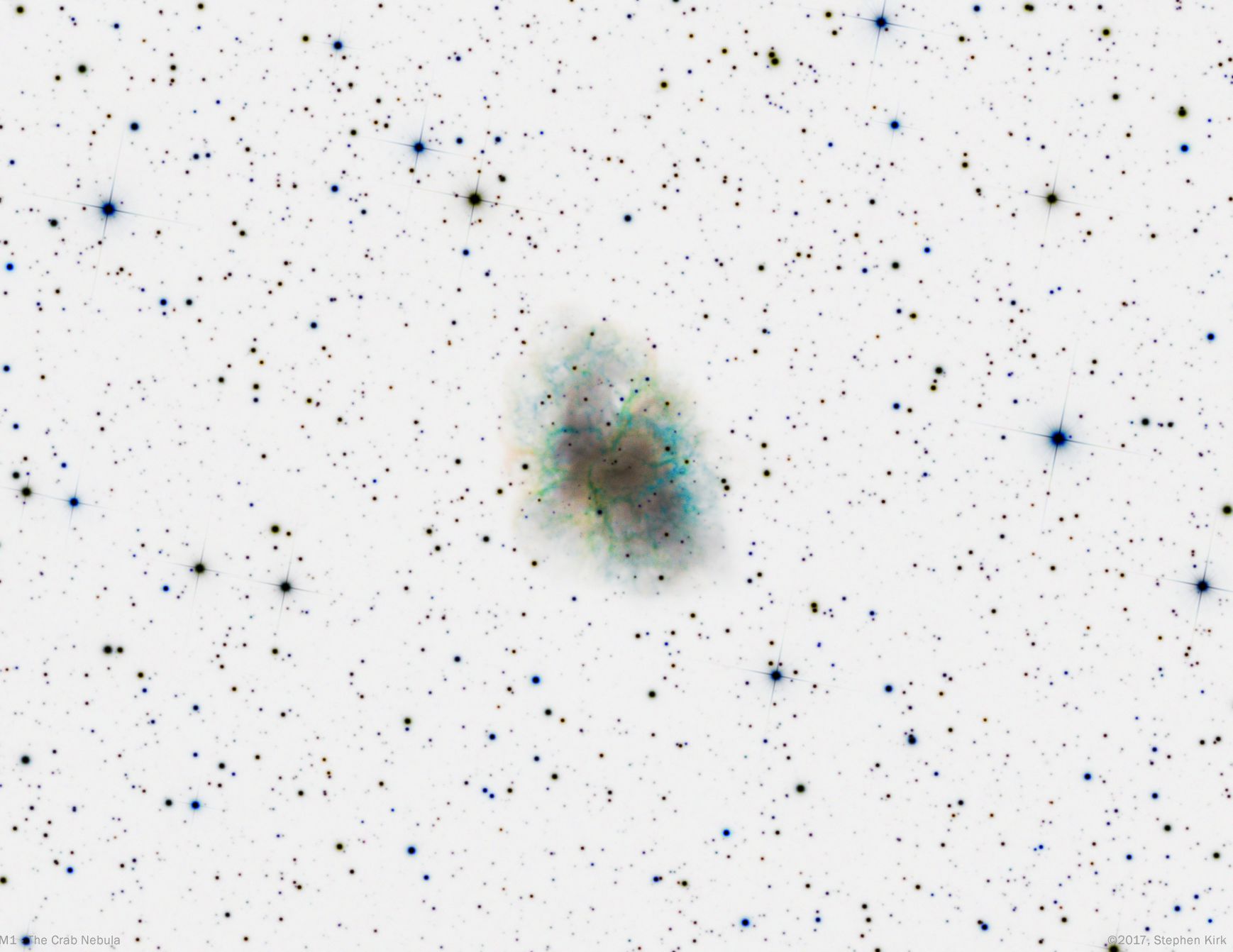
M1 - The Crab Nebula TEC140
The Crab Nebula - M1 - is the expanding remains of a supernova that was seen in 1054 throughput medieval Europe, The Middle East and China. The nebula is very distant at about 6500 light years and lies in the Perseus Arm of our galaxy, further out from The Galaxy's core than The Sun. It is called The Crab because William Parsons from his Irish observatory who first viewed it in 1840 thought it resembled the outline of a crab and the name has stuck. The object was first observed in the 1731 and was linked to the Supernova of 1054 as recently as 1913. Earlier photographic plates from the 1950's and those taken today show a definite expansion in the nebula in the intervening 70 years.
Image Technical Data
Imaged from my backyard in Nottingham, UK in the winter of 2017 with my TEC 140 refractor and Atik 460 cooled CCD camera and Baader LRGB filters. I used a NEQ6 mount guided with OAG.
All images data binned 1x1:
Lum > 10 x 900s ; Red > 15 x 300s ; Green 15 x 300s ; Blue > 19 x 300s
Image capture with APT and processing in PixInsight and Photoshop CC.
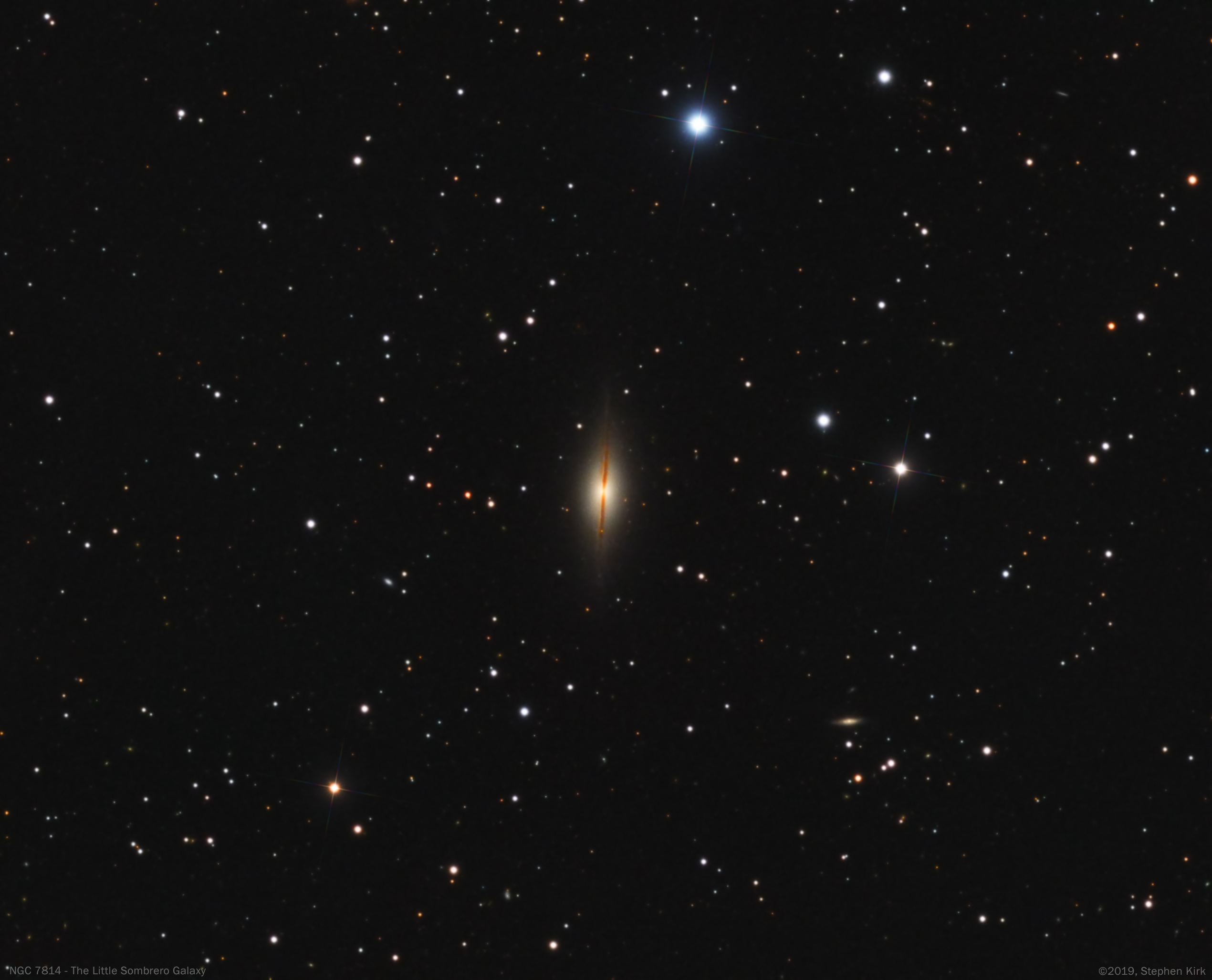
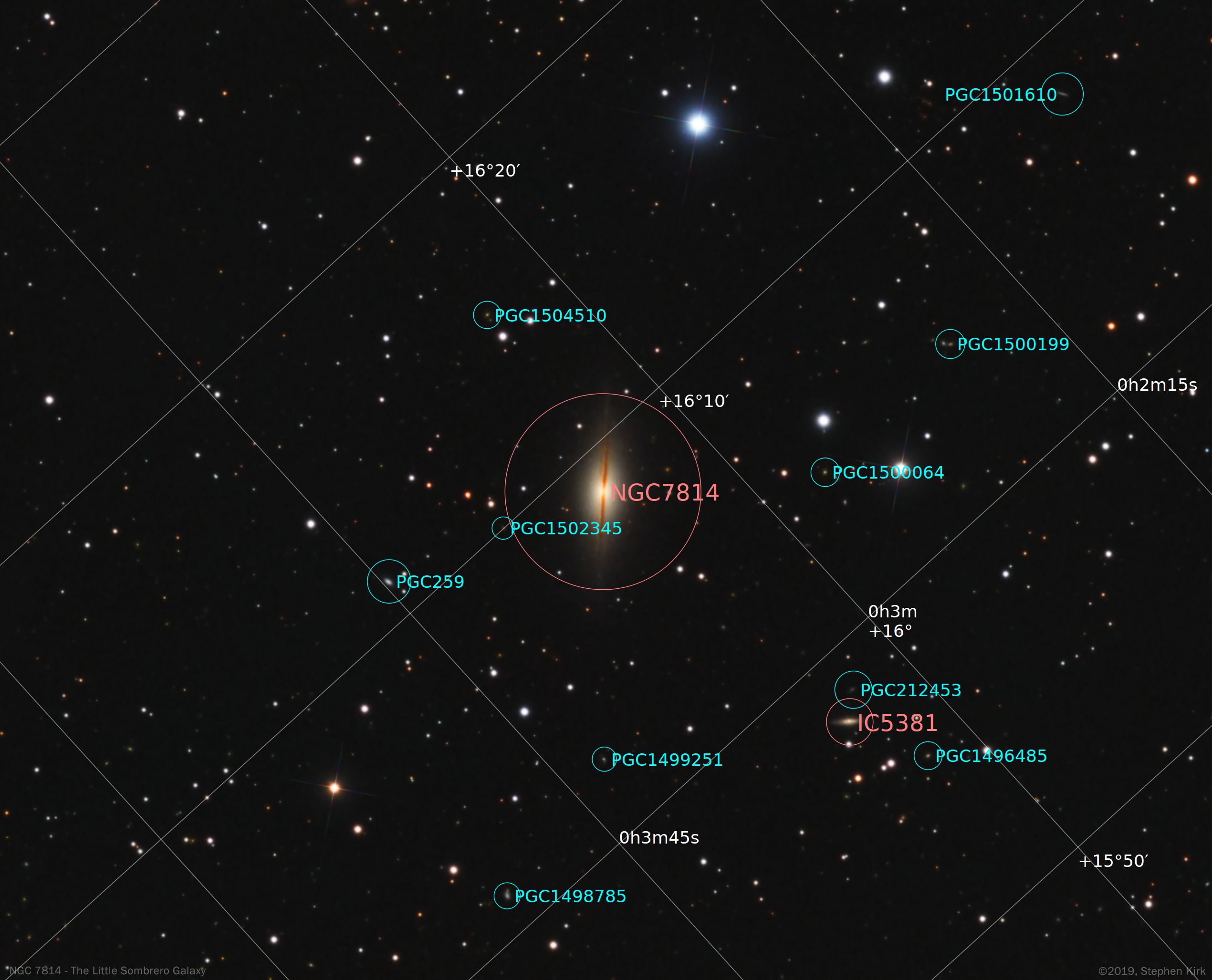
NGC 7814 - The Little Sombrero Galaxy - TEC 140
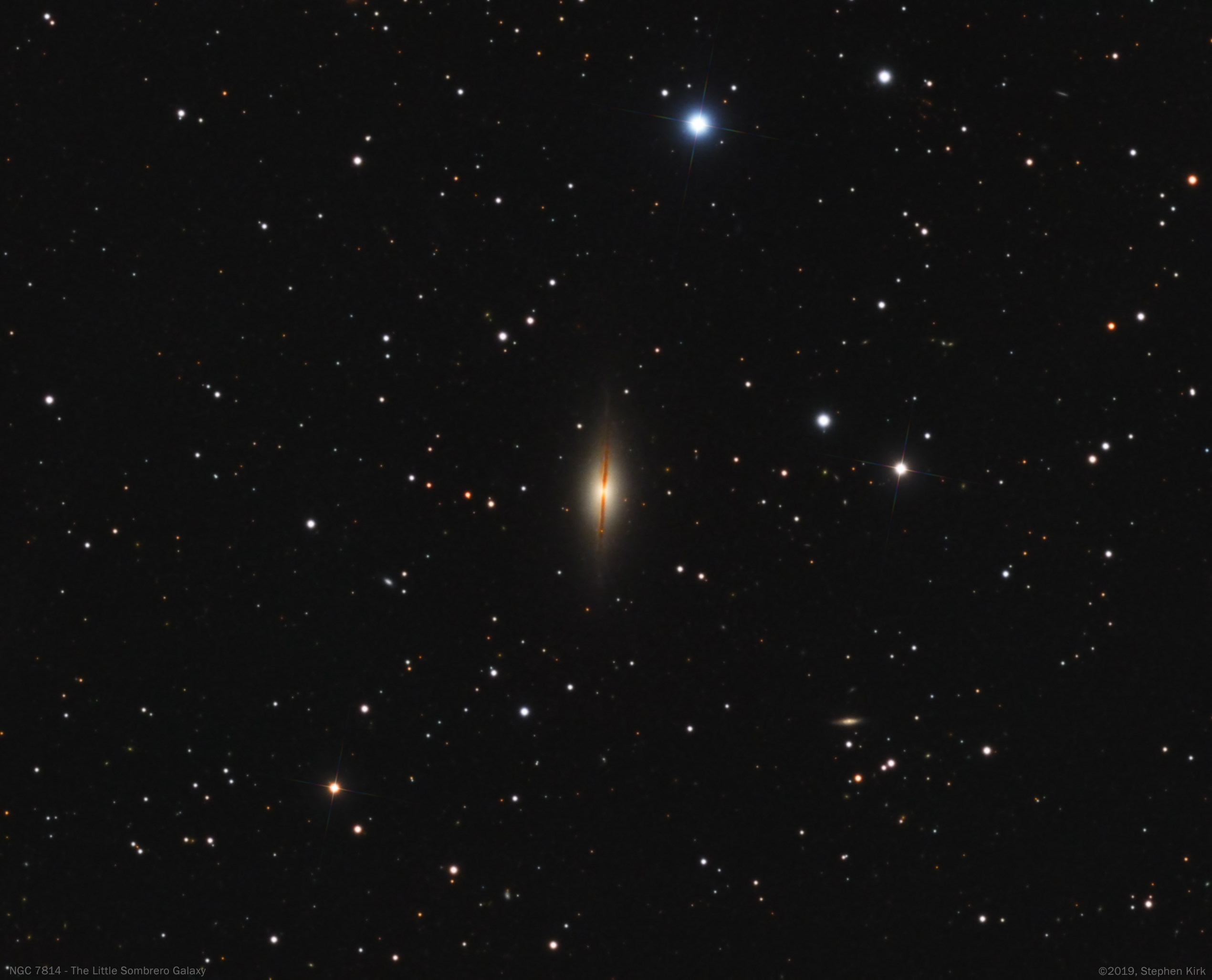
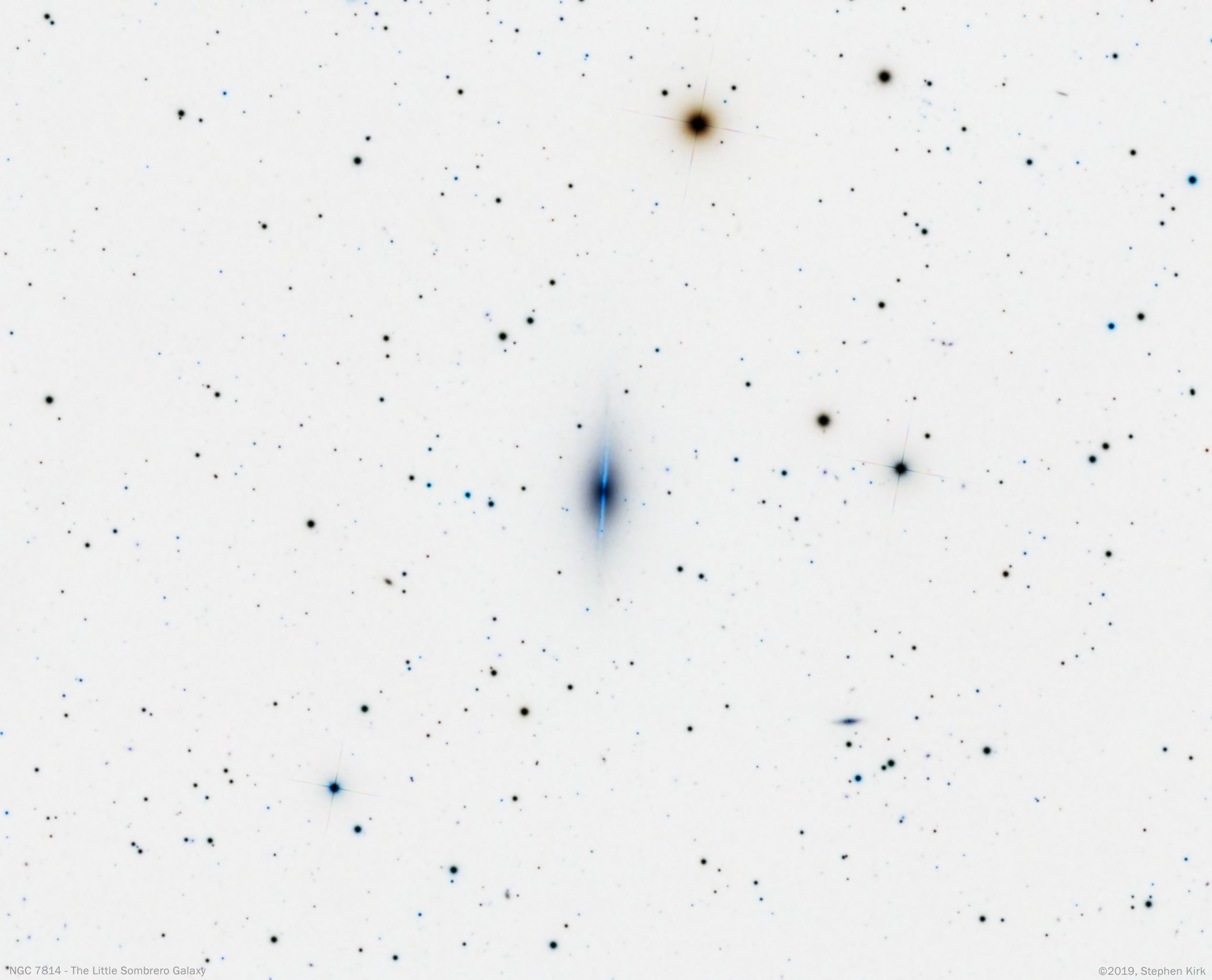
NGC 7814 is an edge-on spiral galaxy 40 million light-years away in the constellation of Pegasus. IT is nicknamed "The Little Sombrero" because of its likeness to The Sombrero Galaxy M104 in Virgo. Close examination of the picture reveals many tiny galaxies, up to a billion light years away in the depths of The Universe.
The dust lanes of the edge-on spiral arms can be easily seen.
Image Technical Data
NGC 7814 is very remote and so needs a long integration (exposure) time. This image was captured from my backyard observatory in Nottingham, UK over the course of three nights in October 2019 (a very wet period in the UK and the capture nights were 2,17 and 24). It took significant dedication to capture the subframes for this image given the dreary weather circumstances and I nearly gave up on several occasions! I used my TEC 140 refractor with Atik 460 cooled CCD camera with Astrodon E Series Generation 2 filters on my OAG guided MESU 200 mount.
Integration is a total of nine hours comprised of:
Luminance > 22 x 900s binned 1x1 ; Red > 17 x 300s 2x2 ; Green > 14 x 300s 2x2 ; Blue > 14 x 300s 2x2
Image capture in Sequence Generator Pro and processing in PixInsight and Photoshop CC. The bright star to the top centre is very difficult to control. This star is of course a foreground star in our own galaxy and is millions of times nearer to the Earth than the galaxy.