
Markarian's Chain
A famous string of galaxies in the constellation of Virgo, named after the astronomer Benjamin Markarian who first discovered their common motion. The chain contains several Messier catalogue objects and is visible in the late winter and spring in the Northern Hemisphere. The galaxies are located between 65-75 million light years away and are nice objects to observe with a telescope if you can do so from a dark sight.
This image was created from a data set acquired in Spring 2019 with my FSQ85 refractor.
Image is centred on "The Eyes" of NGC4435 and NGC4438 just below dead centre of the image. At the bottom is the monstrous supergiant elliptical galaxy M87, the most massive object in the local universe harbouring the famous black hole recently imaged with the event horizon telescope.
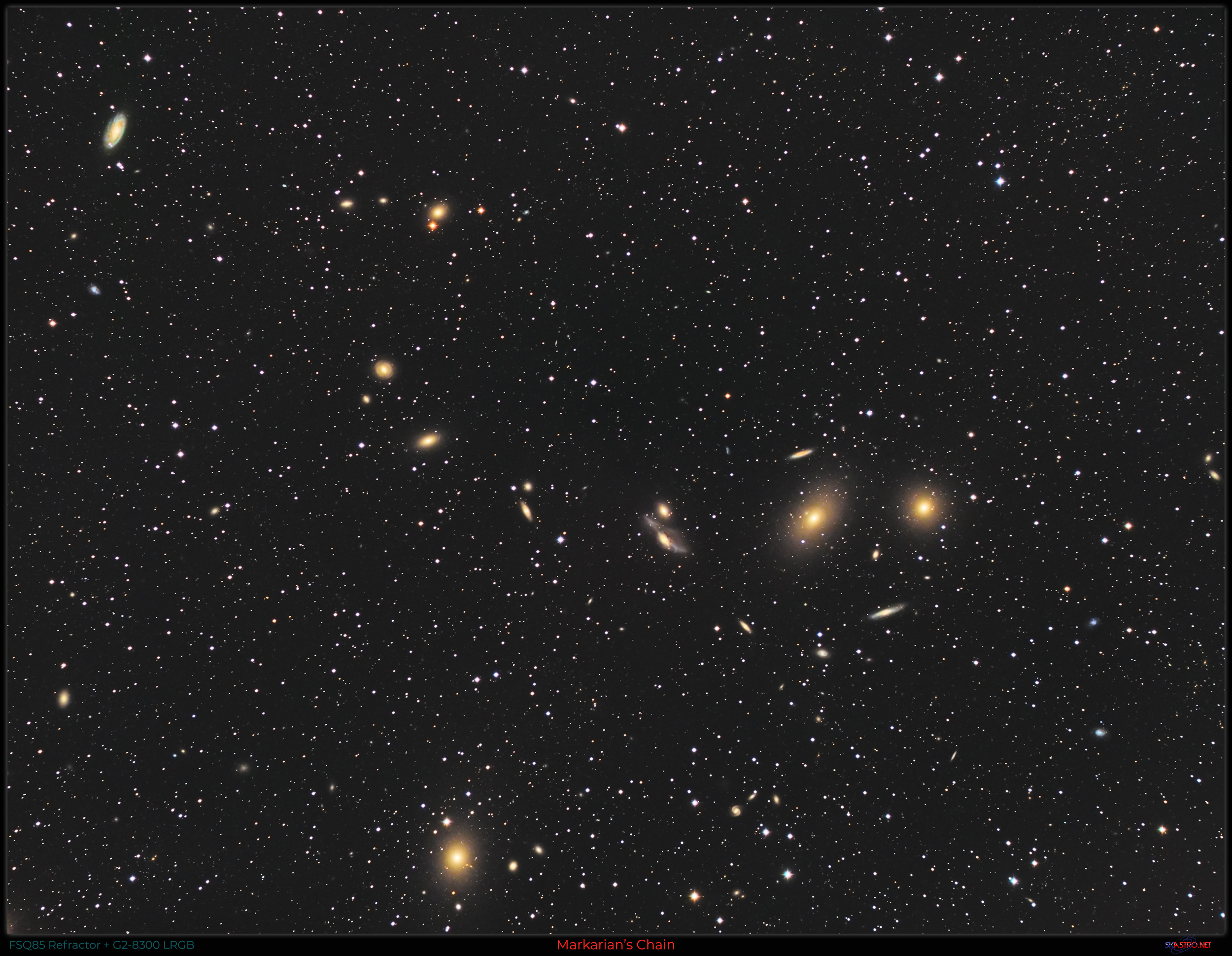
Below is an inverted version that help show the galaxies with more contrast.

Technical Information
The data set was acquired with my FSQ85 refractor with the 0.73 reducer and Moravian Instruments G2-8300 CCD camera with Astrodon LRGB filters.
Data set is as follows: Lum > 26 x 600s ; Red 14 x 300s ; Green > 14 x 300s ; Blue > 14 x 300s
Everything binned 1x1 on my MESU 200 mount and using off axis guiding. The data was acquired in two nights. The data is processed with PixInsight and Photoshop.
Below are two annotated versions; a simpler version showing the main Messier, NGC and IC catalogues and then, at the bottom, a version adding the hundreds of PGC (Primary Galaxy Catalogue) objects deep in the universe many of which are billions of light years away.


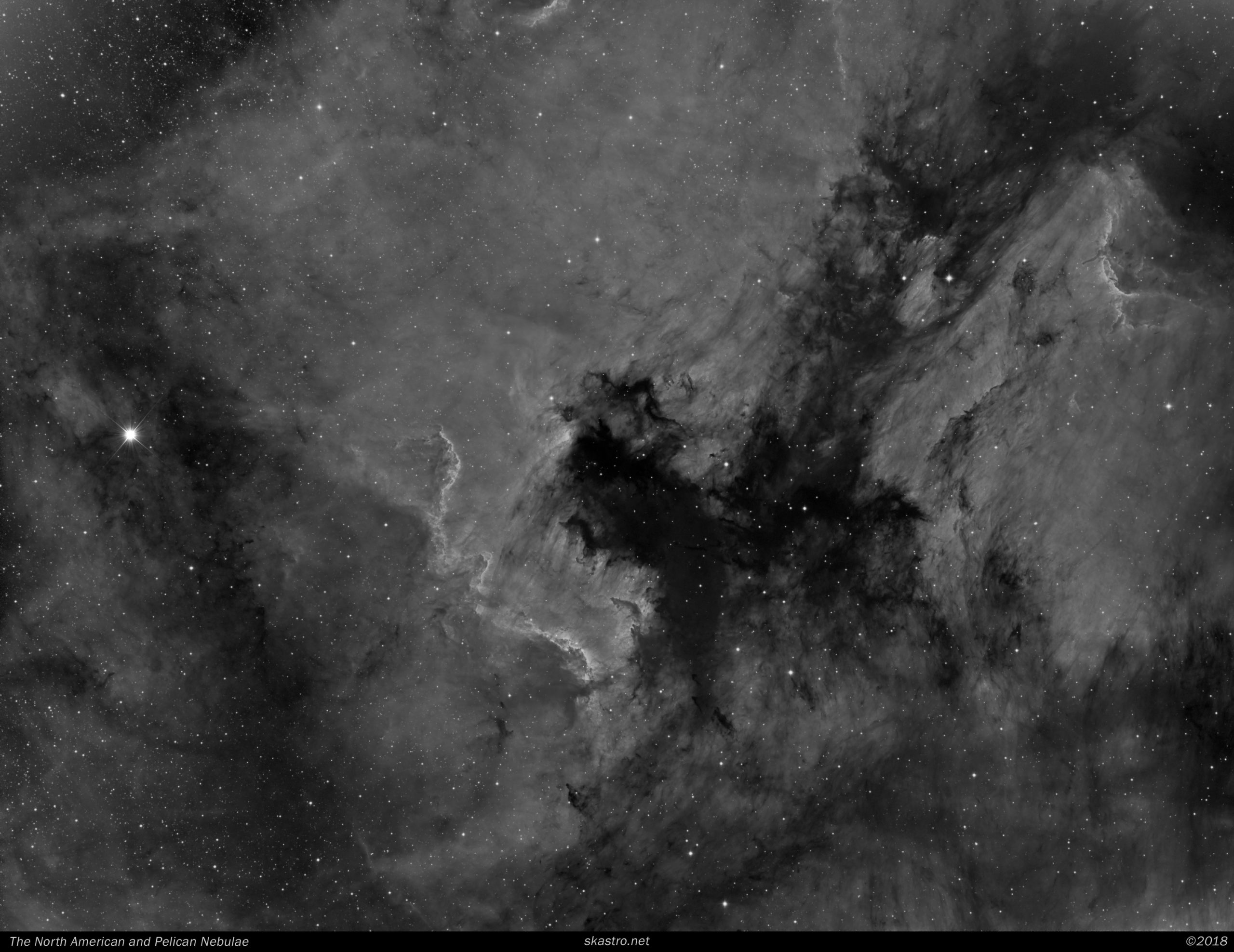
The North American and Pelican Nebulae in Hydrogen Alpha
The North American Nebula and the adjacent Pelican nebula to the right of it are popular objects of the summer and autumn sky in the Northern Hemisphere. Both of these objects are aptly named because the nebula to the left really does look like the continent of North America being looked at by a pelican to the right!
This post discusses a version of these objects in the light of Hydrogen Alpha 3nm only. You can see the vast amount of detail that is emitted at this wavelength by the clouds of hydrogen that the nebulae are composed from.
This picture is composed of 48 x 600s exposures with a Takahashi FSQ85 refractor and Moravian G2-8300 CCD camera with an Astrodon 31mm 3nm Ha filter and the Takahashi 0.73 reducer. The image discussed here is a pure Ha monochrome image but I also combined this data set with RGB colour data as well that you can see here.

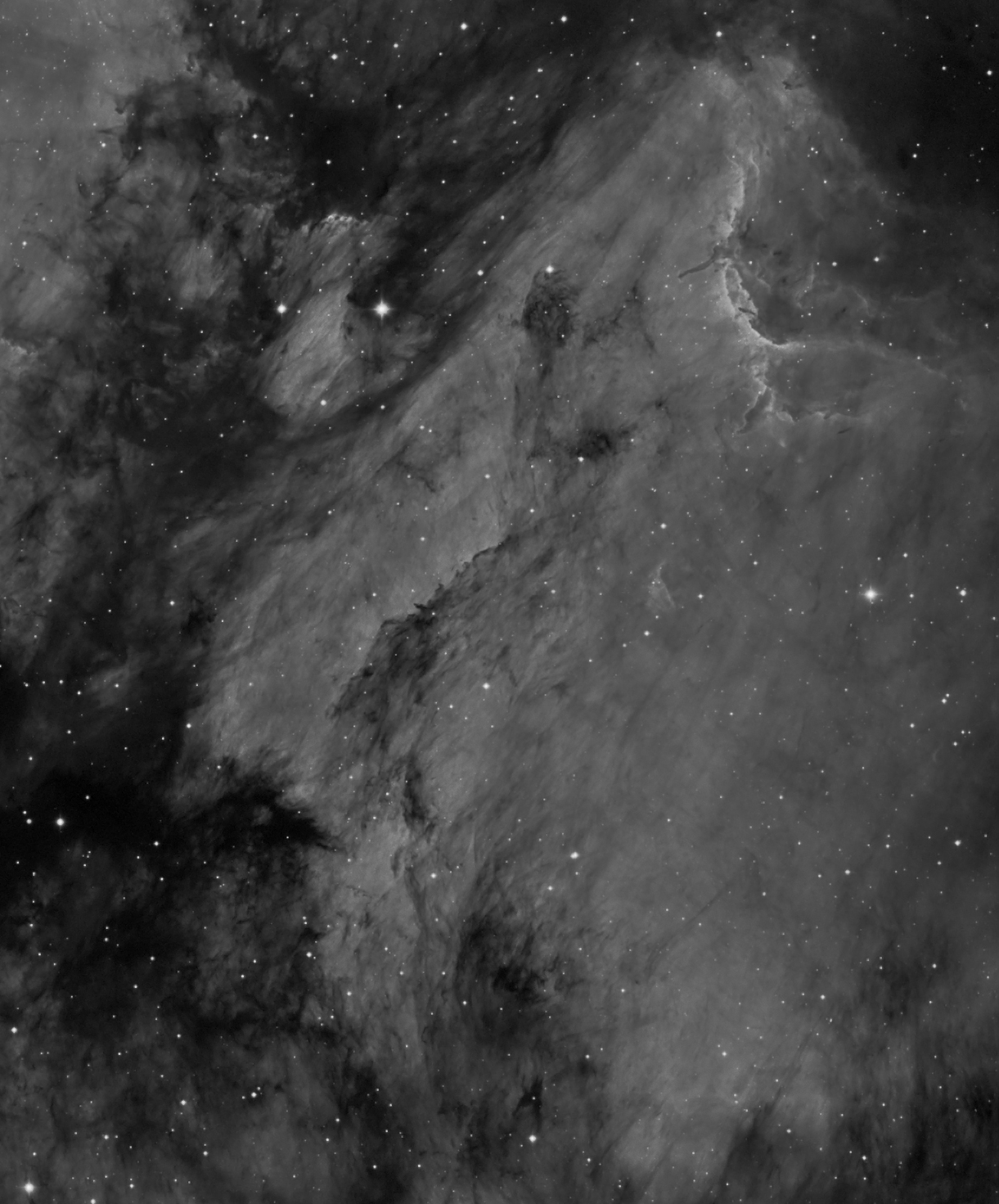
A snippet of the above picture showing The Pelican nebula.
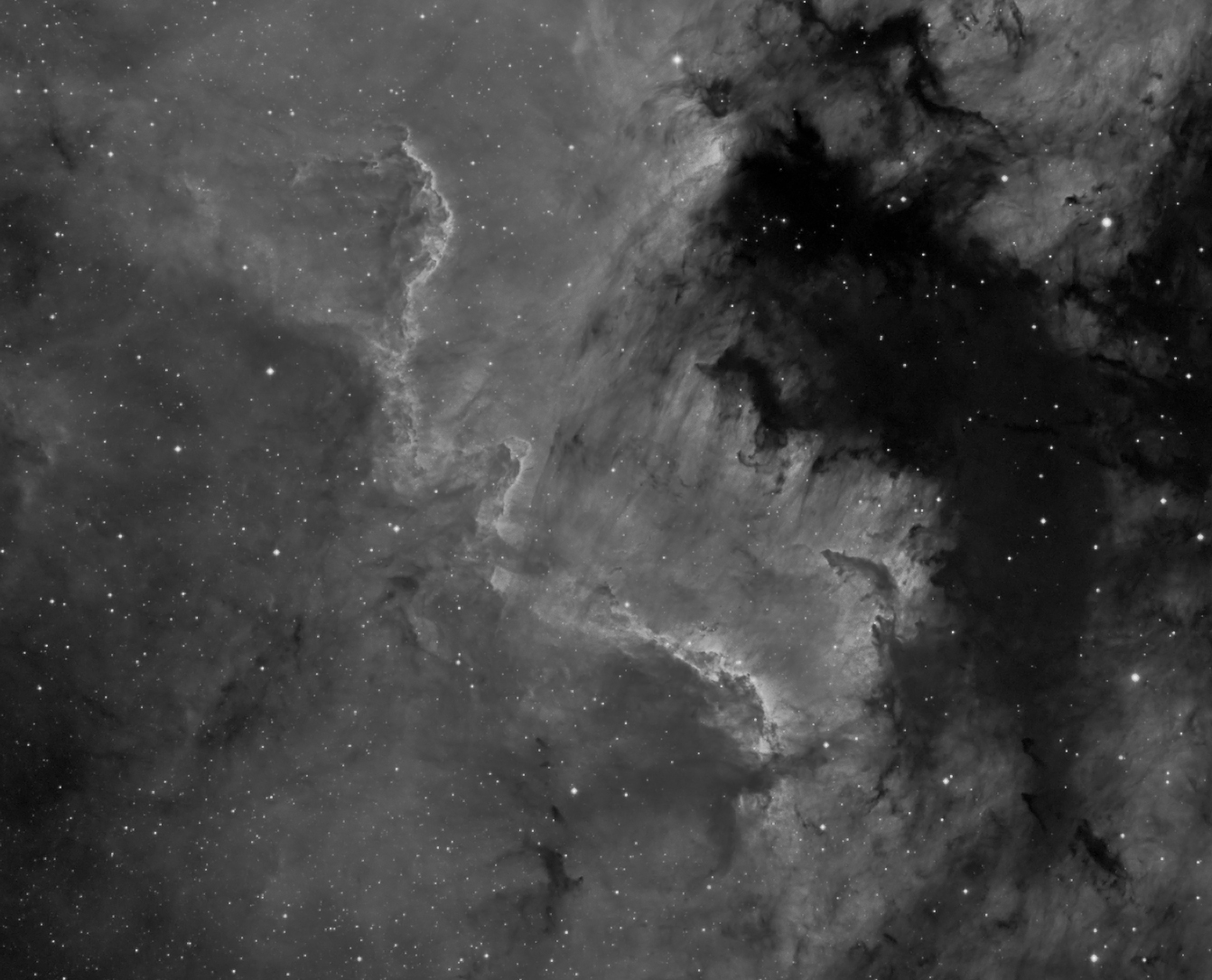
This shows the portion of the nebula commonly known as "The Wall"